Most billing mistakes don't come from carelessness. They come from using the wrong document for the wrong situation. Send a standard invoice to a customs authority and your shipment stalls. Send a commercial invoice to a domestic client and you've added confusion where none was needed. This guide breaks down what each document is, how they differ, and exactly when to use each one.
What is a Standard Invoice
A standard invoice is a request for payment. It documents what you sold, what it cost, and when the buyer needs to pay.
You issue one after delivering a product or completing a service. For most domestic transactions, that is all the paperwork either party needs. The format stays the same whether you are billing a client across town or across the country, as long as both parties operate in the same tax jurisdiction.
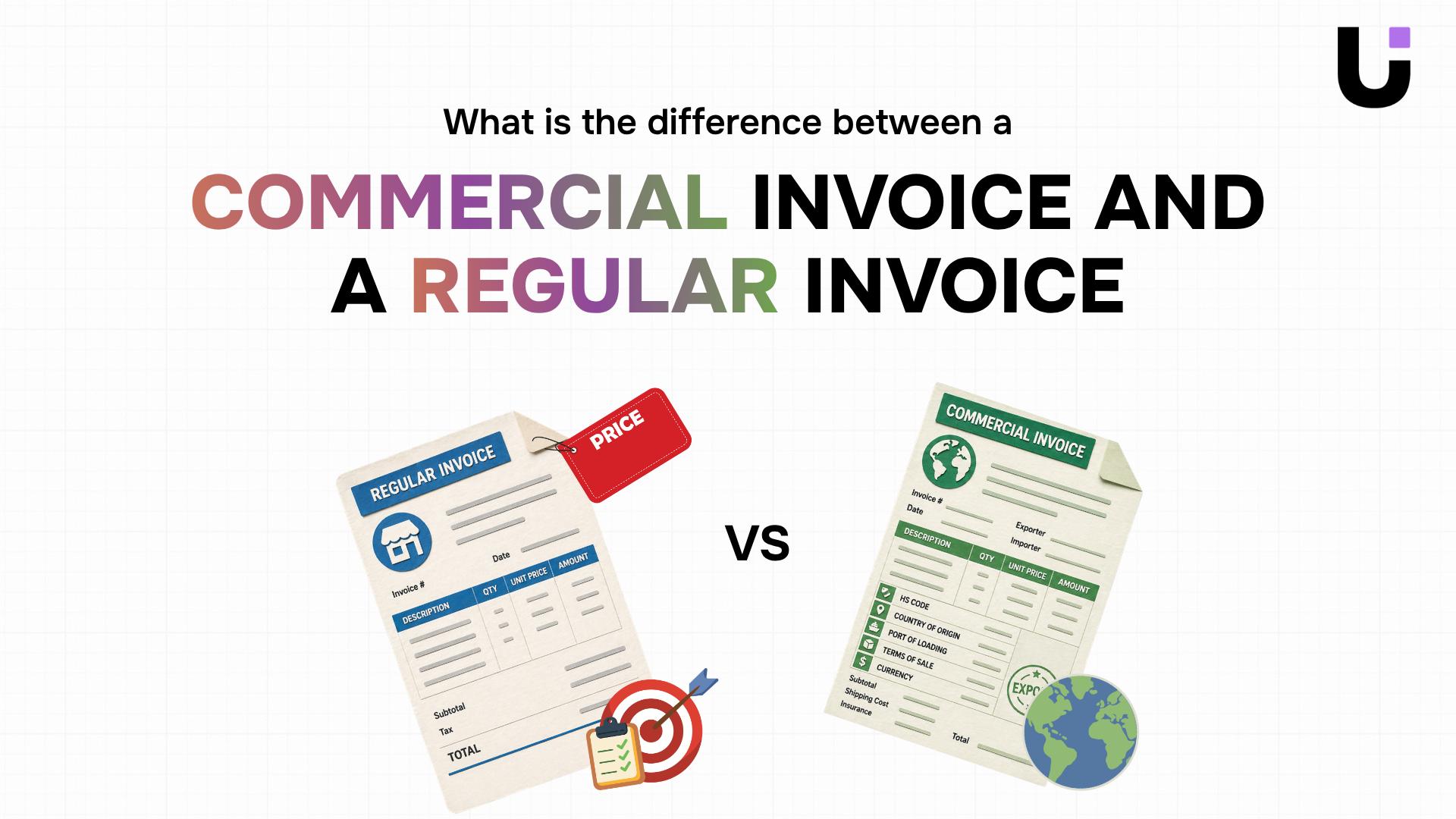
A standard invoice typically includes:
- Seller name, address, and contact details
- Buyer name and billing address
- A unique invoice number
- Issue date and payment due date
- Line-item description of goods or services
- Quantities and unit prices
- Subtotal, applicable taxes, and total amount due
- Payment terms (net 30, net 15, etc.)
Those fields satisfy most accounting systems, tax authorities, and client requirements. In the UK, HMRC requires VAT-registered businesses to include their VAT number and the VAT amount broken out separately on any invoice above £250. The IRS does not mandate a specific invoice format for US domestic transactions, but the fields above meet standard audit and expense documentation requirements.
What a standard invoice does not do is prove anything to a customs authority. It carries no country-of-origin declaration, no harmonized system (HS) code, and no shipping terms. For domestic billing, those omissions are fine. The moment a shipment crosses a border, they become a problem.
What is a commercial invoice
A commercial invoice is a legal trade document issued by an exporter to a foreign buyer. Its primary job is not to request payment. It exists to satisfy customs and border control requirements in the importing country.
When goods cross an international border, customs agencies need a verified record to assess duties, calculate taxes, and decide whether to release a shipment. The commercial invoice is that record. It tells customs authorities what is being shipped, what it is worth, and where it was produced.
US Customs and Border Protection (CBP) requires a commercial invoice for all formal import entries. EU customs authorities treat it as the primary valuation document under the Union Customs Code. These are not optional filings.
A compliant commercial invoice includes everything on a standard invoice, plus:
- HS code (Harmonized System code): a standardized numerical classification customs agencies use to identify goods and apply the correct duty rate
- Declared value: the actual transaction price used to calculate import duties and taxes
- Country of origin: where the goods were manufactured, not where they were shipped from
- Incoterms 2020: standardized trade terms from the International Chamber of Commerce that define who bears responsibility for shipping costs, insurance, and risk at each stage of transit
- Full buyer and seller legal details: business names, addresses, and contact information for both parties
Missing or inaccurate entries in any of these fields can trigger a customs hold, a request for additional documentation, or a rejection at the border.
Key differences between commercial invoice and standard invoice
| Feature |
Standard Invoice |
Commercial Invoice |
| Primary purpose |
Request payment from a buyer |
Satisfy customs requirements for international shipments |
| Used for |
Domestic transactions, service billing |
Cross-border shipments of physical goods |
| HS code required |
No |
Yes |
| Country of origin |
No |
Yes |
| Incoterms |
No |
Yes |
| Declared customs value |
No |
Yes |
| Legal authority |
Billing and accounting |
Customs and trade compliance |
| Who uses it |
Buyer and seller |
Buyer, seller, and customs authority |
| Risk of using wrong type |
Delayed payment, client confusion |
Customs hold, fines, shipment rejection |
The core difference is audience. A standard invoice speaks to your client. A commercial invoice speaks to a government authority. The information each party needs is different, and the consequences of getting it wrong are different too.
When to use each document type
Use a standard invoice when:
- Billing a domestic client for goods or services
- Delivering software licenses or SaaS subscriptions electronically
- Invoicing for professional services, consulting, or managed IT support with no physical component
- Sending recurring invoices for subscription or retainer arrangements
Use a commercial invoice when:
- Shipping hardware, devices, or physical media to a client in another country
- Sending replacement parts or equipment under an international managed services contract
- Fulfilling a software order that includes a physical medium such as a USB drive or pre-loaded device
- Billing a foreign client who requires a commercial invoice for their own import compliance or VAT reclaim
One situation worth noting: some international clients, particularly in the EU, will request a commercial invoice even on service-only engagements because their finance teams need it to support a VAT reclaim. If a client asks for one, issue it.
When none of those triggers apply, a standard invoice is the right document. Issuing a commercial invoice for a domestic transaction adds unnecessary fields and can confuse clients who have no customs requirement to meet.
Best practices for commercial invoice and standard invoice management
1. Standardize your templates
Keep separate, clearly labeled templates for each document type. A standard invoice template and a commercial invoice template should never share the same base file. Mixing them leads to missing fields and formatting errors that slow down both payment and customs clearance.
2. Match the document to the transaction at the point of sale
The invoice decision should happen when the order is created, not when it is ready to ship. If your billing process flags any transaction with an international shipping address for commercial invoice format, the right fields get populated before the shipment leaves your hands.
3. Use accurate HS codes for every physical product line
Look up the correct code at the World Customs Organization (WCO) database or your country's tariff schedule. A generic or missing HS code forces a customs officer to classify the goods manually, which triggers a hold. Save verified HS codes against each product in your invoicing system so repeat shipments populate correctly.
4. Declare the actual transaction value
Understating the declared value to reduce a buyer's import duties is a compliance risk. Customs agencies flag it routinely, and the penalty, including seizure or fines, is far more expensive than the duty savings. Use the actual price paid as defined under the WTO Customs Valuation Agreement.
5. Keep invoices and payment receipts as separate records]
An invoice is a payment request. A receipt is proof that payment was made. Tax authorities treat these as distinct documents. Your commercial invoice belongs in your trade documentation file. Your payment confirmation belongs in your accounts payable records. Good invoice management software separates these automatically.
6. Review destination country requirements before shipping
Customs rules vary by country. Some importing countries require additional certifications, specific descriptions, or translated fields. Check the requirements for each destination, especially for new client relationships or new product categories.
Mistakes to avoid
1. Using a standard invoice for an international shipment
This is the most common and most costly error. A standard invoice does not contain the fields customs authorities need. The shipment will be held until you provide the correct documentation, adding days or weeks to delivery. According to a 2023 Descartes report, incomplete or missing documentation is one of the top causes of customs delays.
2. Leaving the HS code blank or using a vague description
"Electronics" is not a sufficient customs description. "24-port managed network switch, model X200" is. Vague descriptions and missing HS codes are among the leading reasons shipments are held at the border.
3.Under-declaring the customs value
Customs agencies cross-check declared values against market prices and transaction records. Understating the value to reduce duties creates audit risk and can result in fines or seizure of goods.
4. Issuing a commercial invoice for a purely domestic transaction
This adds confusion for clients who have no customs requirement and can create questions from their own finance teams about fields they don't recognize.
5. Treating a commercial invoice as a tax receipt
A commercial invoice is a shipping document, not proof of payment. The IRS does not recognize an unpaid invoice as proof of a deductible expense. HMRC requires a VAT invoice to include the supplier's VAT registration number, the tax point date, and the VAT amount charged. A customs-facing commercial invoice rarely meets that standard without modification.
6. Relying on manual edits to switch between document types
Manual reformatting introduces errors. If your team is editing a standard invoice template to add customs fields before each international shipment, that process will eventually produce a document with missing or incorrect information. Build the document type decision into your invoicing workflow so the right template is selected automatically.
Conclusion
The difference between a commercial invoice and a standard invoice comes down to purpose and audience. A standard invoice tells a client what they owe. A commercial invoice tells a customs authority what crossed a border, what it is worth, and where it came from. Using the wrong one delays shipments, creates compliance risk, and can hold up payment on both ends of a transaction.
Getting this right is not complicated once the decision is built into your process. Match the document to the transaction type, use accurate HS codes and declared values, and keep your trade documentation separate from your payment records. Those three habits eliminate most of the errors that cause customs holds and accounting headaches.
If you want to remove the manual judgment call entirely, Inzo generates the correct document type based on the transaction, applies the right fields automatically, and keeps your invoicing records audit-ready from the moment an order is placed.
Frequently Asked Questions
Q. What is the difference between a commercial invoice and a standard invoice?
A. A standard invoice is a payment request used for domestic transactions and service billing. A commercial invoice is a legal trade document used for international shipments that gives customs authorities the information they need to assess duties and release goods. One collects payment, the other clears customs.
Q. When do I need a commercial invoice instead of a standard invoice?
A. Any time you ship physical goods across an international border. That includes hardware, devices, physical media, and software bundled with a physical component. For purely digital deliverables and domestic transactions, a standard invoice is sufficient.
Q. What information must a commercial invoice include?
A. At minimum: both parties' full legal names and addresses, invoice date and number, a detailed description of each item, quantity, unit price, total value, currency, country of origin, HS code for each product line, Incoterms, and a signed declaration of accuracy. Some destination countries require additional certifications.
Q. Can I use a commercial invoice as a receipt for tax purposes?
A. No. A commercial invoice is a shipping document, not proof of payment. For tax purposes, you need a paid invoice or payment confirmation showing the amount paid, the date, the vendor, and the business purpose. Requirements vary by country, so confirm with your accountant or local tax authority.
Q. Do I need a commercial invoice for software or IT services billed internationally?
A. For purely digital deliverables, most customs authorities do not require one. If any physical goods are involved, such as a USB drive, a hardware dongle, or a pre-loaded device, customs treats the shipment as goods and a commercial invoice is required.
Q. What happens if I send the wrong invoice type to customs?
A. Customs will delay or hold your shipment until you provide the correct documentation. You may also face fines, additional inspections, or a return to sender. Getting the document right before the shipment leaves is always cheaper than correcting it at the border.
Q. Can a client request a commercial invoice for a service-only engagement?
A. Yes. Some international clients, particularly in the EU, request a commercial invoice even for service engagements because their finance teams need it to support a VAT reclaim. If a client asks for one, issue it.


 Elena Petrova15 September 2026


