TL;DR: Most articles define lead time and stop there. This one shows IT company owners where delays actually compound — across handoffs, approvals, and unqualified inputs — and walks through a five-step process for measuring and cutting them. You'll leave with a method you can apply to your next project, not just a definition.
What lead time means in project management
In project management, lead time is the total elapsed time between when work is requested and when it's delivered. That includes every minute the request sits in a queue, waits for approval, or gets handed off between teams — not just the hours someone spends actively working on it.
This is different from how supply chain teams use the term. In manufacturing and procurement, lead time measures how long a supplier takes to fulfill an order. In project management, the clock starts the moment a request enters your system and stops when the output reaches the person who asked for it.
That distinction matters because most project delays don't happen during active work. They happen in the gaps: the intake backlog, the approval queue, the handoff that sits unread for two days. Routing incoming work to the right person automatically removes one of the most common sources of early delay.
For IT teams specifically, lead time is the most honest measure of project delivery time because it captures the full experience: from the moment a stakeholder submits a request to the moment they have a working result.
The next section breaks that span into five measurable components and shows you how to calculate it.
The formula itself is straightforward:
Lead Time = Completion Date − Request Date
Every day between when a request enters your system and when the finished output leaves it counts. No exceptions for weekends, waiting periods, or "we were blocked by the client."
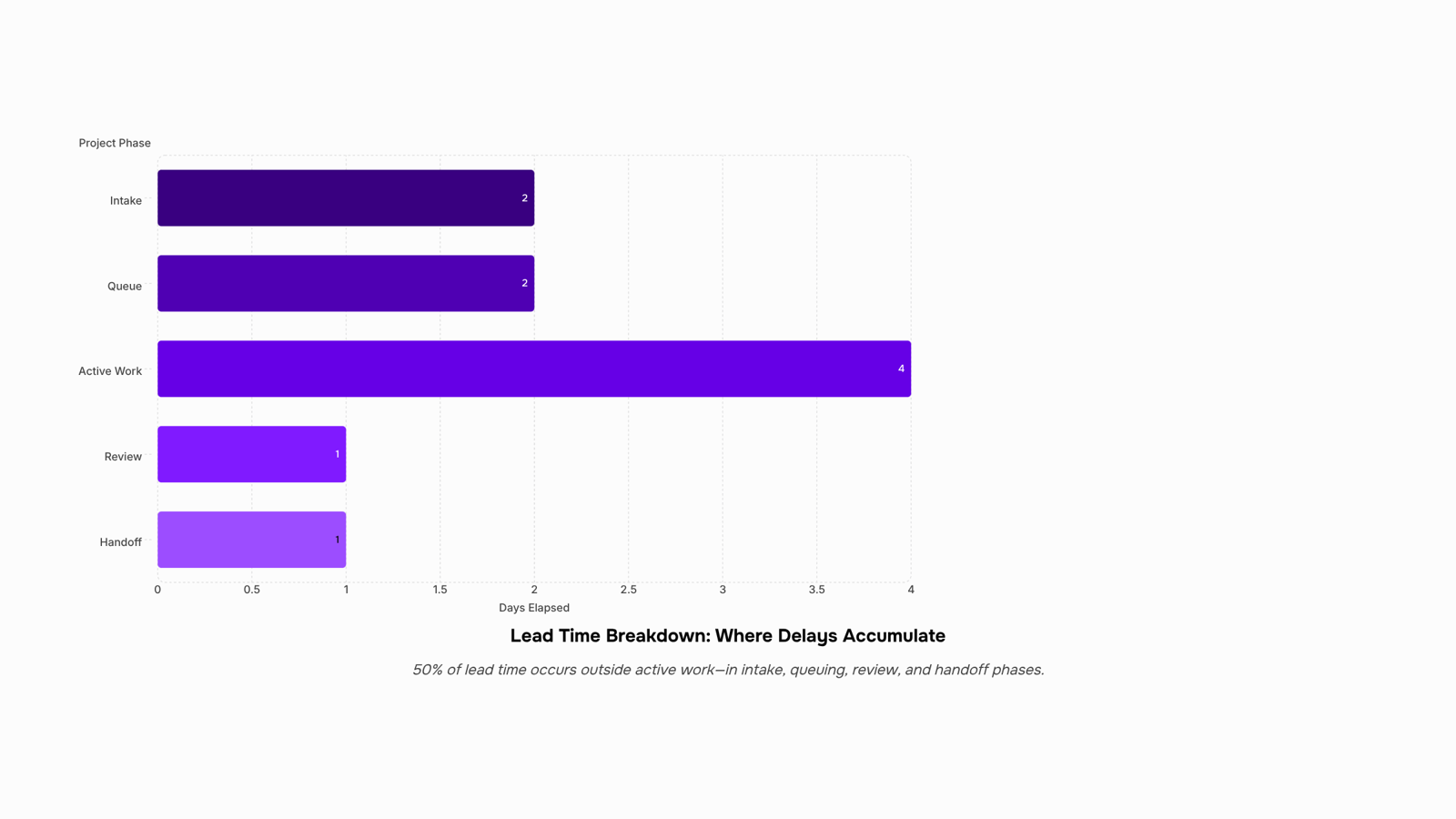
Where teams go wrong is treating lead time as a single number when it's actually five stacked intervals:
Intake — time from request submission to acknowledgment or ticket creation
Queue — time the work sits waiting before anyone picks it up
Active work — time spent actually doing the task
Review — time in QA, approval, or sign-off
Handoff — time between "done internally" and "delivered to the requester"
Most project managers only track active work. The other four phases are where lead time silently inflates.
Worked example. A mid-size IT team receives a request to configure a new client environment on March 1. The ticket sits unassigned for two days (queue), gets picked up March 3, takes four days of active work, waits one day for a security review, and is handed off March 9. Lead time: 8 days. Active work: 4 days. The other 4 days were invisible to anyone watching the sprint board.
If your intake process isn't built around responding to incoming requests within minutes rather than hours, queue time alone can double your lead time before a single task starts. Teams that add routing incoming work to the right person automatically cut that queue phase significantly.
To calculate lead time in project management accurately, log the timestamp when each request arrives, not when work begins. That distinction is where the real data lives, and it's what a structured process for capturing and assigning work as it arrives makes possible.
What happens when lead time runs long
Long lead times don't just slow projects down. They create a chain of consequences that compounds across every phase of delivery.
Missed deadlines are the most visible lead time consequence. When intake takes three days instead of one, and review adds another unexpected buffer, the final delivery date slips before active work even starts. PMI's research consistently shows that IT projects with poor intake and handoff processes are among the most likely to miss their original deadlines.
Cost overruns follow directly: Extended project delivery time means more hours billed, more resources held in standby, and more coordination overhead. A two-week slip on a fixed-price contract can erase the margin on the entire engagement.
Client churn is the quieter damage: Clients rarely complain about a single missed date. They quietly decide the next project goes elsewhere. Long lead times signal disorganization, even when the technical work is solid.
Team bottlenecks become self-reinforcing: When one phase runs long, the next phase queue backs up. Developers sit idle waiting for approved specs. Reviewers get hit with three requests at once. The team's capacity doesn't shrink, but their effective output does, because work is stuck waiting rather than moving.
This compounding effect is what makes it worth the effort to reduce lead time systematically, not just at one stage. The same pattern shows up in how growing teams lose leads between CRM and task handoffs: delays in one system ripple into every system downstream.
Lead time vs. cycle time: what the difference means for your team
These two metrics are often used interchangeably. They measure different things, and confusing them leads to the wrong fix.
Lead time measures the total elapsed time from when a request enters your system to when it's delivered. It includes waiting, queuing, and everything your team hasn't touched yet. Cycle time measures only the active working period — from when someone starts the task to when they finish it.
| Lead time | Cycle time |
|---|
What it measures | Request received → work delivered | Work started → work completed |
Includes idle/wait time | Yes | No |
Best used for | Client-facing commitments, SLA tracking | Team capacity and process efficiency |
Who cares most | Clients, project managers | Developers, delivery leads |
Danger if ignored | Missed deadlines, client churn | Hidden bottlenecks inside the team |
The common mistake in lead time in project management is optimizing cycle time while ignoring lead time entirely. A team can cut active build time from five days to three and still miss the deadline because requests sat unrouted for a week before anyone picked them up. Routing incoming work to the right person automatically closes that gap before the clock even starts.
When your lead time vs cycle time gap is wide, the problem is almost never execution. It's intake.
5 steps to reduce lead time in your projects
Reducing lead time in project management isn't one fix — it's five targeted interventions, each aimed at a phase where time quietly accumulates before a single line of work gets done.
Fix intake routing first: Most IT projects don't stall mid-execution; they stall before they start. When a request lands in a shared inbox or a generic backlog, it waits for a human to decide who owns it. That decision can take hours or days. Automating intake routing — assigning requests to the right queue or owner based on type, urgency, or client — removes that first delay entirely. The same logic applies to lead response: responding to a new request within five minutes can dramatically change how quickly work actually starts moving.
Prioritize the backlog by dependency, not just urgency: A task that looks low-priority in isolation might be blocking three others. When teams sort backlogs by urgency alone, they consistently underestimate how much lead time in project management is driven by sequencing errors. Score each item by both urgency and downstream dependency count before the sprint starts.
Map dependencies before kickoff, not during: Dependency discovery mid-project is one of the most reliable ways to extend lead time. Before a project enters active work, run a 30-minute dependency audit: list every external team, API, approval, or vendor input the project needs, and assign an owner and expected date to each. Teams that do this consistently report fewer mid-sprint blockers and tighter delivery windows.
Compress the approval chain: Approvals are the most overlooked source of accumulated lead time. A project that needs sign-off from three stakeholders in sequence can sit idle for a week between each step. Two changes help: run approvals in parallel where possible, and set a default response window (48 hours is common for IT projects). If no response arrives, the request escalates automatically rather than waiting indefinitely.
Run a post-delivery lead time review: To reduce lead time over time, you need to know where it went. After each project closes, calculate actual lead time against the estimate and trace variance back to one of the four phases above. This is how to calculate lead time in a way that's actually useful — not as a historical record, but as a diagnostic. Teams that review lead time per phase after each delivery typically tighten their estimates within two or three cycles.
The compounding effect matters here. Each phase adds delay independently, but they also interact: a slow intake creates a rushed backlog prioritization, which creates missed dependencies, which creates emergency approvals. Fixing one phase in isolation helps. Fixing all five in sequence is where delivery time actually changes.
Most teams track lead time in project management the same way they track everything else: spreadsheets updated after the fact, status meetings that surface delays too late, and a post-mortem that explains what already went wrong. That approach tells you about lead time. It doesn't help you reduce it.
The fix is pulling lead time visibility into the same system where work actually happens.
Start by logging timestamps at each phase transition, not just at project open and close. Intake received, backlog entry, work started, approval submitted, approval returned, delivered. Six timestamps give you a breakdown by phase. Without that granularity, you can't tell whether your project delivery time problem lives in approvals or in intake.
Lio's real-time routing handles the intake phase automatically, capturing each request and assigning it the moment it arrives. That removes the most common source of invisible delay: work sitting in a queue with no owner. Teams that build a structured process for capturing and assigning work as it arrives consistently see intake delay drop from days to minutes.
For the remaining phases, Prax's task-level time tracking lets you attach actual durations to backlog, dependency, and approval stages so the data accumulates without manual effort.
When your timestamps live in one system, patterns surface fast. You stop estimating where time goes and start seeing it.
Closing
Lead time isn't a single metric — it's five stacked intervals where delays compound silently before active work even begins. The five-step framework in this guide targets each phase, but the highest-leverage fix almost always sits at intake: the moment a request enters your system and waits for routing. That's where most IT teams lose days without realizing it. If you're tracking lead time but still missing deadlines, the bottleneck is almost certainly in how requests get assigned, not how they get executed. Lio automates that routing step — the one that inflates lead time before work starts — so your team spends time building, not waiting. Ready to see how it works? Check out Lio in action on the product page.
FAQ
Q. How is lead time calculated in project management?
A. Lead time = Completion Date − Request Date. Log the timestamp when each request arrives (not when work starts) and subtract it from delivery. This captures all five phases: intake, queue, active work, review, and handoff.Q. What is the difference between lead time and cycle time?
A. Lead time measures total elapsed time from request received to work delivered, including all waiting. Cycle time measures only active working time. Lead time tracks client experience; cycle time tracks team efficiency.Q. How can I reduce lead time in my projects?
A. Target the five phases where delays accumulate: automate intake routing to eliminate queue time, prioritize the backlog, set clear SLAs for review, standardize handoff formats, and measure each phase separately to find the real bottleneck.Q. What counts as the start point when measuring lead time?
A. The start point is when a request enters your system (submission timestamp), not when work begins. This distinction is critical — it's where the hidden delays live and where most teams go wrong.Q. Can lead time be negative, and what does that mean?
A. No. Lead time cannot be negative. A negative result would indicate a data entry error or a completion date recorded before the request date, signaling a tracking or timestamp problem in your system.


 Elena Petrova15 September 2026


