TL;DR: Most B2B sales content treats each stage — prospecting, pitching, closing — as a separate problem. This article connects them into a single relationship arc, from first qualification through long-term retention, so you can see how each step sets up the next. The framework is built for IT company owners managing complex, multi-stakeholder deals.
What B2B sales actually is
B2B sales is the process of selling products or services from one business to another. That single-sentence definition understates what actually makes it hard.
Unlike B2C, where one person decides and often buys the same day, a typical B2B purchase involves multiple stakeholders — Gartner research puts the average buying group for complex IT solutions at 6 to 10 people. Each has different priorities. Each can stall the deal. The b2b sales cycle for IT services commonly runs 3 to 9 months, sometimes longer when procurement and legal get involved.
That timeline changes everything. You are not closing a transaction; you are building enough trust across enough people that the whole group says yes. Price matters, but it rarely wins deals on its own. Relationships do. For IT company owners who are often the primary seller, this is the skill that compounds: a strong relationship shortens the next cycle, generates referrals, and reduces churn after the contract is signed.
Filling your pipeline is only the starting point. Converting it depends on what happens between first contact and signature.
Why relationships drive B2B deals more than price or features
Price gets you into the conversation. Relationships determine whether you close it.
In B2B sales, especially for IT services, buyers are rarely choosing on specs alone. Gartner research consistently shows that purchasing decisions at this level involve six to ten stakeholders, each with different priorities. The rep who has built trust across that group has a structural advantage no feature list can replicate.
Four outcomes tie directly to relationship quality:
Shorter cycles: Buyers who trust you skip several rounds of skepticism. A warm relationship compresses the stages where deals stall most — evaluation and internal approval.
Higher retention: A client who bought because of the relationship is harder to poach on price. They associate the value with you, not just the product.
Referral pipeline: IT buyers talk to peers. One strong relationship can generate introductions that no outbound b2b lead generation strategy matches for conversion rate.
Honest objections: Buyers who trust you tell you why they're hesitating. That feedback lets you address the real blocker instead of guessing.
A solid b2b sales strategy treats relationship-building as the mechanism, not the reward. The b2b sales tips that actually move numbers — consistent follow-up, email-based lead nurturing, multi-stakeholder engagement — all serve that same goal.
How to generate and qualify leads worth building relationships with
Relationship-building doesn't start at the demo. It starts the moment you decide a lead is worth your time.
Most b2b sales lead generation advice treats qualification as a checkbox before the "real" work begins. That framing is backwards. If you're an IT company owner who also carries the sales relationship, a bad-fit lead doesn't just waste an hour — it pulls you away from a client who actually needs what you build.
A practical b2b sales scoring system uses three components: fit (industry, company size, tech stack), authority (can this person actually sign or strongly influence the decision), and intent (are they actively evaluating, or just browsing). Score each dimension separately. A lead who scores high on fit but low on authority needs a different path through your b2b sales funnel than one who has budget and urgency but is a marginal fit.
For IT services specifically, Gartner research consistently shows that multiple stakeholders are involved in purchase decisions, which means qualifying one contact isn't enough. Ask early who else reviews the shortlist.
Once you know a lead clears all three bars, you have something worth investing in. Nurturing those leads through email before the first call builds familiarity that makes the relationship feel less transactional from the start.
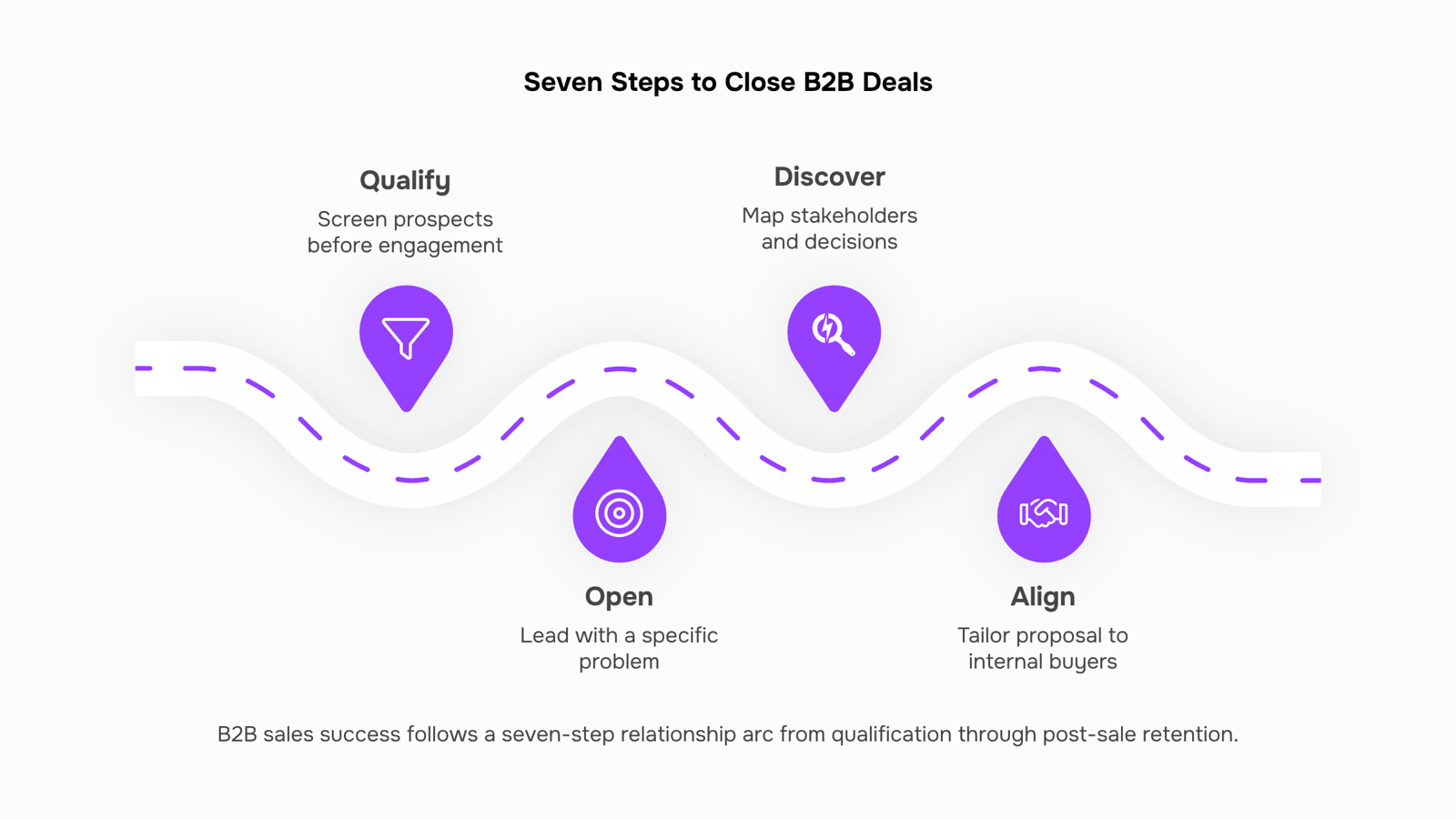
Seven steps to build B2B sales relationships that close and retain
The seven steps below follow the sequence of an actual b2b sales cycle, not a theoretical funnel. Each one builds on the last. Skip a step and the relationship either stalls or never forms.
Qualify before you engage: Confirm fit, authority, and intent before investing time in a prospect. A 50-person IT services firm spending 30 minutes on a discovery call with someone who can't sign is 30 minutes that won't come back. The previous section covers the scoring components in detail — use them here as your entry gate.
Open with a specific problem, not a pitch: Your first outreach should name something real about their situation. "I noticed your team scaled from 20 to 80 engineers in 18 months — onboarding tooling usually breaks at that inflection point" lands differently than "I'd love to show you our platform." Reference something verifiable. This is where effective b2b lead generation strategies separate from cold volume plays.
Run discovery to map the decision structure: For IT services deals, Gartner research consistently shows multiple stakeholders involved in purchase decisions — often six or more. Ask who else evaluates the shortlist, who controls budget, and who can veto. You need a relationship with the network, not just one contact.
Align your proposal to their internal business case: Most proposals fail because they're written for the buyer, not for everyone the buyer has to convince. Structure your proposal so your contact can present it upward without you in the room. Include the business outcome, the risk of inaction, and a clear timeline.
Follow up on a schedule, not a feeling: The biggest b2b sales strategy failure is irregular follow-up. Set a specific cadence after each touchpoint: three business days after a proposal, one week after a demo, two weeks after a "we need to think about it." Structured email nurturing between calls keeps you present without being pushy.
Close by removing friction, not adding pressure: When a deal stalls, the cause is almost always an unresolved risk or a missing internal approval, not a pricing objection. Ask: "What would need to be true for this to move forward this month?" That question surfaces the real blocker. Address it directly.
Build the post-sale relationship before the contract is signed: Introduce your delivery team during the final negotiation stage, not after. Send a clear onboarding timeline before day one. The transition from sales to delivery is where most IT services relationships break — and where retention starts. Understanding the full length and shape of your b2b sales cycle helps you plan this handoff at the right moment.
These seven steps are a b2b sales strategy, not a checklist. The relationship you build in steps one through three determines whether steps four through seven are even necessary — or whether the deal closes itself because you've already earned the trust.
Three categories of tools do most of the work in a relationship-driven b2b sales funnel: lead capture, follow-up tracking, and email nurturing.
Lead capture tools qualify prospects before they enter your pipeline. Without this layer, your team spends time on contacts that will never buy. For driving pipeline from the right sources, qualification criteria need to be set before outreach starts, not after.
Follow-up tracking maps to steps three through five in the framework, where deals stall most often. Lio handles lead scoring and routing automatically, so the right prospect reaches the right person without a manual handoff creating a delay.
Email nurturing keeps relationships warm across the full b2b sales cycle between active conversations. Consistent, relevant touchpoints are what separate closed deals from stalled ones. A practical starting point for this layer is structuring your nurture sequences by stage rather than by calendar interval.
Match the tool to the stage where friction actually lives. Buying all three without that mapping adds process, not speed.
B2B vs. B2C sales: the differences that change how you sell
The core difference between B2B and B2C selling isn't complexity — it's who you're selling to and how long they take to decide.
Dimension | B2B | B2C |
|---|
Cycle length | Weeks to months | Hours to days |
Decision-makers | 6–10 stakeholders (Gartner) | Usually one person |
Relationship depth | High — trust precedes the contract | Low — product does the work |
Follow-up cadence | Structured, multi-touch over weeks | One or two reminders max |
For IT company owners who sell and manage simultaneously, this gap matters. A B2C instinct — pitch hard, close fast — collapses in B2B because the buyer isn't one person. Your b2b sales strategy has to account for consensus, not just conviction.
That's why understanding what is b2b sales at the structural level — not just the tactical one — changes how you build every stage of your pipeline.
Common mistakes that kill B2B sales relationships early
Most B2B sales relationships don't break at the close. They break in the first two weeks.
Slow first response is the most common killer. Responding to an inbound inquiry after 24 hours drops your conversion odds sharply — the prospect has already moved on mentally, if not literally.
Generic follow-up is the second. Sending the same deck to every contact signals you didn't listen. Personalize to the specific pain they named, or don't send it.
Skipping stakeholder mapping is where IT company owners get caught most often. You're selling to one person, but Gartner research consistently shows six to ten people influence enterprise IT purchases. Missing even one budget holder can stall a deal for months. A solid understanding of your b2b sales cycle tells you when to map stakeholders, not after.
Treating the close as the finish line ends referrals before they start. The relationship that produces renewals and introductions begins the day the contract is signed.
For b2b sales tips on keeping that pipeline warm, email nurturing strategies are worth reviewing before your next follow-up sequence.
Closing
The seven steps work because they treat B2B sales as a relationship problem, not a transaction problem. You now know how to qualify leads worth your time, map the decision structure across multiple stakeholders, and align your proposal so your contact can sell it internally without you. But here's what breaks most B2B sales strategies in practice: the gap between when a lead comes in and when your team responds. A prospect who reaches out on Tuesday and hears back on Thursday has already moved on to your competitor. Lio closes that gap automatically — it qualifies incoming leads, logs context, and alerts your team in real time, so the relationship starts the moment the buyer raises their hand. See how it works with a free trial.
FAQ
Q. What is B2B sales?
A. B2B sales is selling products or services from one business to another. Unlike B2C, it involves multiple stakeholders (typically 6-10 people), longer cycles (3-9 months), and relationship-driven decisions where trust matters more than price alone.Q. What are the most effective strategies for B2B sales?
A. Qualify leads before engaging, open with a specific problem, map the decision structure across all stakeholders, align proposals to their internal business case, follow up on a schedule, remove friction at close, and build the post-sale relationship before the contract is signed.Q. How do I generate leads for B2B sales?
A. Score leads on three dimensions: fit (industry, company size), authority (can they sign or influence), and intent (actively evaluating). Focus on quality over volume — a bad-fit lead wastes time you could spend nurturing prospects who actually need what you build.Q. What is the difference between B2B and B2C sales?
A. B2C involves one decision-maker who often buys the same day. B2B involves 6-10 stakeholders with different priorities, cycles lasting 3-9 months, and decisions driven by relationships and trust, not just features or price.Q. How do you build relationships in B2B sales?
A. Open with a specific problem about their situation, map the full decision network, structure proposals so your contact can present upward, follow up on a consistent schedule, and introduce your delivery team before the deal closes to show you're invested in their success.


 Elena Petrova15 September 2026


