TL;DR: Most content on cold email marketing agencies either lists names or defines terms without helping you decide. This article gives you a structured way to evaluate agencies against your actual sales process, including what separates good deliverability work from surface-level setup. You'll also see when outsourcing makes sense and when an in-house system with AI tooling is the better call.
What a cold email marketing agency actually does
A cold email marketing agency handles the outbound prospecting work your sales team either can't prioritize or hasn't built the infrastructure to run well. That covers more ground than most buyers expect when they first start evaluating cold email agency services.
At the core, you're paying for four distinct functions:
List building and segmentation — sourcing verified contacts that match your ICP, filtered by industry, company size, job title, and buying signals. A competent agency doesn't hand you a CSV from a generic database; they build targeted segments that reflect how your buyers actually make decisions.
Copywriting and sequence design — writing multi-step email sequences (typically 3 to 6 touches) with subject lines, body copy, and call-to-action variants tested against each other. The cold email strategies that get replies matter here more than volume.
Technical setup and deliverability management — configuring sending domains, SPF/DKIM/DMARC records, inbox warming, and sending limits to protect your domain reputation. This is the work most in-house teams skip, and it's why campaigns fail before a single reply comes in.
Campaign execution and reporting — managing send schedules, monitoring reply rates, handing off interested leads to your sales team, and reporting on open rates, reply rates, and booked meetings.
Some agencies also offer cold email generator tools and automation infrastructure as part of their stack. Others operate more like managed services, where a human strategist owns the campaign end to end.
Knowing which model you're buying matters before you sign anything. The next section covers what measurable outcomes you should hold each model accountable for.
How cold email agencies improve sales conversions
A good agency moves the needle on three specific numbers: reply rate, meeting booked rate, and pipeline value generated per month. Understanding which levers they pull to improve each one lets you set realistic targets before you sign anything.
On reply rates, the mechanism is copy and targeting working together. Agencies that run cold email automation at scale can A/B test subject lines, opening hooks, and call-to-action phrasing across hundreds of sends simultaneously. An in-house team running manual sequences rarely has the volume to reach statistical significance in under 60 days. An agency typically gets there in two to three weeks.
Meeting rates improve through sequence design. Most in-house campaigns stop at two follow-ups. Agencies routinely run five to seven-touch sequences with deliberate spacing and varied angles, which is where most of the incremental bookings come from.
Pipeline value is where cold email outsourcing compounds. Because agencies own deliverability infrastructure, domain warm-up, and list hygiene, more emails actually land in primary inboxes. A message that reaches the inbox converts at a meaningfully higher rate than one filtered to spam, regardless of copy quality.
The honest caveat: agencies improve these numbers when given accurate ICP definitions and a product with a clear pain point. Weak positioning limits what any external team can do. For context on what good campaigns look like structurally, 2025 cold email strategies that actually get replies is worth reading before your first agency call.
Benefits of hiring a cold email marketing agency
Hiring externally makes the most sense when your team lacks the time or specialization to run outbound consistently. Here is what you actually gain.
Faster time to pipeline: A good agency has sequences, targeting frameworks, and deliverability infrastructure already in place. Where an in-house hire might take 60 to 90 days to get their first campaign live, an experienced agency can launch in two to three weeks.
Deliverability expertise you would otherwise have to build: Domain warming, inbox rotation, and bounce management are technical disciplines. Most IT company owners do not want to own that learning curve while also running a business.
Access to tested copy and cold email strategies that get replies: Agencies running dozens of campaigns per month accumulate signal fast. They know which subject line patterns get ignored and which angles convert in your vertical.
Lower fixed cost than a full-time hire: Agency retainers typically run between $2,000 and $6,000 per month. A dedicated in-house SDR costs more once you factor in salary, benefits, and ramp time, and they still need tooling on top.
Tooling without the overhead: Agencies bring their own cold email generator tools and sequencing platforms. You avoid paying for software seats you would otherwise need to evaluate, purchase, and maintain.
The case to hire a cold email agency is strongest when speed and specialization matter more than direct control.
How to evaluate and choose the right agency
Choosing the right cold email marketing agency comes down to four things: their process, their proof, their transparency, and how they handle failure.
Start with deliverability infrastructure: Any agency worth hiring should be able to explain how they warm up sending domains, how many domains they rotate across, and what their bounce rate thresholds are before they pause a campaign. If they can't answer those questions specifically, they're guessing with your reputation.
Ask for campaign data, not case studies: Case studies are curated. Ask instead for raw reply rate benchmarks from recent campaigns in your industry. A competent agency should be hitting 3–8% reply rates on well-targeted lists. If they quote you numbers above 15% without context, ask how they define a "reply" — some agencies count out-of-office responses.
Evaluate their ICP research process: The most common reason outsourced cold email underperforms is shallow targeting. Ask them: how do you build the contact list? Do you use a third-party data provider, manual research, or both? What signals do you use to qualify a prospect before they enter a sequence? Vague answers here predict vague results.
Red flags to watch for:
They guarantee a specific number of meetings booked before seeing your offer or market
They can't show you the actual email copy from a past campaign
They push you toward a 6-month contract before running a pilot
Their reporting is limited to open rates and click rates, with no reply or meeting data
Before you sign anything, ask one more question: "What does a failing campaign look like, and what do you do when that happens?" How an agency answers that tells you more than their pitch deck.
If you're still deciding whether to outsource at all, choosing the right email marketing service covers the broader evaluation criteria worth understanding before you commit to any external partner.
What a cold email agency should cost in 2026
Most cold email outsourcing retainers run between $1,500 and $5,000 per month in 2026. What separates those tiers isn't always quality — it's often deliverables volume, reporting depth, and whether copywriting is included or billed separately.
A $1,500–$2,500 retainer typically covers one sequence, basic list building, and monthly reporting. At $3,000–$5,000, you should expect A/B testing, dedicated copywriting, domain warm-up management, and weekly performance reviews. Anything above $5,000 without those elements is a red flag.
Watch for setup fees billed on top of the retainer. A one-time onboarding fee of $500–$1,000 is normal. Fees above that, with no clear deliverable attached, usually signal padding.
Before signing, ask what reply rate they guarantee and what happens if they miss it. Agencies confident in their work will answer directly. If the contract doesn't reference performance benchmarks, review the cold email strategies that get replies before committing to anything.
When to skip the agency and build cold email in-house
Building cold email in-house makes sense for three types of teams: those running high-volume outbound where agency retainers ($3,000–$8,000/month) eat into margin, those who need to iterate messaging faster than a monthly agency review cycle allows, and those where the ICP knowledge lives internally and is genuinely hard to transfer.
The real barrier used to be tooling. Writing sequences, managing deliverability, personalizing at scale, and tracking replies across multiple inboxes required either a dedicated ops hire or stitching together four separate tools. That's changed.
Cold email automation platforms now handle sequence logic, send-time optimization, and reply detection without manual setup for each campaign. Evox, WorksBuddy's outbound agent, is built specifically for this: you define the ICP and offer, and it generates personalized sequences, monitors reply signals, and routes warm leads to your sales team automatically. Your team stops managing the mechanics and focuses on the conversations that matter.
The in-house path does carry real tradeoffs. You own deliverability management, which means warming domains, monitoring bounce rates, and rotating inboxes when needed. If nobody on your team has done this before, expect a 4–6 week ramp before campaigns perform consistently. The cold email strategies that get replies are learnable, but they take time to apply correctly.
Where in-house wins decisively: when you're testing messaging weekly, when your sales team needs to own the voice, or when you've already tried an agency and the output felt generic. For teams evaluating cold email generator tools as a starting point, the infrastructure cost is lower than most expect.
Making the decision: agency, in-house, or hybrid
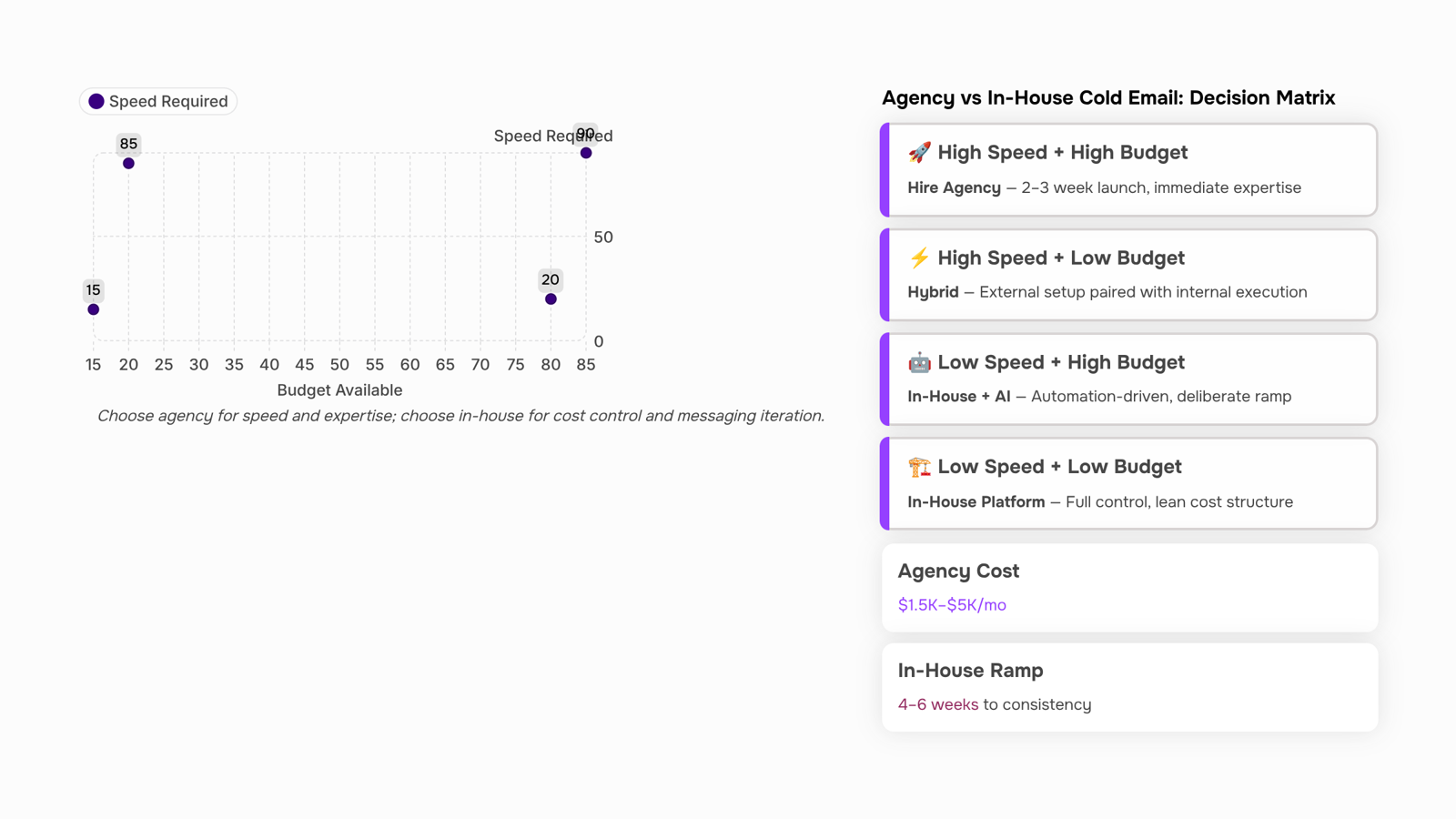
The right call depends on two variables: how much control you want over messaging, and what you can actually spend.
Situation | Best fit |
|---|
Under $3K/month budget | In-house with automation |
Need results in 30 days, no internal bandwidth | Hire a cold email agency |
Have a sales rep but no sequences built | Hybrid: internal ownership, external setup |
Want to test a new market segment | Agency for 90 days, then bring in-house |
Cold email outsourcing makes sense when speed matters more than margin. Agencies carry the infrastructure, the copywriters, and the deliverability knowledge. You pay for that.
In-house wins on cost and iteration speed once the system is running. Tools like AI email automation platforms and cold email generator tools close most of the capability gap that used to justify a retainer.
If you're still weighing approaches, cold email strategies that get replies is worth reading before you sign anything.
Closing
Choosing between an agency and an in-house system depends on one thing: whether you need speed and specialization more than direct control. Agencies excel when your team lacks bandwidth or deliverability expertise. But if you want to own your outbound process, reduce monthly spend, and keep campaigns flexible, a platform built for cold email automation can deliver the same outcomes without the retainer.
Start by auditing your current pipeline. How many qualified leads does your team need per month, and how much time can you realistically dedicate to outbound? That answer will tell you whether to call an agency or explore what a dedicated cold email system can do.
FAQ
Q. What services do cold email marketing agencies offer?
A. Cold email agencies handle list building, copywriting and sequence design, technical setup (SPF/DKIM/DMARC), and campaign execution with reporting. Some also provide cold email generator tools and automation infrastructure.Q. How can a cold email marketing agency improve my sales conversions?
A. Agencies improve reply rates through A/B testing at scale, boost meeting rates with longer sequences, and increase pipeline value by managing deliverability so emails reach primary inboxes consistently.Q. What are the benefits of hiring a cold email marketing agency?
A. You get faster time to pipeline, deliverability expertise, tested copy frameworks, lower fixed costs than a full-time hire, and tooling without overhead. Speed and specialization are the biggest wins.Q. How do I choose the best cold email marketing agency for my business?
A. Evaluate their deliverability infrastructure, ask for raw campaign data (not case studies), assess their ICP research process, and ask how they handle failing campaigns. Red flags include guaranteed meeting promises and limited reporting.Q. How much does a cold email marketing agency cost?
A. Most retainers range from $1,500 to $5,000 per month in 2026. Cost depends on list size, sequence complexity, and the level of hands-on strategy included.


 Elena Petrova15 September 2026


