TL;DR: Most guides on qualifying sales leads hand you a framework acronym without explaining what to actually check, in what order, or how the process holds up when your pipeline gets busy. This one gives IT company owners a criteria-first approach: define what a qualified lead looks like, build a scoring system around it, and wire up automation so volume doesn't create chaos.
What qualifying a sales lead actually means
Lead qualification is the process of deciding whether a contact is worth your sales team's time before you invest effort in pursuing them. A qualified lead meets enough of your criteria — fit, intent, authority, budget, timing — that working the opportunity makes commercial sense.
Skipping that filter is where IT sales teams lose the most time. Reps chase contacts who were never going to buy, while actual buyers wait. One common pattern on lean teams: a single misqualified deal consumes two weeks of follow-up that should have gone to three better-fit prospects.
The cost isn't just wasted calls. It's delayed pipeline, inaccurate forecasting, and burnout on a team that can't afford either.
Sales lead qualification also changes what your CRM data tells you. When unqualified contacts sit alongside real opportunities, your conversion metrics become unreliable and your pipeline reviews turn into triage sessions.
If you want a working definition of what separates a contact from a real opportunity, this breakdown of the qualification framework covers the distinction clearly. The next section maps the specific criteria — fit, intent, authority, timing, budget — and where each data point actually comes from.
Know the criteria that define a qualified lead
Qualified leads share five observable traits. When your reps know what to look for in each one, they stop guessing and start making faster, more consistent decisions.
ICP fit is the first filter. Does the company match your ideal customer profile on firmographic signals: industry, headcount, tech stack, and revenue band? For IT service companies, this often means checking whether the prospect runs the infrastructure you support. That data lives in LinkedIn, Apollo, or your CRM enrichment layer before a rep ever picks up the phone.
Intent tells you whether the prospect is actively looking or just browsing. High-intent signals include repeated visits to your pricing page, a demo request, or a content download tied to a buying decision (a security audit checklist, for example, carries more weight than a blog post). Your marketing automation platform captures most of this automatically if you have event tracking set up.
Authority confirms you're talking to someone who can move a deal forward. In IT sales, the decision often sits with a CTO, IT director, or operations lead, not the person who filled out the form. A quick LinkedIn check or a direct question in the first call ("Are you the person who'd sign off on this?") resolves this in under two minutes.
Budget doesn't require an exact number upfront. What you need is a rough range: can this company plausibly afford your service tier? Company size, funding stage, and current tooling spend are reasonable proxies when you can't ask directly.
Timing is the final gate. A lead with perfect fit, clear authority, and budget is still low priority if they're locked into a contract for another eight months. Ask early. "When are you looking to make a move?" is a direct question that saves everyone time.
These five criteria are the foundation of any lead scoring model worth building on. Assign weights based on what your closed-won data actually shows, not what a generic BANT template suggests. For lean IT sales teams, that calibration is the difference between a system that helps and one that just adds admin work.
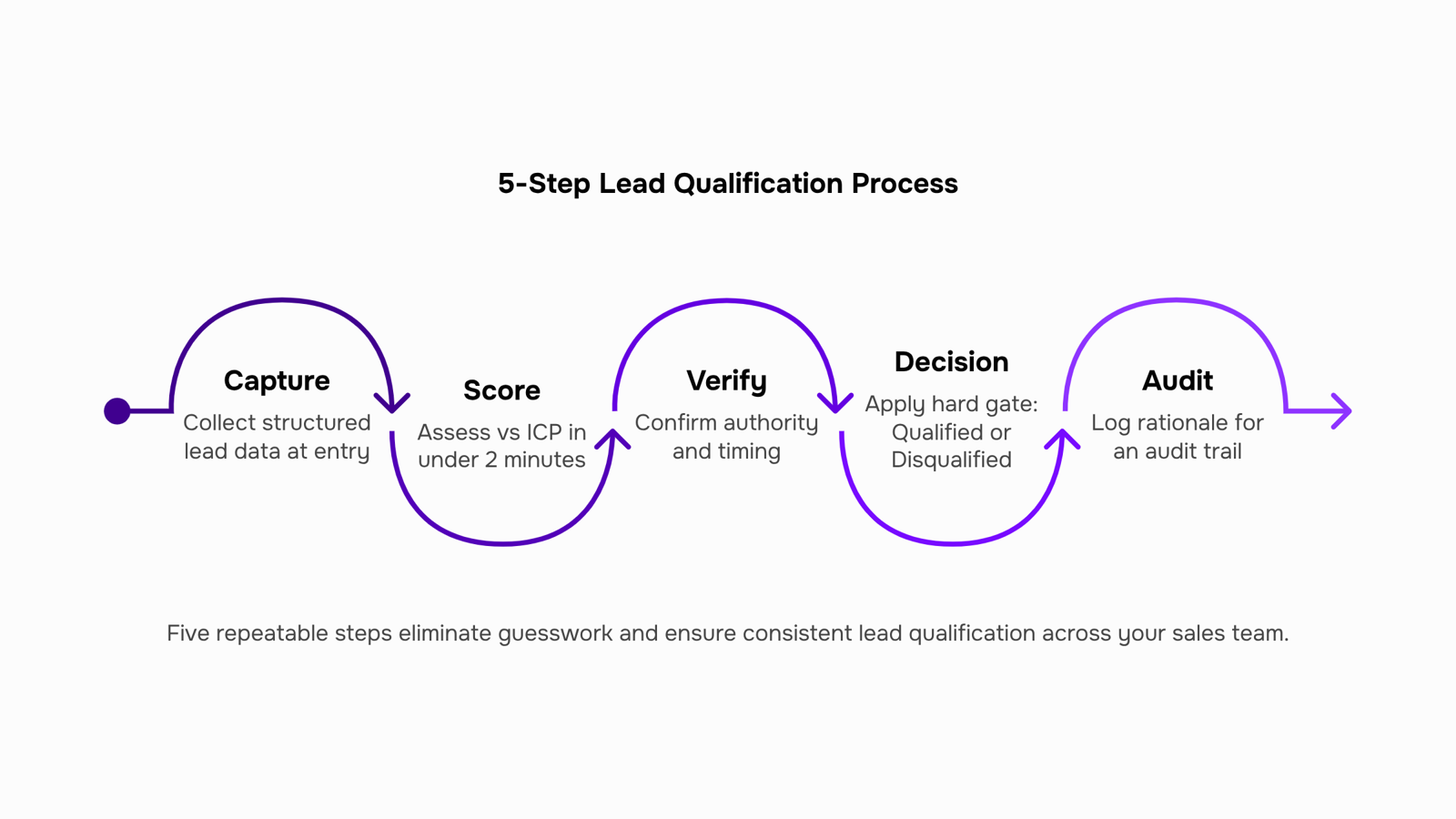
Qualify sales leads in 5 repeatable steps
Once you have your criteria locked (fit, intent, authority, timing, budget), the next problem is consistency. Without a repeatable process, two reps will score the same lead differently, and your pipeline data becomes noise. Here is a five-step sales lead qualification framework your team can run on every inbound lead, regardless of who picks it up.
Capture structured data at the point of entry: Before a rep touches the lead, your form, chatbot, or intake flow should collect the fields that map directly to your ICP: company size, industry, role, and the problem they're trying to solve. If a lead arrives without these, flag it for enrichment before routing. Unstructured leads waste rep time on discovery that should have happened automatically.
Score against your ICP before the first call: Take the data from step one and run it against your scoring model. A 50-person IT services firm in your target vertical scores differently from a solo freelancer who filled out the same form. This step should take under two minutes if your scoring criteria are defined. If it takes longer, your ICP needs tightening. The 5-signal lead scoring system behind consistent follow-up rates shows how to make this fast and objective.
Verify authority and timing in the first touchpoint: The opening call or email is not a pitch. It is a qualification gate. Confirm that the person you're talking to can approve or directly influence the purchase, and ask one direct question about timeline: "Is this something you're looking to solve in the next 30 to 60 days, or are you still in research mode?" Their answer tells you whether to accelerate or nurture.
Apply a hard qualification decision: After step three, every lead gets one of three labels: qualified, nurture, or disqualified. Qualified moves to the pipeline. Nurture goes into a sequence with a defined re-evaluation date. Disqualified gets closed with a note so you can audit your lead sources later. Skipping this decision is where most lean IT sales teams lose time. For a deeper look at what separates a qualified lead from a contact, the B2B lead qualification framework using ICP covers the logic in full.
Log the qualification rationale, not just the outcome: Record why a lead was qualified or disqualified, not just the label. Over 90 days, this data shows you which lead sources produce ICP-fit contacts and which ones fill your pipeline with noise.
This is how you qualify leads quickly without cutting corners on the criteria that actually predict close. The full qualification framework for IT companies walks through each decision point in detail if your team is building this from scratch.
Use AI to qualify leads faster
AI qualification works by applying your criteria the moment a lead arrives, not hours later when a rep gets to the queue. That timing gap is where most IT sales teams lose deals they never knew were winnable.
Here is what AI actually does in a qualification workflow:
Scores on capture: When a form submits or an inbound message lands, an AI lead qualification model checks the lead against your defined criteria (company size, tech stack, role, intent signals) and assigns a score before any human touches it. No lag, no manual triage.
Flags data gaps automatically: If a lead comes in without a company name or with a personal email, the system surfaces that gap immediately rather than letting an incomplete record sit in the queue. Your rep knows what to verify before the first call.
Routes by fit, not by arrival order: A lead scoring threshold determines which leads go to which rep, or whether they enter a nurture sequence instead. High-fit leads get a response in minutes; low-fit leads don't consume rep time.
Enriches in the background: While routing happens, AI pulls firmographic data (industry, headcount, funding stage) from connected sources and attaches it to the record. The rep opens the lead already knowing whether it clears the qualification bar.
For lean IT sales teams where one missed lead can mean a missed quarter, that sequence removes the manual research step that typically takes 15 to 30 minutes per lead.
How AI improves lead qualification accuracy goes deeper on the scoring logic if you want to understand how models weight criteria differently by deal type.
Three mistakes that disqualify good leads before reps see them
Most lead loss isn't a targeting problem. It's a process problem that happens before a rep ever opens the record.
Slow response is the most common culprit. Inbound leads that wait more than five minutes for contact convert at a fraction of the rate of those reached immediately. On a lean IT sales team, that window closes fast.
Incomplete capture fields are the second failure. If your form doesn't collect company size, role, or use case at the point of entry, reps spend the first call gathering data that should already be in the CRM — or they skip the lead entirely.
No scoring rules is the third. Without defined criteria for qualifying sales leads, every lead looks equally urgent. Reps default to recency, not fit.
To qualify leads quickly, audit these three checkpoints: response time, capture completeness, and scoring logic. The 5-signal lead scoring system is a practical place to start.
Closing
Qualifying leads isn't about applying a generic framework—it's about defining what actually converts for your IT business, then enforcing that standard consistently before your reps waste time on contacts who were never going to close. The five-step process in this article (structured capture, ICP scoring, authority verification, hard decisions, and rationale logging) works because it removes guesswork at each gate and gives you audit data that improves your lead sources over time.
But here's the gap most teams hit: even with a solid framework, manual qualification breaks down the moment volume picks up. That's where automation changes the game. If you want these criteria applied automatically the instant a lead arrives—scored, routed, and ready for your rep without adding a review step—explore how AI-powered lead qualification can compress your qualification cycle from hours to seconds. Ready to see it in action?
FAQ
Q. What are the criteria for qualifying sales leads?
A. The five core criteria are ICP fit (company matches your ideal profile), intent (active buying signals), authority (decision-maker or influencer), budget (can afford your tier), and timing (ready to move within your sales cycle). Weight each based on your closed-won data, not generic templates.Q. How do I qualify sales leads quickly and efficiently?
A. Capture structured data at entry, score against your ICP in under two minutes, verify authority and timing in the first call, apply a hard qualification decision (qualified/nurture/disqualified), and log the rationale. This five-step process keeps reps focused on real opportunities.Q. What tools can I use to qualify sales leads?
A. Use your CRM enrichment layer for firmographic data, marketing automation for intent signals, LinkedIn for authority checks, and lead scoring tools to automate the decision. AI qualification platforms compress all of this into one automated workflow at lead arrival.Q. Can AI help qualify sales leads?
A. Yes. AI scores leads on capture against your criteria, flags data gaps automatically, and routes by fit rather than arrival order. This eliminates the lag between lead arrival and qualification, so high-fit prospects reach your reps immediately.Q. What is the difference between a qualified lead and an unqualified lead?
A. A qualified lead meets enough of your criteria (fit, intent, authority, budget, timing) that working the opportunity makes commercial sense. An unqualified lead fails one or more gates and should enter nurture or be closed to preserve rep bandwidth.


 Elena Petrova15 September 2026


