What is the purpose of PI planning in SAFe
What PI planning is, in plain terms
Program Increment (PI) planning is a structured, two-day event inside the Scaled Agile Framework (SAFe) where every team in an Agile Release Train (ART) aligns on what they will deliver over the next 8 to 12 weeks. Think of it as the planning layer that sits above individual sprints: how sprint planning works inside each iteration determines the week-by-week work, but PI planning determines whether that work is pointed in the right direction.
The coordination problem it solves is specific. When five or more Agile teams work toward a shared product, each team's backlog can drift out of sync with the others. Dependencies get discovered mid-sprint, which is the worst possible time. A SAFe PI planning event forces that discovery to happen before a single sprint begins, while there is still room to adjust.
According to Scaled Agile Inc.'s SAFe 6.0 documentation, the standard PI length is 8 to 12 weeks, with the two-day planning event bookending each increment. That cadence is deliberate: short enough to stay responsive, long enough to deliver something meaningful.
For a deeper look at what PI planning stands for in Agile and where the term comes from, that context helps before walking through the preparation steps below.
What is the purpose of PI planning in SAFe
The SAFe PI planning event exists to solve one specific coordination problem: multiple Agile teams building toward the same product release, each planning in isolation, discovering conflicts only after work has started.
The purpose of PI planning in SAFe is to pull all those teams into a shared planning session before a single sprint begins. Teams hear the same business context, review the same priorities, and negotiate dependencies face-to-face. When a dependency between Team A and Team B surfaces in a planning room, it takes minutes to resolve. When it surfaces mid-increment, it can cost weeks.
Three outcomes drive the purpose of the event:
Shared mission alignment : Every team leaves knowing which business objectives the increment is serving, not just which features they're building.
Early dependency visibility : Teams map cross-team dependencies on a program board, so blockers are visible before they become delays.
A collective delivery commitment : Teams publish iteration plans and PI objectives that the whole program can see, creating accountability without micromanagement.
Understanding what PI planning stands for in Agile helps clarify why this alignment layer exists above the sprint level. How sprint planning works inside each iteration is a separate process, but it depends on PI objectives being clear first.
Teams that skip this event typically discover their planning gap around week four of the increment, when rework is already expensive.
Key outcomes your team walks away with
A well-run PI planning event produces four concrete artifacts your team can act on immediately.
PI objectives are the first. Each Agile team commits to a prioritized list of business and stretch goals for the increment. These aren't aspirational statements; they're the targets against which each team gets measured at the PI system demo.
The team iteration plans come next. Every team leaves with sprint-by-sprint commitments mapped across the full 8-to-12-week increment. This is where how sprint planning works inside each iteration connects directly to PI-level goals, because each sprint's scope traces back to a committed PI objective.
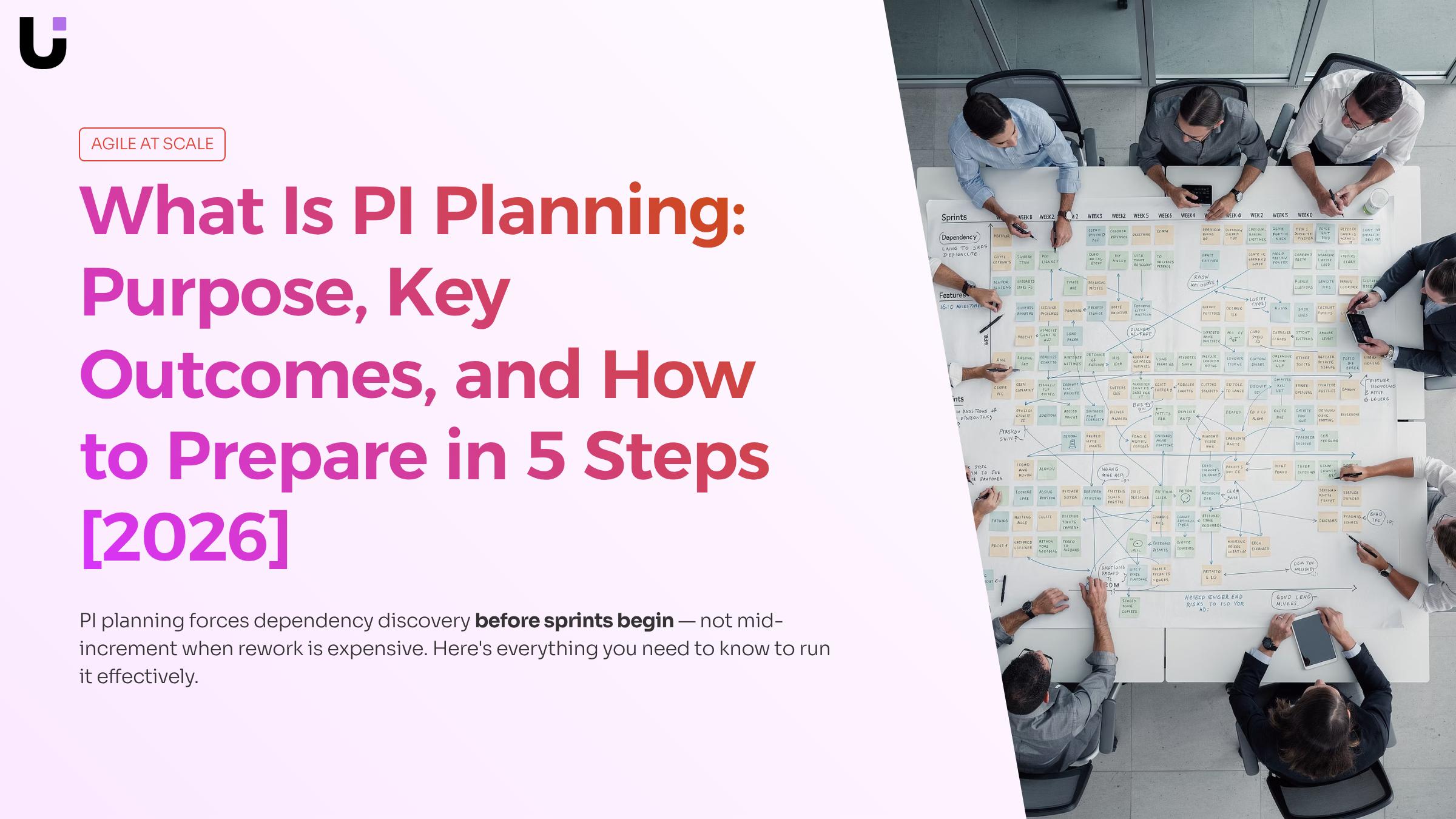
The program board makes cross-team dependencies visible in one place. Features, milestones, and handoffs are mapped across teams and iterations so anyone can see where a delay in one team's work creates a blocker downstream. Most dependency conflicts surface here before they become delivery problems.
Finally, the risk register captures every ROAM item: risks that are Resolved, Owned, Accepted, or Mitigated. Teams that skip this step tend to rediscover the same risks mid-increment, which is expensive.
Together, these PI planning outcomes give IT leads something most sprint ceremonies don't: a shared delivery commitment across every team, not just within one. That's the core PI planning benefit in agile programs running five or more teams. Adaptive planning tools that adjust as PI objectives shift make it easier to keep these artifacts current when priorities change mid-increment.
How often PI planning should happen
Most teams running SAFe follow a program increment length of 8 to 12 weeks, which means program increment planning happens four to six times per year. Scaled Agile Inc.'s SAFe 6.0 framework treats this range as the default, with 10 weeks being the most common choice for IT teams balancing delivery pace against planning overhead.
What drives the decision? Team size, dependency complexity, and how stable your product vision is. Smaller teams with tightly scoped work can compress to 8 weeks. Larger Agile Release Trains with heavy cross-team dependencies often need the full 12 to absorb coordination time.
The real risk is stretching too long. When PIs run past 12 weeks, priorities drift, capacity assumptions go stale, and the tools that support PI planning and team collaboration lose their value because the plan no longer reflects reality. How often should PI planning be done? Often enough that your teams are never more than one quarter out of sync.
How to prepare for a PI planning event in 5 steps
Preparation is where most SAFe PI planning events succeed or fail. The two-day ceremony itself is structured, but what you bring into the room determines whether the team leaves with real commitments or a wall of sticky notes that age badly.
Work through these five steps in the two to three weeks before the SAFe PI planning event.
1. Align on vision and top features
The Business Owners and Product Management need to agree on the top 10 features before anyone else sees them. If that conversation happens in the room, you lose half a day. Circulate the vision briefing at least one week out and resolve any priority conflicts in advance.
2. Refine the program backlog
Features going into PI planning should be estimated, have clear acceptance criteria, and be free of blockers that would make them impossible to plan. A feature that arrives with a vague description forces teams to guess, which produces unreliable iteration plans. Aim for the top 20 features to be genuinely ready, not just listed.
3. Run capacity planning per team
Each Agile team needs a realistic picture of available capacity across the four or five sprints in the increment. Account for holidays, known support rotations, and anyone who is partially allocated to another program. Teams that skip this step routinely over-commit in iteration 1 and spend the rest of the PI recovering. Understanding what PI planning stands for in Agile helps newer team members grasp why this number matters so much.
4. Review architectural runway
System Architects and the Engineering team should confirm that the infrastructure and technical foundations exist to support the planned features. If a feature depends on an API integration that hasn't been built yet, that dependency needs to surface before planning, not during it. This is one of the clearest PI planning benefits in agile programs at scale: forcing technical readiness into the conversation early.
5. Lock logistics and pre-read materials
For in-person events, confirm the room, AV, and wall space. For remote ones, test the collaboration tooling the day before. Distribute the vision, architecture overview, and team rosters at least 48 hours ahead. Teams that arrive having read the materials spend planning time planning, not catching up.
Once the event ends, the outputs (PI objectives, team iteration plans, the program board) need a permanent home. Tools that support PI planning and team collaboration make that handoff cleaner, especially when objectives need to stay visible across sprints. Taro's project planning workspace is built for exactly this: housing PI artifacts so nothing gets lost between the event and the first sprint review.
PI planning vs. sprint planning: what is different
Both ceremonies plan work, but they operate at completely different scales, and mixing them up leads to real coordination failures.
PI planning in Agile spans an entire program increment, typically 8 to 12 weeks, and pulls every Agile Release Train team into the same room to align on objectives, surface cross-team dependencies, and commit to a shared delivery horizon. Sprint planning, by contrast, is a single-team event that runs at the start of each two-week iteration. It takes the work already committed during PI planning and breaks it into executable tasks.
The distinction matters because the two ceremonies answer different questions:
PI planning asks : What does the whole program deliver over the next quarter, and who depends on whom?
Sprint planning asks : What does this team finish in the next two weeks?
How sprint planning works inside each iteration only makes sense once PI planning has set the boundaries. Without the PI-level commitments in place, sprint planning devolves into teams picking work in isolation, which is exactly the dependency conflict that PI planning exists to prevent.
One sets the map. The other navigates it.
Where to track PI artifacts after the event ends
PI planning outcomes only create value if they survive the event. Objectives, dependencies, and iteration plans tend to drift the moment teams return to their daily queues unless they live in a single, shared location everyone checks.
That location needs to show work at two levels: the program increment horizon (8 to 12 weeks) and the individual sprint. Most teams try to manage this across a mix of spreadsheets, slide decks, and disconnected boards, which is how program increment planning decisions get lost by week three.
Taro's project planning view handles both layers. Team-level iteration plans sit inside the same workspace as cross-team dependencies, so ownership stays visible through execution, not just during the event.
Pair it with adaptive planning tools that adjust as PI objectives shift and your PI planning outcomes actually drive delivery.
Make PI Planning Work Beyond the Two Days
PI Planning is only as useful as what happens after the room clears. When teams leave with shared objectives, iteration plans, and a clear picture of dependencies, the event has done its job. The preparation steps covered here — from readiness checks to backlog refinement to cross-team alignment — exist to make those outputs real, not ceremonial.
The gap most teams hit isn't in the planning room. It's in the weeks that follow, when PI objectives drift, risks get forgotten, and iteration plans live in a slide deck no one opens. That gap closes when execution stays visible.
Lio's project planning view gives your PI outputs a single place to live through the full increment — objectives tracked, risks flagged, and team plans updated as work moves. If you're preparing for your next PI event, explore how Lio keeps planning connected to execution.
FAQ
Q. What is the purpose of PI planning in SAFe?
A. PI Planning aligns every team on an Agile Release Train around shared objectives for the next 8 to 12 weeks. It surfaces dependencies, resolves cross-team conflicts, and produces committed program increments before work starts.
Q. How often should PI planning be done?
A. Every 8 to 12 weeks, aligned to four development sprints plus one innovation and planning sprint. Skipping or compressing it is usually where alignment breaks down first.
Q. What are the key outputs of PI planning?
A. 1.Team PI Objectives: prioritized, committed goals for the increment
2.A Program Board mapping cross-team dependencies and flagged risks
A draft iteration plan for the first sprint
Q. How do I prepare for a PI planning event?
A. Book the two-day block at least three weeks out. Product management needs a prioritized program backlog, and each team needs their capacity numbers. Without those two inputs, the event becomes a scheduling exercise.
Q. What is the difference between PI planning and sprint planning?
A. Sprint planning covers one team over two weeks. PI planning aligns multiple teams across 8 to 12 weeks. PI planning sets the destination. Sprint planning decides what each team does on each leg.
Q. How long does a PI planning event take?
A. Two days for co-located teams. Remote teams often need an extra half-day. Smaller ARTs can compress to one day; larger programs with more than eight teams may need more.


 Elena Petrova15 September 2026


