What sales velocity actually measures
Sales velocity measures how fast your pipeline converts into revenue. Specifically, it tells you how many dollars move through your sales process per day. That single number reflects four things at once: how many deals you're working, how large those deals are, how often you close them, and how long the whole process takes.
The formula is:
Sales velocity = (Number of opportunities × Average deal size × Win rate) ÷ Sales cycle length in days
Each variable on its own tells an incomplete story. A high win rate looks good until you realize your reps are closing small deals slowly. A large average deal size looks good until you see the cycle length is 180 days. Sales velocity collapses all four signals into one number, which is why it's a more honest measure of pipeline health than any single metric.
Most sales teams already track win rate and deal count. What they miss is how those numbers interact. A 10% improvement in win rate produces a different outcome than a 10% reduction in cycle length, depending on where your pipeline is weakest. Sales velocity makes that tradeoff visible.
For IT services companies, pipeline speed is especially sensitive to early-stage delays. Slow lead response inflates cycle length before a deal even enters the pipeline, dragging down velocity before a rep has had a single conversation. The 7 sales pipeline metrics every sales manager should track and a pipeline scorecard can help you pinpoint where the drag is coming from.
How to calculate your sales velocity
The formula is:
Sales velocity = (Opportunities × Average deal size × Win rate) ÷ Sales cycle length
Each variable is a number you already track. Here is how to pull them and run the calculation.
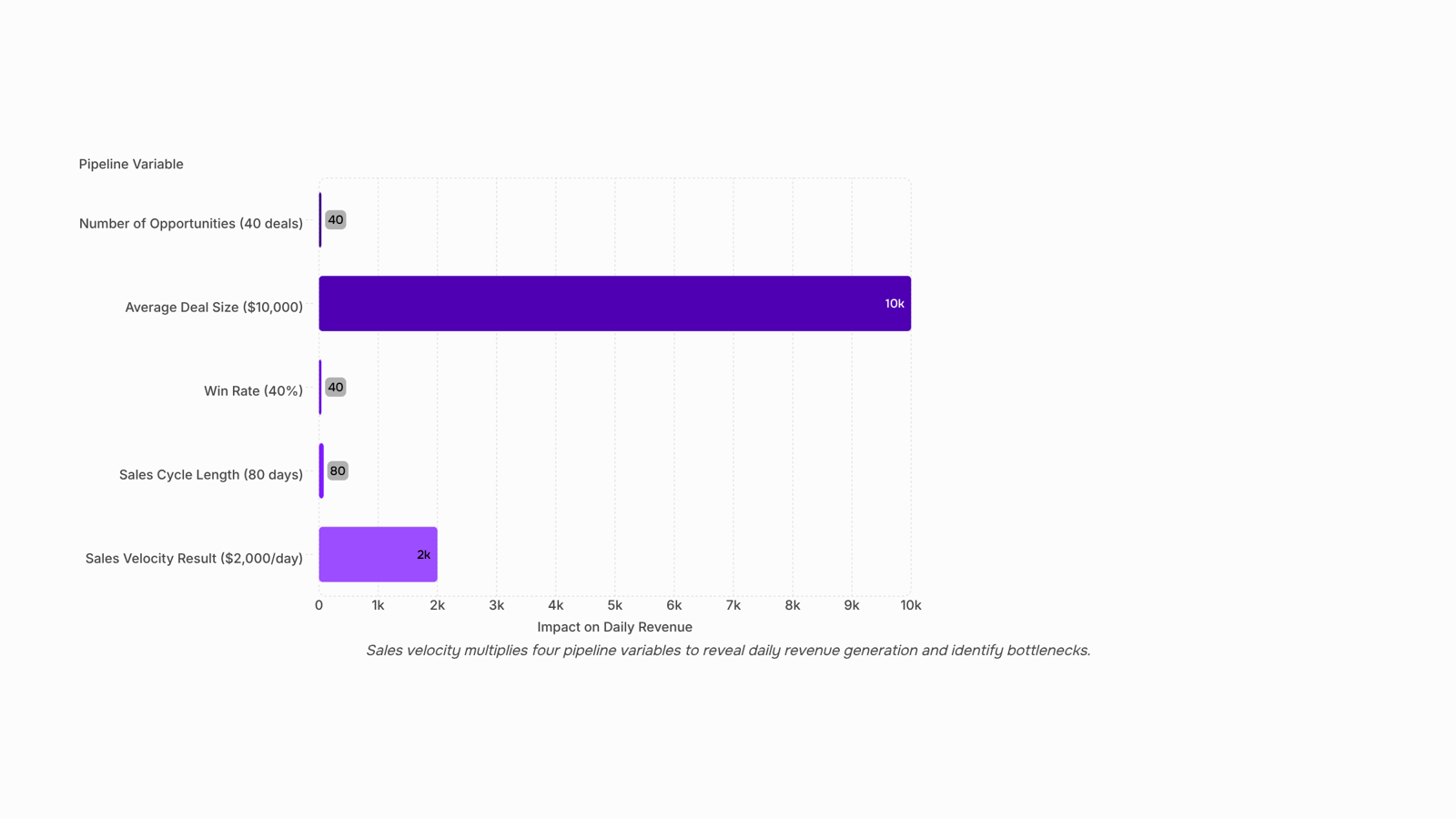
Count your active opportunities: Use only qualified pipeline — deals that have passed discovery or your equivalent qualification gate. If you have 40 opportunities in your CRM right now, that is your number.
Calculate average deal size: Add the total value of all closed-won deals over the last 90 days, then divide by the number of deals. If you closed 20 deals worth $200,000 combined, your average deal size is $10,000.
Find your win rate: Divide closed-won deals by total closed deals (won plus lost) in the same period. Twenty wins out of 50 total closed deals gives you a win rate of 0.40, or 40%.
Measure your sales cycle length in days: Average the number of days from first contact to close across your closed-won deals. A typical B2B SaaS cycle runs 60 to 90 days; if yours averages 80 days, use 80.
Now plug in the numbers:
(40 × $10,000 × 0.40) ÷ 80 = $2,000 per day
That figure tells you how much revenue your pipeline generates each day at its current pace. Run the same calculation next quarter and you have a directional signal: if the number drops, something in the four variables deteriorated. If it climbs, something improved.
One practical note: use the same time window for every variable. Mixing a 30-day win rate with a 6-month average deal size produces a number that means nothing.
If you want to see where the bottlenecks are hiding before you run this calculation, a sales funnel analysis will surface the stage where deals stall most often.
What a good sales velocity rate looks like
There is no universal number that defines a good sales velocity rate. The right benchmark depends on your segment, deal complexity, and where you are in your growth curve.
That said, a few patterns hold across B2B IT and SaaS companies. Early-stage teams with shorter cycles and smaller deals often see lower raw velocity numbers but healthier pipeline speed because they close faster. Enterprise-focused teams carry higher average deal sizes but longer cycles, which compresses velocity even when win rates look strong.
A practical starting point: if your win rate sits below 20% for qualified opportunities, that is the first variable dragging your number down. CSO Insights data consistently shows B2B technology companies averaging win rates between 20% and 30% on forecast deals. Anything below that range signals a qualification or competitive positioning problem, not a volume problem.
For sales cycle length, most B2B SaaS deals close somewhere between 30 and 90 days depending on deal size and buyer complexity. If your cycle runs longer than your segment average, your velocity will suffer even if deal size and win rate are solid.
The most useful way to interpret your result is to track it over time, not against an industry table. A rising velocity number, even a modest one, means your sales pipeline speed is improving. A flat or falling number is the signal to run a structured pipeline review before diagnosing which variable to fix first.
Four factors that drag your sales velocity down
Each of the four formula variables can stall your sales velocity rate, but they fail in predictable ways for IT sales teams.
Number of opportunities drops when top-of-funnel activity looks healthy but qualification is weak. Reps log every inbound lead as an opportunity, which inflates the count and buries the real pipeline. The fix is tighter entry criteria, not more leads.
Average deal size shrinks when proposals default to the smallest scope a prospect will approve. IT services teams often underprice to reduce friction, particularly on net-new accounts. Over time, that pattern pulls the average down across the whole pipeline.
Win rate is where most teams look first, but it is rarely the root problem. A low win rate is usually a symptom of poor fit at entry, not a failure at close. If you are losing deals late, check what got into the pipeline early.
Sales cycle length is the factor most directly connected to lead response time, and it is the one IT sales teams underestimate most. Research from Lead Connect and similar B2B response studies consistently shows that responding to an inbound inquiry within the first hour produces significantly higher qualification rates than responding the same day. For IT companies selling complex services, a slow first response signals disorganization to a buyer who is already evaluating three other vendors. That perception extends every subsequent stage.
Of the four, sales cycle length is the highest-leverage fix for most IT teams. Shortening it by even 15 to 20 percent produces a proportional lift in velocity without touching deal size or win rate. Start there before adjusting your pricing or reworking your qualification criteria.
For a broader view of which numbers actually predict revenue outcomes, the most important sales productivity metrics to track covers the full diagnostic stack alongside sales cycle length.
How to use sales velocity to predict future revenue
Multiply your current sales velocity rate by the number of weeks or months in your planning horizon and you get a forward revenue estimate. A team closing $40,000 in pipeline value per week projects roughly $480,000 over the next quarter. That math is simple. The assumptions underneath it are not.
The sales velocity formula holds only if your inputs stay stable. If your win rate drops mid-quarter because a competitor cuts pricing, or your average deal size shifts because you moved upmarket, the projection drifts. Treat the output as a directional signal, not a hard commitment.
Two assumptions deserve particular scrutiny when you use this to predict future sales:
Pipeline volume is consistent: If your team stops prospecting in month two, the number of opportunities feeding the formula shrinks and the estimate breaks.
Sales pipeline speed stays constant: Seasonal slowdowns, procurement freezes, or a spike in lead response time can all stretch your average cycle length without warning.
The most useful application is scenario modeling. Run three versions: one with current inputs, one with a 10% win rate improvement, one with a 15% shorter cycle. The gap between scenarios tells you where to focus.
For a broader view of which metrics to track alongside velocity, 7 pipeline metrics every sales manager should know is a practical companion read.
Four steps to improve your sales velocity this quarter
Each variable in the sales velocity formula pulls in a different direction. The fastest gains usually come from fixing the right one first.
Qualify harder at the top of the funnel: More opportunities only help if they're real. Unqualified leads inflate your pipeline, drag down your win rate, and stretch your sales cycle length without adding revenue. Score leads against a tight ICP before they enter the pipeline. For IT services companies, that typically means filtering by company size, tech stack fit, and budget authority before the first call.
Find one lever to increase average deal size: This doesn't require new products. Review your last 20 closed-won deals and look for a pattern: which add-ons or tiers came up late and got accepted? Propose them earlier. A 15% increase in average contract value produces the same velocity lift as a 15% increase in win rate, with no change to headcount.
Fix lead response time before you touch close tactics: Most sales teams focus on late-stage objections while ignoring the gap at the top. Research consistently shows that B2B leads contacted within five minutes of inquiry are significantly more likely to convert than those reached an hour later. For IT buyers who are often evaluating multiple vendors simultaneously, a slow first response can decide the deal before a demo ever happens. Faster response compresses your sales cycle length and improves win rate at the same time.
Audit where deals stall, not just where they close: Most cycle-length problems live in one or two stages, not spread evenly across the pipeline. Pull your average time-in-stage data and find the bottleneck. A pipeline scorecard helps you spot whether the delay is a process gap, a rep behavior, or a handoff problem between sales and technical pre-sales.
Work through these in order. Opportunity quality sets the ceiling. Everything else is optimization within it.
Closing
Sales velocity isn't just a number to track—it's a diagnostic tool that reveals exactly where your pipeline is leaking time and money. The formula itself is simple, but what matters is what happens after you calculate it: identifying which of the four variables is actually holding you back, then fixing the highest-leverage one first. For most IT sales teams, that's cycle length, and the fastest way to compress it is eliminating the gap between lead arrival and first contact. Lio's lead management system cuts that delay by automating lead routing and triggering immediate outreach, which directly shortens your cycle and lifts velocity without touching deal size or win rate. Ready to see how much velocity you're leaving on the table? Start a free trial and run your first calculation with real pipeline data.
FAQ
Q. What is a good sales velocity rate?
A. There's no universal benchmark—it depends on your segment and deal complexity. The better approach: track your velocity over time. A rising number means your pipeline is accelerating; flat or falling signals a problem in one of the four variables.Q. How do I calculate sales velocity?
A. Use this formula: (Number of opportunities × Average deal size × Win rate) ÷ Sales cycle length in days. Pull qualified pipeline count, average your last 90 days of closed deal value, calculate win rate from the same period, and measure average days to close.Q. What factors affect sales velocity?
A. Four variables: opportunity count, average deal size, win rate, and sales cycle length. Each one can drag velocity down independently. Cycle length is the highest-leverage fix for most IT teams—shortening it 15–20% produces proportional velocity gains without changing pricing or qualification.Q. Can sales velocity be used to predict future sales?
A. Yes. Multiply your current velocity rate by weeks or months in your planning horizon for a forward revenue estimate. A team closing $40,000 per week projects ~$480,000 over a quarter, assuming pipeline composition stays constant.Q. What is the difference between sales velocity and sales cycle length?
A. Sales cycle length is one input into the velocity formula—it measures days from first contact to close. Sales velocity is the full picture: it combines cycle length with deal count, size, and win rate to show how many dollars move through your pipeline per day.Q. How often should I measure sales velocity?
A. Measure quarterly to spot meaningful trends without noise. Use consistent time windows for all four variables—mixing a 30-day win rate with 6-month deal size produces meaningless numbers. Track it over time to identify which variable shifted.


 Elena Petrova15 September 2026


