Stand-Up Meeting: What It Is and How to Run One in 6 Steps [2026]
TL;DR: Most stand-up guides stop at the three questions and call it done. This one covers the exact mechanics IT team leads need to surface blockers before they stall a sprint — including how to adapt the format for remote and async-first teams without losing accountability. You'll finish with a repeatable 6-step process you can run starting tomorrow.
What a stand-up meeting actually is
A stand-up meeting is a short, time-boxed team check-in, typically 15 minutes, where each person shares what they completed, what they're working on next, and what's blocking them. The format comes directly from Scrum, where it's called the Daily Scrum, and it's built on Scrum's core principle of daily inspection and adaptation.
The standing posture is intentional. Physical discomfort keeps the meeting short. Once teams moved to remote work, the posture became optional, but the time constraint stayed non-negotiable.
What separates a daily stand-up meeting from a status meeting is its direction. Status meetings report upward. Stand-ups coordinate laterally, so the team, not a manager, surfaces problems and adjusts.
The three questions give the meeting its structure, but they're a means to an end. The real output is a team that knows, every single day, whether the sprint is on track. That visibility connects directly to the sprint planning meeting that sets the work your standup tracks each day, and it's what makes stand-up meetings worth protecting.
Why the daily stand-up matters in Scrum
The daily stand-up meeting earns its place in Scrum because it serves three functions that no other ceremony covers at the same frequency: sprint visibility, blocker detection, and team alignment.
Sprint visibility means every team member knows the current state of the board before they write a line of code or open a design file. Without a daily check-in, individual contributors work from yesterday's mental model of the sprint, which drifts further from reality as the week progresses. The sprint planning meeting that sets the work your standup tracks each day creates the plan; the stand-up keeps everyone honest about whether that plan still holds.
Blocker detection is where the format pays off most. A blocker surfaced on Monday morning is a scheduling problem. The same blocker surfaced on Thursday afternoon is a sprint failure. The daily stand up meeting is the only ritual that creates a daily forcing function for surfacing those issues before they compound.
Team alignment is subtler but just as important. When each person states what they finished and what comes next, dependencies become visible in real time. That visibility is the practical expression of Scrum's core principle of daily inspection and adaptation.
If your team finds the live format hard to sustain, it's worth evaluating [whether an async standup format fits your team better than a live one](https://worksbuddy.ai/blogs/async-vs-status-meetings-what-1000
How to run a stand-up meeting in 6 steps
Six steps you can follow starting tomorrow.
Step 1: Schedule it at the same time every day
Pick a time that fits your team's actual work rhythm, not the calendar default. Most teams run their stand-up at the start of the day before deep work begins. Fix the time, fix the location (or video link), and protect it. Consistency is what turns a meeting into a habit.
Step 2: Decide who belongs in the room
The stand-up is for the people doing the sprint work. Stakeholders, managers, and observers can attend, but they don't speak during the round. Keeping the participant list tight is what keeps the stand up meeting format from drifting into a status report for leadership.
Step 3: Open with the sprint board, not a blank agenda
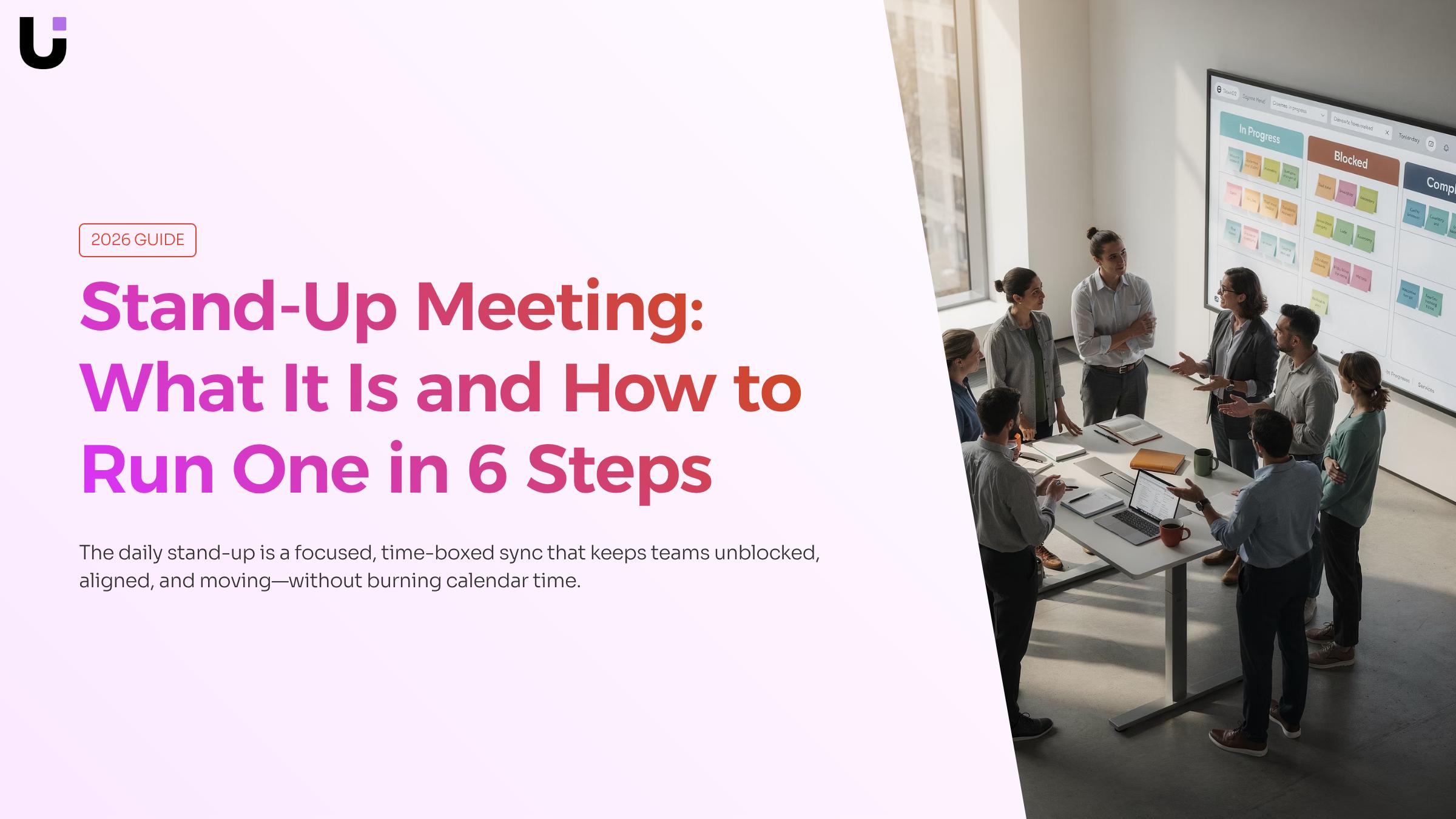
Before anyone speaks, pull up the shared task board so the team is looking at real work state, not recalling it from memory. A tool like Taro surfaces which tasks moved, which are blocked, and what's overdue, so the conversation stays grounded in facts. This is the part most teams skip, and it's why stand-ups lose credibility over time.
Step 4: Run the three questions in order
Each person answers three things:
- What did I complete since the last stand-up?
- What will I complete before the next one?
- What is blocking me?
That structure is the core of the daily stand up meeting agenda and it exists for a reason. Question one confirms progress. Question two commits to a next action. Question three surfaces problems early, which matters because a blocker left unaddressed for more than a day rarely resolves itself.
Keep each person's turn to 60 to 90 seconds. If someone is going long, the facilitator redirects, not the team.
Step 5: Triage blockers immediately after the round
When a blocker comes up, note it. Don't solve it during the stand-up. Once everyone has spoken, spend 60 seconds assigning each blocker to a specific owner who will resolve it before the next meeting. This is the step most guides omit, and it's where Scrum's core principle of daily inspection and adaptation actually gets applied. Blockers without owners become sprint failures.
Step 6: Close at 15 minutes, no exceptions
The Scrum Guide (2020) sets the daily Scrum at 15 minutes for a reason. A meeting that regularly runs over signals one of two problems: too many participants, or topics that belong in a separate working session. End at the time-box. Move longer conversations to a follow-up with only the people who need to be there.
If your team is distributed and a live 15-minute call is hard to coordinate, it's worth evaluating whether an async stand-up format fits your team better than a live one before defaulting to a recurring meeting no one attends fully.
The sprint retrospective is where recurring blockers from your stand-ups get resolved for good. Use that meeting to fix the pattern, not the stand-up itself.
A stand-up meeting agenda and template you can use today
Copy this agenda into your next meeting invite and adjust the time blocks to fit your team.
Live stand-up (15 minutes)
- Yesterday's progress (4 min) — each person answers: what did I complete?
- Today's plan (4 min) — what will I finish by end of day?
- Blockers (4 min) — what is stopping me? Flag it; don't solve it here.
- Wrap and assign follow-ups (3 min) — owner takes each blocker offline.
This structure reflects Scrum's core principle of daily inspection and adaptation, not just a status report ritual.
Remote or async stand-up template
If your team spans time zones, a written format works just as well. Each person posts three lines in Slack or your project channel before 10 a.m.:
- Done: [task name]
- Today: [task name]
- Blocked by: [person or dependency, or "nothing"]
Before you settle on live versus async, check whether an async standup format fits your team better than a live one.
Nursing stand-up meeting template note
Clinical teams often add a fourth line: patient safety flag or handoff note. Same three-question spine, one domain-specific addition.
Your daily stand-up meeting template only works if the work it tracks is already defined. That definition comes from the [sprint planning meeting that sets the work your standup tracks each day](https://worksbuddy.ai/blogs/what-
How to keep stand-up meetings short and on track
Three facilitation moves do most of the work.
Start a visible timer. The Scrum Guide's 15-minute time-box exists for a reason. Put a countdown on screen or on the wall. When people see time running, they self-edit. Without it, the meeting expands to fill whatever space you give it.
Cut problem-solving in the room. The daily stand up meeting is a coordination check, not a working session. The moment someone starts debugging a bug or negotiating scope, use one phrase: "Let's take that offline." Name two people who need to stay, let everyone else leave. This single rule prevents most overruns.
Apply the one-day blocker rule. If a blocker hasn't moved in 24 hours, it belongs in a dedicated conversation, not another stand-up. Blockers that sit longer than a day tend to compound. A sprint retrospective is where recurring ones get resolved permanently, but the standup is where you flag them fast and hand them off faster.
Keep the format tight and stand up meetings stay useful. Let any one of these slip and the 15 minutes quietly becomes 30.
Running stand-up meetings with remote and distributed teams
Remote stand-ups introduce one real decision: synchronous or async. Getting that wrong costs more than the meeting itself.
Synchronous works when your team overlaps by at least three to four hours, blockers are interdependent, and the stand up meeting format depends on real-time problem-solving. A live video call keeps Scrum's core principle of daily inspection and adaptation intact and lets you read whether someone's "fine" actually means fine.
Async works when time zones are spread across more than six hours, or when interrupting deep work for a 15-minute call produces more drag than value. Teams post updates in a shared channel — what they completed, what's next, what's blocked — on their own schedule. To decide whether an async standup format fits your team better than a live one, check one thing: are blockers getting resolved within the same day, or sitting unread until someone notices?
A few conditions that tip the decision:
- Overlap under three hours: default to async
- Active sprint with shared dependencies: default to sync
- Mixed zones: run sync for the overlap window only, async for everyone outside it
What are stand up meetings worth remotely? Exactly as much as the format you choose for the team you actually have.
Common stand-up mistakes and how to fix them
Four failure modes show up repeatedly in daily stand-up meetings, and each one is fixable once you name it.
Status report drift happens when updates shift from blockers and coordination to progress summaries for the manager. Redirect with the three standup questions every time.
Blocker avoidance is quieter but more damaging. When blockers go unaddressed past one day, they compound fast. Make it safe to surface them by separating the blocker from the person raising it.
Unequal talk time lets two people consume the whole 15-minute window. A strict round-robin fixes this without awkwardness.
Skipping blocked days breaks the Scrum's core principle of daily inspection and adaptation. Short stand-up meeting format or async works fine; no meeting at all does not.
Closing
The stand-up meeting only works when it surfaces blockers before they stall your sprint—and that only happens if your team is looking at real work state, not recalling it from memory. The six-step process above gives you the structure, but the tool matters. When your sprint board is already visible before anyone speaks, each person answers the three questions in under a minute, blockers get assigned to owners on the spot, and you're done in 15 minutes with actual clarity on whether the sprint is on track.
Start a free sprint in Taro and run your next stand-up off the board. You'll see immediately how much faster the conversation moves when everyone is looking at the same facts.
FAQ
What is the purpose of a daily stand-up meeting in Scrum?
The daily stand-up serves three functions: sprint visibility so everyone knows current work state, blocker detection to catch problems before they compound, and team alignment so dependencies become visible in real time.
How do I conduct an effective stand-up meeting?
Open with your sprint board so the team sees real work state. Run the three questions in order for each person (60–90 seconds each), triage blockers immediately after, and assign each one to a specific owner. Close at 15 minutes.
What are the benefits of having a daily stand-up meeting?
Daily stand-ups keep everyone aligned on sprint progress, surface blockers early so they don't become sprint failures, and create a forcing function for the team to inspect and adapt work daily.
How can I keep my stand-up meetings concise and on track?
Fix the time and location, keep the participant list tight to sprint workers only, open with the board (not blank agendas), and enforce the 15-minute time-box. If someone goes long, the facilitator redirects.
Can stand-up meetings be done virtually for remote teams?
Yes. Remote stand-ups work live over video at a fixed time, or async via written posts in Slack before a set time. Both formats work if the team can see shared work state and blockers get assigned to owners.
How long should a stand-up meeting be?
Exactly 15 minutes, no exceptions. The Scrum Guide sets this time-box for a reason. Meetings that run over signal too many participants or topics that belong in a separate working session.
What are the three questions asked in a Scrum stand-up?
What did I complete since the last stand-up? What will I complete before the next one? What is blocking me? These three questions confirm progress, commit to next actions, and surface problems early.


 Elena Petrova15 September 2026


