What account retention actually means
Account retention is your company's ability to keep existing accounts active, engaged, and generating revenue over time. It's related to customer retention but not identical. Customer retention counts individual contacts or end users; account retention tracks the business relationships, the contracts, the named organizations paying you every month or year.
The account retention rate measures what percentage of those accounts you still hold at the end of a given period, net of cancellations and non-renewals. Renewal rate is narrower still: it only counts accounts that reached a contract end date and chose to continue. An account can renew and still churn six months later. These distinctions matter because conflating them produces misleading numbers.
The more important distinction is between reactive and proactive retention. Reactive retention kicks in when a client signals they're leaving. Proactive retention is the system you run before that signal ever arrives: scheduling follow-ups based on last touch and deal stage, maintaining a full relationship history for every account, and balancing new pipeline with protecting existing accounts.
Most IT firms only have the reactive version. The rest of this article is about building the proactive one.
Why retention beats acquisition on ROI
Acquiring a new B2B client costs up to 7x more than keeping an existing one. That gap is even wider in IT services, where onboarding, scoping, and trust-building all carry real time costs before a new account generates margin.
The math compounds quickly. A 5% increase in retention rates can lift profits by up to 95% — not because retained clients spend more overnight, but because their revenue is predictable, their support costs drop over time, and they refer others without a sales cycle attached.
Account retention vs customer acquisition is often framed as a budget debate. It shouldn't be. Retention is a structural advantage: existing accounts already trust your delivery model, require less hand-holding, and expand more readily when you solve new problems for them.
The failure most IT firms make is treating retention as a reactive function — something the account manager handles after a client signals dissatisfaction. By then, the relationship has already eroded. Customer retention strategies that work are built on consistent, proactive touchpoints: scheduling follow-ups based on last touch and deal stage and maintaining a full relationship history for every account so nothing falls through between handoffs.
Retention is where margin lives. Acquisition is where it gets spent.
The most common reasons IT companies lose accounts
Most IT companies don't lose accounts because they delivered bad work. They lose them because the client stopped feeling like a priority.
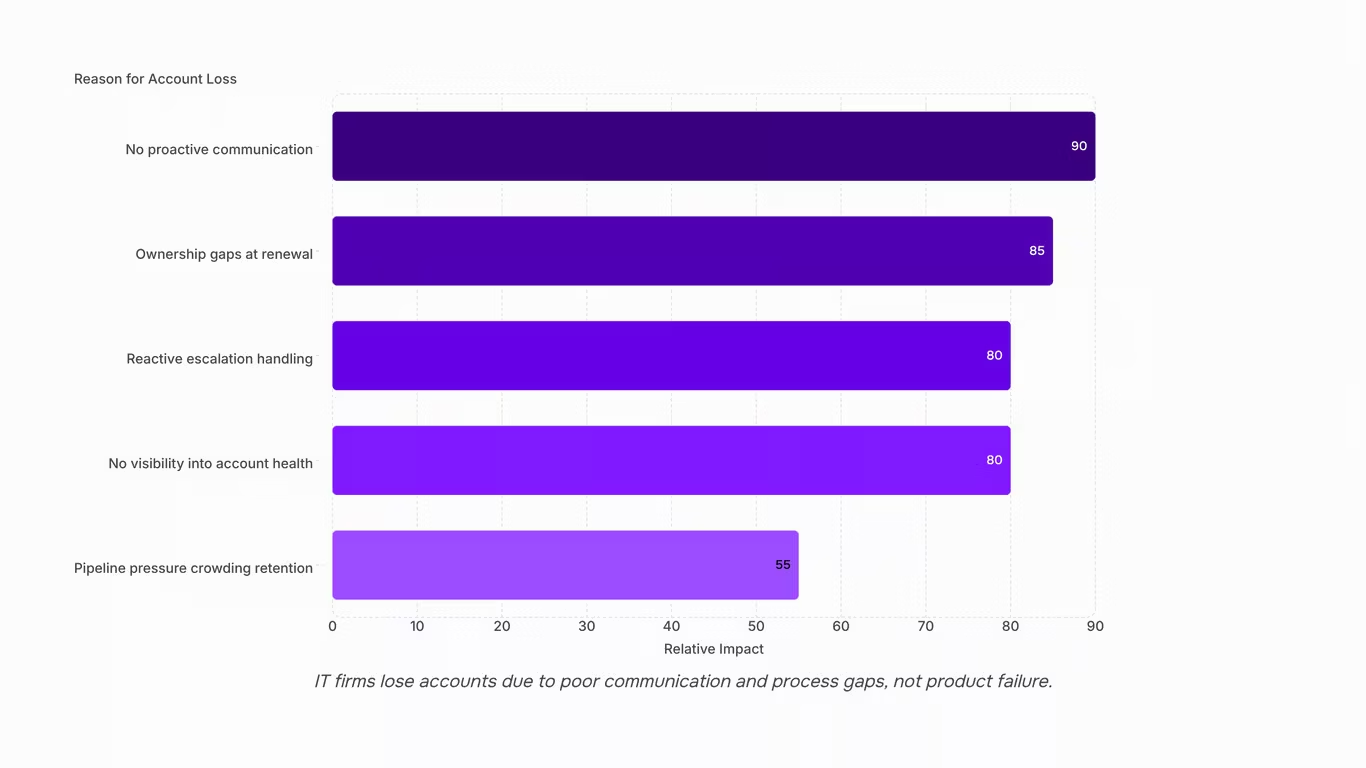
The failure usually shows up in one of four places:
- No proactive communication : The team delivers, invoices, and goes quiet. The client interprets silence as indifference. By the time they raise a concern, they've already started evaluating alternatives. Research from tabs.com confirms that long wait times and a general lack of empathy erode client trust faster than product failures do.
- Ownership gaps at renewal time : Nobody owns the relationship between project close and renewal. Account managers assume the delivery team is staying in touch. The delivery team assumes the account manager is. The client hears from nobody.
- Reactive escalation handling : Issues get resolved, but only after the client escalates. That pattern trains clients to distrust the relationship. Reduce account churn by catching problems before they become tickets, not after.
- No visibility into account health : Teams that lack a system for maintaining a full relationship history for every account miss the signals: a slowing response rate, a skipped QBR, a new stakeholder who never got properly introduced.
- Pipeline pressure crowding out retention : When sales targets dominate attention, existing accounts get deprioritized. Balancing new pipeline with protecting existing accounts is a structural problem, not a motivation problem.
These aren't random failures. They're predictable gaps in account loss prevention that show up when retention has no owner and no process.
How to measure your account retention rate
The formula is straightforward. Take your accounts at the end of a period, subtract any new accounts added during that period, divide by the accounts you started with, then multiply by 100:
Account retention rate = ((End accounts – New accounts) / Start accounts) × 100
If you started the quarter with 80 accounts, added 10 new ones, and finished with 82, your retention rate is 82.5%. That math comes from the standard retention rate formula used across B2B service businesses.
For IT service firms and managed service providers, a healthy account retention rate typically sits above 85% annually. Below 80% signals a structural problem, not a run of bad luck.
Once you have the number, use it to triage. Sort accounts by last meaningful interaction, contract renewal date, and open support tickets. Accounts with no contact in 60-plus days and a renewal inside 90 days are your highest-risk tier. Automated tools can help here by scheduling follow-ups based on last touch and deal stage so nothing slips through.
Run this calculation monthly, not just at year-end. A quarterly snapshot hides the month where account loss actually started.
7 strategies to improve account retention
Most account churn in IT service firms is preventable. Research consistently points to poor follow-up and weak communication as the primary drivers, not product failure or pricing. The seven steps below move from early detection through relationship deepening, in roughly the order you should work them.
1. Set up churn signal monitoring before accounts go quiet
Define three or four behavioral signals that precede cancellation in your accounts: declining support ticket volume, missed QBRs, slower invoice payment, or a change in the main contact. Track these weekly, not monthly. A 50-seat MSP that monitors these signals catches at-risk accounts 30 to 60 days earlier than one that waits for a renewal conversation.
2. Tier your accounts by revenue and relationship health
Not every account deserves the same response time. Segment by annual contract value and engagement score, then assign clear ownership. Your top 20% of accounts by revenue should have a named contact who checks in proactively, not reactively.
3. Automate follow-up cadences based on account activity
Manual follow-up falls through the gaps when a team is managing 40-plus accounts. Scheduling follow-ups based on last touch and deal stage removes the guesswork and keeps every account on a consistent contact rhythm without relying on memory.
4. Build a full relationship history for every account
When the account manager changes, or when a client asks "what did we agree on last quarter," the answer should take seconds, not a search through email threads. Maintaining a full relationship history for every account means any team member can pick up context immediately and the client never feels like they're starting over.
5. Run structured quarterly business reviews
A QBR is the single highest-leverage touchpoint for account retention. Prepare a one-page summary of outcomes delivered, upcoming priorities, and any open risks. Clients who see measurable progress renew; clients who feel invisible churn.
6. Act on feedback within two weeks
Collect a short satisfaction check-in at 90 days and at each renewal cycle. The feedback itself matters less than what you do with it. If a client flags a communication gap and nothing changes in two weeks, the signal you send is that the feedback was performative.
7. Balance new pipeline work with protecting existing accounts
Account loss prevention requires dedicated attention, not leftover bandwidth. Balancing new pipeline with protecting existing accounts is a resource allocation decision, and most IT firms underinvest in the retention side until a key account is already walking out. Set a weekly time block for account health reviews the same way you block time for prospecting.
These seven customer retention strategies work together. Signals feed your tiering, tiering drives your follow-up cadence, and the QBR closes the loop by turning relationship history into a visible record of value delivered.
Account retention vs. customer acquisition: how to balance both
Most IT companies default to acquisition spend because new logos feel like growth. Retention is quieter, but the economics favor it heavily. Acquiring a new B2B customer typically costs five to seven times more than keeping an existing one, and existing accounts convert upsells at a far higher rate than cold prospects do.
The table below maps the practical difference:
| Dimension |
Acquisition |
Retention |
| Cost |
High (outbound, sales cycles, demos) |
Low (QBRs, check-ins, proactive support) |
| Timeline to revenue |
3–9 months |
Days to weeks |
| Effort |
New relationship from scratch |
Existing trust and context |
| Revenue impact |
One-time contract value |
Compounding via renewals and expansion |
The right balance depends on your account retention rate. If churn is above 10% annually, retention deserves more budget than most teams give it. If your pipeline is thin, acquisition takes priority, but not at the cost of neglecting active accounts.
Balancing new pipeline with protecting existing accounts requires visibility into both simultaneously, not a choice between them.
One mistake that quietly kills retention
Most IT service firms treat a signed contract as the finish line. It isn't. The account is only as secure as the last meaningful conversation you had with that person.
The operational failure is predictable: after onboarding, follow-up becomes reactive. You respond to problems instead of preventing them. By the time a client signals dissatisfaction, the decision to leave is often already made.
The fix is a scheduled-touch cadence tied to account stage, not just deal activity. Scheduling follow-ups based on last touch and deal stage keeps relationships warm before they cool. Pair that with maintaining a full relationship history for every account so every touchpoint builds context, not just contact. That combination is your core account loss prevention habit.
Closing
The seven strategies in this article only work if your team has the visibility to spot at-risk accounts and the timing to act before they leave. That means automating follow-up schedules, maintaining a complete relationship history across every touchpoint, and surfacing churn signals before renewal conversations happen. Without a system that handles the operational side of retention — the scheduling, the tracking, the reminders — even the best retention strategy becomes another thing your team forgets to do. Lio connects your account data, automates follow-up cadences, and surfaces relationship health in real time, so proactive retention becomes your default, not your exception. Ready to move from reactive to proactive? Explore how Lio's features enable the retention workflows that actually stick.
FAQ
Q. What strategies can I use to improve account retention?
A. Monitor churn signals weekly, tier accounts by revenue and health, automate follow-up cadences, maintain relationship history across handoffs, schedule QBRs before renewal, and balance new pipeline with protecting existing accounts. These seven steps move from early detection through relationship deepening.
Q. How can I reduce account churn rates?
A. Eliminate ownership gaps at renewal, catch problems before escalation, maintain proactive communication between projects, and track account health signals like declining ticket volume or missed QBRs. Most churn is preventable—it comes from poor follow-up and weak communication, not product failure.
Q. What are the most common reasons for account loss?
A. No proactive communication, ownership gaps at renewal, reactive escalation handling, no visibility into account health, and pipeline pressure crowding out retention. Clients stop feeling like a priority long before they cancel.
Q. How can I measure account retention rates?
A. Use this formula: ((End accounts – New accounts) / Start accounts) × 100. For a quarter starting with 80 accounts, adding 10, and ending with 82, retention is 82.5%. Run this monthly, not just annually, to catch churn early.
Q. What is the difference between account retention and customer acquisition?
A. Account retention tracks business relationships and named organizations paying you; customer acquisition counts new individual contacts or end users. Acquiring a new B2B client costs up to 7x more than keeping an existing one.
Q. What is a good account retention rate for an IT service company?
A. A healthy account retention rate for IT service firms typically sits above 85% annually. Below 80% signals a structural problem, not random bad luck.
Q. How often should I check in with existing accounts to prevent churn?
A. Automate follow-ups based on last touch and deal stage so nothing falls through gaps. Accounts with no contact in 60+ days and renewal inside 90 days are highest-risk. Your top 20% by revenue should have a named contact checking in proactively.


 Elena Petrova15 September 2026


