TL;DR: Most B2B SaaS lead generation guides list every channel and leave you to guess which ones fit your business. This one ranks the channels that actually drive pipeline in 2026, shows you how to pick the right three for your stage, and covers where AI changes the game before your competitors figure it out.
Why generic lead gen advice fails for B2B SaaS
B2B SaaS lead generation is the process of identifying companies that fit your ideal customer profile, attracting them through specific channels, and moving them toward a sales conversation or trial. The subscription model raises the stakes: a lead that goes cold costs you the initial deal plus every renewal attached to it.
Most lead gen advice fails SaaS teams because it treats every business as identical. A $500/month SMB product and a $50,000 enterprise contract need completely different channel strategies. Lumping them together produces guidance that fits neither.
The right channel depends on three variables: your average contract value (ACV), your sales motion (self-serve vs. sales-assisted), and where your buyers actually spend time. Getting this wrong means paying twice: once in ad spend, again in the sales hours spent disqualifying leads that were never going to close.
Channel selection also shapes what happens after a lead arrives. A webinar lead needs different follow-up than a paid ad lead. Getting that routing wrong is where most pipeline quietly disappears.
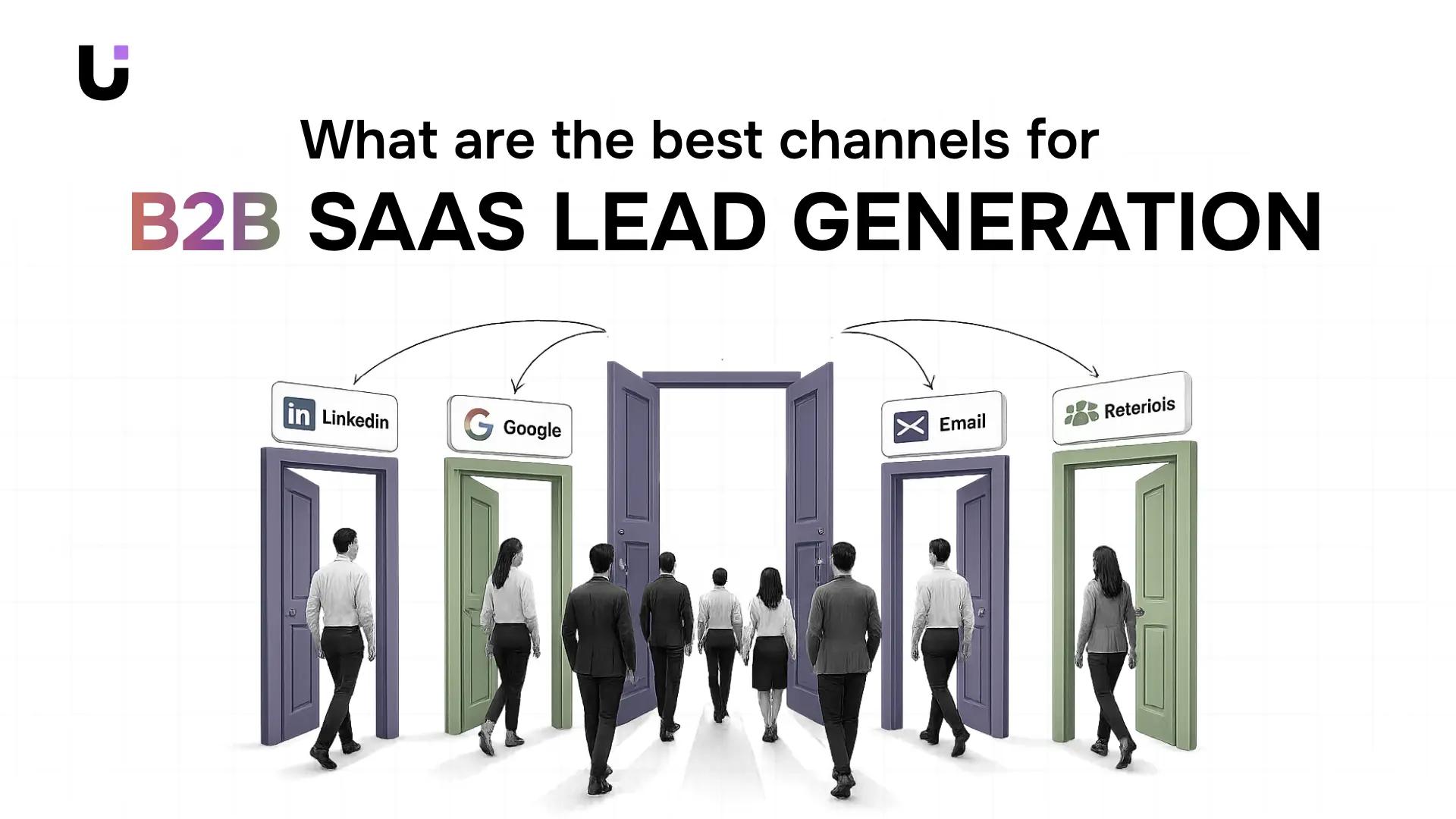
The 7 channels that actually drive B2B SaaS pipeline in 2026
Not all seven channels perform equally for every SaaS business. The right one depends on your ACV, how your buyers research solutions, and how much pipeline you need in the next 30 days versus the next 12 months.
Here is how each channel stacks up across cost, speed to lead, deal-size fit, and scalability.
1. SEO and content marketing
The highest-volume, lowest-cost-per-lead channel over time, but it takes 6 to 12 months to produce meaningful pipeline. Best for teams with ACV under $15K where buyers self-educate before talking to sales. You are compounding, not sprinting, so this channel rewards patience and punishes teams that need pipeline this quarter.
The content that converts in 2026 is not broad thought leadership. It is bottom-of-funnel: comparison pages, use-case breakdowns, integration guides, and problem-specific tutorials that buyers search when they are close to a decision. These are core lead generation strategies for SaaS businesses that want predictable inbound volume without paying per click indefinitely.
2. LinkedIn outbound
The most direct path to a named decision-maker in a specific company size and role. Works best for ACV above $10K where a 30-minute discovery call is worth the rep's time. Cost per qualified lead is high (often $150 to $300+), but fit tends to be better than paid channels because you are targeting by job title and company type, not keyword intent.
Enriching profiles before outreach cuts wasted touches significantly. Pulling firmographic data from a LinkedIn URL before the first message is now table stakes for teams running this at volume. A sequence sent to a well-researched list of 50 contacts outperforms a generic blast to 500.
3. LinkedIn Ads
Faster than organic LinkedIn but expensive. Sponsored content and Lead Gen Forms work for mid-market deals where you need awareness at scale. Expect CPCs of $8 to $15 for competitive SaaS categories. Conversion rates from ad click to qualified meeting are low without a strong offer: a free audit, a benchmark report, or a live demo with a specific hook.
The mistake most teams make here is running brand-awareness creative to a cold audience and expecting pipeline. LinkedIn Ads work when the offer is specific, the audience is tight, and the follow-up is fast.
4. Google Ads (paid search)
High intent, fast results, expensive at scale. Buyers searching "B2B SaaS [category] software" are often close to a decision, which makes this channel strong for deals with a short sales cycle. Budget $50 to $150 per click in competitive categories.
Paid search works poorly for new categories where buyers do not yet know what to search for. If you are creating a market rather than capturing existing demand, this channel will burn budget without producing pipeline. It is best used as a demand-capture tool, not a demand-creation one.
5. Cold email outbound
Low cost, fully controllable, and the fastest channel to spin up. A sequence can be live in a day. Deliverability and reply rates have dropped as inboxes get noisier, but a tightly targeted list with a relevant offer still converts.
The failure mode is volume over precision: 500 generic emails to a bad list produce nothing. The speed-to-lead advantage also disappears if your routing is slow. Responding within five minutes of a reply doubles qualification rates in most outbound motions. A fast sequence paired with slow follow-up is a wasted investment.
6. Partner and integration ecosystems
Underused by early-stage teams, but one of the highest-quality lead sources for SaaS products that sit inside a larger workflow. A listing in a marketplace (HubSpot App Marketplace, Salesforce AppExchange) or a co-marketing agreement with a complementary tool produces warm leads with established context.
These leads convert at higher rates because they arrive with intent already formed. The trade-off is time: partner channels are slow to build and hard to replicate. Teams that invest early see compounding returns; teams that wait find the best partner slots already taken.
7. Webinars and virtual events
Best for complex, high-ACV deals where education is part of the sales motion. Attendance converts to pipeline at a higher rate than most paid channels when the topic is specific. Generic "state of the industry" webinars underperform. A narrow, problem-specific session for a defined ICP outperforms.
Lead scoring by engagement depth separates genuine interest from passive registration. Someone who attended live and asked a question is not the same signal as someone who downloaded the replay three weeks later. Treating them the same wastes rep time on the wrong contacts.
The table below summarizes where each channel sits across the four dimensions that matter most for B2B SaaS pipeline in 2026.
| Channel |
Relative cost |
Speed to first lead |
Best ACV fit |
Scalability |
| SEO / content |
Low |
Slow (6-12 mo.) |
Under $15K |
High over time |
| LinkedIn outbound |
Medium |
Medium (2-4 wks.) |
$10K and above |
Medium |
| LinkedIn Ads |
High |
Fast (days) |
$15K-$75K |
High with budget |
| Google Ads |
High |
Fast (days) |
Under $30K |
Medium |
| Cold email |
Low |
Fast (1-7 days) |
$5K-$50K |
High |
| Partner / ecosystem |
Low |
Slow (3-6 mo.) |
Any |
Medium |
| Webinars / events |
Medium |
Medium (weeks) |
$20K and above |
Low |
How to pick the right 3 channels for your stage
Channel selection comes down to three questions. Answer them honestly and the right channels become clear.
1. What is your average deal size?
Deals under $10K ACV close on self-serve momentum, so content SEO and paid search do the heavy lifting. Deals above $50K ACV require relationship-building before a prospect will engage, which means LinkedIn outreach and event-based channels earn their cost. Mid-market deals in between usually need both: inbound to create awareness, outbound to accelerate the conversation.
2. How long is your sales cycle?
A 30-day cycle means you need channels that produce high-quality leads for B2B SaaS quickly. Paid search and cold email are the fastest. A 90-day cycle gives you time to let content compound and warm audiences through LinkedIn. Matching channel speed to cycle length prevents the common mistake of running slow channels against a quota that needs pipeline this month.
3. What can your team actually sustain?
A two-person sales team cannot run seven channels at once. Outbound email and LinkedIn prospecting each require consistent daily effort. Content SEO requires months before it returns anything. Pick the two or three channels your team will execute consistently rather than the five they will abandon by Q2.
A practical starting point for most SaaS teams at different stages:
- Pre-product-market-fit (under $1M ARR): Cold email outbound plus one content play. Speed and control matter more than scale.
- Early growth ($1M-$5M ARR): LinkedIn outbound plus SEO content. You have enough proof to make outreach credible and enough time to let content build.
- Scaling ($5M ARR and above): Paid search plus partner ecosystem plus content. You can afford paid channels and have the integrations to make partner listings work.
Once leads start arriving, the next problem is speed. A qualified lead that sits uncontacted for even a few hours loses temperature fast. Cutting your lead response time matters as much as the channel itself.
The metrics that actually matter
Most teams measure B2B SaaS lead generation by total lead volume. That number tells you almost nothing about where to invest next quarter.
Four metrics actually matter:
- Lead-to-qualified rate by channel : A channel sending 500 leads at 4% qualification is worse than one sending 80 leads at 35%.
- Cost per qualified lead, not cost per lead : Paid search looks expensive until you factor in qualification rate. According to DemandZen's B2B funnel KPI guide, tracking volume and source together is what identifies your highest-performing channels.
- Time to first response : Qualification rates drop sharply after the first hour. A channel that converts well on paper looks broken when your team takes 48 hours to follow up.
- Pipeline contribution measured in closed revenue : Opportunities created is a vanity metric without the revenue number next to it.
Run these four monthly. If a channel fails on two or more, pause it before you scale it. AI lead scoring keeps the qualification signal current without manual audits every week.
Where AI changes the channel game in 2026
AI does not replace channels. It changes what is possible inside each of them.
1. Outbound personalization at scale
Cold email and LinkedIn outreach used to force a trade-off: personalized messages to a small list, or generic messages to a large one. AI closes that gap. Enrichment tools pull firmographic and intent data automatically, and AI-assisted copy tools use it to write messages that read as researched, without a rep spending 20 minutes per contact. A two-person outbound team can now run sequences that used to require five.
2. Intent signal detection
AI-powered platforms surface which companies are actively researching your category based on content consumption, job postings, and third-party data. This changes how you prioritize both paid and outbound spend. Instead of targeting everyone who fits your ICP, you target the subset that is in-market right now. Cost per qualified lead drops when your list is filtered by intent before you spend a dollar.
3. Lead scoring without manual rules
Traditional scoring required someone to assign point values to every action and update them as behavior shifted. AI models learn from historical conversion data and adjust automatically. A lead who visited your pricing page twice and works at a recently funded company scores differently than someone who watched one webinar replay. That distinction matters when your reps have 40 leads and time for 10.
4. Routing and response speed
The five-minute response window is nearly impossible to hit manually at scale. AI-assisted routing assigns leads to the right rep based on territory, deal size, and ICP fit the moment they arrive, no queue review required.
The teams that win in 2026 are not running the most channels. They are running two or three with better data, faster follow-up, and tighter qualification. If your reps are still hunting for context or chasing assignments, that is the bottleneck worth fixing first.
FAQ
Q. What are the most effective strategies for B2B SaaS lead generation?
A. Content marketing paired with outbound sequencing converts best for most SaaS teams. SEO captures existing demand; cold outreach creates demand where none exists yet.
Q. What are the best channels for B2B SaaS lead generation in 2026?
A. Content marketing and LinkedIn outbound produce the highest-quality pipeline consistently. Cold email works at volume with a tight list. Paid search closes the gap when you need pipeline fast. The right answer depends on your ACV and sales cycle length.
Q. How do I pick the right lead generation channels for my SaaS stage?
A. Start with two questions: what is your average deal size, and how long is your sales cycle? Deals under $10K ACV convert well through paid search and content. Deals above $30K ACV need LinkedIn outbound and event-based channels. Match channels to your motion, not to industry buzz.
Q. How do I measure B2B SaaS lead generation success?
A. Track four numbers: lead-to-qualified rate by channel, cost per qualified lead, time to first response, and pipeline contribution in closed revenue. Volume alone tells you nothing. Eighty leads that close beats 500 that never convert.
Q. Where does AI have the biggest impact on lead generation?
A. Three areas: outbound personalization at scale, intent-based filtering that surfaces in-market accounts only, and automated lead scoring that routes the right leads before the response window closes. Teams are using all three now.
Q. How many channels should a B2B SaaS company run at once?
A. Two to three, run well. Depth beats breadth. Add a new channel only after your current ones produce predictable results.
Q. Why do paid leads go cold before sales follows up?
A. Buying intent decays within hours, not days. Most teams follow up in 48 to 72 hours. By then, the prospect has moved on. Automated routing and a sub-five-minute response process solve this, not faster reps.


 Elena Petrova15 September 2026


