TL;DR: Most content on lead generation funnels stops at the diagram. This article treats the funnel as an operational system, walking through each of the 7 stages where IT leads quietly drop off — and what to do about it. You'll finish with a clear picture of where your current funnel breaks and exactly how to fix it.
What a lead generation funnel actually is
A lead generation funnel is the structured path a stranger takes from first hearing about your business to becoming a qualified sales opportunity. It's not a metaphor for "marketing." It's a sequence of deliberate steps, each with a specific job: attract the right people, capture their contact details, nurture their interest, and surface the ones ready to buy.
The distinction that matters most for a b2b lead generation funnel: the funnel doesn't end when someone fills out a form. That's where most teams treat it as finished, and where most revenue leaks. The gap between lead capture and first contact is where deals quietly die.
A lead generation funnel is also not the same as a sales funnel. The lead gen funnel owns everything before a rep gets involved. The sales funnel starts after. Conflating the two means your marketing team optimizes for volume while your sales team drowns in unqualified contacts.
If you want the broader picture of how to get more leads into the top of that funnel, that's a separate problem worth solving in parallel. But the funnel itself is about conversion quality, not just quantity.
The four stages of a lead generation funnel
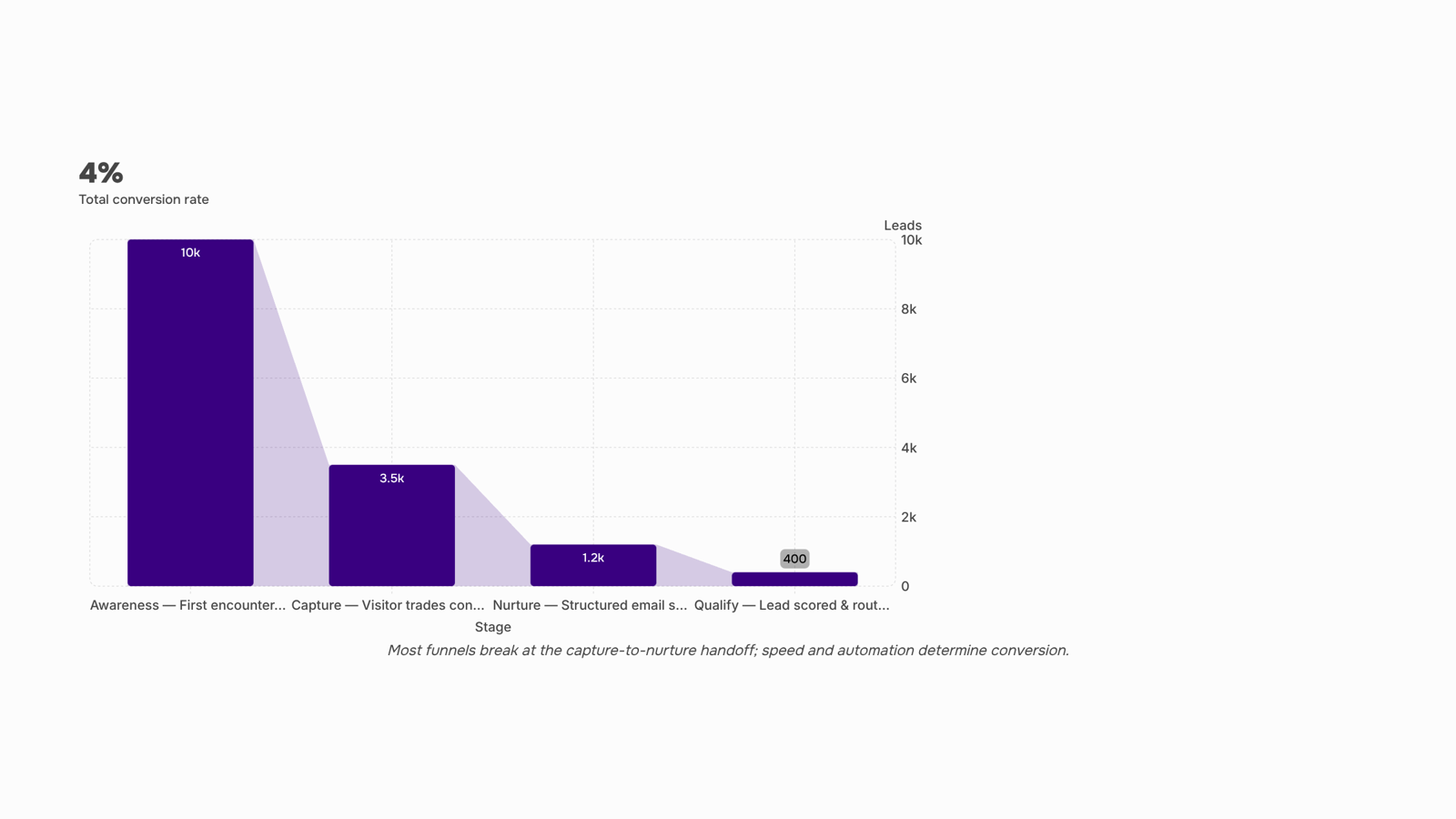
Most funnel diagrams show you four boxes with arrows. They don't tell you what actually happens inside each one.
Awareness is where a potential buyer first encounters your business — through a search result, a LinkedIn post, a referral, or a paid ad. Your job here is to be findable and credible. The key action: publish content or run campaigns that match what your target buyer is actively searching for.
Capture is the moment a visitor trades contact information for something valuable — a guide, a free audit, a demo request. This is where a prospect enters your CRM. The key action: reduce friction on your forms and make the offer specific enough that only your target buyer would want it.
Nurture is the stage most B2B lead generation funnels handle poorly. A lead sits in your database while nothing happens. The key action: run a structured email sequence that builds trust and moves the lead toward a buying conversation. Effective B2B email nurturing is what separates a list from a pipeline.
Qualify is where you confirm the lead is worth a sales conversation — right budget, right authority, right timing. The key action: score leads by behavior (email opens, page visits, form fills) and route high-intent ones to a rep immediately. Speed matters here. Most leads that don't convert stall because no one followed up fast enough.
Each stage has a specific failure mode. Knowing which stage is broken tells you exactly where to fix it.
How a lead generation funnel differs from a sales funnel
Both funnels move leads toward revenue, but they own different parts of that journey. Treating them as the same thing usually means marketing and sales are duplicating work or, worse, dropping leads in the gap between them.
Dimension | Lead generation funnel | Sales funnel |
|---|
Scope | Attracts and qualifies strangers | Converts qualified leads into customers |
Owner | Marketing team | Sales team |
Goal | Fill the pipeline with qualified leads | Close deals and generate revenue |
Entry point | Anonymous visitor or cold prospect | A lead already captured and scored |
The lead generation funnel ends the moment a lead meets your qualification threshold and passes to sales. The sales funnel picks up from there. If your lead generation funnel stages are working correctly, sales receives contacts who already understand the problem you solve, not cold strangers who need re-educating.
The handoff point is where most revenue leaks. If your lead generation strategies are producing volume but deals stall early, the issue is usually a broken handoff, not weak closing. Understanding why leads stop converting almost always points back to that boundary.
How to build a lead generation funnel in 7 steps
Define your target audience before you build anything: Funnel structure follows buyer profile, not the other way around. An IT managed services provider selling to finance directors needs different entry points, content, and timing than one selling to operations managers. Write a one-paragraph profile: role, pain, trigger event, and what "good enough" looks like to them.
Choose one top-of-funnel channel and own it: Most teams spread across LinkedIn, paid search, cold email, and SEO simultaneously, and do none well. Pick the channel where your target buyer already spends time researching. For most b2b lead generation funnel builds, that's either organic search or LinkedIn outreach. Add a second channel only after the first converts consistently.
Build a single lead magnet tied to a specific problem: A checklist, audit template, or short guide works better than a generic ebook when it solves one named problem. A managed IT provider might offer a "15-point security audit checklist for SMBs" rather than "The Complete Guide to IT Security." Specific beats comprehensive every time.
Set up your capture and qualification layer: Your landing page form should ask only what you need to score the lead: company size, role, and one intent signal (a question like "what's your biggest IT headache right now" tells you more than job title alone). Keep it to four fields maximum. Every extra field drops conversion.
Close the first-contact gap immediately: This is where most lead generation funnels break. Research consistently shows that leads contacted within five minutes of submitting a form are far more likely to convert than those reached an hour later, yet most B2B companies take hours or days. Automate the first touchpoint. A triggered email that acknowledges the download and offers a next step (a short call, a relevant case study, a diagnostic question) keeps the lead warm while your team prepares a real response. Evox handles this automatically, sending timed, personalized follow-up sequences based on what the lead downloaded and how they behaved after.
Build a nurture sequence for leads that aren't ready yet: Most leads that enter a b2b lead generation funnel aren't ready to buy on day one. A four to six email sequence over two to three weeks, each email addressing a specific objection or use case, moves leads from aware to interested without requiring your sales team to chase manually. For guidance on structuring those emails, best B2B email lead nurturing strategies covers sequencing logic in detail.
Measure conversion at each stage, then fix the worst drop-off first: Visitor to lead, lead to qualified, qualified to meeting: track all three. If you're converting visitors to leads at 3% but only 10% of those leads ever reach a sales conversation, the nurture sequence is your problem, not traffic. Why most leads don't convert covers the most common failure points at this stage.
The next section walks through a concrete lead generation funnel example for an IT services company so you can see how these steps connect in practice.
A real b2b lead generation funnel example
Take a mid-sized IT managed services firm. Before: they ran Google Ads to a generic homepage, collected contact forms manually, and had no defined follow-up process. Reps called leads when they had time, sometimes days later. Conversion from inquiry to qualified opportunity sat below 8%.
After building a deliberate b2b lead generation funnel: paid traffic goes to a landing page offering a free network security audit. That page feeds leads into a segmented CRM. An automated three-email sequence runs within the first 48 hours, covering common pain points around downtime and compliance risk. Leads who open two or more emails get flagged for rep outreach. Reps now call within four hours of that signal.
The result: qualified pipeline doubled within one quarter, without increasing ad spend.
This lead generation funnel example works because each stage has a defined exit condition. The audit offer attracts the right audience. The nurture sequence filters intent. The behavioral trigger removes guesswork from rep prioritization. For a deeper look at converting those leads once they're in the funnel, the handoff moment is where most teams lose ground.
Four ways to optimize your funnel for better conversion rates
Four levers move the needle on lead generation funnel optimization. Each one is testable in isolation, so you can run changes without rebuilding the whole system.
Lead scoring thresholds: Most teams set a score and never revisit it. Audit your closed-won deals quarterly and check what score they carried when they entered your pipeline. If most closed deals scored 40+ but your threshold is 25, raise it.
First-contact speed: Research from Harvard Business Review puts the odds of qualifying a lead 21 times higher when you respond within five minutes versus 30. That gap is where most IT services funnels lose deals silently.
Nurture cadence: A five-email sequence sent over 14 days outperforms the same five emails sent over 60 days for most B2B buyers. If your sequence is stretched thin, compress it. B2B email nurturing strategies has benchmarks worth checking.
Stage-exit criteria: Define exactly what moves a lead forward. "Opened two emails" is not a criterion. "Clicked pricing page and replied to outreach" is.
Evox's funnel and conversion reports show drop-off by stage, so you can see which lever to pull first rather than guessing. For a deeper look at why leads stall before converting, that piece covers the most common gaps.
Common mistakes that break your funnel before it starts
Three setup errors account for most b2b lead generation funnel failures, and all three happen before a single rep makes contact.
Single-source capture means one channel outage kills your pipeline. Build capture across at least two sources from day one.
No routing rules means leads sit unassigned. Most teams lose the first-contact window entirely — and speed matters more than most realize at this stage. If you want to close that gap, automating lead generation removes the manual handoff that causes it.
No disqualification criteria means your reps work every lead equally, burning time on contacts who were never going to buy.
These aren't optimization problems. They're structural gaps. Fix them in your lead generation funnel setup, not after it's running. An automated sales funnel bakes all three rules in from the start.
Closing
A lead generation funnel only works when every stage converts—and most teams break at the handoff between capture and first contact. You now know exactly where that happens: leads sit in your database while hours pass, interest cools, and deals quietly die. The seven-step framework above fixes each stage, but the real bottleneck is speed. Most of these mistakes aren't effort problems—they're process problems. Lio handles capture, routing, and pipeline tracking automatically, so your team responds to leads in minutes, not hours. Ready to close that gap? Start a free trial and see how fast your first response can be.
FAQ
Q. How do I create an effective lead generation funnel?
A. Start with a specific buyer profile, choose one top-of-funnel channel, build a targeted lead magnet, set up a four-field capture form, close the first-contact gap with automation, nurture cold leads with email sequences, and measure conversion at each stage to find your biggest leak.Q. What are the stages of a lead generation funnel?
A. Awareness (prospect finds you), Capture (they trade contact info), Nurture (you build trust via email), and Qualify (you confirm fit and route to sales). Each stage has a specific failure mode—knowing which breaks tells you exactly where to fix it.Q. How does a lead generation funnel differ from a sales funnel?
A. Lead gen owns everything before a rep gets involved; sales owns the conversion after. Lead gen fills the pipeline with qualified leads; sales closes deals. The handoff point is where most revenue leaks when leads aren't properly qualified or routed.Q. How can I optimize my lead generation funnel for better conversion rates?
A. Reduce form friction to four fields max, automate first contact within five minutes of submission, build a four-to-six email nurture sequence for cold leads, and measure conversion at each stage to identify your worst drop-off point first.Q. What are the best practices for building a lead generation funnel?
A. Own one top-of-funnel channel before adding a second, tie your lead magnet to a specific problem not a generic topic, keep capture forms short, close the first-contact gap immediately with triggered automation, and always measure before optimizing.


 Elena Petrova15 September 2026


