TL;DR: Most content on encouraging sales quotes treats the problem as a copywriting fix. This piece gives IT company owners a complete system: the signals that tell you when to follow up, the message structure that moves prospects from quote to decision, and the workflow that stops deals from going quiet. Built for service-based IT sales, not product checkouts.
Why most sales quotes never get a response
Most IT service quotes die quietly. The prospect opens the PDF, skims the total, and moves on. No reply, no objection, no closure. Just silence.
Salesforce research consistently shows that a significant share of B2B quotes receive zero follow-up from the sending team. That alone explains a large portion of poor sales quote conversions. The prospect didn't say no. The seller just stopped.
The timing problem compounds this. Most IT companies send a quote and wait. But buying decisions at this level involve multiple stakeholders, budget approvals, and competing priorities. A prospect who was genuinely interested on Monday may have mentally moved on by Thursday, not because they chose a competitor, but because no one kept the conversation alive.
Friction is the other culprit. A quote buried in an email thread, with no clear expiry date, no next step, and no easy way to ask a question, gives the prospect nothing to act on. The best practices for following up on sales quotes all point to the same fix: structure replaces hope.
When you build a multi-layer follow-up system around your quotes, you stop relying on the prospect to re-engage. You create the conditions for a response instead of waiting for one.
How to encourage customers to request sales quotes
Most IT service companies lose quote opportunities before a prospect ever fills out a form. The barrier isn't price or competition — it's friction. A buried contact form, a vague CTA, or a three-step request process is enough to send a prospect to someone easier to reach.
To optimize your website for sales quotes, start with the request path itself. Every service page should have a visible, specific CTA — not "contact us" but "get a quote for managed IT support." Specificity reduces hesitation. Place the CTA above the fold and repeat it after any pricing or scope details, where buying intent peaks.
Reduce the fields on your quote request form to the minimum needed to qualify the lead. Name, company size, and the service they need is enough to start. Every additional field drops completion rates. If your team needs more detail, collect it on the discovery call, not the form.
Social proof placed near the CTA does real work here. A one-line client result — "reduced downtime by 40% for a 120-person logistics firm" — is more persuasive than a paragraph of credentials. Specificity signals credibility to multi-stakeholder buyers who are comparing several vendors.
For high-value IT service quotes, response speed matters more than most teams realize. Research on B2B lead response consistently shows that leads contacted within the first hour are significantly more likely to convert than those reached later. Pair fast response with automated follow-up reminders so no inbound request goes cold while your team is heads-down.
Encouraging sales quotes from the right prospects also means qualifying intent early. AI-driven lead scoring can surface which form submissions are worth prioritizing, so your team spends time on quotes that are likely to close.
What language drives prospects to act on a sales quote
The words you use in a follow-up message matter as much as the timing. Vague language ("just checking in") signals low confidence and gives the prospect nothing to act on. Specific language tied to their situation moves the conversation forward.
Subject lines are where most follow-ups fail before they're even opened. "Following up on your quote" competes with fifty other emails. "Your IT support quote: valid through Friday" creates a concrete reason to open now. Including the expiry date in the subject line works because it reframes the quote as a time-bound decision, not an open-ended one.
Inside the message, two framing techniques consistently reduce buyer hesitation. First, anchor to the cost of inaction: "Every week without managed backup is a week of unprotected endpoints" is more persuasive than "let me know if you have questions." Second, reduce perceived risk by naming the next step explicitly: "A 15-minute call is all we need to confirm the scope and move forward." Prospects stall when the path forward feels unclear or heavy.
For sales quote language specifically, the goal is to make saying yes feel smaller than saying nothing. Phrases like "we can hold this pricing until [date]" or "I can adjust the scope if the budget is the constraint" give the prospect a low-friction way to re-engage without feeling pressured.
Encouraging sales quotes to convert also means addressing the multi-stakeholder reality in IT services. If your contact needs sign-off from a CFO or IT director, offer a one-page summary they can forward internally. That single addition removes a common bottleneck that kills deals silently.
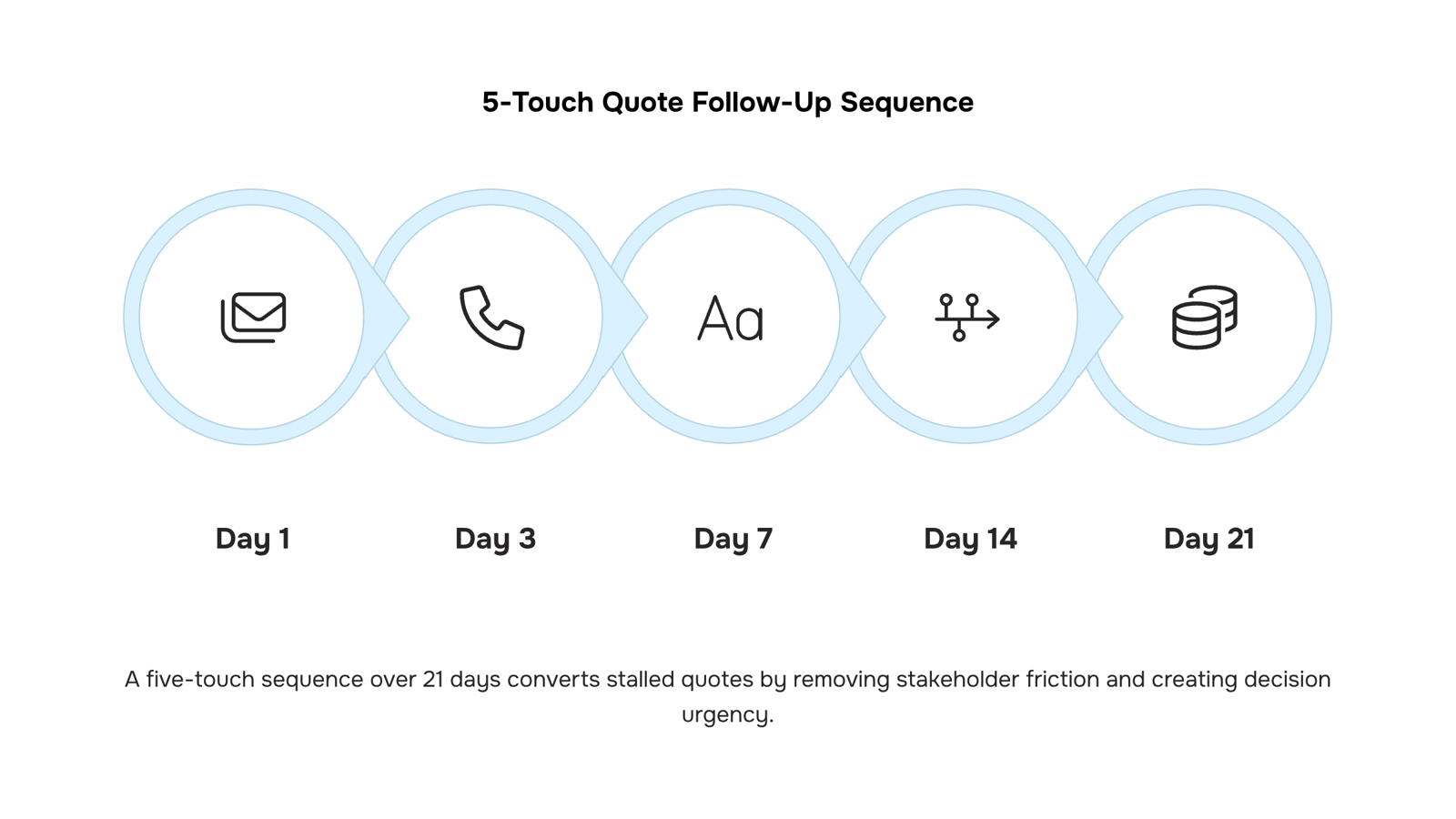
The follow-up system that converts quotes into contracts
Most quotes don't die because the buyer lost interest. They stall because no one followed up at the right moment with the right message.
Here's a sequence that works for IT service teams, where a single quote often involves a technical lead, a finance approver, and a decision-maker who wasn't on the original call.
Day 1 (same day you send the quote): Send a short confirmation email. Name the specific problem the quote solves, not just the line items. "This covers the network segmentation work we scoped to reduce your audit exposure" lands better than "please find the attached proposal."
Day 3: Follow up by phone or LinkedIn, not email. Ask one question: "Did the quote land with the right people internally?" This surfaces the real blocker, whether that's a missing stakeholder, a budget cycle, or a competing priority.
Day 7: Send a value-add email. Attach a one-page case study from a similar IT engagement, or reference a relevant compliance deadline. Don't ask for a decision. Give them a reason to re-open the document.
Day 14: This is your expiry nudge. Reference the quote's validity window directly. Pricing tied to a specific date converts better than open-ended proposals, and sales quote best practices consistently point to expiry framing as one of the highest-leverage moves in the sequence.
Day 21: Final check-in. Keep it two sentences. "Still worth a conversation, or should I close this out?" gives the buyer an easy exit and often triggers a response either way.
According to HubSpot, most sales quotes receive no follow-up at all. Running even this five-touch sequence puts you ahead of the majority of IT service providers competing for the same budget.
For teams managing more than a handful of open quotes, automated follow-up reminders remove the tracking burden so the sequence runs without someone manually watching a spreadsheet.
How to prioritize which quotes deserve your attention
Not every open quote deserves the same energy. For a small IT services team, treating a $500 hardware refresh the same as a $50,000 managed services contract is how follow-up capacity gets wasted.
Two signals tell you where to focus.
Deal size and margin is the obvious one. Set a threshold, say $10,000, above which every quote gets a personal call within 24 hours. Below that, an automated sequence handles it.
Stakeholder involvement is the better predictor. When a quote has gone to a procurement lead, IT director, or CFO, the decision is multi-stakeholder and slower, but the close rate on followed-up quotes is significantly higher than on ignored ones. If you're not using AI-driven lead scoring to flag these automatically, you're relying on memory, which fails under volume.
Two additional signals worth tracking:
Quote opened but no reply within 48 hours: high-intent, needs a direct nudge
Quote not opened after 72 hours: the contact may be wrong, or the email landed in spam
Improving sales quote conversions starts with triage, not templates. Once you know which quotes are worth chasing, a multi-layer follow-up system gives you the cadence to actually close them.
Common mistakes that kill sales quote conversions
Four errors account for most failed sales quote conversions in IT services, and they're all fixable.
Slow response: Research on lead response timing consistently shows that waiting more than 24 hours after sending a quote drops close rates sharply. A prospect who asked for pricing on Tuesday has often moved on by Thursday. Send a confirmation the moment the quote goes out, then follow up within one business day.
No expiry date: A quote without a deadline is an open invitation to stall. Set a 7 to 14-day expiry on every quote. It creates a natural reason to follow up and filters out prospects who were never serious.
No defined next step: Ending a quote with "let us know if you have questions" puts the burden on the buyer. Instead, propose a specific action: a 20-minute review call, a scope confirmation, a decision date. Buyers in multi-stakeholder IT decisions need a structure to move forward.
Generic templates: A managed services quote that reads like a software subscription quote signals low effort. Reference the prospect's specific pain points, their environment, and the outcome they described. That specificity is what encouraging sales quotes actually do — they reflect the buyer's problem back at them.
For teams struggling with all four, a multi-layer follow-up system addresses the sequencing problem that generic advice misses.
Automating quote follow-ups without losing the personal touch
Automation handles the timing so you don't have to guess when to follow up on sales quotes. Set triggers based on quote-open events or expiry windows, and the system sends reminders without you manually tracking each deal. The rep's job stays relational: respond to replies, answer objections, move the conversation forward.
Where most teams go wrong is letting automation replace the message entirely. A triggered reminder still needs a human-written note, a specific reference to the client's project, and a clear next step.
Lio's trigger-based workflows let you build that structure once and apply it consistently, without turning every follow-up into a copy-paste job.
Closing
You now have a complete system: the signals that trigger follow-up, the message structure that moves prospects from quote to decision, and the five-touch sequence that stops deals from going quiet. The gap between knowing this and running it is execution. Audit your current quote follow-up process this week — count how many open quotes received zero touches after day one, and how many expired without a final check-in. Once you see the pattern, you can close it. Lio automates the timing and prioritization so nothing slips while your team focuses on the conversations that matter. Ready to stop losing deals to silence?
FAQ
How can I encourage customers to request sales quotes?
Reduce friction on your request form to name, company size, and service needed. Place a specific CTA above the fold on every service page, and add social proof nearby showing measurable client results. Speed matters: respond within the first hour to inbound requests.
What are some effective strategies for increasing sales quote conversions?
Build a five-touch follow-up sequence across days 1, 3, 7, 14, and 21. Use expiry dates to create urgency, anchor messages to the cost of inaction, and offer a one-page summary prospects can forward internally to remove stakeholder bottlenecks.
What language should I use when encouraging sales quotes?
Replace vague language like 'just checking in' with specifics tied to their situation. Use subject lines with expiry dates, name the next step explicitly, and reduce perceived risk by offering low-friction re-engagement options like 'we can adjust scope if budget is the constraint.'
How can I optimize my website to generate more sales quotes?
Use specific CTAs like 'get a quote for managed IT support' instead of generic 'contact us.' Minimize form fields, place CTAs above the fold and after pricing details, and add social proof with measurable results near the CTA to signal credibility.
What are the best practices for following up on sales quotes?
Follow a five-touch sequence: day 1 confirmation, day 3 phone check-in, day 7 value-add email, day 14 expiry nudge, and day 21 final check-in. Automate reminders so the sequence runs without manual tracking and nothing slips.


 Elena Petrova15 September 2026


