TL;DR: Most SMB sales tool roundups list features without explaining which bottleneck each one actually fixes. This one maps every recommendation to a concrete problem IT company owners run into: slow lead response, manual follow-up work, and no clear view of pipeline health. Read on to find out which tools solve which problems, and which ones you can skip.
What SMB sales means and why it is different
SMB sales is the practice of selling products or services to small and medium-sized businesses, typically companies with fewer employees and lower revenue than enterprise accounts.
The difference from enterprise sales comes down to three things: cycle length, team size, and who makes the decision. SMB sales cycles move faster, often closing in days or weeks rather than months. The decision-maker is usually the owner or a single manager, not a procurement committee. And the sales team handling these accounts is lean, sometimes one or two reps covering hundreds of prospects.
That speed and simplicity is an advantage, but it creates its own pressure. When cycles are short, a slow response or a missed follow-up kills the deal. When the team is small, there is no room for manual processes that eat hours without producing pipeline.
The tools worth using in SMB sales are the ones built around that reality: fast lead response, consistent follow-up, and clear pipeline visibility. Good lead nurturing software for small businesses addresses exactly that gap. The next section names the four bottlenecks that make or break most SMB sales operations.
Key challenges that slow down SMB sales teams
Four bottlenecks show up repeatedly across SMB sales teams, and each one compounds the others.
Slow lead response is the most damaging. By the time a rep follows up on an inbound inquiry, the prospect has already heard from a competitor. Most SMB teams lack the automation to respond within minutes, so warm leads go cold before anyone notices.
No follow-up system makes the problem worse. Closing an SMB deal typically requires multiple touchpoints, yet most reps stop after one or two attempts. Without a structured sequence, deals stall and pipeline dries up quietly. Lead nurturing software for small businesses exists specifically to close this gap.
Poor pipeline visibility means owners are guessing, not managing. When deal status lives in someone's head or a shared spreadsheet, forecasting is unreliable and coaching is impossible. The best lead management tools for sales teams solve this with real-time pipeline views.
Manual data entry is the hidden tax on every rep's day. Time spent logging calls and updating contact records is time not spent selling. It also introduces errors that corrupt the data you're trying to use for smb sales strategies.
These four key challenges in smb sales are why the tools below were chosen.
Four criteria matter most when choosing between smb sales tools.
Integration with your existing stack: A tool that doesn't connect to your email, calendar, or ticketing system creates the same manual data entry problem you're trying to solve. Check for native sync before you evaluate anything else.
Automated follow-up: Most SMB deals close after multiple touchpoints, not one. Look for tools with sequence-based follow-up built in, not bolted on as an add-on. This is where email marketing campaign tools and dedicated lead nurturing software for small businesses tend to outperform generic CRMs.
Pipeline visibility: You need to see where deals stall, not just how many are open.
Lead management for small business: The tool should score, route, and log leads automatically. If your team is still doing that by hand, check the best lead management tools for sales teams before committing to anything.
Here are seven tools worth considering, each matched to a specific problem IT company owners run into during the SMB sales cycle.
Evox (WorksBuddy) — Built for teams that lose deals to slow follow-up. Evox runs multi-step email sequences automatically, scores leads based on open and click behavior, and alerts your reps the moment a prospect shows buying intent. If your team is managing 50–200 active leads and following up manually, this is where the time loss is happening. Evox removes that gap without adding headcount.
HubSpot CRM (Free tier) — Best for teams moving off spreadsheets for the first time. The free plan covers contact management, deal pipelines, and basic email tracking. The ceiling hits fast once you need sequences or reporting beyond 90 days, but for a 3–5 person sales team getting structured, it's a low-friction starting point. Upgrade costs jump sharply at the Starter and Professional tiers, so factor that in before you commit.
Pipedrive — Designed around pipeline visibility rather than contact volume. IT service companies with longer sales cycles (30–90 days) find the visual deal board easier to manage than HubSpot's list-heavy interface. Activity reminders and email sync are built in. It doesn't have native lead scoring, so pair it with a dedicated email automation for SMB tool if nurturing is part of your process.
Apollo.io — Strongest for outbound prospecting. Apollo combines a B2B contact database with sequencing, so you can find IT decision-makers and email them from the same platform. The free plan caps at 50 email credits per month, which is enough to test the workflow before committing to the $49/month basic tier.
Zoho CRM — A reasonable choice if you're already inside the Zoho ecosystem (Zoho Books, Zoho Desk). The native integrations reduce setup time. Outside that ecosystem, the interface takes longer to configure than most SMB teams want to spend. Worth evaluating if you need lead management for small business alongside accounting in one vendor relationship.
Lemlist — Purpose-built for cold email with personalization at scale. Where most sequencers send identical emails, Lemlist lets you embed personalized images and dynamic text blocks without manual editing per contact. IT companies running outbound campaigns to named accounts get measurably higher reply rates with this approach. Starts at $39/month per seat.
Close CRM — Built specifically for inside sales teams that live on the phone and email. Built-in calling, SMS, and email sequencing in one interface means reps don't switch tabs mid-conversation. It's more expensive than the others here (from $49/month per user), but teams that do high-volume outreach recover that cost quickly in rep efficiency.
A few patterns worth noting across this list. Tools 1, 3, and 6 address the follow-up and nurturing problem directly — the stage where most SMB deals stall. Tools 2, 5, and 7 are stronger on pipeline structure and contact organization. Apollo sits in the middle, covering prospecting and sequencing together.
For a deeper look at how these tools fit into a broader lead nurturing software for small businesses stack, or how they connect to sales enablement software for small businesses, those comparisons are worth reading before you finalize your shortlist.
Here's how the seven smb sales tools stack up across the dimensions that matter most for a small IT services team:
Tool | Lead capture speed | Automation depth | CRM integration | Starting price |
|---|
Evox | Instant (behavior triggers) | Full multi-step sequences | Native | Paid plans from ~$49/mo |
HubSpot CRM | Form/manual entry | Moderate (workflow add-ons) | Native | Free tier; paid from $15/mo |
Pipedrive | Manual/import | Basic email sequences | Native | From $14/mo |
Apollo.io | Prospecting database | Outbound sequences | Via Zapier | From $49/mo |
Lemlist | Manual/import | Cold email sequences | Via integration | From $39/mo |
Notion CRM | Manual | None native | None | Free tier available |
Zapier | N/A (connector only) | Trigger-based | Any connected app | Free tier; paid from $19.99/mo |
For lead management for small business, the gap between tools with native CRM integration and those relying on connectors shows up fast when your pipeline grows past 200 active contacts. Evox and HubSpot handle that natively. If your priority is email marketing campaign automation, Evox and Lemlist lead on sequence depth, though Evox adds lead scoring that the others don't include at base tier.
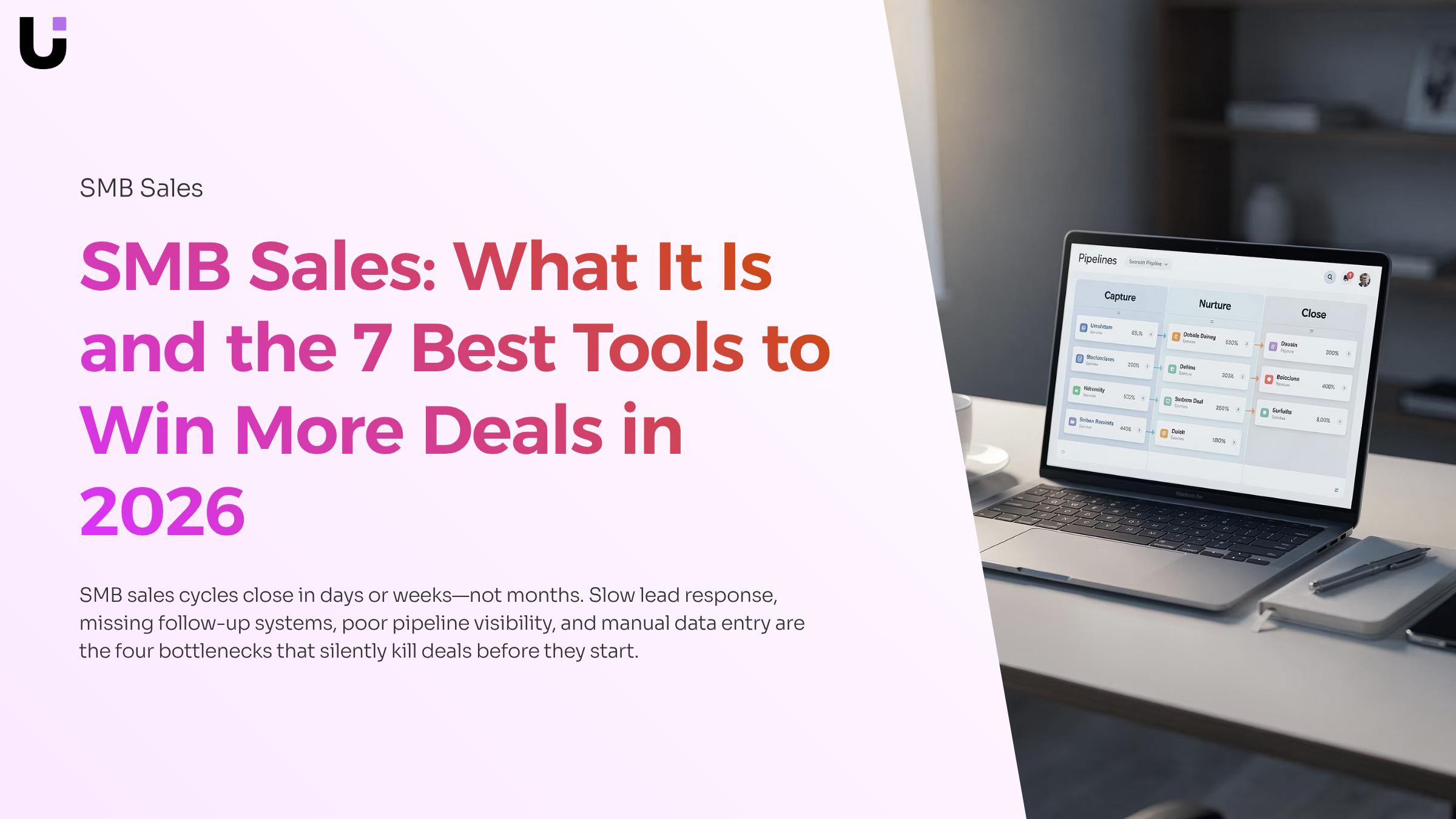
A simple smb sales plan doesn't need a 20-page document. It needs three stages, each with one clear owner: capture, nurture, close.
Capture: This is where most SMB teams leak deals before they even start. Use a dedicated lead capture tool (Lio handles this well) to pull inbound leads from your website forms, ads, and LinkedIn into one place automatically. The moment a lead enters, it gets scored and routed. No manual triage.
Nurture: This is where smb sales strategies live or die. Most deals don't close on first contact — they close after consistent follow-up across multiple touchpoints. Map your lead nurturing software for small businesses to a sequence: an intro email, a value-add follow-up, and a direct ask. Evox runs this automatically, tracking opens and flagging leads who engage so your reps know exactly who to call.
Close: Your sales enablement software for small businesses should handle proposals, e-signatures, and deal tracking in one motion. Sigi covers the contract side; your CRM closes the loop.
The sequence only works when the three stages connect. A tool handling one stage in isolation still leaves your team stitching data together manually.
Three setup errors show up repeatedly across SMB sales teams, regardless of which tools they're using.
Buying tools before defining the process. A CRM or email automation platform reflects your workflow — it doesn't create one. Teams that skip the capture-nurture-close sequence covered above end up with a cluttered tool that nobody trusts.
Ignoring data quality from day one. Dirty data compounds fast. One field left inconsistent across 200 contacts breaks segmentation, skews lead scoring, and sends the wrong sequence to the wrong person. Blair Carey's analysis of SMB sales mistakes puts data quality first for exactly this reason.
Running tools in isolation. Your email marketing campaign tools and CRM need to share data. When they don't, reps follow up on leads already closed, and managers can't see which smb sales strategies are actually working.
Closing
The difference between SMB sales teams that hit quota and those that don't almost always comes down to one thing: how fast they respond to leads and how consistently they follow up. You can have the best reps in the industry, but if they're spending hours on manual follow-up instead of selling, deals slip away. The tools that matter most are the ones that automate sequences, score leads based on real buying signals, and keep pipeline visible in real time—not the ones with the longest feature list.
Evox is built specifically for this: multi-step email campaigns that run on autopilot, lead scoring that alerts your reps the moment a prospect engages, and a CRM that doesn't require hours of setup. If your team is managing 50–200 active leads and losing deals to slow follow-up, start a free trial and see the time difference in your first week.
FAQ
Q. What are the most effective SMB sales strategies?
A. Fast lead response, consistent multi-step follow-up, and clear pipeline visibility. SMB cycles move in days or weeks, so automation that removes manual follow-up work and alerts reps to buying intent is where most deals are won or lost.
Q. How can I improve my SMB sales team's performance?
A. Eliminate manual follow-up with email sequences, implement lead scoring to prioritize hot prospects, and give reps real-time visibility into pipeline. Most SMB teams recover 5–10 hours per rep per week by removing data entry and follow-up drudgery.
Q. What are the best SMB sales tools for small businesses?
A. Evox for automated sequences and lead scoring, Pipedrive for pipeline visibility, and Apollo.io for outbound prospecting. Choose based on your bottleneck: follow-up, pipeline management, or prospecting.
Q. How do I create an SMB sales plan?
A. Start by identifying your bottleneck: slow lead response, no follow-up system, poor pipeline visibility, or manual data entry. Then choose tools and processes that address that specific problem before layering on complexity.
Q. What are the key challenges in SMB sales?
A. Slow lead response, no structured follow-up system, poor pipeline visibility, and manual data entry. Each compounds the others and kills deals before reps realize it's happening.
Q. What is the difference between SMB sales and enterprise sales?
A. SMB cycles close in days or weeks (not months), decisions are made by one owner or manager (not committees), and teams are lean (one or two reps covering hundreds of prospects). Speed and simplicity are advantages, but they demand automation to avoid losing deals to slow follow-up.
Q. How much should a small business spend on sales tools?
A. Start with one tool that solves your biggest bottleneck—HubSpot Free or Evox for follow-up, Pipedrive for pipeline. Most SMB teams recover the cost within weeks by reclaiming rep time from manual work.


 Elena Petrova15 September 2026


