Priority management techniques are structured methods for deciding what your team works on, in what order, and why. Used well, they cut the noise between urgent-feeling tasks and work that actually moves the business forward. This article covers six techniques you can apply right now, plus a comparison of the most common frameworks and how to keep everything in one place.
What are priority management techniques?
Priority management is the practice of ranking work by impact and urgency so your team spends time on the right things. It is not the same as time management. Time management asks how you use the hours you have. Priority management asks whether you are filling those hours with the right work in the first place.
Most teams skip this step. They react to the loudest request, the most recent Slack message, or whatever the most senior person mentioned last. The result is a calendar full of activity and a roadmap that barely moves.
Priority management techniques give you a repeatable system so those decisions are consistent, visible, and defensible.
Why priority management matters for your team
Getting priorities right has a direct effect on how your team performs and how they feel about their work.
- Clarity: Everyone knows what to work on next without asking a manager.
- Alignment: Work connects to goals the business actually cares about.
- Speed: Fewer context switches mean faster delivery on high-value tasks.
- Retention: People who understand why their work matters stay longer (Gallup, 2023).
- Revenue: Teams that prioritize by impact ship the features and projects that move the number.
None of these outcomes happen by accident. They come from choosing and consistently applying the right technique for your team's context.
6 priority management techniques that actually work
1. The Eisenhower Matrix
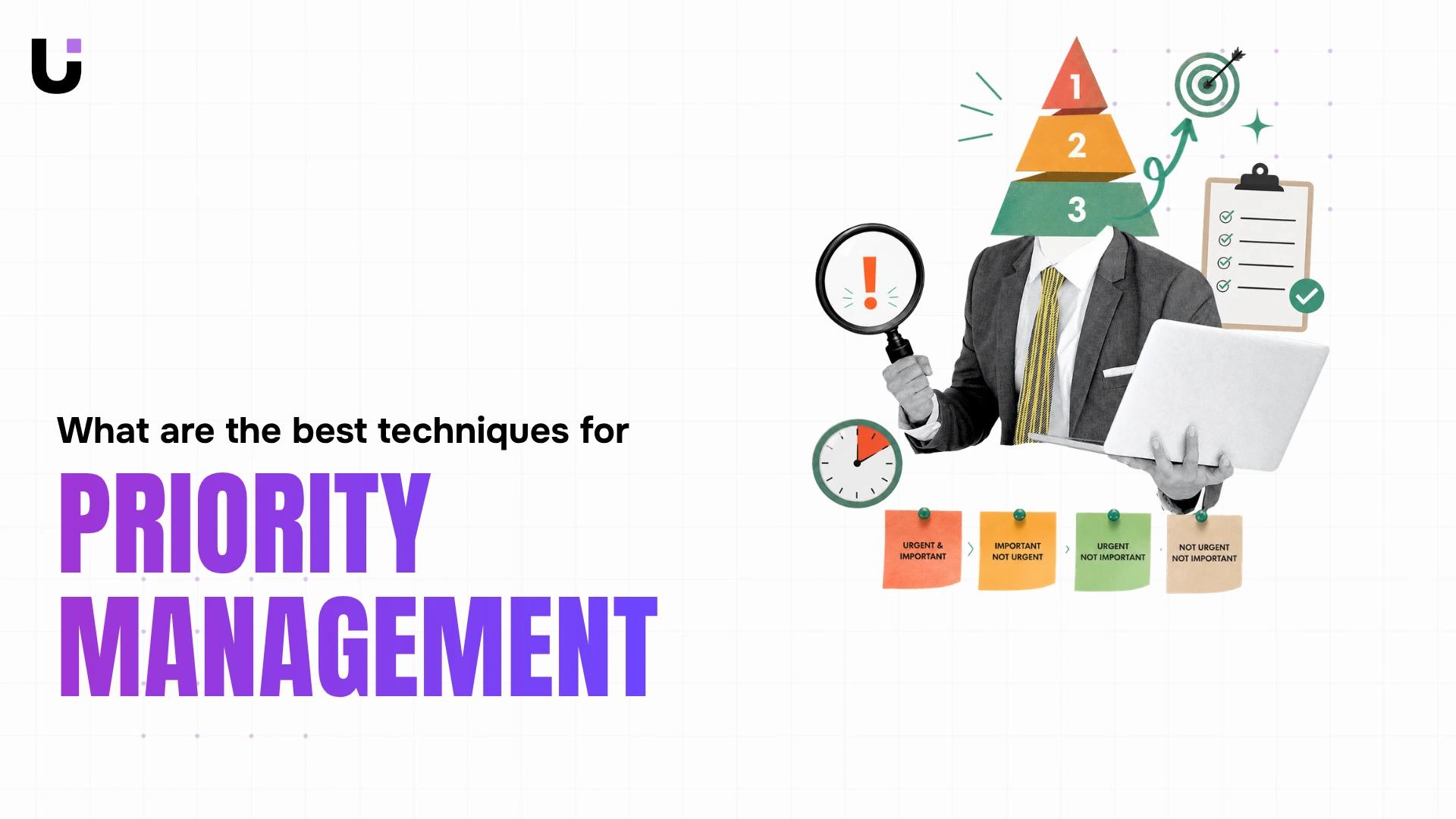
The Eisenhower Matrix sorts every task into one of four quadrants based on two dimensions: urgency and importance.
|
Urgent |
Not urgent |
| Important |
Do it now |
Schedule it |
| Not important |
Delegate it |
Eliminate it |
The technique is named after President Dwight Eisenhower, who reportedly separated the urgent from the important as a decision rule. Stephen Covey later popularized it in The 7 Habits of Highly Effective People (1989).
Where most teams go wrong is treating everything as urgent and important. Run a quick audit: take your team's current task list and force every item into one of the four boxes. You will almost always find that a large portion of the list belongs in "delegate" or "eliminate." That is time you can recover immediately.
2. MoSCoW prioritization
MoSCoW stands for Must have, Should have, Could have, and Won't have. Product and project teams use it to agree on scope before work begins, which prevents the endless negotiation that happens mid-sprint.
The technique works because it forces stakeholders to say out loud which features or tasks are truly non-negotiable. A "must have" is something the project fails without. A "won't have" is something explicitly out of scope for this cycle, not forever.
Run a MoSCoW session at the start of every planning cycle. Give each stakeholder a fixed number of "must have" votes so the list does not inflate. If everything is a must, nothing is.
3. The RICE scoring model
RICE stands for Reach, Impact, Confidence, and Effort. It gives each initiative a numeric score so you can rank a backlog without relying on gut feel or whoever speaks loudest in the room.
The formula is: (Reach x Impact x Confidence) / Effort.
- Reach: How many users or customers does this affect per quarter?
- Impact: How much does it move the key metric? (Score 0.25 to 3.)
- Confidence: How sure are you of the estimates? (Express as a percentage.)
- Effort: How many person-months does it require?
Intercom's product team developed RICE to reduce bias in roadmap decisions (Intercom, 2018). It works best when your team has enough data to estimate reach and impact with reasonable confidence. If you are early-stage or working on novel problems, pair it with qualitative judgment.
4. The Ivy Lee method
The Ivy Lee method is one of the oldest productivity techniques still in use. At the end of each workday, each person writes down the six most important tasks for the next day, ranked in order. They work through the list in order and carry anything unfinished to the next day's list.
Ivy Lee sold this method to Charles Schwab of Bethlehem Steel in 1918. Schwab reportedly paid him $25,000 after seeing the results across his executive team (Clear, 2017).
The power is in the constraint. Six tasks. Strict order. No multitasking. Applied at the team level, it becomes a daily standup artifact: each person shares their top three, which surfaces conflicts and dependencies before they become blockers.
5. Value vs. effort mapping
Value vs. effort mapping (sometimes called an impact-effort matrix) plots initiatives on a two-by-two grid. The horizontal axis is effort. The vertical axis is value. The goal is to fill your near-term roadmap with high-value, low-effort work and make deliberate decisions about everything else.
The four zones:
- Quick wins: High value, low effort. Do these first.
- Major projects: High value, high effort. Plan and resource properly.
- Fill-ins: Low value, low effort. Do when capacity allows.
- Time sinks: Low value, high effort. Avoid or cut.
This technique is most useful during quarterly planning when you have a long list of potential work and need to make trade-offs visible to stakeholders. Put the grid on a shared screen and plot items together as a team. The conversation that follows is often more valuable than the grid itself.
6. OKR-based prioritization
OKRs (Objectives and Key Results) connect daily work to company-level goals. Each objective is a qualitative direction ("Become the default tool for remote teams"). Each key result is a measurable outcome that signals progress ("Increase weekly active users by 30% in Q2").
When your team uses OKRs to prioritize, the question for any new request becomes: does this move a key result? If yes, it earns a place on the roadmap. If not, it waits or gets dropped.
Google, Intel, and LinkedIn have used OKRs to align large organizations (Doerr, 2018). The technique scales down just as well. A team of five can run a lightweight OKR cycle in a single planning session. Keep the number of objectives small, two to three per team per quarter, so the filter stays sharp.
Common mistakes teams make with prioritization
Even good frameworks fail when teams apply them badly. Watch for these patterns.
Treating all techniques as permanent : MoSCoW works well for scoped projects. RICE works well for product backlogs. The Eisenhower Matrix works well for individual task management. Match the technique to the context rather than forcing one method onto every situation.
Skipping the stakeholder conversation : A prioritized list that lives only in a project manager's head does not create alignment. Share the ranked list, explain the criteria, and get visible agreement before work starts.
Reprioritizing too often : Changing priorities every week signals that the original prioritization was not grounded in real goals. Aim to lock priorities for a meaningful cycle, two to four weeks at minimum, before revisiting.
Confusing activity with progress : A team can be busy and still be working on the wrong things. Tie your priority list to outcomes, not outputs.
Priority management techniques vs. time management
These two concepts are related but distinct. Understanding the difference helps you know which problem you are actually solving.
|
Priority management |
Time management |
| Core question |
What should we work on? |
When and how do we do it? |
| Unit of focus |
Tasks, projects, initiatives |
Hours, blocks, schedules |
| Main risk without it |
Working on the wrong things |
Working inefficiently |
| Key tools |
RICE, MoSCoW, OKRs, matrices |
Time blocking, Pomodoro, calendars |
| Team vs. individual |
Primarily a team practice |
Primarily an individual practice |
Most productivity advice focuses on time management because it is easier to measure. But a team that manages time brilliantly while working on the wrong priorities will still miss its goals. Start with priorities, then layer in time management.
Keeping your priorities in one place
A technique only works if your team can see it. When priority decisions live in someone's inbox or a spreadsheet no one can find, the system breaks down fast.
A work management tool gives you a single place to record your ranked task list, attach the scoring criteria you used, and connect each item to the goal it supports. When a new request comes in, anyone on the team can check the current priority list and make an informed call without pulling a manager into a side conversation.
The goal is not more process. It is fewer "what should I work on?" questions and more time on the work that actually matters.
The right framework is only half the equation
Every technique in this guide — the Eisenhower Matrix, MoSCoW, RICE, Ivy Lee, value vs. effort mapping, and OKRs — works on paper. The gap between a framework on a whiteboard and a team that actually uses it consistently comes down to one thing: a system that keeps priorities visible, up to date, and connected to real work.
That is where most teams stall. They run a great planning session, score the backlog, agree on the must-haves, then scatter the decisions across sticky notes, spreadsheets, and a Slack thread nobody can find a week later.
The techniques in this article give you the thinking. But thinking without infrastructure fades fast. A dedicated work management tool keeps your ranked task list in one place, attaches the scoring criteria you used, and connects each item to the goal it supports — so when a new request lands, anyone on the team can make an informed call without pulling a manager into a side conversation. If you want to see how that looks in practice, Taro's Auto Prioritization re-orders your entire backlog automatically based on due dates, dependencies, and strategic impact — no grooming meeting required.
Pick one technique this week, run it for a full planning cycle, and build from there. Consistency beats perfection every time.


 Elena Petrova15 September 2026


