TL;DR: Most customer acquisition guides hand you a list of channels and call it a strategy. This one covers the full arc: how to define your approach, calculate what each customer actually costs you, and build the operational layer that determines whether leads convert or go cold. Response time and lead routing get the same attention as targeting and messaging, because that's where most acquisition budgets quietly leak.
What customer acquisition means and why it matters
Customer acquisition is the process of turning a stranger into a paying customer through a repeatable, measurable set of actions. That last word matters: repeatable. Most IT company owners acquire early clients through referrals and personal networks, which works until it doesn't. When that pipeline dries up, there's no system to fall back on.
It's worth separating this from lead generation, which covers only the top of the funnel. A new customer acquisition strategy spans the full journey: awareness, consideration, conversion, and the handoff to delivery. Lead generation feeds the machine; customer acquisition is the machine.
For IT firms specifically, a deliberate strategy matters because the sales cycle is long, deal sizes vary widely, and the cost of chasing the wrong prospects adds up fast. Without a defined process, you can't measure what's working, can't spot where deals stall, and can't make a case for investing more in the channels that convert.
The next section covers exactly that measurement layer: how to calculate your customer acquisition cost, what a healthy cost-to-lifetime-value ratio looks like, and how to benchmark your numbers against B2B email nurturing and retention benchmarks for IT services firms.
How to calculate your customer acquisition cost
Customer acquisition cost (CAC) is the total you spend to win one new customer. The formula is straightforward:
CAC = Total acquisition spend ÷ Number of new customers acquired
"Total acquisition spend" covers everything: paid ads, sales salaries, outbound tools, proposal time, and any agency fees, over the same period you're counting new customers.
Here's a worked example sized for an IT services firm. Say you spend $8,000 in a quarter across Google Ads, a part-time SDR, and your CRM subscription. You close 10 new clients. Your CAC is $800 per customer.
Whether $800 is healthy depends entirely on your customer lifetime value (LTV). A managed services client worth $18,000 over three years gives you an LTV:CAC ratio of 22:1, which is strong. Most B2B SaaS benchmarks suggest a healthy ratio sits between 3:1 and 5:1; IT services firms with longer contracts can push higher. If your ratio drops below 3:1, your customer acquisition costs are eroding margin faster than revenue can cover them.
A few things distort the number if you're not careful:
Counting only ad spend and ignoring sales time understates CAC significantly
Mixing new and expansion revenue in the same period skews your customer count
Ignoring churn means your LTV estimate is too optimistic
If you want to reduce CAC without cutting pipeline volume, improving how you generate and qualify leads is usually the faster lever than negotiating ad rates down.
Why most acquisition efforts stall before they convert
Most new customer acquisition efforts fail at the same three points, regardless of how much you spend getting leads in the door.
Slow response is the first. Responding to an inbound inquiry within five minutes versus 30 minutes can increase conversion rates significantly, yet most IT firms reply hours later, by which point the prospect has moved on.
Unqualified routing is the second. When a lead lands with no scoring or context, your best salesperson wastes time on a company that was never a fit, while a high-value prospect waits.
No follow-up sequence is the third. A single email after a demo is not a customer acquisition tactic. Most deals close after five or more touchpoints, but most teams stop at two.
These aren't channel problems. Spending more on lead generation strategies or B2B email nurturing won't fix a broken handoff process. The seven-step framework below addresses each failure point directly.
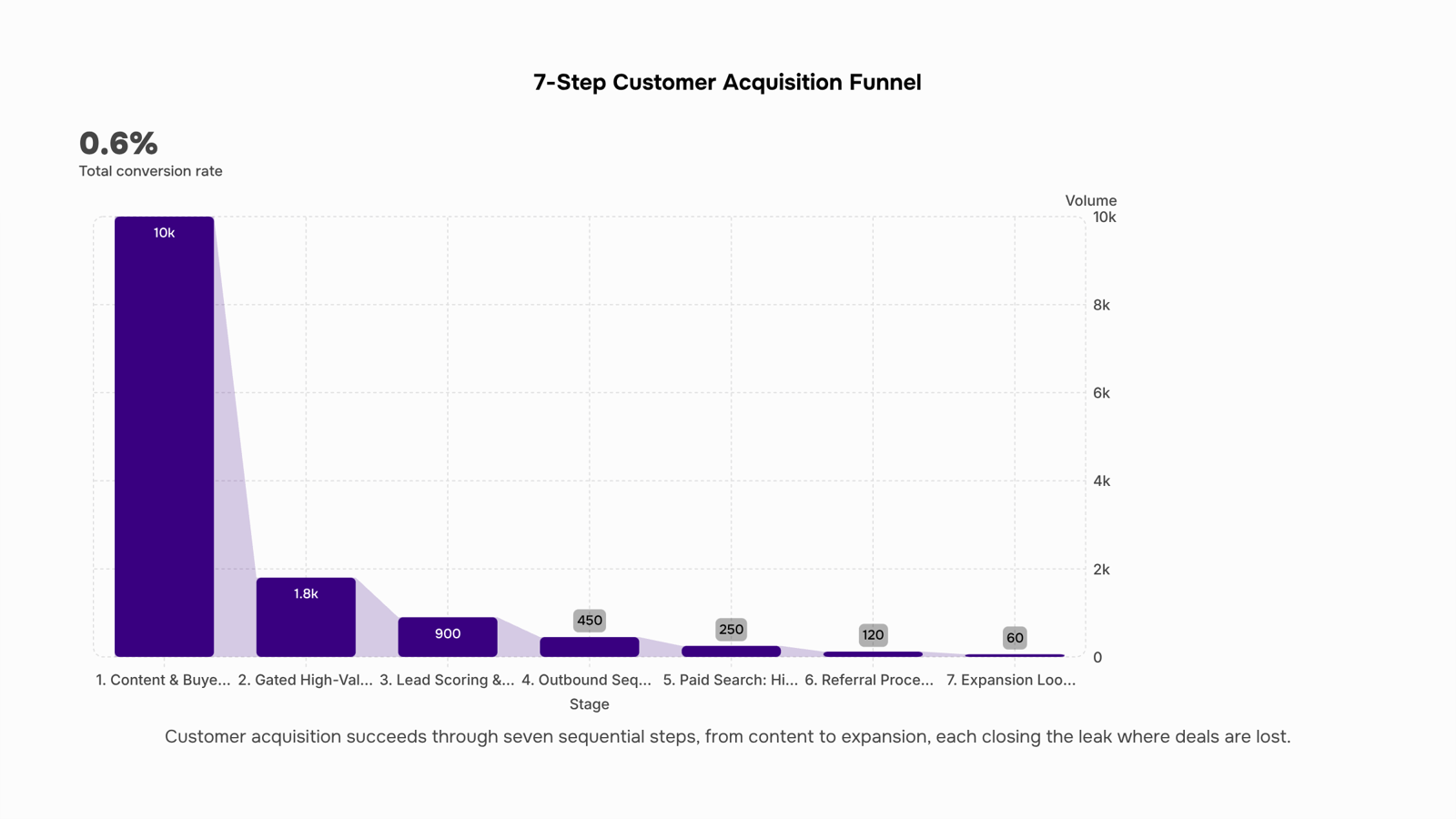
7 customer acquisition strategies that move the needle
These seven strategies address the three failure points directly: slow response, unqualified routing, and no follow-up sequence. Work through them in order. The early steps build the pipeline; the later ones protect it.
Publish content that answers real buyer questions: IT buyers search for solutions before they search for vendors. A managed services company that publishes a guide on "how to reduce IT downtime for a 50-person office" will appear when that buyer is in research mode. Start with three to five questions your sales team hears on every first call, and build content around those. For a deeper look at building this pipeline, 10 proven lead generation strategies covers the channel mix in detail.
Gate one high-value asset behind a form: A checklist, audit template, or benchmark report converts anonymous traffic into named leads. Keep the form short: company name, email, and company size is enough to qualify at this stage. One IT consultancy using a "cloud readiness assessment" PDF saw form completions convert at roughly 18%, well above typical gated content benchmarks.
Score and route leads the moment they arrive: This is where most IT companies lose deals. A lead that fills out a form at 9 a.m. and gets a call at 4 p.m. is already cold. Set up scoring rules based on company size, job title, and page behavior, then route high-intent leads to a rep automatically. InsideSales research found that contacting a lead within five minutes makes conversion roughly 9× more likely than waiting 30 minutes.
Run a structured outbound sequence to your target accounts: Inbound alone rarely fills a pipeline for IT services firms. Build a sequence of four to six touches across email and LinkedIn over two to three weeks, each adding a different angle: a case study, a relevant stat, a short audit offer. The goal is a 15-minute call, not a sale. B2B email lead nurturing strategies has sequence templates you can adapt directly.
Run paid search against high-intent keywords: "Managed IT services [city]" and "IT support for [industry]" keywords convert because the buyer is already looking. Keep budgets tight at first, $500 to $1,000/month, and measure cost per meeting booked rather than cost per click. This gives you a CAC number you can compare against your average contract value.
Build a referral process, not just a referral hope: Most IT firms get referrals passively. A simple process, asking satisfied clients at the 90-day mark and again at renewal, with a clear ask and a small incentive, turns a random event into a repeatable channel. Referred customers typically close faster and churn less, which directly lowers your blended customer acquisition cost.
Create an expansion loop from existing accounts: New customer acquisition is expensive. Selling an additional service to a current client costs a fraction of winning a new one. Map your client base by service coverage, identify accounts using only one of your offerings, and run a quarterly outreach to those gaps. This is the fastest path to revenue growth that most IT owners overlook. For the retention side of this equation, a 6-step retention system for IT firms walks through how to structure it.
The sequence matters. Steps one through three build inbound flow and fix the response-time problem. Steps four and five add outbound volume and give you real CAC data. Steps six and seven close the loop so acquisition costs drop over time as your base grows.
How email marketing fits your acquisition strategy
Email sits at the intersection of your inbound and outbound work, which makes it one of the most cost-efficient channels in any new customer acquisition plan.
The basic mechanics: a prospect downloads a resource, enters a nurture sequence, and receives three to five emails spaced over two to three weeks. Each email addresses a specific objection or use case. The final one asks for a meeting. For IT companies, that sequence might move from "here's the security risk you're ignoring" to "here's how a team like yours fixed it" to a direct ask.
Personalization matters more than volume. Emails referencing the recipient's industry or a specific trigger (a job posting, a funding round, a product launch) consistently outperform generic blasts. You don't need to personalize every word, just the opening line and the offer.
Three metrics tell you whether the sequence is working:
Open rate (above 30% suggests your subject line and sender name are credible)
Reply rate (above 3% means the message is resonating)
Meetings booked (the only number that connects email to your customer acquisition strategy)
For a deeper look at building sequences that convert, these B2B email strategies cover the structure in more detail.
Customer acquisition vs. customer retention: where to put your budget
Most IT service businesses spend heavily on acquisition while underinvesting in retention, even though retaining an existing client typically costs five times less than winning a new one (Bain). That gap matters when your average cost per customer acquisition in B2B SaaS runs $200–$400 or higher, depending on channel mix.
A simple rule: if your annual churn rate is above 10%, fix retention first. New customers you win will leak out as fast as you bring them in, and your customer acquisition costs compound the damage.
If churn is under control, shift budget toward acquisition. Improving account retention and managing the retention side of the relationship are worth reading before you scale spend.
The practical split most IT company owners land on: 60–70% acquisition, 30–40% retention, adjusted quarterly based on churn data.
Fragmented acquisition stacks quietly inflate CAC. When lead capture, qualification, routing, and follow-up each live in separate tools, manual handoffs introduce delays, and research from InsideSales suggests responding to a lead within five minutes versus 30 increases conversion rates significantly.
Lio handles lead capture and scoring; Evox runs the follow-up sequences automatically. Together, they remove the gap where most leads go cold. Your lead generation strategies and email nurturing tactics feed one connected system instead of three disconnected ones, which keeps your customer acquisition strategy consistent without adding headcount.
Closing
The gap between a strong acquisition strategy on paper and one that actually lowers CAC is almost always operational. Leads need to be captured, qualified, and routed before the window closes—and most IT firms lose deals in that handoff, not in targeting or messaging. Response time, lead scoring, and follow-up sequences determine whether your pipeline converts or goes cold.
That's where the real leverage lives. You can optimize channels endlessly, but if a qualified lead sits in your inbox for four hours, your acquisition cost stays high and your conversion rate stays flat. Lio automates that entire layer: capturing leads, scoring them based on fit, and routing them to the right person instantly. Start with a free trial and see how much of your current pipeline you're leaving on the table.


 Elena Petrova15 September 2026


