TL;DR: Most role-definition articles read like a job posting. This one connects each responsibility to a measurable output, maps the right tools to each duty, and shows IT company owners exactly what an email marketing manager produces — and what gaps they leave when the role is understaffed or undefined. You'll finish with a clear picture of whether this hire fits your current stage.
What an email marketing manager actually is
An email marketing manager owns the full lifecycle of a company's email channel: strategy, execution, deliverability, and revenue attribution. The title sounds tactical, but the job is fundamentally about pipeline. Every campaign, nurture sequence, and triggered send either moves a prospect closer to a signed contract or it doesn't.
What separates a strong hire from an average one is accountability to outcomes, not activity. A capable email marketing manager doesn't report on emails sent. They report on open rates, click-to-pipeline ratios, and what percentage of closed deals touched an email sequence in the last 90 days.
The role sits at the intersection of copywriting, data analysis, and campaign management best practices. In practice, that means the person needs to read a deliverability report, rewrite a subject line, and brief a designer in the same afternoon. The skills required to be an effective email marketing manager span both technical and creative domains, which is why the role is harder to staff than most job postings suggest.
For IT company owners, the clearest way to evaluate this hire: can they connect a specific campaign decision to a revenue number? If yes, you have the right person.
Core responsibilities of an email marketing manager
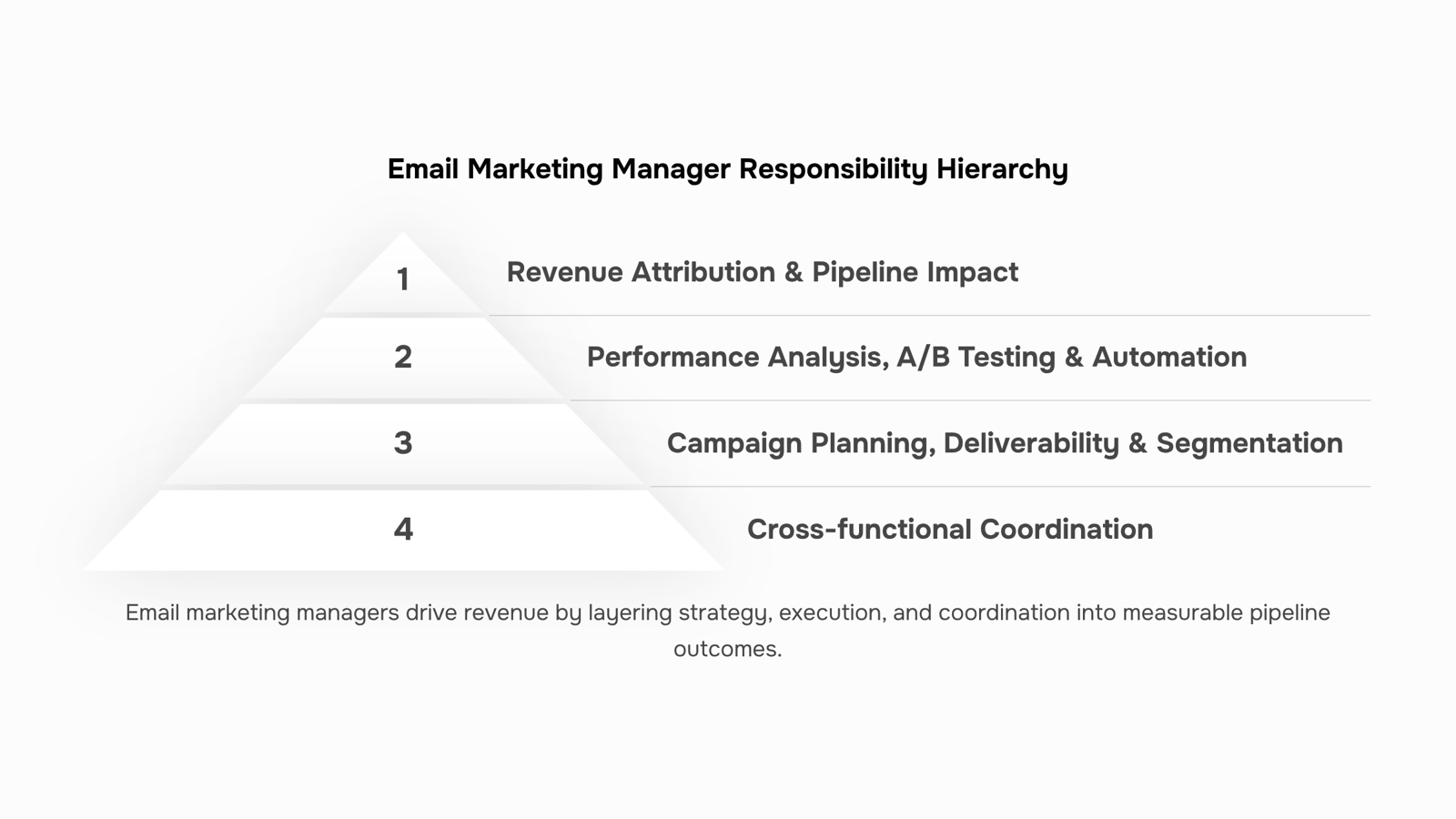
An email marketing manager carries six to eight distinct responsibilities, and each one connects directly to a number you can measure.
List strategy and segmentation is where pipeline starts. The manager decides which contacts receive which messages, based on firmographic data, behavior, or stage in the buying cycle. Poor segmentation is the fastest way to inflate unsubscribes and suppress deliverability scores, so this decision has consequences beyond open rate.
Campaign planning and execution covers the end-to-end build: copy brief, template selection, send scheduling, and QA before deployment. A manager who runs this tightly reduces the gap between "campaign approved" and "campaign live" from days to hours. That speed matters when your sales team is working a time-sensitive deal.
Deliverability management is the technical layer most hiring managers underestimate. The role owns DNS records (SPF, DKIM, DMARC), sender reputation monitoring, and bounce handling. One misconfigured record can land an entire domain in spam, which means zero revenue from email until the issue is resolved.
Performance analysis and reporting translates raw data into decisions. Open rate, click-to-open rate, conversion rate, and revenue attributed to email are the numbers that matter. A strong manager presents these with context, not just as a dashboard screenshot, so the business knows what to do next.
Automation and nurture sequence design determines how leads move through the pipeline without manual intervention. This is where how automated email marketing works becomes a daily operational concern, not a concept. A well-built nurture sequence can move a cold contact to a sales-qualified lead in two to three weeks with no human touch required.
A/B testing and optimization is ongoing, not a one-time project. Subject lines, send times, CTA placement, and offer framing all get tested in rotation. Over a quarter, systematic testing typically produces measurable lift in click-through rate.
Cross-functional coordination rounds out the role. The manager aligns with sales on lead handoff criteria, with content on asset production timelines, and with product on feature announcement timing. Without this coordination, campaigns go out of sync with the rest of the business.
For IT company owners evaluating email marketing manager responsibilities before making a hire, the practical question is which of these seven functions your current setup handles well and which ones are gaps. The next section covers the campaign management best practices and specific skills that separate a high-performing manager from one who just keeps the lights on.
Skills required to be an effective email marketing manager
The skills that actually move pipeline fall into two categories: ones that are expected at the door, and ones that separate a good hire from a great one.
Table stakes first: Any candidate should arrive knowing how to build and segment lists, write subject lines that clear spam filters, and read a campaign report without hand-holding. Familiarity with HTML email structure matters too, even if they are not writing code daily. These are the floor, not the differentiator.
The skills that drive revenue are harder to screen for:
Deliverability diagnosis: Knowing that open rates dropped is easy. Knowing whether the cause is a reputation issue, a list hygiene problem, or a sending-time mismatch takes pattern recognition built over real campaigns.
Behavioral segmentation logic: High performers build sequences based on what contacts do, not just who they are. That means thinking in triggers, not just demographics.
Copy that converts without sounding like copy: IT buyers read fast and distrust hype. A manager who writes plainly and tests rigorously will outperform one who writes beautifully but never runs a B test.
Data interpretation under ambiguity: Attribution in email is messy. The best managers make confident decisions with incomplete data rather than waiting for a clean picture that never arrives.
On the soft-skills side, cross-functional communication matters more than most job postings admit. An email marketing manager coordinates with sales on lead handoffs, with product on launch timing, and with IT on domain authentication. Friction in any of those relationships slows campaigns.
For a broader view of how these skills apply one level down, the skills that make email marketing specialists effective covers the execution layer in more detail.
Most email marketing managers work across four or five tool categories simultaneously. Knowing what those categories are — and which ones eat the most time — helps you hire smarter and set realistic expectations for the role.
Email service providers (ESPs) are the foundation. Platforms like Mailchimp, Klaviyo, or HubSpot handle list management, template building, and send scheduling. A manager spends time here daily, but the real differentiator is knowing how to read deliverability data, not just hit "send."
Analytics and reporting tools sit alongside the ESP. Google Analytics 4, combined with UTM tracking inside the ESP, tells the manager which campaigns drove site visits and which drove revenue. Without this pairing, campaign performance reports are incomplete.
A/B testing and optimization tools — whether built into the ESP or standalone like Litmus — handle subject line testing, render previews across 90-plus email clients, and spam filter checks. Skipping this step is one of the most common reasons open rates plateau.
CRM integration is where many setups break down. When the email platform doesn't sync cleanly with the CRM, lead status updates lag, follow-up sequences misfire, and sales blames marketing for cold leads that were never actually cold.
This is where a platform like Evox changes the daily workflow. Evox combines a lead CRM with multi-step email campaigns and two-way inbox sync, so the manager isn't manually reconciling data between systems. Automated lead nurturing runs in the background while the manager focuses on strategy and copy.
For AI-powered tools that support this role, the category is expanding fast, but the highest-value use cases remain sequence personalization and send-time optimization.
The tools an email marketing manager uses daily are only as effective as the processes connecting them. Fragmented stacks create manual overhead; integrated ones free up the hours that go toward campaign management best practices.
What an email marketing manager typically earns in 2026
Salary ranges for email marketing manager jobs vary more than most job boards suggest, so it helps to anchor expectations before you post a role.
In the US, the median email marketing manager salary sits between $65,000 and $85,000 annually, based on aggregated data from Glassdoor and LinkedIn Salary (2025). The full range runs from roughly $52,000 at smaller companies to $110,000 or more at enterprise tech firms. In the IT and technology sector specifically, compensation skews toward the upper half of that band, particularly when the role owns automation workflows or manages a dedicated sending infrastructure.
A few factors move the number meaningfully:
Company size: A 20-person IT firm typically pays $60,000–$72,000. A 200-person SaaS company often pays $80,000–$95,000 for the same title
Scope: Managers who own deliverability, segmentation, and tool selection command more than those executing campaigns inside a rigid template
Certifications: HubSpot and Google Analytics credentials appear in a majority of 2025 job postings and correlate with higher offers
If you want the role to attract someone with the skills required to be an effective email marketing manager, budget at the midpoint or above. Underpaying for this role usually means hiring someone who treats it as a stepping stone.
How to become a successful email marketing manager
Start with hands-on execution, not credentials. Most hiring managers reviewing candidates for this role care far more about what you've shipped than what you've studied.
Build your foundation in three areas:
Campaign execution: Run real campaigns, even small ones. A/B test subject lines, track open rates, and document what moved the needle. Hiring managers want to see that you understand campaign management best practices, not just the theory behind them.
Technical fluency: Learn how automated email marketing works inside at least one major platform. Klaviyo, HubSpot, and Mailchimp are the most common starting points. Certifications from HubSpot Academy or Google Analytics appear in a majority of job postings and take under 10 hours to complete.
Analytical habit: Get comfortable in a spreadsheet before you touch a dashboard. Revenue-per-email, list growth rate, and unsubscribe trends are the numbers that connect your work to business outcomes.
If you're searching for an email marketing manager role near you, prioritize companies where email is a primary revenue channel, not a support function. That's where the role carries real scope.
The skills required to be an effective email marketing manager go deeper on the analytical side if you want to pressure-test your current gaps.
Closing
An email marketing manager isn't a coordinator who sends campaigns—they're a pipeline operator who connects every send to revenue. The role demands technical depth (deliverability, segmentation, automation), creative rigor (copy that converts, systematic testing), and cross-functional discipline (sales alignment, product timing). If your current setup treats email as a volume game rather than a precision channel, this hire closes that gap fast.
The tools exist to support this work, but only if someone owns the strategy. Evox handles the automation, inbox monitoring, and campaign sequencing that frees your manager to focus on the decisions that move deals. Ready to see how it works? Take a quick product tour and watch how the platform handles the operational layer—so your team can focus on strategy.
FAQ
Q. What does an email marketing manager do?
A. They own the full email lifecycle: strategy, execution, deliverability, and revenue attribution. The role connects each campaign decision to measurable pipeline outcomes, not just activity metrics.Q. What skills are required to be an effective email marketing manager?
A. Table stakes: list building, subject line writing, campaign reporting. Revenue drivers: deliverability diagnosis, behavioral segmentation, conversion-focused copy, and data interpretation under ambiguity. Cross-functional communication ties it together.Q. What tools does an email marketing manager use?
A. Email service providers (Mailchimp, Klaviyo, HubSpot), analytics platforms (Google Analytics 4), A/B testing tools (Litmus), CRM integration, and automation platforms that handle nurture sequences and triggered sends.Q. How much does an email marketing manager typically earn?
A. The article does not provide salary data. Compensation varies by geography, company size, and experience level; research current market rates for your region.Q. How can I become a successful email marketing manager?
A. Master list segmentation, deliverability mechanics, and A/B testing fundamentals first. Then develop behavioral segmentation logic, data interpretation skills, and cross-functional communication—these separate good managers from great ones.


 Elena Petrova15 September 2026


