TL;DR: Most sales funnel articles define the stages and stop there. This one shows IT company owners what should happen at each stage, what breaks when it doesn't, and how to build a funnel your team can actually run without losing leads between steps.
What a sales funnel is
A sales funnel maps the path a buyer takes from first hearing about your company to signing a contract. It tracks the buyer's journey, not your internal deal status. That distinction matters: a sales pipeline shows where your deals are; a sales funnel shows where your buyers are mentally, and why some drop off before they ever become deals.
Most IT services companies lose prospects in the gap between initial contact and a real conversation. Understanding your funnel is how you find that gap and close it. If you want a deeper look at where leads fall through, this breakdown of common funnel leaks is worth reading alongside this article.
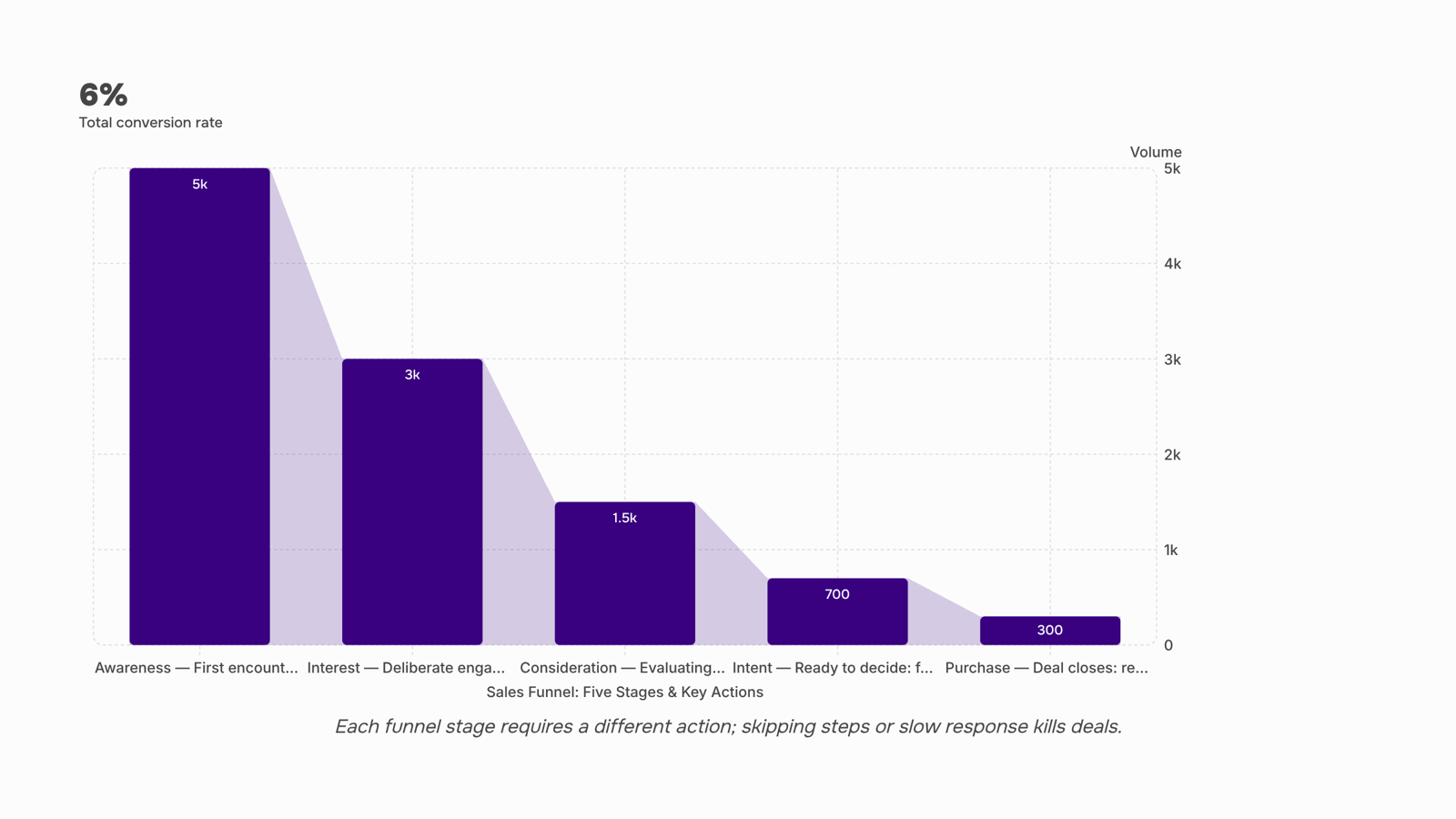
Sales funnels typically run five stages: Awareness, Interest, Consideration, Intent, and Purchase. Each stage reflects a shift in the buyer's thinking, and each one requires a different response from your sales team. The next section walks through all five with concrete examples from an IT services context, so you can see exactly what "moving a prospect forward" looks like at each point. For context on what qualifies a lead before they enter the funnel, see this qualification framework.
The five stages of a sales funnel
Each stage of a sales funnel represents a distinct shift in buyer psychology. Your job at every stage is different, and conflating them is where most IT sales teams lose deals they should have won.
Awareness is when a prospect first encounters your company. In an IT services context, this might be a CTO clicking a LinkedIn post about managed security services or landing on your site after searching "IT support for fintech companies." You cannot sell here. The one thing to do: make sure your message names the problem clearly enough that the right person recognizes themselves in it.
Interest is when that prospect starts engaging deliberately, reading case studies, watching a demo video, or opening your emails more than once. At this stage, an IT buyer is quietly asking, "Is this vendor worth my time?" The one thing to do: give them something specific enough to hold attention, a benchmark, a comparison, a short technical explainer, not a generic brochure.
Consideration is when the prospect is actively evaluating you against alternatives. They may request a capabilities deck, ask about your SLA terms, or loop in a procurement contact. This is the stage where qualifying the lead properly determines whether the next conversation moves forward or stalls. The one thing to do: confirm budget, authority, need, and timeline before investing further sales time.
Intent signals that the prospect is ready to decide. They've asked for a proposal, responded to a pricing question, or scheduled a call with a decision-maker. This is the stage most IT service firms mismanage by going quiet after sending a quote. The one thing to do: follow up within 24 hours and give the prospect a clear next step, not "let me know if you have questions."
Purchase is when the deal closes, but the stage isn't passive. Contract friction, slow e-signature turnaround, or a delayed onboarding kickoff can still kill a deal that was essentially won. The one thing to do: remove every administrative obstacle between verbal agreement and signed contract.
Across all five sales funnel stages, the pattern is the same: each stage has one job, and skipping ahead costs you the deal. A basic sales funnel template maps these stages to your actual pipeline so your team knows exactly what action belongs where. If you want to know where your funnel is already breaking down before you build anything new, the next section covers the three failure points that show up most often.
Where most sales funnels break down
Three failure points account for most of the drop-off in sales funnels that look fine on paper but convert poorly in practice.
Slow first response: Most B2B leads go cold within the first hour after submitting a form or sending an inquiry. If your team takes 24 hours to reply, you're not competing on price or service quality anymore. You've already lost the conversation. This is the single most fixable problem in sales funnel management, and most teams ignore it.
No qualification criteria at entry: When every lead gets treated the same, your best reps spend time on contacts who were never going to buy. A basic qualification framework, even three or four criteria like company size, budget range, and decision-making authority, separates real prospects from noise. If you're not sure what those criteria should be for your IT business, this qualification framework for IT companies is a practical starting point.
No follow-up sequence after initial contact: A single email or call is not a follow-up strategy. Most prospects need five to eight touchpoints before they're ready to buy, but the majority of sales funnels stop after one or two. The lead doesn't say no. It just goes quiet, and no one chases it.
If any of these sound familiar, your funnel isn't broken at the bottom. It's leaking earlier than you think.
How to build a sales funnel that converts
Building a funnel that converts isn't about adding more stages. It's about making each stage intentional. Here are five steps to build one that works.
Map your buyer journey from first touch to closed deal: Before you configure anything, write down every action a prospect takes between discovering you and signing. Most IT company owners find they have 6 to 8 distinct moments. That map becomes your sales funnel stages.
Define entry criteria for each stage: A stage without entry criteria is just a label. Decide what a prospect must have done or said before they move forward. For example: a lead only enters "Proposal" once they've confirmed budget and timeline. Without this, your pipeline fills with contacts that will never buy.
Set a response-time standard at the top of the funnel: Speed at the top matters more than at any other stage. B2B leads contacted within five minutes of submitting a form are significantly more likely to convert than those reached an hour later (InsideSales.com). Pick a target, write it down, and hold your team to it. Thirty minutes is a reasonable starting point for most IT services teams.
Build a follow-up sequence before you need it: Most B2B leads don't convert on first contact, and a large share never receive a second touchpoint at all. A simple three-to-five email sequence, written in advance and triggered by stage entry, removes the gap between lead capture and meaningful engagement. If you want to see what this looks like when it runs automatically, an automated sales funnel setup covers the mechanics in detail.
Measure conversion rate at every stage, not just at the bottom: Knowing your overall lead-to-close rate tells you the outcome. Knowing where prospects drop off tells you what to fix. Track the percentage moving from each stage to the next, and review it monthly.
A sales funnel template can give you a starting structure, but the criteria and standards you set inside it are what determine whether it converts.
How to optimize your funnel for better conversions
Three tactics move the needle more than anything else in sales funnel management.
Tighten your lead qualification criteria: Most IT service companies let too many unqualified leads enter the funnel, which inflates pipeline numbers and buries reps in low-probability work. Define two or three hard entry criteria per stage — company size, budget range, decision-maker access — and enforce them. Fewer leads with higher fit convert at a measurably better rate than a bloated list of maybes.
Shorten response time at the top of the funnel: Speed matters more at the awareness and interest stages than at any other point. Research from InsideSales consistently shows that contacting a lead within five minutes of first touch dramatically increases the chance of a conversation. Every hour you wait, that probability drops. Set a hard response-time standard and track it weekly.
Run a monthly stage-by-stage conversion audit: Pick one sales funnel stage where leads are stalling and ask why. Is the follow-up sequence too long? Is the proposal arriving too late? A single focused fix per month compounds quickly. This is also where a structured sales funnel analysis pays off — it gives you a repeatable method for spotting exactly which stage is leaking revenue before the quarter ends.
Good sales funnel software does four things: captures leads the moment they come in, assigns them to the right rep automatically, tracks movement through each stage, and surfaces conversion data without requiring manual exports. Most teams cobble this together across three or four disconnected tools, which is exactly where leads fall through.
For IT company owners, the gap between lead capture and first contact is where deals die. Effective sales funnel management means that gap is measured in minutes, not days.
Lio's Custom Sales Pipeline Builder is built for this workflow. You define the stages that match your actual sales process, set automatic assignment rules, and get stage-by-stage conversion data without building a separate report. Evox's funnel and conversion reports sit alongside it, so you can see where volume drops and act on it in the same week.
If you sell through an online store, the right sales funnel software for e-commerce has different requirements, but the core logic is the same: visibility at every stage, no manual handoffs.
Closing
Your sales funnel isn't broken because you're missing stages—it's broken because one of those stages isn't running fast enough or isn't being measured. The five-stage framework works. What kills most IT services funnels is slow first response, missing qualification criteria, or leads that go dark after one touchpoint. Fix those three, and your conversion rate climbs without adding complexity.
The biggest leak happens in the first hour after a lead arrives. If your team can't respond within 30 minutes, you're already losing deals. Start there—measure your current response time this week, then test what happens when you cut it in half.
FAQ
Q. What is a sales funnel and how does it work?
A. A sales funnel maps the buyer's journey from first contact to signed deal, tracking their mental shift at each stage. Unlike a pipeline (which shows deal status), a funnel reveals why prospects drop off and where your team needs to act differently.Q. What are the different stages of a sales funnel?
A. The five stages are Awareness (first encounter), Interest (deliberate engagement), Consideration (evaluating alternatives), Intent (ready to decide), and Purchase (closing and onboarding). Each stage requires a different response from your sales team.Q. How do I create an effective sales funnel strategy?
A. Map your buyer's actual journey, define entry criteria for each stage, set a response-time standard (30 minutes or less at the top), build a follow-up sequence in advance, and measure conversion rate between stages monthly, not just at the bottom.Q. How can I optimize my sales funnel for better conversions?
A. Respond to leads within the first hour, qualify prospects at entry to avoid wasting time on unfit contacts, and implement a five-to-eight touchpoint follow-up sequence. Most IT funnels leak because of slow responseQ. What is the difference between a sales funnel and a sales pipeline?
A. A sales pipeline shows where your deals are in your internal process; a sales funnel shows where buyers are mentally and why they drop off. The funnel reveals buyer psychology; the pipeline reveals deal status.


 Elena Petrova15 September 2026


