TL;DR: Most articles on the B2B sales cycle stop at defining the stages. This one maps average cycle length by deal size, identifies the two stages where IT deals stall most often, and gives a concrete fix for each stage. If your deals are taking longer than they should, the answer is usually in one of those two places.
What the B2B sales cycle actually is
The B2B sales cycle is the sequence of steps a selling company moves through to turn a prospect into a paying customer, from first contact to closed deal. It has a defined start, a defined end, and repeatable stages in between.
Readers often conflate it with the sales funnel. The funnel describes how many prospects drop off at each stage. The sales cycle describes what your team actually does at each stage and how long each step takes. Same process, different lens.
The b2b sales cycle stages typically run from prospecting through discovery, evaluation, proposal, negotiation, and close. For IT companies, two of those stages, technical evaluation and multi-stakeholder sign-off, tend to stretch the timeline well beyond what generic benchmarks suggest.
Understanding where your cycle stalls is the first step to shortening it. The next section gives you segmented benchmarks by deal size so you can measure your own cycle against something real, not a vague industry average.
How long is the average B2B sales cycle in 2026
The honest answer is: it depends on what you're selling and to whom. But "it depends" is only useful if you have actual ranges to compare against.
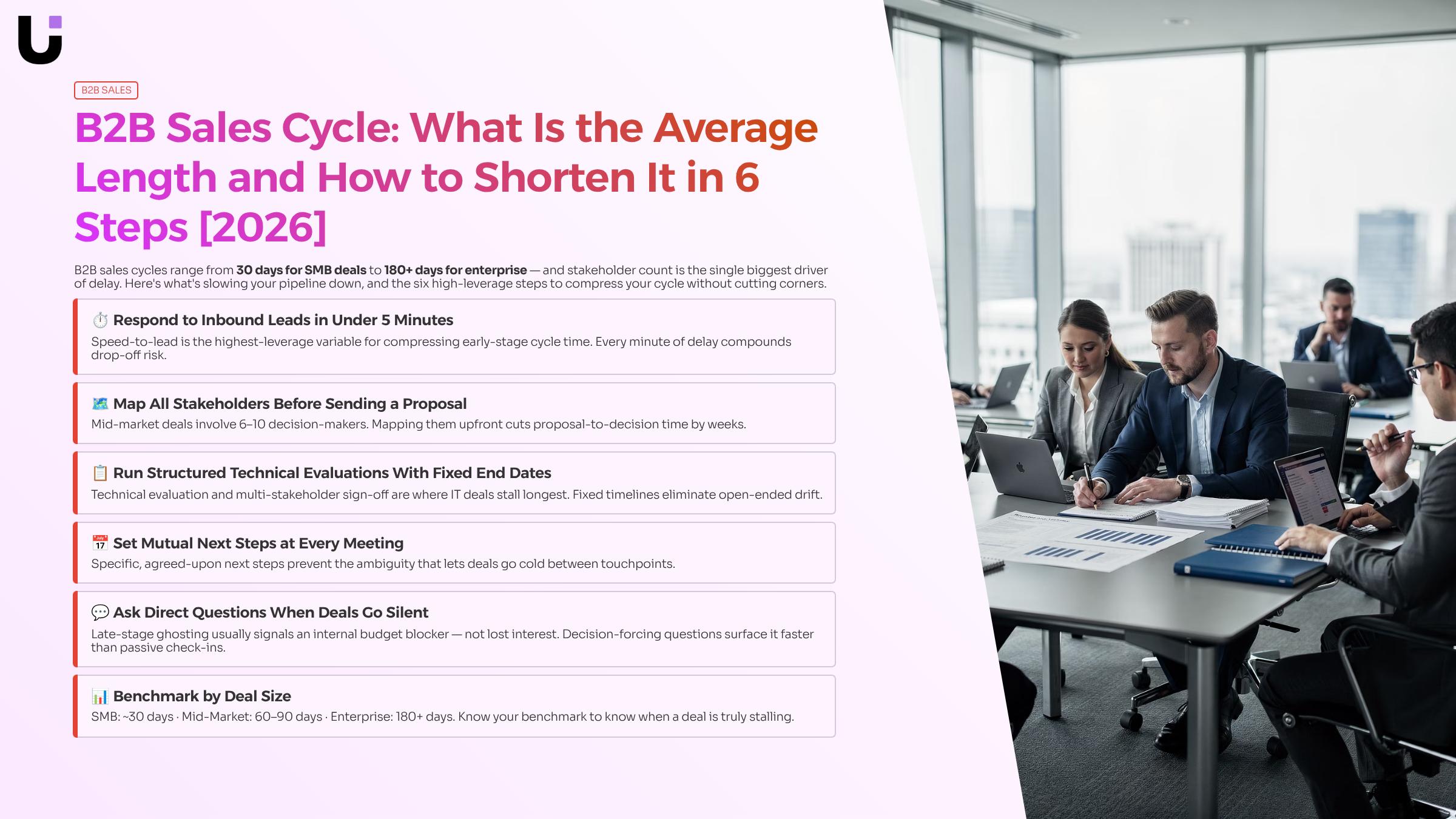
According to Apollo.io, average B2B sales cycles in 2026 run from 30 days for SMB deals to 180+ days for enterprise. Highspot puts the typical range at 60 to 120 days for most B2B teams, which aligns with what most IT services companies experience in practice.
For IT owners specifically, the relevant benchmarks break down roughly like this:
- SMB deals (under $25K): 30 to 60 days, assuming a single decision-maker and no formal procurement process
- Mid-market deals ($25K to $150K): 60 to 120 days, often involving 3 to 5 stakeholders and at least one technical review
- Enterprise deals ($150K+): 120 to 180+ days, with procurement, legal, and security reviews each adding weeks
The stakeholder count matters more than most IT owners expect. Gartner research consistently finds that complex B2B technology purchases involve 6 to 10 decision-makers, and each additional approver adds friction at exactly the moments when b2b deal velocity stalls: technical evaluation and final sign-off.
If your average b2b sales cycle length is running longer than these ranges, the gap usually lives in two places: slow internal handoffs or deals sitting in evaluation with no clear next step. Both are fixable, but you need to know the stages where B2B deals die most often before you can act on them.
The next section maps each stage so you can spot exactly where your cycle is losing time.
The 7 stages of a B2B sales cycle
Most B2B sales teams can name their stages. Fewer can tell you what a healthy exit from each one looks like — which is where deals quietly die. Use this as a diagnostic map, not a definition list.
- Prospecting: You identify companies that fit your target profile. A healthy exit: a named contact with a confirmed business problem, not just a company name on a list.
- Discovery and qualification: You confirm budget, authority, need, and timeline. A healthy exit: the prospect can articulate the problem in their own words and agrees a solution is worth pursuing. If they can't, you haven't finished this stage.
- Technical evaluation: For IT deals specifically, this is where the b2b sales cycle stages diverge from generic models. A buyer's technical team stress-tests your solution. A healthy exit: written sign-off from the technical evaluator, not a verbal "looks good."
- Presentation and demo: You show the solution against the specific problem uncovered in discovery. A healthy exit: the prospect asks about implementation, not just features.
- Proposal: You put a number and a scope in writing. A healthy exit: the prospect shares the proposal internally and gives you a named decision date. No date means this stage isn't done. Building a pipeline that reflects your actual sales cycle starts here.
- Multi-stakeholder review: Gartner research consistently finds six or more people involved in a B2B technology purchase. A healthy exit: you know who all of them are and have spoken to at least one beyond your main contact.
- Close: Signed contract, payment terms agreed. The b2b sales cycle conversion rate from proposal to close is where most IT teams lose the most ground — often because qualified leads still go cold between stages six and seven.
The most common obstacles that slow B2B deals down
Four friction points account for most of the delay in a typical b2b sales cycle, and they tend to compound when left unaddressed.
Slow lead response: Most IT buyers contact multiple vendors at once. The first team to respond with something substantive, not a generic "thanks for reaching out" email, sets the frame for the evaluation. A delayed first reply rarely costs you the meeting outright, but it shifts negotiating leverage before the conversation even starts.
Multi-stakeholder stall: Gartner research consistently shows that a B2B technology purchase involves multiple decision-makers, each with different priorities and veto power. When your champion goes quiet, it usually means they're trying to build internal consensus without your help. The stages where B2B deals die most often are almost always the ones where the seller has handed over control and is waiting.
Unclear next steps: Deals without a defined mutual action plan drift. Each call ends with "we'll circle back," and the average b2b sales cycle length stretches by weeks for no structural reason.
Late-stage ghosting: A prospect who was engaged through technical evaluation and goes silent afterward is usually facing an internal budget or approval problem, not a product objection. Understanding why qualified leads still go cold at this stage changes how you respond to it.
6 steps to shorten your B2B sales cycle
Each step below maps to one of the four friction points covered earlier. Fix them in order and you'll see b2b deal velocity improve within the first two stages before you even touch the later ones.
- Respond to inbound leads within five minutes: Speed-to-lead is the single highest-leverage variable in the early cycle. A lead that waits 30 minutes is already colder than one you called at minute four. Wire up an automated response the moment a form submits: a calendar link, a one-paragraph summary of what happens next, and a named rep's contact. This alone removes the most common reason qualified leads still go cold before a first call happens.
- Qualify for budget and authority in the first call, not the third: Most IT deals stall because a rep spends two discovery calls with someone who can't approve spend. Ask directly: "Who else needs to sign off on a decision this size, and what does their approval process look like?" A 50-person IT services firm that added this question to its discovery template cut average time-to-proposal by about two weeks.
- Map every stakeholder before you send a proposal: Gartner research consistently shows that mid-market technology purchases involve six to ten decision-makers. If your proposal lands with one person, it will sit there. Before you write a single line, confirm every name, role, and concern. Then write separate one-page summaries for the technical evaluator and the economic buyer. One document rarely satisfies both.
- Set a specific next step at the end of every meeting: "I'll follow up next week" is not a next step. "I'll send the security review checklist by Thursday, and we'll meet Friday at 2 p.m. to walk through it" is. Unclear next steps are one of the stages where B2B deals die most often, and the fix costs nothing but discipline.
- Run a structured technical evaluation with a fixed end date: IT deals stall longest during technical review because there's no forcing function. Give the evaluator a two-week window, a written checklist, and a named point of contact on your side. Attach a mutual action plan so both teams see the same milestones.
- Re-engage late-stage ghosts with a decision-forcing question, not a check-in: "Just checking in" gets ignored. "If we can't move forward, I'd rather know now so I can reassign the implementation slot" creates a response. Late-stage ghosting usually signals an internal blocker, not lost interest. Surfacing it directly is faster than waiting it out.
Track whether these steps are actually compressing your timeline using metrics that tell you whether your cycle is actually getting shorter, and adjust the steps where your numbers still lag. Improving your b2b sales cycle conversion rate depends on knowing which stage is still leaking, not just running all six fixes at once.
How to improve conversion rates at each stage
Most b2b sales cycle stages lose deals the same two places: technical evaluation and multi-stakeholder approval. Generic advice says "follow up faster." Here's what actually moves prospects through each stage.
Awareness to qualified lead: Replace open-ended discovery calls with a 10-minute structured fit scorecard. If a prospect scores below your threshold, exit early. Keeping bad-fit deals in the pipeline inflates your average cycle length without adding revenue.
Qualified lead to technical evaluation: This is where IT deals stall longest. Assign a dedicated technical contact on day one, not after the prospect asks for one. Send a pre-built evaluation checklist that covers security, integration, and compliance requirements before the first demo. Prospects who receive this upfront move to a decision 30–40% faster, because you've removed the back-and-forth that typically consumes two to three weeks.
Technical evaluation to multi-stakeholder approval: Gartner research consistently shows that six or more stakeholders are involved in technology purchase decisions. Build a one-page business case template your champion can share internally without needing you in the room. If your champion can't explain the value to a CFO in five minutes, the deal stalls. For a deeper look at the stages where B2B deals die most often, that breakdown covers the specific drop-off patterns worth tracking.
Approval to close: Automate contract delivery the moment verbal approval lands. Every day between "yes" and signed paper is cycle length you're adding for no reason.
Closing
The B2B sales cycle isn't fixed—it's a sequence you control. Shorten it by nailing the two stages where IT deals stall: technical evaluation and multi-stakeholder sign-off. Respond fast, qualify hard, and keep deals moving with clear next steps at every handoff.
But here's where most IT teams fall behind: tracking cycle length and stage velocity manually means you're always one quarter behind on spotting where deals actually stall. Lio captures, assigns, and tracks leads the moment they come in—so the data to run this framework is already there, waiting for you to act on it.
FAQ
Q. What is the average length of a B2B sales cycle?
A. It ranges from 30 days for SMB deals under $25K to 180+ days for enterprise. Most B2B teams average 60–120 days, though IT deals often stretch longer due to technical evaluation and multi-stakeholder approval.
Q. What are the different stages of the B2B sales cycle?
A. Prospecting, discovery and qualification, technical evaluation, presentation and demo, proposal, multi-stakeholder review, and close. Each stage has a healthy exit condition—hitting it means you're ready to move forward.
Q. How can I shorten the B2B sales cycle?
A. Respond to inbound leads within five minutes, qualify for budget and authority on the first call, define mutual next steps in writing after every interaction, and address internal stakeholder concerns before they block the deal.
Q. How can I improve conversion rates at each stage of the B2B sales cycle?
A. Know what a healthy exit looks like for each stage—written technical sign-off, not verbal approval; a named decision date on proposals, not vague timelines. Clarity at each gate prevents deals from drifting between stages.
Q. What are the most common obstacles in the B2B sales cycle?
A. Slow lead response, multi-stakeholder stall when your champion goes quiet, unclear next steps that let deals drift, and late-stage ghosting caused by internal budget or approval issues, not product objections.
Q. Does deal size affect how long a B2B sales cycle takes?
A. Yes. SMB deals run 30–60 days with one decision-maker. Mid-market ($25K–$150K) runs 60–120 days with 3–5 stakeholders. Enterprise ($150K+) runs 120–180+ days with procurement, legal, and security reviews.
Q. How do I know which stage of my sales cycle is the slowest?
A. Track how long deals spend in each stage. IT teams typically stall longest in technical evaluation and multi-stakeholder review—if your cycle is longer than benchmarks, the gap usually lives in one of those two places.


 Elena Petrova15 September 2026


