TL;DR: Most content on lifecycle marketing stops at the stage names. This article maps each stage to specific email sequences, CRM triggers, and lead-scoring rules you can wire up without a dedicated marketing team. If you run an IT company and want to know what actually happens inside the automation, this is the operational breakdown.
What is lifecycle marketing?
Lifecycle marketing is a strategy that sends the right message to a customer based on exactly where they are in their relationship with your business — not based on when your team has time to send a campaign.
Traditional campaign-based marketing treats your entire list the same way. Lifecycle marketing treats each contact as an individual moving through predictable stages: stranger, prospect, first-time buyer, repeat customer, at-risk account. Each stage has a specific trigger — a signup, a purchase, 60 days of silence — and a specific action tied to that trigger in your CRM.
That distinction matters in measurable terms. Behavior-triggered emails consistently outperform batch sends on open rates, and retaining an existing customer costs significantly less than acquiring a new one. The gap exists because lifecycle marketing responds to what a customer actually did, not what a marketer assumed they might want.
This is also why lifecycle marketing is inseparable from CRM data. Without a system tracking behavior, purchase history, and engagement signals, you're guessing at stage. With it, you're running a customer retention management system that compounds over time.
Lifecycle marketing sits at the intersection of a strong inbound marketing strategy and a marketing automation workflow — the concept only works when both are in place.
How does the customer lifecycle marketing process work?
The process runs in a loop, not a line. Each stage has a specific trigger (something the customer does or doesn't do) and a specific action your system takes in response. Here's how it maps out.
Awareness. A prospect finds you through search, an ad, or a referral. The trigger is a first-touch event — a page visit, a form fill, a content download. Your CRM creates a new contact record and tags the lead source. The action: enroll them in a short introductory sequence that matches the channel they came from.
Acquisition. The lead engages — opens emails, revisits pricing, books a demo. CRM status moves from "new" to "qualified." The trigger is behavioral: a score threshold crossed, or a high-intent page visited twice. The action: route to a rep or trigger a conversion-focused sequence. This is where inbound marketing strategy and CRM data start working together.
Onboarding. The deal closes. Status flips to "customer." The trigger is a closed-won event in the CRM. The action: a timed onboarding sequence — day 1, day 3, day 7 — each email tied to a specific activation milestone, not a calendar date.
Retention. Usage signals (or the absence of them) drive this stage. A customer who hasn't logged in for 14 days gets a re-engagement email. One who just hit a usage milestone gets an upsell prompt. A solid customer retention management system makes these triggers automatic, not manual.
Advocacy. High engagement score plus a positive NPS response triggers a referral or review request. The action is timed: ask too early and you damage the relationship; ask after a clear win and conversion rates climb.
What separates customer lifecycle marketing from campaign-based marketing is this: every action is conditional on what the customer actually did, not on what week it is. A marketing automation workflow built on CRM lifecycle data removes the guesswork entirely.
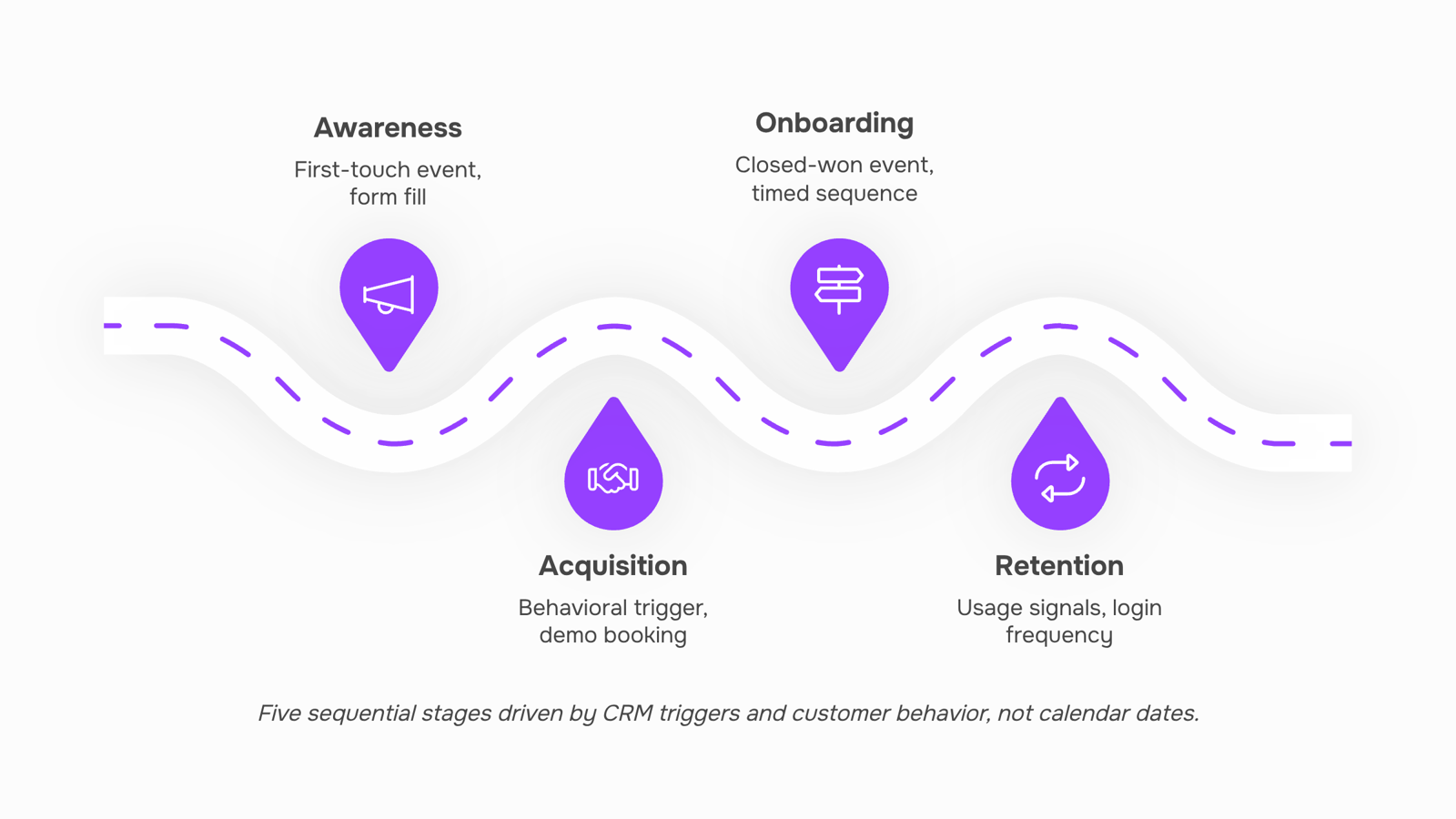
Key stages of the customer lifecycle
Awareness
A prospect encounters your brand for the first time. In your CRM, this is the moment a contact record is created — typically triggered by a form fill, ad click, or content download. Your inbound marketing strategy determines how many of these contacts arrive already educated versus cold.
Acquisition
The prospect takes a meaningful action: books a demo, starts a trial, or requests a quote. CRM status moves from "lead" to "qualified lead" or "opportunity." This is where lifecycle marketing diverges from traditional campaign thinking — instead of blasting a list, you trigger the next message based on what the contact actually did.
Onboarding
The contact becomes a customer and needs to see value quickly. CRM status shifts to "active customer," and a behavior-triggered sequence begins — not a generic welcome series, but one that responds to what the customer has and hasn't done inside your product. Behavior-triggered emails consistently outperform batch sends on open rates, which is why this stage rewards marketing automation workflows over manual outreach.
Retention
The customer is active, but engagement can drift. CRM data flags the signal: login frequency drops, feature usage stalls, support tickets spike. A solid customer retention management system catches these signals before churn becomes a decision. Retention is where lifecycle marketing pays its clearest dividend — keeping an existing customer costs significantly less than acquiring a new one.
Advocacy
The customer renews, expands, or refers others. CRM status updates to "advocate" or "champion," and your lifecycle program shifts to referral sequences, case study requests, or upsell campaigns. This stage only works if the previous four were executed well — advocacy is an outcome, not a tactic you can manufacture.
Each status change is a handoff instruction. Miss it, and the right message goes out at the wrong time, or not at all. That gap is where most SaaS marketing strategies quietly lose revenue.
Benefits of lifecycle marketing for service businesses
Five outcomes stand out when service businesses shift from one-off campaigns to customer lifecycle marketing.
Higher retention revenue: Customers who receive stage-matched communication stay longer. Retention typically costs five to seven times less than acquiring a new account, so even modest improvements compound quickly against your acquisition spend.
Better email engagement: Behavior-triggered emails, sent when a CRM status changes rather than on a broadcast schedule, consistently outperform batch sends on open and reply rates. Your marketing automation workflow becomes measurable because each trigger maps to a specific stage.
Shorter sales cycles on expansion: When onboarding and retention sequences run automatically, reps enter upsell conversations with warm, already-educated contacts rather than cold ones.
Cleaner pipeline data: Tying each lifecycle stage to a CRM status change means your pipeline reflects real buyer behavior, not guesswork. A customer retention management system built on that data gives you early warning before churn happens.
Predictable advocacy: Clients who move through a structured advocacy stage refer at higher rates than those who receive ad-hoc outreach.
Evox automates the CRM triggers and email sequences behind each of these outcomes.
How lifecycle marketing differs from traditional marketing
The core difference is scope. Traditional campaign-based marketing asks "who should receive this message right now?" Lifecycle marketing asks "where is this person in their journey, and what do they need next?"
Dimension | Traditional marketing | Lifecycle marketing |
|---|
Trigger | Calendar or budget cycle | Customer behavior or CRM signal |
Goal | Maximize reach per campaign | Move each contact to the next stage |
Measurement | Opens, clicks, campaign ROI | Retention rate, CLV, stage progression |
Personalization | Segment-level (industry, title) | Individual-level (actions, timing, history) |
Relationship model | Transactional | Continuous |
Campaign-based approaches treat every send as a standalone event. A lifecycle approach treats each email as one step in a longer sequence, where what a contact did last week determines what they receive this week.
That distinction matters most when you're trying to reduce churn. A well-structured customer retention management system depends on knowing which customers are drifting before they cancel, not after. Campaigns can't surface that signal. CRM-connected lifecycle sequences can.
If you're building the underlying marketing automation workflow, the table above is where to start scoping what needs to change.
How IT firms use lifecycle marketing in real workflows
Two scenarios show how this plays out in practice.
Scenario 1: Managed services onboarding: A new client signs a contract. That event fires a CRM trigger in Evox, which starts a 6-email onboarding sequence: welcome email on day 1, service overview on day 3, first check-in prompt on day 7. Each email is conditional. If the client opens the day-3 email but doesn't book the check-in, Evox sends a follow-up on day 9. If they book, that branch stops. No manual tracking. No dropped handoffs.
Scenario 2: Renewal risk detection: A client's support ticket volume spikes in month 10 of a 12-month contract. That behavioral signal updates their CRM lifecycle stage from "active" to "at-risk." Evox triggers a sequence: a personal note from the account manager, then a case study showing how a similar firm resolved the same issue, then a renewal offer with a service upgrade. The sequence runs automatically. The rep gets notified only when the client replies.
Both workflows depend on the same foundation: CRM data driving email timing, not a calendar. That's what separates effective IT lifecycle management from one-off campaigns. Behavior-triggered emails consistently outperform batch sends on open rates, and the gap widens the more granular your CRM lifecycle marketing data gets.
How AI is changing lifecycle marketing in 2026
AI is shifting lifecycle marketing from rule-based sequences to systems that respond to actual behavior. The difference is measurable: behavior-triggered emails consistently outperform batch sends on open rates, and the gap widens as your contact list grows.
Three changes are happening right now in how teams use lifecycle marketing software:
Predictive churn scoring flags at-risk accounts before they go quiet, based on login frequency, support ticket volume, or contract renewal proximity
Dynamic send-time optimization moves beyond "Tuesday at 10am" rules and schedules each email when that specific contact is most likely to open
Generative content variation produces subject line and body copy variants tested against CRM segments, not just A/B splits across your whole list
For IT companies, this matters most at the expansion stage. An account that hasn't touched a feature in 45 days is a churn signal, not a re-engagement candidate for a generic newsletter. Customer lifecycle marketing software that reads CRM activity and triggers a targeted sequence at that moment is doing something a scheduled campaign never could.
Closing
Lifecycle marketing isn't a campaign strategy — it's a behavior-response system that runs on CRM data and triggers, not calendars. You now understand the five stages, what each trigger looks like, and why behavior-triggered emails outperform batch sends. The gap between knowing this and acting on it is small: map your current CRM stages to automated email sequences tied to real customer actions. Evox handles this mapping with built-in lifecycle triggers, so you can wire up stage-matched communication without rebuilding your entire stack. Ready to see how it works? Start with a quick look at how Evox connects your CRM lifecycle stages to automated sequences.
FAQ
Q. What is the customer lifecycle marketing process?
A. It's a loop where each customer stage — awareness, acquisition, onboarding, retention, advocacy — triggers a specific CRM action and email sequence. Every message is conditional on what the customer actually did, not on calendar dates.Q. How can I create an effective lifecycle marketing strategy?
A. Map your five CRM stages to specific triggers (form fill, demo book, purchase, login frequency drop, referral request). Then build timed email sequences for each stage that respond to customer behavior, not broadcast schedules.Q. What are the benefits of using lifecycle marketing for my business?
A. Higher retention revenue, better email engagement, shorter sales cycles on upsells, and cleaner pipeline data. Behavior-triggered emails outperform batch sends, and retaining a customer costs five to seven times less than acquiring a new one.Q. How does lifecycle marketing differ from traditional marketing approaches?
A. Traditional marketing treats your entire list the same way on a schedule. Lifecycle marketing sends the right message based on where each customer is in their relationship with you, triggered by their actual behavior.Q. What role does personalization play in lifecycle marketing?
A. Personalization in lifecycle marketing means matching the message to the stage and the trigger, not just inserting a name. A onboarding email responds to what the customer has done in your product; a retention email responds to usage signals.Q. What is the best customer lifecycle marketing software for small teams?
A. Look for tools with built-in lifecycle triggers, CRM status mapping, and behavior-based automation — so you can wire up stage-matched sequences without a dedicated marketing ops person. Evox handles this natively.


 Elena Petrova15 September 2026


