Cross-Channel Marketing vs. Multi-Channel Marketing: Which Drives Better Results in 2026
TL;DR: Most articles on this topic define the two approaches and leave you to figure out the rest. This one tells you which performs better, under what conditions, and what the performance gap actually looks like in practice. If you run an IT company and want to know where to put your marketing budget in 2026, this is the comparison that matters.
What cross-channel marketing actually means
Abstract 3D visualization of cross-channel and multi-channel marketing pathways with interconnected data streams and professional blue-gray aesthetic
Cross-channel marketing is a strategy where every channel you use shares a common view of the customer. A prospect who clicks a LinkedIn ad, then opens a follow-up email, then visits your pricing page is recognized as the same person at each step — and the next message they receive reflects where they are in that journey, not where the channel assumes they are.
That shared data layer is the mechanism that separates cross-channel from simply being present on multiple platforms. As dotdigital puts it, cross-channel marketing is about coordination: channels work together to guide customers rather than broadcast independently. The distinction matters because most teams already run multiple channels. The question is whether those channels are informing each other.
In practice, this means a customer's behavior on one channel changes what they see on another. An abandoned cart triggers a retargeting ad, not just an email. A sales call outcome updates the email sequence. That coordination is what drives better customer engagement across channels — and it requires more than a shared calendar or consistent brand colors.
The next section covers exactly how that data flow works in a connected touchpoint sequence, and where most cross-channel strategies break down before they reach automation.
How cross-channel marketing works in practice
The mechanics start with a single customer record that updates in real time across every channel your team uses. When someone clicks a LinkedIn ad, that action writes to their profile. When they open your follow-up email two days later, that event updates the same record. When they visit your pricing page, the system notes it. Every subsequent touchpoint reads that history before deciding what to show next.
That shared data layer is what makes cross-channel marketing strategy different from simply running campaigns on multiple platforms. The channels aren't parallel tracks. They're a sequence, and each step is informed by what happened before it.
A concrete example: a B2B SaaS company runs paid social to cold audiences. A prospect clicks but doesn't convert. The system triggers a three-email nurture sequence, and the content of email one reflects the specific ad variant they clicked. If they open the email but still don't book a call, retargeting ads shift from awareness messaging to a case study. The channel changes. The context carries over.
Cross-channel marketing automation is what makes this operationally possible at any volume. Without it, coordinating that sequence manually across paid, email, and web means someone is updating segments by hand and inevitably falling behind. Automating the email layer of this stack is usually where teams start, since email is the highest-frequency touchpoint and the easiest place to wire conditional logic.
The coordination is the strategy. Presence alone isn't.
Cross-channel vs. multi-channel marketing: a direct comparison
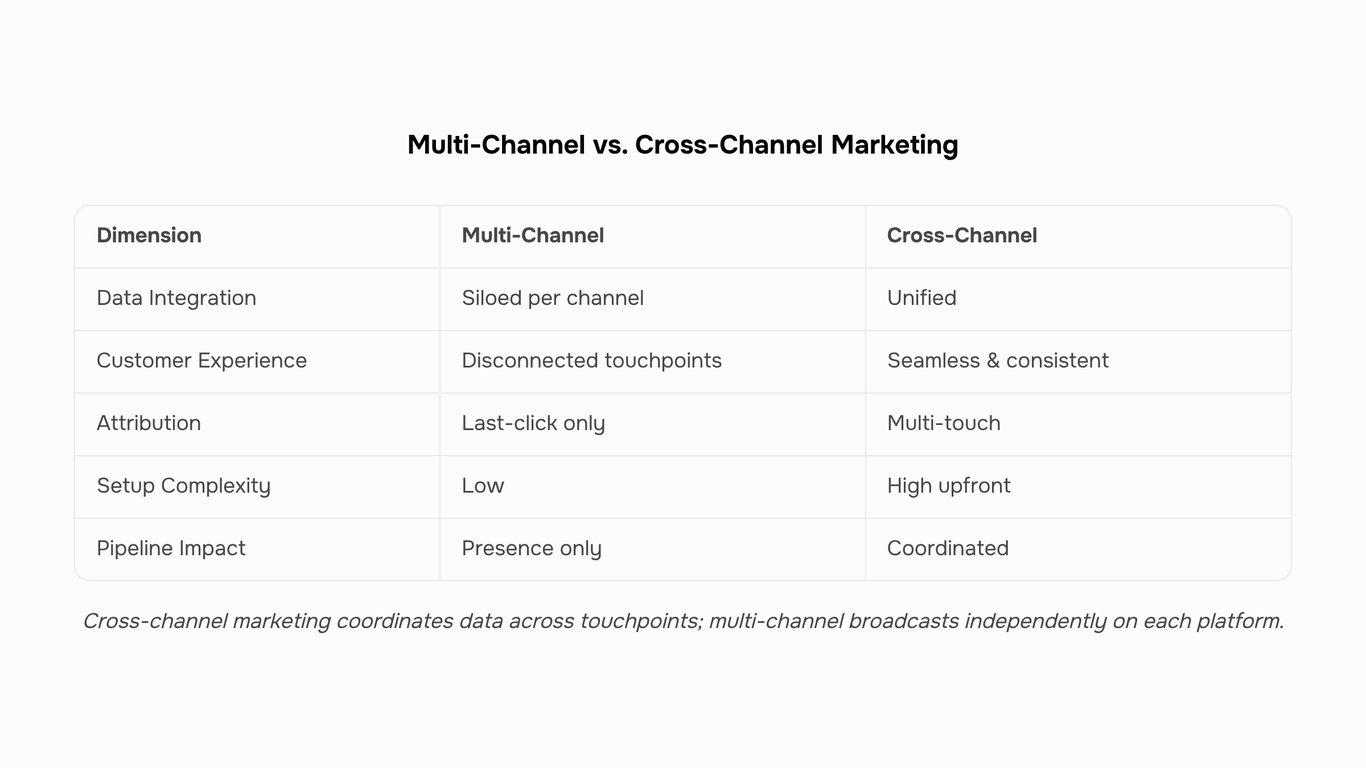
The table below puts the two approaches side by side across the four dimensions that matter most for IT company owners running B2B campaigns.
Dimension | Multi-channel marketing | Cross-channel marketing |
|---|
Data integration | Each channel holds its own data. No shared profile across platforms | Customer data flows into a single profile; each channel reads from and writes to the same record |
Customer experience consistency | A prospect may see a LinkedIn ad, then receive an unrelated email sequence with no connection to what they clicked | Touchpoints build on each other — the email references the ad, the follow-up reflects what the prospect did next |
Attribution accuracy | Last-click or first-click only. You can see which channel closed the deal, not which sequence produced it | Multi-touch attribution is possible because the data is connected. You can trace the path, not just the endpoint |
Setup complexity | Low. Publish on each platform independently | Higher upfront. Requires a shared data layer, integration between tools, and mapped customer journeys |
Coordination between channels is what separates cross-channel from simply being present on multiple platforms — a distinction that becomes expensive to ignore once your pipeline has more than a few active touchpoints.
When multi-channel marketing makes sense: you're early-stage, testing which channels produce responses at all, or your team doesn't yet have the tooling to connect data across platforms. Before you coordinate channels, you need to know which channels are worth connecting.
When cross-channel marketing makes sense: you have consistent traffic on two or more channels, you're losing deals in the middle of the funnel rather than at the top, and you can't tell which combination of touches is producing your best customers. That last problem — attribution accuracy — is where most B2B teams feel the gap first.
The setup cost is real. But for customer engagement across channels to produce measurable pipeline results, the data has to be connected. Multi-channel marketing gets you presence. Cross-channel marketing gets you a system.
Benefits of cross-channel marketing for customer engagement
A cross-channel marketing strategy does something siloed multi-channel setups cannot: it treats every touchpoint as part of one conversation instead of five separate ones. That shift produces measurable differences in how fast leads move and how long customers stay.
Pipeline speed improves when a prospect's behavior on one channel triggers the next relevant message on another. A contact who opens a LinkedIn ad and then visits your pricing page shouldn't get a generic nurture email the next morning. They should get a follow-up that references what they just looked at. That kind of sequencing shortens the consideration phase.
Retention goes up when customers feel recognized across channels rather than re-introduced at every touchpoint. Consistent, behavior-aware communication across email, ads, and your site signals that you know who they are, which builds the trust that drives repeat purchases.
Attribution becomes usable. Multi-channel reporting tells you which channels got clicks. Cross-channel reporting tells you which sequences produced revenue. That distinction matters when you're deciding where to put next quarter's budget.
Personalization scales without manual effort. Once you connect behavioral data across channels, customer engagement across channels becomes trigger-driven rather than calendar-driven. You're responding to what contacts actually do, not guessing when to reach out.
The email layer is where most of this coordination lives in practice. Optimizing that layer is usually the highest-leverage starting point.
How to build a cross-channel marketing strategy in 5 steps
Start with a channel audit, not a technology decision. Most teams jump straight to automation platforms before they know which channels are actually driving pipeline. That order gets expensive fast.
Audit your current channels. List every touchpoint where a prospect or customer encounters your brand: paid search, email, LinkedIn, retargeting, organic content. For each, note what data you're capturing and whether it's stored in a shared system or a silo. This audit is the foundation of any cross-channel marketing strategy worth building. If you're still deciding which channels belong in your stack, choosing the right channels before you connect them is a useful starting point.
Map the customer journey across channels. Identify the sequence most buyers actually follow, not the ideal path you designed. Where do they enter? Where do they stall? A prospect who clicks a LinkedIn ad, reads a blog post, then goes cold for two weeks needs a different re-engagement trigger than one who opens three emails in a row.
Define the coordination rules. Decide what action on one channel triggers a response on another. A webinar registration, for example, should automatically shift that contact out of cold outreach and into a nurture sequence. Write these rules before you configure anything.
Connect email as the coordination layer. Email is where cross-channel marketing automation does its heaviest lifting. It's the channel you control fully, and it's where behavioral signals from other channels (ad clicks, page visits, form fills) should converge into a single triggered sequence. For practical guidance on improving conversion rates on the email layer of your cross-channel stack, the principles apply directly here.
Automate multi-step sequences with inbox sync. Once your rules are defined, wire up a tool that runs multi-step campaigns and keeps your inbox in sync with campaign state. Evox handles this specifically: automating the email layer of your cross-channel campaigns so follow-ups fire on signal, not on a fixed calendar.
How to measure cross-channel campaign success
Four metrics tell you whether your cross-channel campaign is actually working or just busy.
Unified customer journey completion rate tracks how many prospects move through your intended sequence — from first touch to conversion — without dropping off between channels. A low rate usually points to a handoff problem, not a messaging problem.
Cross-channel attribution rate measures what percentage of closed deals involved more than one channel. If that number is high, your channels are genuinely coordinating. If it's low, you're running parallel campaigns that happen to share a budget.
Channel-assisted conversions show which channels contributed to a conversion without being the last touch. This is where most small IT teams find their biggest blind spot: email often assists a LinkedIn-sourced lead three times before the form fill, but single-touch reporting hides it entirely. Before you can measure this accurately, it helps to have already done the work of choosing the right channels before you connect them.
Response time per channel measures how quickly your campaign reacts when a prospect engages. Improving conversion rates on the email layer of your stack often comes down to this single variable. Delays over 30 minutes between a trigger event and a follow-up email consistently reduce conversion rates across B2B campaigns.
Most small IT teams don't fail at cross-channel strategy because they chose the wrong channels. They fail because they're managing email sequences, lead nurturing, and campaign reporting across three or four disconnected tools, and the coordination cost eats the results.
Centralizing that work in a single cross channel marketing automation platform removes the manual handoffs. You get one place to trigger follow-up sequences, track which touchpoints moved a lead forward, and pull attribution data without exporting CSVs.
Evox handles the email layer specifically — sequences, timing, and response tracking — so your team can focus on improving conversion rates on the email layer rather than chasing sync errors.
Closing
Stop Running Channels in Parallel and Start Running Them Together
The gap between multi-channel and cross-channel marketing isn't a technology problem — it's a coordination problem. Multi-channel puts your message in more places; cross-channel makes those places work as a single system. Teams that make that shift stop losing leads to timing gaps and channel handoff failures, and start closing them instead.
The practical starting point is your email and automation layer. Get that right — shared contact history, trigger-based sequences that respond to real behavior, a two-way inbox that keeps replies in context — and the rest of the stack has something to coordinate around.
Evox handles exactly that layer: multi-step campaigns, two-way inbox sync, and the automation logic that ties channel activity to actual follow-up. If you're building a cross-channel strategy without adding headcount, that's where to start. See what Evox does and map it against what your current stack is missing. 🎯
FAQ


 Elena Petrova15 September 2026


