TL;DR: Most enterprise SaaS teams that plateau aren't publishing too little — they're publishing without a structure that connects programmatic scale to topical authority to AI answer engine visibility. This piece gives IT company owners a four-layer framework that addresses each gap in sequence, with specific criteria for diagnosing which layer is broken before adding more content volume.
Why enterprise SaaS SEO keeps plateauing
Most enterprise SaaS content teams are not publishing too little. They are publishing into a structural mismatch they have not named yet.
The plateau pattern looks like this: a team ships 20 to 40 articles a quarter, organic sessions tick up modestly, then flatten. Leadership asks for more volume. The team obliges. The flatline holds. What looks like a content problem is actually an architecture problem.
Publishing volume stopped being the constraint around the time Google's Helpful Content updates began rewarding demonstrable topical authority over keyword coverage. For enterprise SaaS specifically, that shift hit harder than it did for SMB-focused products. Enterprise buyers run longer research cycles, involve more stakeholders, and cross-reference sources before a single demo gets booked. A content library that covers breadth without depth signals exactly the wrong thing to both Google and the AI assistants now summarizing your category for prospective buyers.
That last point is the one most teams miss entirely. AI answer engine optimization for B2B SaaS is a distinct layer from traditional SEO, and enterprise content that ignores LLM citability is leaving an increasingly visible channel unaddressed.
The fix is not a content calendar tweak. It is a stack: programmatic pages that capture demand at scale, cluster content that builds topical authority SaaS teams can actually measure, and an authority layer that earns citations. Tracking the metrics that actually signal authority growth is where most teams realize the plateau was predictable.
How enterprise SaaS SEO differs from SMB SaaS SEO
The gap between SMB SaaS vs enterprise SaaS SEO isn't about budget or team size. It's structural, across four dimensions that change what "good SEO" even means.
Keyword breadth: An SMB SaaS company might own 200 to 500 target keywords across one product line. An enterprise SaaS company with three or more product lines needs a SaaS keyword research strategy that spans thousands of terms, segmented by persona, vertical, and buying stage. A single keyword list won't hold that.
Buying cycle length: SMB deals close in days or weeks. Enterprise deals run three to twelve months, which means content needs to support evaluation, internal champions, and security reviews, not just initial discovery.
Multi-product taxonomy: When your product has modules, tiers, or distinct use cases, your site architecture has to reflect that without cannibalizing rankings across related terms. Most SMB-era site structures collapse under that weight.
Compliance content requirements: Enterprise buyers in regulated industries want SOC 2, HIPAA, and GDPR coverage in the content itself, not buried in a trust page. That creates a content category most SMB playbooks never touch.
The strategies that moved rankings at a 50-person SaaS company will stall at a 500-person one. Understanding how SEO fits into a broader SaaS marketing strategy helps, but enterprise SaaS SEO needs its own structural model, which the next section maps out.
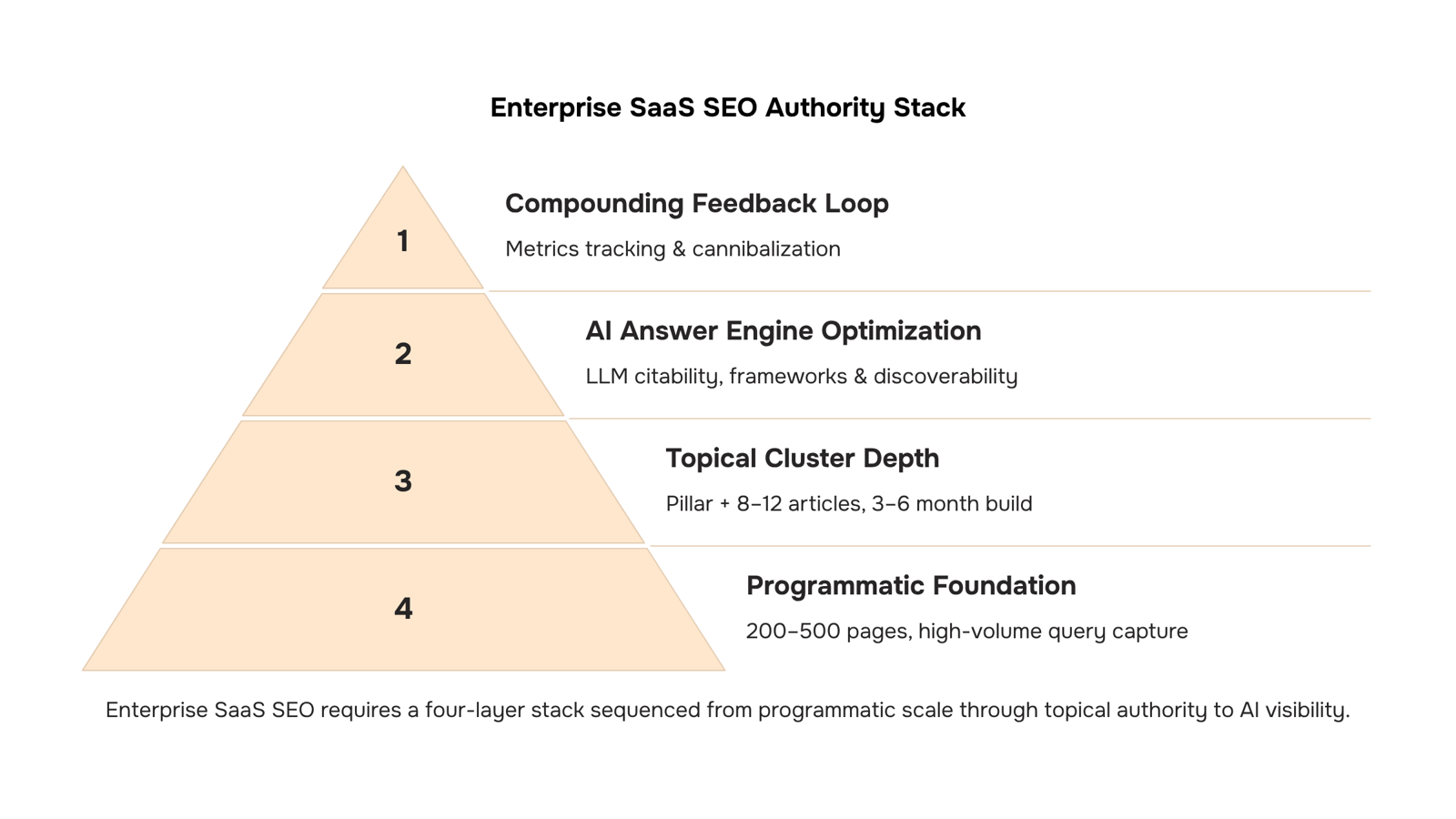
The Enterprise SaaS SEO Authority Stack: a 4-layer framework
The Authority Stack is a four-layer model for enterprise SaaS SEO that sequences content investment in the order it compounds. Each layer builds on the one before it. Skip a layer and the layers above it produce diminishing returns.
Layer 1: Programmatic Foundation
Programmatic SEO SaaS teams use this layer to cover high-volume, low-complexity queries at scale: integration pages, comparison pages, use-case landing pages by industry or role. The goal is indexed surface area. Without it, your topical cluster content has nowhere to link into. Most enterprise teams can build 200 to 500 programmatic pages in a single sprint using templated CMS structures. The risk here is thin content penalties in SaaS environments, where Google's Helpful Content system has become more aggressive about pages that share 80%+ of their body copy. Every programmatic template needs a differentiated data field or a unique value block per page.
Layer 2: Topical Cluster Depth
Topical authority in SaaS is built by owning a subject completely, not by publishing the most posts. A cluster needs a pillar page, 8 to 12 supporting articles, and internal linking that flows traffic toward conversion paths. Teams that skip Layer 1 often publish clusters that float without anchor pages, which limits the authority signal Google can consolidate. Topical cluster content in B2B SaaS typically takes 3 to 6 months to show measurable organic traffic lift, so sequencing this after programmatic foundation shortens that window.
Layer 3: AI Answer Engine Optimization
This is the layer most enterprise teams skip entirely. AI answer engine optimization for B2B means structuring content so that LLMs (ChatGPT, Perplexity, Gemini) cite your brand when buyers ask category-level questions. That requires named frameworks, cited statistics, and direct answers to the exact questions your ICP types into AI assistants. The AI answer engine optimization for B2B SaaS discipline is new enough that most enterprise content teams have no formal process for it yet, which makes it the highest-leverage gap in the stack right now.
Layer 4: Compounding Feedback Loop
The fourth layer is operational: a system for tracking the metrics that actually signal authority growth, feeding ranking data back into content planning, and retiring or consolidating pages that cannibalize each other. Without this loop, Layers 1 through 3 decay. Teams that run this well treat SEO as a pipeline, not a publishing calendar. For a look at how teams run this pipeline end to end, the process is more systematic than most content leads expect.
The next section maps this stack to multi-product keyword architecture, where enterprise teams most often create the internal cannibalization problems Layer 4 is designed to catch.
How to structure keyword research across product lines
Start with a product-line inventory, not a keyword tool. Pull every distinct use case, buyer persona, and integration your product supports, then assign each one a root topic. That root topic becomes the parent page. Everything else branches from it.
The structural rule that prevents cannibalization: one URL owns one intent. If two product lines both target "workflow automation," you need a disambiguation layer, either a comparison page or a feature-specific landing page that separates the intents before Google does it for you.
For a multi-product enterprise SaaS company, a workable architecture looks like this:
Map product lines to root topics: One root topic per product, no overlap.
Identify shared vocabulary: Terms like "API integration" or "user permissions" that cut across products get a dedicated pillar page, not a page per product.
Audit for orphaned clusters: Any subtopic page with no internal links pointing to it is invisible to crawlers and readers alike.
Assign ownership: Each cluster needs one team or one person accountable for coverage gaps.
A solid SaaS keyword research strategy also accounts for where each keyword sits in the buying cycle. Informational terms belong in cluster content; high-intent terms belong on product pages. Mixing them on the same URL is where most enterprise SaaS SEO architectures quietly break down.
Ranko maps this structure automatically across product lines, so gaps surface before they compound.
What metrics to track beyond keyword rankings
Keyword rankings tell you where you sit. They don't tell you whether that position is producing anything.
For enterprise SaaS SEO, four metrics actually matter to a senior stakeholder.
Topical share of voice measures the percentage of keywords in a defined cluster where your domain ranks in the top 10. A rising share of voice signals that the authority stack is compounding, even before pipeline moves.
AI citation rate tracks how often your content appears in ChatGPT, Perplexity, or Google's AI Overviews for target queries. Most teams don't measure this yet, which is exactly why it's a differentiator now.
Assisted pipeline from organic connects your CRM to organic sessions via UTM attribution. Pull this from HubSpot or Salesforce to show which content clusters are touching deals before the first sales call.
Content cluster coverage score is a simple ratio: published pages divided by planned pages per cluster. Low coverage predicts future ranking gaps before they appear in a traffic report.
These four replace a ranking screenshot with a story about whether the program is working. For a broader look at how to measure SaaS lead generation success, the same outcome-first logic applies.
How the authority stack runs in practice
The sequence matters as much as the strategy. Start with keyword clustering: group targets by intent and assign each cluster a pillar page plus three to five supporting articles. That structure is the foundation for both programmatic SEO SaaS pages and topical authority SaaS content that compounds over time.
Once clusters are mapped, the programmatic layer runs first. Templatized pages capture high-volume, low-competition terms and begin accumulating index coverage while longer editorial pieces are still in production. Those editorial pieces, published over the following four to eight weeks, build the contextual depth that signals topical authority to Google.
The layer most teams skip is AI answer engine optimization for B2B SaaS. Each published article needs structured answers, FAQ schema, and citation-ready phrasing so LLMs pull from your content rather than a competitor's.
Ranko runs this as a single pipeline: keyword research feeds content briefs, briefs feed drafts, drafts ship with AEO formatting built in. How teams run this pipeline end to end shows the actual workflow. Then use tracking the metrics that actually signal authority growth to confirm each layer is producing before scaling spend.
Common mistakes that stall enterprise SaaS SEO
Four mistakes show up repeatedly in enterprise SaaS SEO audits, and each one compounds the others.
Skipping the AEO layer: Most teams optimize for Google rankings and ignore LLM citability entirely. That's a shrinking strategy. If your content isn't structured for AI answer engine optimization for B2B SaaS, you're invisible in the channel that's growing fastest.
Programmatic pages without a canonical strategy: Thin content penalties in SaaS are almost always traced back to duplicate or near-duplicate programmatic pages that were never canonicalized. Google consolidates them, dilutes authority, and ranks none of them.
Measuring rankings instead of topical coverage: A keyword moving from position 9 to 6 tells you almost nothing. Tracking the metrics that actually signal authority growth means watching coverage gaps close across a cluster, not individual keyword positions.
Treating clusters as one-time builds: A SaaS keyword research strategy only compounds when clusters get updated, expanded, and interlinked on a rolling basis. Static clusters decay. Compounding ones don't.
Closing
Enterprise SaaS SEO plateaus not because teams publish too little, but because they publish without the structural layers that compound. The Authority Stack—programmatic foundation, topical cluster depth, AI answer engine optimization, and feedback loops—sequences your content investment so each layer amplifies the one below it. Before you add more volume, audit which of these four layers your program is missing. That diagnosis will tell you whether your next hire should be a content writer or a systems operator.
FAQ
Why do enterprise SaaS companies plateau in organic traffic despite publishing regularly?
Most teams publish into a structural mismatch: breadth without depth, programmatic pages without anchor clusters, and no optimization for AI answer engines. Google's Helpful Content updates reward topical authority, not keyword coverage. Add volume to a broken architecture and the flatline holds.
What are the key differences between enterprise SaaS SEO and traditional SEO?
Enterprise SaaS spans thousands of keywords across multiple products, supports 3-12 month buying cycles, requires multi-product site architecture without cannibalization, and often needs compliance content (SOC 2, HIPAA, GDPR). SMB-era strategies collapse under that complexity.
How do I build topical authority in a competitive SaaS category?
Own a subject completely: one pillar page, 8-12 supporting articles, and internal linking that consolidates authority signals toward conversion paths. Topical clusters typically show organic lift in 3-6 months when built after a programmatic foundation.
What is AI answer engine optimization and why does it matter for B2B SaaS?
It's structuring content so LLMs cite your brand when buyers ask category questions. Requires named frameworks, cited statistics, and direct answers to questions your ICP types into ChatGPT or Perplexity. Most enterprise teams have no formal process for this yet, making it the highest-leverage gap.
How can I improve SEO for my enterprise SaaS company?
Sequence the four-layer stack: programmatic pages for scale, topical clusters for authority, AI optimization for LLM citability, and feedback loops to retire cannibalizing content. Skip a layer and the layers above it produce diminishing returns.
How do I measure the effectiveness of my enterprise SaaS SEO efforts?
Track metrics that signal authority growth: ranking position by cluster, organic traffic by buying stage, AI mention frequency, and internal cannibalization rates. Treat SEO as a pipeline with feedback loops, not a publishing calendar.
How does programmatic SEO apply to enterprise SaaS without triggering thin-content penalties?
Every programmatic template needs a differentiated data field or unique value block per page. Google's Helpful Content system penalizes pages sharing 80%+ body copy. Build 200-500 programmatic pages in one sprint, but ensure each one adds distinct information.


 Ryan Mitchell14 September 2026


