TL;DR: Most content on automated lead distribution stops at "route leads to the right rep" and leaves you to figure out the rest. This piece maps the distribution logic you actually need to configure, shows where rules-based routing breaks down and AI-driven routing picks up, and gives IT company owners a five-step implementation path they can act on today.
What automated lead distribution actually means
Automated lead distribution is the process of assigning incoming leads to the right sales rep automatically, based on defined rules or AI-driven logic, the moment a lead enters your system. It sits between lead capture and lead follow-up in your sales workflow, and it's a distinct problem from both.
Capturing a lead means getting contact details into your CRM. Scoring a lead means ranking its quality. Distribution answers a different question entirely: who works this lead, and when?
That distinction matters because the handoff is where most IT companies lose deals. A lead can be captured instantly and scored accurately, then sit in a queue for two hours while a manager decides who to assign it to. By then, the conversation has gone cold.
There are two approaches to distribution logic. Rules-based routing assigns leads using fixed criteria: territory, company size, product line, or round-robin rotation. AI-driven routing goes further, matching leads to reps based on historical close rates, rep availability, and deal type. The gap between the two becomes obvious when your rules are misconfigured and the wrong rep gets every enterprise lead.
If you want to automate the earlier stages of your lead pipeline before distribution kicks in, that foundation matters too. Real-time lead routing only delivers value when the leads feeding into it are clean.
Why manual assignment quietly kills sales productivity
Manual lead assignment looks manageable until you measure it. A rep gets a notification, finishes what they're doing, checks the CRM, and routes the lead — that sequence routinely takes 30 minutes to several hours. By then, the prospect has moved on or replied to a competitor.
Lead response time is where the damage shows up first. Research consistently finds that contacting a lead within the first minute produces dramatically higher conversion rates than waiting five minutes or more. Manual processes almost never hit that window at scale.
The hidden costs compound from there:
Rep idle time: Managers spend time triaging and assigning instead of coaching. Reps wait for assignments instead of selling.
Skill mismatches: Without routing logic, a complex enterprise inquiry lands with a junior rep simply because they were next in the queue.
Missed follow-ups: When assignment is manual, follow-up reminders live in someone's head or a spreadsheet. Both fail under volume.
If you've already worked to automate the earlier stages of your lead pipeline, manual assignment at the handoff point cancels much of that efficiency gain.
Automated lead distribution software removes the human bottleneck at the moment it matters most: the first touch. The right lead reaches the right rep in seconds, not shifts. That single change tightens lead response time, reduces wasted capacity, and gives your team a realistic shot at the conversion window before it closes.
Rules-based vs. AI-driven distribution: how they differ
Rules-based distribution works on fixed logic: if a lead comes from Region A and requests Service B, assign it to Rep C. You define the conditions once, the system executes them every time. It's predictable, auditable, and easy to explain to a new sales manager. For teams with a stable lead mix and clear territory boundaries, it handles real-time lead routing reliably without any model to maintain.
AI-driven distribution goes further. Instead of matching on static fields, it scores each lead against historical conversion data, rep performance patterns, and deal velocity, then routes to whoever is most likely to close. The lead assignment rules shift dynamically as the model learns. A rep who consistently closes mid-market IT security deals gets those leads, even if they're technically "out of territory."
The tradeoff is transparency. Rules-based logic is easy to audit when something breaks. AI-driven routing is harder to interrogate, which matters when a rep asks why they received fewer leads this week.
Dimension | Rules-based | AI-driven |
|---|
Setup complexity | Low | Medium to high |
Accuracy over time | Static | Improves with data |
Best for | Defined territories, fixed criteria | Mixed lead types, variable rep strengths |
Failure mode | Mismatched criteria break routing | Poor training data skews assignments |
Audit trail | Clear | Requires logging configuration |
Most IT services teams start with rules-based logic and layer in AI once they have 6-12 months of clean conversion data. If you want to automate the earlier stages of your lead pipeline before configuring distribution, that foundation makes both models more accurate. For teams ready to move beyond static rules, AI-driven lead qualification that feeds your distribution rules is the logical next step.
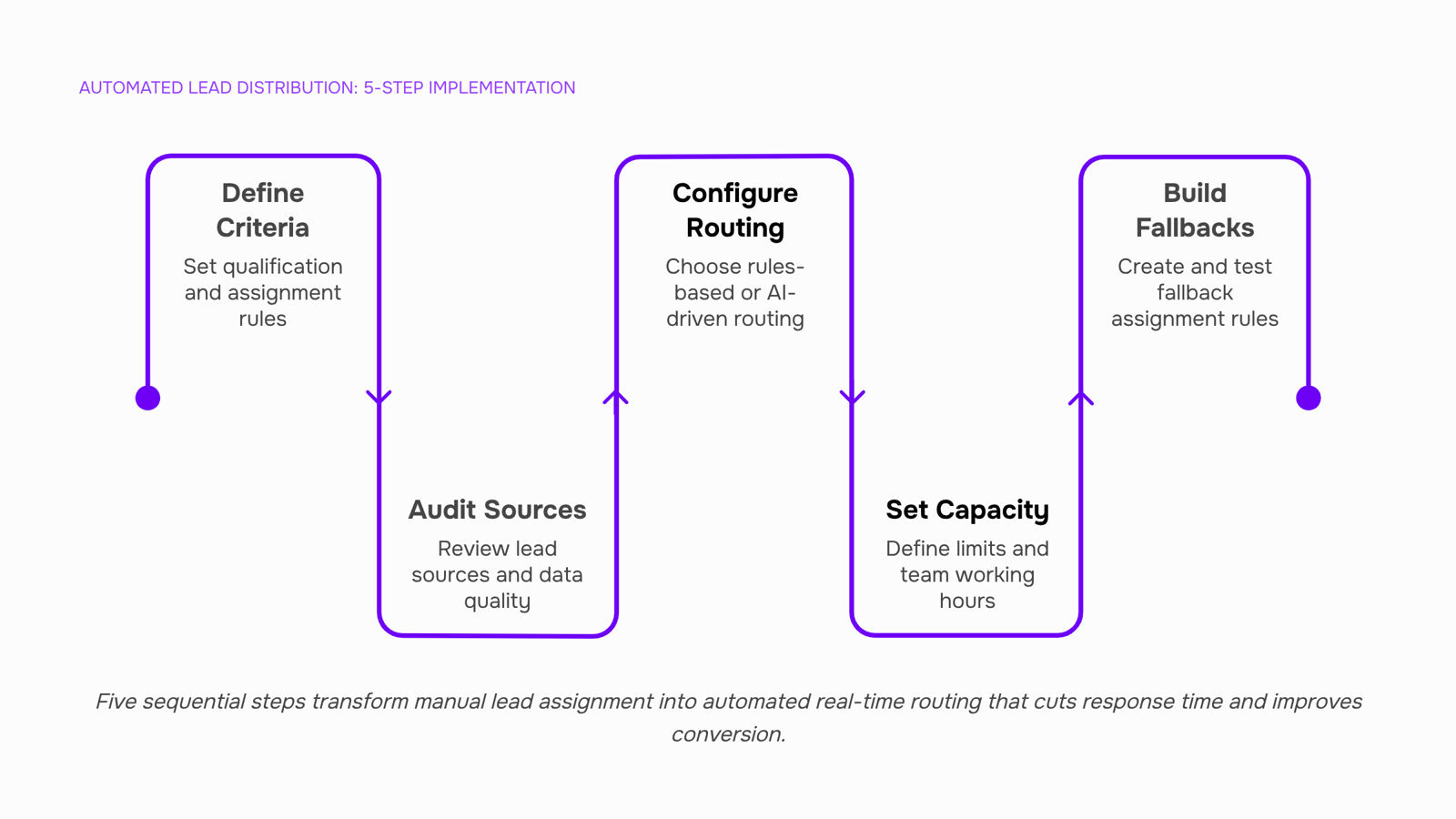
Five steps to implement automated lead distribution
Before you configure anything, decide what "done" looks like. A distribution system that runs without clear success criteria will drift — leads pile up with one rep, response times creep back up, and nobody notices until a deal falls through.
Here are the five steps to get it right the first time.
Define your assignment criteria: List the variables that actually predict a good match: territory, deal size, product line, rep specialization, and current capacity. Don't start with round-robin just because it's the default. If your team has three enterprise reps and five SMB reps, equal distribution is the wrong starting point. Map criteria to outcomes first, then build the rules.
Audit your lead sources and data quality: Your lead assignment rules are only as good as the data feeding them. Before you configure routing logic, check that every form, ad platform, and inbound channel is passing clean, consistent field values — company size, industry, geography, lead source. A rule that routes by "company size" breaks the moment that field comes in blank or formatted differently across sources. Fix the data pipeline first.
Choose your distribution model and configure the rules: Based on the previous section's framework, you've already picked between rules-based and AI-driven routing. Now translate that decision into actual logic. For rules-based: build if-then conditions in your automated lead distribution software, starting with the highest-priority criteria (territory, then deal size, then rep availability). For AI-driven: set the scoring inputs and let the model weight them, but review the first 50 assignments manually to confirm the outputs match your intent.
Set capacity limits and working-hour windows: Round-robin without capacity weighting is one of the most common configuration errors — covered in the next section. Prevent it here by capping how many open leads each rep can hold at once (a typical starting point is 20 to 30 active leads per rep, adjusted by your average sales cycle length). Also define working hours per rep so real-time lead routing doesn't assign a hot inbound lead to someone who won't see it for 14 hours.
Build and test your fallback rules: Every distribution system needs a fallback for when primary rules fail: the assigned rep is on leave, a territory has no owner, or a lead doesn't match any defined criteria. Without a fallback, those leads go nowhere. Define a backup assignee (usually a team lead or a shared queue), set a re-assignment trigger if the lead isn't contacted within a defined window, and run a simulation with edge-case leads before going live.
Lio's Smart Lead Distribution handles steps three through five inside a single configuration view, so capacity limits, routing logic, and fallback rules stay connected rather than scattered across separate tools.
Once the system is live, the next thing to watch is what breaks — the three most common configuration errors that quietly kill distribution performance.
Common mistakes that break distribution after setup
Three configuration errors cause most post-launch failures, and they're all avoidable.
No fallback rule: When a lead doesn't match any assignment condition, it sits in a queue with no owner. Hours pass. Lead response time climbs, and the opportunity cools. Every distribution setup needs a catch-all rule, typically a senior rep or a shared inbox with a defined SLA, so nothing falls through.
Round-robin without capacity weighting: Distributing leads equally across reps sounds fair until one rep is managing 40 open deals and another has 12. Equal volume is not equal opportunity. Weight assignments by current pipeline load, not just headcount, and recalibrate that weighting at least monthly.
Ignoring lead source data: A lead from a paid enterprise campaign and a lead from a free-trial signup require different handling. Treating them identically wastes your strongest reps on low-intent contacts and routes high-intent buyers to whoever happens to be next in the queue. Map source to segment before you build assignment rules, not after.
Each mistake compounds the others. A system with no fallback, unweighted rotation, and source-blind rules will erode the productivity gains automated lead distribution was supposed to create.
How to measure whether your distribution system is working
Three numbers tell you whether your automated lead distribution setup is earning its place.
Average lead response time is the first check. Pull it weekly for the first month after launch. If your real-time lead routing is working, you should see response times drop toward the five-minute window where conversion rates hold up. If the average is still sitting above 30 minutes, the routing rules aren't firing correctly or reps aren't getting notifications they can act on.
Rep conversion rate by assignment method tells you whether the right leads are reaching the right reps. Segment your closed/won data by how each lead was assigned: manual, round-robin, or skill-based. A gap of more than 10 percentage points between methods usually means one assignment logic is mismatched to your lead mix. This is the metric most teams skip, and it's the one that reveals whether your automated lead distribution software is actually improving outcomes or just moving leads faster.
Lead aging rate measures how many leads sit uncontacted past your defined SLA window, typically 24 hours for most IT services teams. A rising aging rate after launch signals a capacity problem, not a routing problem. That's the cue to revisit rep workload caps.
If you want a broader view of what sits upstream, a solid lead management framework gives these metrics the context they need to drive real decisions.
Closing
Automated lead distribution removes the handoff bottleneck that kills most sales pipelines. By routing leads to the right rep in seconds instead of hours, you tighten response time, eliminate wasted capacity, and give your team a realistic shot at converting before the prospect moves on. The five-step implementation path above works whether you start with rules-based routing or move straight to AI-driven logic. Once you've mapped your criteria, audited your data, and configured your rules, the system runs without constant management. If you're ready to see how this plays out in practice, Lio's Smart Lead Distribution feature handles the exact routing logic described here—real-time assignment from the moment a lead enters your system, with capacity limits, fallback rules, and audit trails built in. Take a look at how it routes your first 10 leads and you'll see the time savings immediately.
FAQ
How can automated lead distribution improve sales team productivity?
It eliminates manual assignment delays, getting leads to the right rep in seconds instead of hours. That tightens response time, reduces rep idle time spent waiting for assignments, and prevents skill mismatches that waste capacity on the wrong person.
What are the benefits of using automated lead distribution software?
Faster lead response time, reduced manager overhead, better rep capacity utilization, fewer missed follow-ups, and higher conversion rates by hitting the first-contact window before prospects move on.
Can automated lead distribution help reduce lead response times?
Yes. Research shows contacting a lead within the first minute produces dramatically higher conversion rates than waiting five minutes or more. Automated routing hits that window at scale; manual processes almost never do.
How do I implement automated lead distribution in my CRM system?
Define your assignment criteria, audit data quality across all lead sources, choose rules-based or AI-driven routing, set capacity limits and working-hour windows, then build fallback rules for edge cases. Test with your first 50 leads before full rollout.
What is the difference between round-robin and skills-based lead routing?
Round-robin distributes leads equally to all reps regardless of fit. Skills-based routing matches leads to reps based on specialization, past close rates, and deal type—producing better conversion rates but requiring more setup and data.


 Elena Petrova15 September 2026


