How can I minimize portfolio risk
TL;DR: Most content on portfolio risk focuses on financial assets. This article applies the same logic to IT project portfolios: how to spot which projects carry the most risk, score them consistently, and act before a delayed dependency or scope change derails delivery. The 6-step framework gives you a repeatable process you can run with your existing team.
What portfolio risk actually means
In personal finance, portfolio risk is the chance that a combination of assets fails to meet financial objectives. In project management, the concept maps directly — but the assets are projects, not stocks.
Project portfolio risk is the probability that running multiple projects simultaneously will produce outcomes worse than planned: missed deadlines, blown budgets, or strategic goals that quietly slip. The key word is "simultaneously." A single project has its own risks. A portfolio multiplies them, because projects share resources, depend on each other, and compete for leadership attention all at once.
This matters more than most teams realize. IT organizations rarely run one project at a time. When several initiatives are in flight, a delay in one doesn't stay contained — it ripples. A blocked integration holds up two other projects. A developer pulled onto an emergency slows a sprint two teams away.
Project portfolio management gives you the structure to see those ripples before they become derailments. Understanding portfolio risk is the first step: knowing what it is, what drives it, and how to measure it so you can act before a deadline is already gone.
Key factors that create portfolio risk
Four drivers account for most of the portfolio risk IT teams face. Understanding them is the first step in any practical risk assessment framework.
Resource contention happens when two or more projects compete for the same developer, tester, or infrastructure. A mid-sprint security audit that pulls your lead engineer off a product release is a textbook example. One project slips, then the delay ripples.
Dependency chains connect projects in ways that aren't always visible on a Gantt chart. If Project B can't begin integration testing until Project A ships its API, a two-week delay in Project A becomes a two-week delay everywhere downstream.
Scope creep is the quietest driver. A single "small addition" per project sounds harmless until you're managing eight projects and each one has grown 15-20% beyond its original estimate. Collectively, that's a portfolio that no longer fits the team's capacity.
External blockers include vendor delays, compliance reviews, and client approvals that sit outside your control. These are harder to prevent, but continuous risk monitoring gives you earlier warning so you can replan before a deadline breaks.
Good project portfolio management means tracking all four drivers together, not in isolation. When you score each one by probability and impact, you get a clearer picture of where to act first, and you can build a risk mitigation plan for each high-scoring project before it escalates.
Systematic vs. unsystematic portfolio risk
Most portfolio risk discussions treat all risk as one category. That's the mistake. Two fundamentally different types exist, and confusing them leads to the wrong response.
Systematic risk affects your entire portfolio at once. A budget freeze, a company-wide hiring halt, or a sudden regulatory change hits every project simultaneously. You cannot eliminate it by reshuffling your project mix. As Investopedia notes, systematic risk is not diversifiable — it can only be managed through contingency planning and executive-level decisions.
Unsystematic risk is contained. One project loses its lead developer. One client changes scope mid-sprint. One vendor goes dark. These events hurt that project, but they don't automatically cascade across your portfolio. Unsystematic risk can generally be reduced through diversification, better dependency mapping, and backup resourcing.
The distinction changes your response completely. When a systematic risk fires, you need portfolio-level decisions: reprioritize, pause lower-value work, reallocate. When an unsystematic risk fires, you handle it at the project level without pulling leadership into every conversation.
In project portfolio management, the goal is to minimize unsystematic exposure through structure, so that when systematic events hit, your team has the bandwidth to absorb them. The next section shows you exactly how to do that.
How to minimize portfolio risk in 6 steps
Start by listing every active project your team is running. Not just the big ones — include the maintenance work, the "quick fixes" that have been running for three months, and the internal initiatives that never made it onto a formal roadmap. You cannot manage what you haven't mapped. A simple spreadsheet works here; the goal is a single view of your full project portfolio.
Map your portfolio. List every active project with its owner, budget, deadline, and current status. If you can't fill in one of those fields, that gap is itself a risk signal.
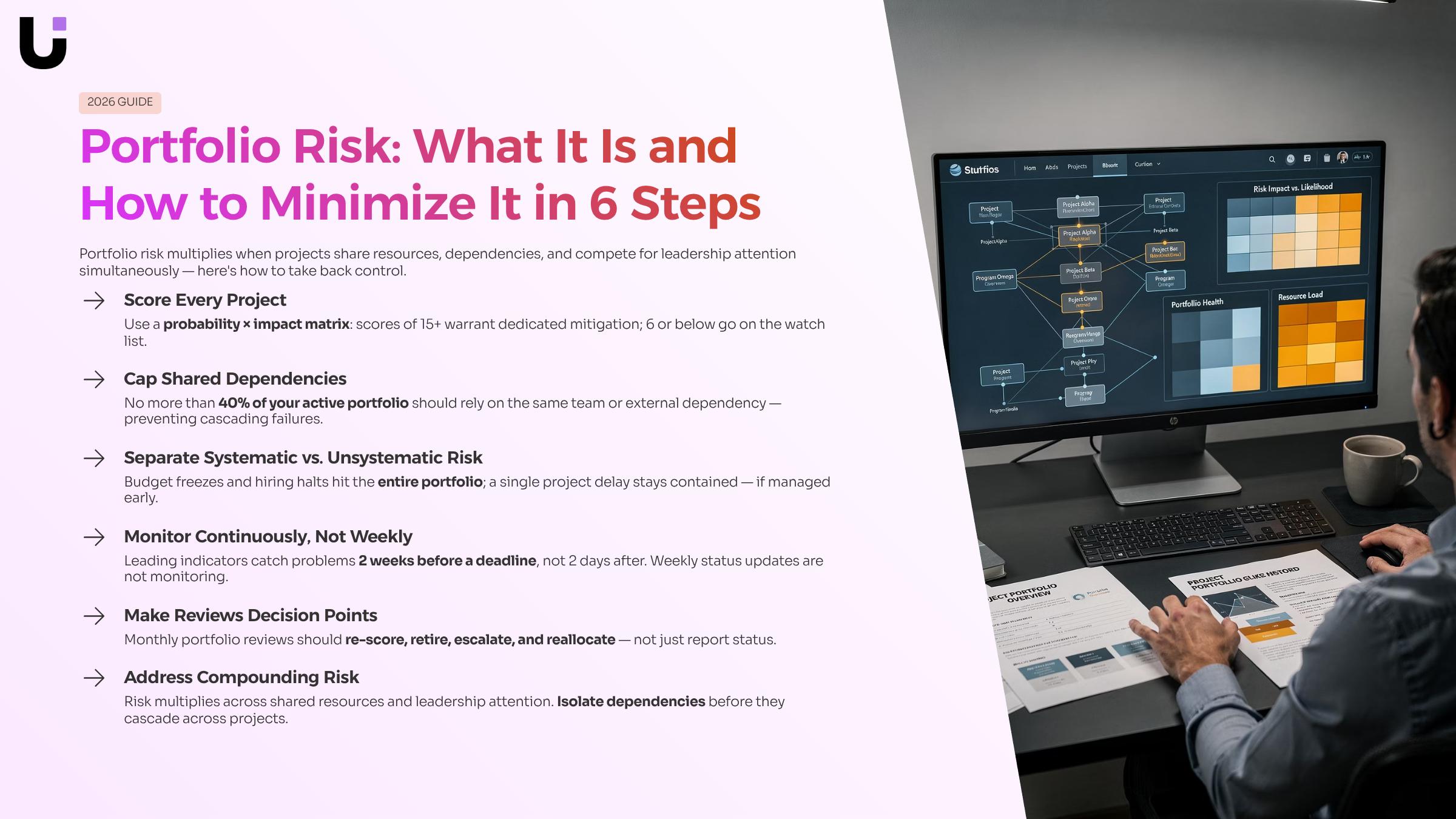
Score each project by risk. Use a probability-times-impact matrix, the standard approach in most risk assessment frameworks: estimate the likelihood a problem occurs (1–5 scale) and the impact if it does (1–5 scale), then multiply. A score of 15 or higher warrants a dedicated mitigation plan. A score of 6 or below can sit on a watch list. Everything in between needs an owner and a check-in cadence.
Identify dependencies. Look across your scored list and ask: which projects share the same three developers, the same vendor, or the same infrastructure environment? A delay in one cascades into the others. Draw those connections explicitly — even a simple table with projects as rows and shared resources as columns will surface the bottlenecks most teams miss until it's too late.
Diversify your workload. This is where portfolio risk management diverges from single-project thinking. If 80% of your active projects share the same technology stack, the same delivery quarter, or the same client, you've concentrated your exposure. Spread new project intake across timelines, resource pools, and risk profiles. A mix of short-cycle and long-cycle projects, for example, means a slip in a six-month initiative doesn't freeze your entire team's output.
Monitor continuously. Weekly status updates in a shared doc don't count as monitoring. You need leading indicators — budget burn rate, task completion velocity, open blockers — tracked against thresholds, not just reported. Continuous risk monitoring means catching a project trending toward a miss two weeks before the deadline, not two days after. Teams that track these signals in real time, rather than in retrospective reports, catch unsystematic risks while they're still contained to one project.
Run a monthly portfolio review. Bring the full scored list back to the table every four weeks. Re-score projects that have changed scope or lost resources. Retire projects that no longer serve the business case. Escalate anything that has crossed your risk threshold since last month. The review isn't a status meeting — it's a deliberate decision point about where to invest, where to cut, and what to protect.
A tool like Taro can automate steps 5 and 6 by surfacing a risk alerts dashboard that flags threshold breaches across your portfolio without requiring a manual audit each week. That matters most when your team is running eight or more concurrent projects and the cognitive load of tracking each one manually starts producing blind spots.
How diversification reduces portfolio risk
Diversification is a risk mitigation technique that attempts to reduce losses by allocating investments among various instruments — and the same logic applies directly to your project portfolio.
When every project on your roadmap shares the same resource pool, the same timeline, and the same technical dependencies, a single failure cascades. One delayed vendor, one engineer out sick, one scope change — and three projects slip simultaneously. Spreading project portfolio risk across different types of work (new builds, maintenance, internal tooling), different timelines (short-cycle and long-cycle), and different resource owners breaks that chain.
A practical rule: no more than 40% of your active portfolio should depend on the same team or external dependency at once. If your mapping step (from the framework above) shows otherwise, that concentration is itself a risk score input.
Diversification also creates a buffer for the unexpected. When one workstream stalls, others continue delivering value, which keeps stakeholder confidence intact and gives you room to build a risk mitigation plan for each high-scoring project without triggering a full portfolio pause.
For a deeper look at how this fits into project portfolio management as a discipline, that context shapes how you structure diversification from the start.
Common portfolio risk mistakes to avoid
Three mistakes show up repeatedly in project portfolio management, and each one quietly undermines the framework steps you just followed.
Treating all projects as equal priority. When every project carries the same urgency, resource conflicts go unresolved and high-impact work gets delayed by low-impact work. Assign a risk-weighted priority tier to each project before allocating people or budget.
Ignoring dependency risk. A project that looks healthy in isolation can still collapse if it relies on a delayed upstream deliverable. Map dependencies explicitly, then build a risk mitigation plan for each high-scoring project that accounts for those connections.
Reviewing risk only at kickoff. Risk profiles shift as scope changes, team capacity fluctuates, and timelines compress. Good portfolio risk management requires continuous risk monitoring throughout delivery, not a single assessment at the start. A project that scored low in week one can become your biggest exposure by week six.
The six framework steps only hold up if you can track them without switching tools. In Taro, project portfolio risk monitoring runs alongside your work, not separate from it. Overdue task risk prediction flags slipping projects before they miss a deadline, and task completion prediction surfaces which work streams are at risk of running long. Pair those signals with the risk alerts dashboard and you have continuous risk monitoring without a weekly manual review. When a project scores high, build a risk mitigation plan directly inside the same workspace.
Closing
Portfolio risk isn't something you solve once and forget — it's a rhythm. The six-step framework gives you the structure: map, score, identify dependencies, diversify, monitor continuously, and review monthly. But the real unlock happens when you stop treating risk review as a quarterly checkbox and start catching problems before they become crises.
Taro's risk alerts dashboard automates the monitoring and review work, so you're not manually tracking budget burn and blocker counts across spreadsheets. You get notified when a project trends toward a miss, giving you two weeks to replan instead of discovering the problem at deadline. Ready to move from reactive firefighting to proactive risk management? Start a free trial and see how continuous monitoring changes your portfolio visibility.
FAQ
How can I minimize portfolio risk?
Map all active projects, score them using a probability-times-impact matrix, identify shared resource dependencies, diversify your workload across timelines and risk profiles, monitor leading indicators continuously, and run monthly portfolio reviews to re-score and escalate changes.
What are the key factors that contribute to portfolio risk?
Resource contention (teams competing for the same developer), dependency chains (delays cascading across projects), scope creep (15-20% growth per project), and external blockers (vendor delays, compliance reviews) drive most portfolio risk.
What is the difference between systematic and unsystematic portfolio risk?
Systematic risk hits your entire portfolio at once (budget freeze, hiring halt) and requires portfolio-level decisions. Unsystematic risk is contained to one project (lost developer, client scope change) and can be reduced through better dependency mapping and backup resourcing.
Can diversification reduce portfolio risk?
Yes. Spreading projects across different timelines, resource pools, technology stacks, and risk profiles prevents concentrated exposure. A mix of short-cycle and long-cycle work means a slip in one initiative doesn't freeze your entire team's output.
How do I assess and manage portfolio risk across multiple projects?
Use a probability-times-impact matrix to score each project (likelihood × impact), then identify which projects share resources or dependencies. Projects scoring 15+ need dedicated mitigation plans; 6 or below go on a watch list; everything in between needs an owner and check-in cadence.
How often should I review portfolio risk?
Run a formal monthly portfolio review to re-score projects that have changed scope or lost resources. Between reviews, monitor leading indicators (budget burn, task velocity, open blockers) continuously so you catch trends early, not at deadline.
What is a good risk score threshold for escalating a project?
A score of 15 or higher (using a 1–5 probability and impact scale multiplied together) warrants a dedicated mitigation plan and escalation. Scores of 6 or below stay on a watch list; scores in between need an owner and regular check-ins.


 Elena Petrova15 September 2026


