TL;DR: Most guides list AI email features without explaining when they actually outperform manual work. This one walks through the decision logic behind each optimization layer, from subject lines to send timing, so you know where gen AI email optimization adds real lift and where it wastes cycles.
What AI actually does inside an email campaign
Modern desk with computer displaying email analytics and AI optimization metrics in professional workspace
AI does three distinct jobs inside an email campaign, and most teams blur them together when evaluating tools. Separating them makes it easier to spot where your current stack is weak.
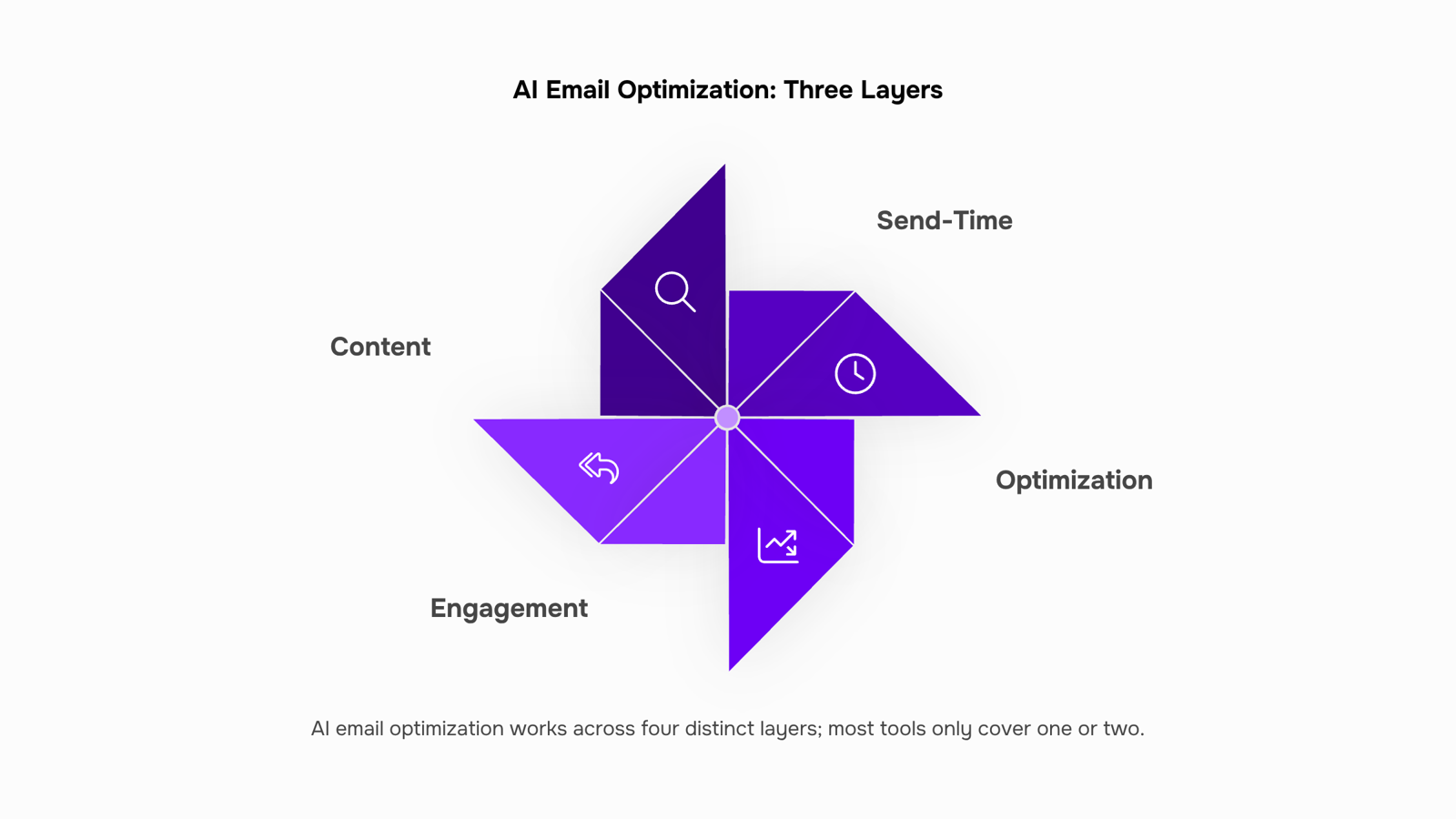
Content generation is the most visible job. The AI drafts subject lines, body copy, and CTAs based on prompts and context you provide. Output quality depends far more on the data you feed in (your ICP description, past winners, tone guidelines) than on the model itself. A generic prompt produces generic copy.
Send-time prediction uses historical engagement data to determine when each contact is most likely to open. Instead of blasting your list at 9 AM Tuesday because a blog post said so, the system learns that Contact A opens at 7:14 AM and Contact B opens after lunch. This is where AI in email marketing uses machine learning algorithms to personalize content, optimize send times, and segment audiences.
Performance optimization is the ongoing feedback loop. The AI runs multivariate tests across subject lines, layouts, and segments, then reallocates send volume toward winning variants. This is where automated email campaigns compound gains over weeks, not just individual sends.
Most guides lump these under "AI email marketing optimization" as if one toggle handles all three. In practice, some tools only cover generation. Others handle send-time but skip content. Knowing which job you need solved first prevents you from buying a tool that's strong where you're already fine and weak where you're bleeding opens.
For a breakdown of which platforms cover which jobs, see the best AI email marketing tools for your business.
How AI generates and improves email content
Large language models generate email content by predicting the next most probable token based on patterns in their training corpus. That corpus typically includes billions of web pages, marketing copy, and conversational text. But the quality of AI-generated email content you get back depends far more on what you feed in than on the model's raw capability.
The mechanism works like this:
You provide context: audience segment, product details, campaign goal, tone constraints, and any personalization variables (first name, company size, last action taken).
The model uses that context as a conditioning signal, narrowing its probability space from "all possible English sentences" to "sentences relevant to this specific reader and goal."
It outputs a subject line, body paragraph, or CTA variant that you review, edit, or deploy.
When the prompt is vague ("write a marketing email"), you get generic output indistinguishable from spam. When the prompt includes the recipient's industry, their last interaction with your product, and the specific pain point you solve, AI email personalization actually works. The difference is not the model. It is the specificity of your input.
Training data matters too. Models trained heavily on B2C retail copy will default to urgency language ("Don't miss out!") that falls flat in B2B IT sales. If your tool lets you describe your campaign goal in plain English and generate the email structure, you bypass that mismatch because the system constrains output to your stated context rather than relying on generic patterns.
Where gen ai email optimization generation gets practical: pair generated variants with automated A/B testing that tracks open and click variants without manual review. The model produces five subject lines. The system sends each to a small slice of your list. The winner goes to the rest. You need roughly 1,000 recipients per variant to reach statistical significance on open rates, so lists under 5,000 contacts benefit more from AI personalization than from split testing.
The takeaway: AI does not write good emails. It writes emails shaped by the constraints you give it. Better constraints, better output.
AI-generated email content wins on speed and consistency. You can describe your campaign goal in plain English and generate the email structure for a five-step nurture sequence in minutes. A human writer needs hours for the same output. When you're running 20+ campaigns per quarter across different segments, that throughput gap compounds fast.
AI also removes the "blank page" problem. It produces usable first drafts with consistent tone, correct formatting, and on-brand CTAs every time. For routine touchpoints like onboarding drips, renewal reminders, and event follow-ups, gen ai email optimization generation performs at or above human baseline because the emotional range required is narrow.
Where humans still win:
High-stakes relationship emails (contract renewals, churn saves, partnership pitches) where reading the room matters more than reading the data
Situations requiring cultural nuance, humor, or references to a shared history with the recipient
Early-stage prospect outreach where a single off-tone sentence kills trust
Recipients can often detect AI-written messages. Gmelius identifies 20 common signs of AI-generated emails that erode credibility, from generic phrasing to overly polished structure.
The practical move: use AI for volume and first drafts, then have a human edit anything going to high-value contacts or relationship-sensitive stages. For email open rate improvement AI handles subject line variants well, especially when paired with automated A/B testing that tracks open and click variants without manual review. But the reply-worthy body copy for your top 50 accounts? Write that yourself.
Send-time optimization and personalization: the mechanics
Send-time optimization AI works by analyzing each contact's historical engagement patterns, including when they open, click, and reply, then cross-referencing that with time-zone data to predict the window where your message is most likely to land at the top of their inbox.
Instead of blasting your entire list at 9 AM your time, the system staggers delivery so each recipient gets the email during their personal high-engagement window. AI in email marketing uses machine learning algorithms to personalize content, optimize send times, and segment audiences, and the practical result is measurable email open rate improvement AI delivers over fixed schedules.
The difference matters more than most teams expect. A fixed send time treats your list as one block. Gen ai email optimization generation models treat each contact as an individual signal source, recalculating predictions as new engagement data arrives.
Now, AI email personalization versus simple merge fields. A merge field swaps in {first_name} or {company}. Dynamic personalization tokens go further:
Behavioral tokens pull in the last product page visited, the last email link clicked, or the lead score tier
Conditional blocks show or hide entire paragraphs based on segment membership or funnel stage
Subject-line variants adapt phrasing to match the recipient's past open patterns, not just their name
A merge field says "Hi Sarah." A dynamic token says "Hi Sarah, here's the integration doc you viewed Tuesday," and sends it at the hour Sarah typically checks email. That specificity is what moves open and reply rates.
Evox builds personalization tokens and planned send-time optimization directly into its campaign builder, so you configure these behaviors once and let the system adapt as AI improves email marketing across send-time, personalization, and lead nurturing with each send cycle.
Running A/B tests at scale without manual effort
Traditional A/B testing forces you to split your list, wait days for results, then manually pick the winner and push it to the remaining segment. That workflow breaks down once you're running more than two or three automated email campaigns simultaneously. You stop testing because the overhead isn't worth it.
AI-driven A/B testing changes the sequence. Instead of a fixed split with a predetermined review date, the system continuously monitors open and click rates across variants, detects when one version reaches statistical significance, and automatically routes remaining sends to the winner. No human has to check a dashboard or flip a toggle.
For this to produce reliable results, you need volume. Most AI email marketing optimization engines require a minimum of 1,000 recipients per variant before confidence intervals tighten enough to declare a winner. Below that threshold, you're better off running sequential tests across campaigns rather than splitting a small list.
The practical difference: a team running five campaigns per week can test subject lines, preview text, and CTA placement across all five without adding review cycles. You describe your campaign goal in plain English and generate the email structure, then let gen ai email optimization generation handle variant creation and selection.
Evox handles this with automated A/B testing that tracks open and click variants without manual review, promoting the winning version as soon as significance is reached. The bottleneck shifts from "who checks the results" to "what do we test next," which is the only bottleneck worth having.
Connecting email engagement to downstream follow-up automatically
Most AI email marketing optimization content stops at "send better emails." It skips what happens after the email lands. The real gap between marketing and sales sits in response time: how fast your system acts on an open, a click, or silence.
Here's what closing that gap looks like in practice:
A lead clicks a pricing link in your sequence. Within seconds, the CRM tags them as "high intent" and moves them into a shorter-delay follow-up branch.
A lead opens three emails but never replies. After 48 hours of no response, an automated email campaign fires a different angle, maybe a case study or a direct calendar link.
A lead goes cold. The system downgrades their score and pauses outreach so your sender reputation stays clean.
These aren't hypothetical workflows. EVOX's email sequence automation with configurable delays handles exactly this: engagement signals trigger the next step without a rep checking dashboards. Adobe's journey analytics team describes this as connecting email engagement to downstream outcomes for next-generation measurement.
The pattern most teams miss: gen ai email optimization generation isn't only about writing better subject lines. It's about making the system respond to behavior the way a sharp rep would, except at 2 AM on a Saturday. When your automated A/B testing tracks open and click variants without manual review, those engagement signals feed directly into follow-up logic. No manual handoff required.
How to apply these optimizations in your current workflow
Start with your biggest bottleneck. Low open rates point to subject line and send-time problems — fix those first with AI email personalization and send-time optimization. Low replies signal weak body copy or mismatched offers. No follow-up at all is the most expensive gap because warm leads go cold.
EVOX handles these layers natively: multi-step sequences with built-in delays, personalization tokens, and automated A/B testing that tracks open and click variants without manual review. You diagnose, pick one layer, and build the sequence around that constraint first.
Closing
AI email optimization works best when you layer it deliberately: start with content generation for volume campaigns, add send-time prediction once you have 30+ days of engagement history, then automate performance testing to compound wins over time. Most IT company owners run these steps across three or four different tools, or skip them entirely. The faster move is to consolidate—pick a platform that handles content generation, send-time logic, A/B testing, and trigger-based follow-up in one place, so you're not stitching together a fragmented stack. What's your biggest bottleneck right now: writing volume, timing consistency, or proving which variants actually work?
FAQ
How can I use AI to optimize my email marketing campaigns?
Start with content generation for subject lines and body copy, layer in send-time prediction to stagger delivery by recipient engagement patterns, then automate A/B testing to reallocate volume toward winning variants. Each step compounds the last.
Can AI help improve email open rates and conversion rates?
Yes. AI subject-line variants paired with automated A/B testing drive measurable open-rate lift. Send-time optimization adds 15–25% improvement by delivering messages during each recipient's peak engagement window instead of blasting at a fixed time.
How does AI-generated email content compare to human-written content?
AI wins on speed and consistency for routine campaigns. Humans win on high-stakes relationship emails and early-stage outreach where tone and nuance matter. Best practice: use AI for volume and first drafts, then have humans edit anything going to top-value accounts.
What are the key benefits of using AI for email optimization and generation?
Speed (five-step sequences in minutes, not hours), consistency across campaigns, personalization at scale via behavioral tokens and dynamic blocks, and measurable performance gains through automated testing without manual review.
What are the best AI-powered tools for generating effective email content?
Tools that combine content generation, send-time prediction, and A/B testing in one platform outperform point solutions. Look for systems that let you describe your campaign goal in plain English and handle multivariate testing automatically.
Does AI email optimization work for cold outreach or only nurture sequences?
AI excels at nurture sequences where you have historical engagement data to learn from. Cold outreach benefits more from AI personalization (behavioral tokens, dynamic blocks) than from send-time prediction, since you have no prior engagement history.
How much data does AI need before send-time optimization becomes accurate?
30+ days of engagement history per contact gives the system enough signal to predict open windows reliably. With fewer than 30 days, predictions are noisy; with 90+ days, accuracy stabilizes and compounds across campaigns.


 Elena Petrova15 September 2026


