How do I create a effective media plan for my business
TL;DR: Most media plan guides hand you a channel checklist and stop there. This one gives IT company owners a decision sequence: from audience mapping through channel mix to ROI review cadence, with specific steps tied to pipeline outcomes rather than vanity metrics. You'll finish with a seven-step framework you can apply to your next campaign before it goes live.
Modern minimalist workspace with media planning materials, analytics tablet, and strategic documents in professional blue and gray tones
A media plan is a documented decision about where, when, and how much you spend to reach a specific audience. It names the channels, sets the budget per channel, defines the flight dates, and ties each placement to a measurable outcome.
That last part is what separates it from a general standard marketing plan format. A marketing strategy tells you what you want to achieve. A media plan tells you exactly which channels carry the message, at what spend, and how you will know if it worked. Without that specificity, you are not planning — you are guessing.
A social media plan is a subset of this. It covers organic and paid activity across social channels, but a full media plan also includes paid search, display, email, sponsorships, and any other paid or owned channel your team uses.
For IT company owners, the distinction matters because budget decisions live in the media plan, not the strategy deck. If you cannot point to a line that says "LinkedIn: $4,000 in Q1, targeting IT directors, measured by demo requests," you do not yet have a media plan. You have a direction. Those are not the same document, and building the wrong one wastes the quarter.
A marketing strategy answers "what are we trying to achieve and why?" A media plan answers "where, when, and how much do we spend to get there?" The two documents are related but not interchangeable.
Your marketing strategy sets the direction: target market, positioning, value proposition, competitive angle. It lives at the business level and rarely changes quarter to quarter. Your media plan is the execution layer. It takes that strategy and translates it into specific channels, budgets, flight dates, and measurable placements.
A practical way to see the gap: a strategy might say "grow enterprise pipeline in Q3." The media plan specifies that you'll run LinkedIn Sponsored Content at $8,000/month, retargeting display at $2,000, and a paid newsletter placement in one industry vertical, with impressions and cost-per-lead tracked weekly.
The confusion matters because teams that skip the media plan and work only from a strategy end up with ad-hoc spend and no clean way to measure what drove results. A social media planner or social media planning template helps bridge this gap by giving your team a structured place to log channel decisions separately from strategy documents.
One document sets the goal. The other funds and schedules the path to it.
A complete media plan has six components. Miss one and you're not planning — you're guessing.
Target audience definition: Name the specific buyer segment: company size, role, industry, and the problem they're actively trying to solve. "IT decision-makers" is too broad. "IT directors at 50-to-200-person professional services firms evaluating their first MDR vendor" is workable.
Channel mix: List every channel you're buying or placing on — paid search, LinkedIn, trade publications, email, display — and why each one reaches that audience. A standard marketing plan format can anchor this section if you're building the media plan inside a broader marketing document.
Budget allocation: Break spend by channel, not just total. Include production costs alongside placement costs — most plans forget this and run short.
Social media planning calendar: Map every paid and organic placement to a specific date, week, or sprint. This is where your sample social media plan becomes a live schedule rather than a static document.
KPIs tied to each channel: Impressions measure reach; pipeline contribution measures performance. Choosing the right marketing KPIs before you launch means you're not retrofitting measurement after spend is gone.
Review cadence: Set a fixed date — typically every four weeks for active campaigns — to compare actuals against plan and reallocate budget where performance warrants it. This is the component most plans omit entirely, and the one most directly connected to ROI.
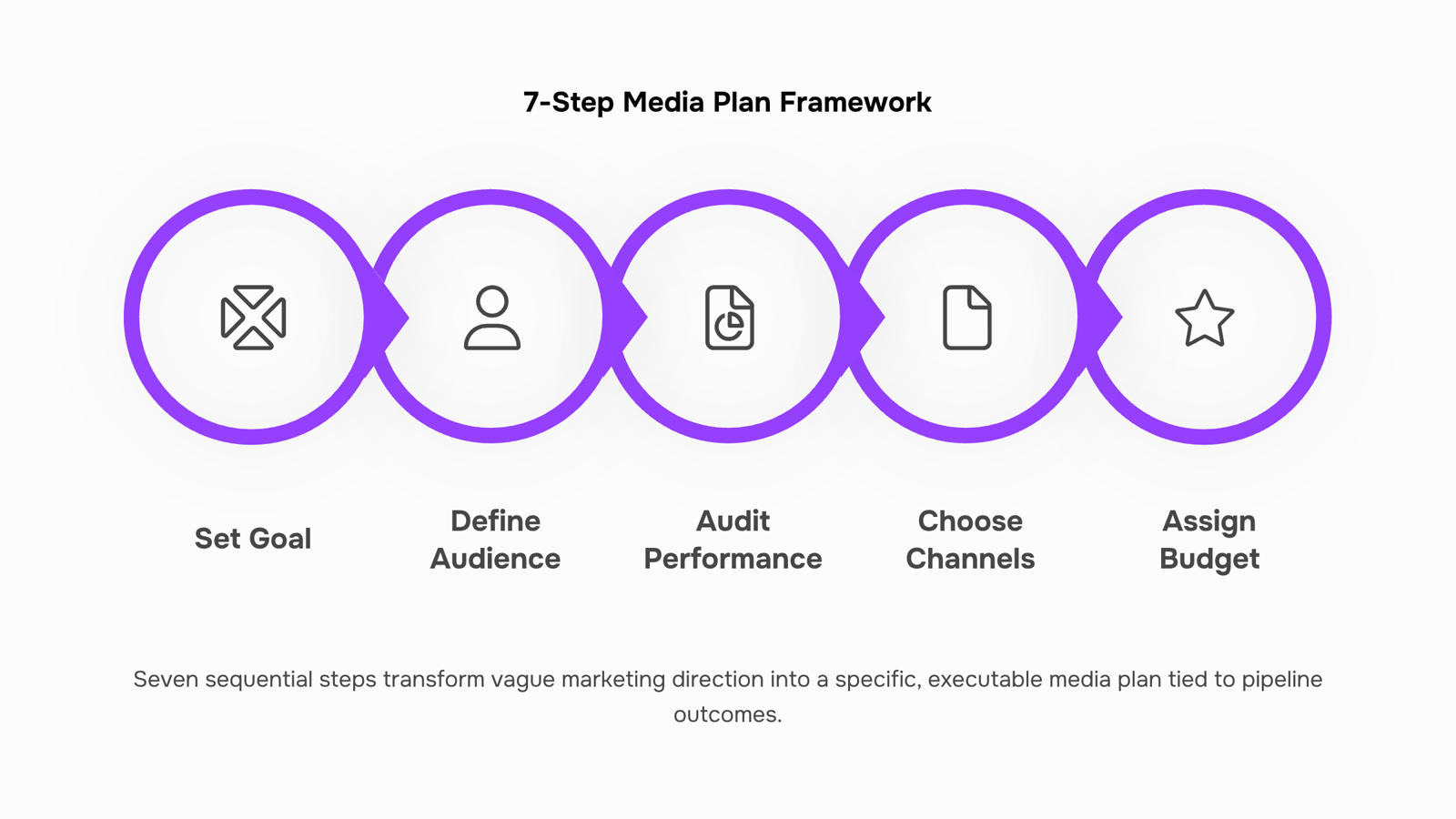
Set a measurable goal before you touch a channel: Every decision downstream, from which platforms you buy to how much you spend, flows from this. A goal like "increase qualified pipeline" is too vague. "Generate 40 demo requests from mid-market IT buyers in Q2" gives you something to plan against. If your goal isn't specific enough to fail, it's not specific enough to plan around.
Define your audience in buying-stage terms: Knowing your ICP is a start. Knowing whether you're targeting buyers who've never heard of you versus buyers who've already visited your pricing page changes every channel and message decision. Map your audience to a stage: awareness, consideration, or decision. Each stage needs different content, different channels, and a different success metric.
Audit what you already have: Before allocating budget, pull performance data from the last two to three quarters. Which channels produced pipeline? Which produced clicks but no conversions? This audit prevents you from rebuilding the same underperforming mix with a fresh budget. Most teams skip this step and wonder why results plateau.
Choose channels based on where your audience actually is: This is where a standard marketing plan format diverges from a media plan: the media plan forces a channel-by-channel commitment with budget attached. For IT companies, LinkedIn and targeted search typically outperform broad display for demand generation. Pick two or three channels you can fund properly rather than spreading thin across six.
Assign budget, timing, and ownership to each channel: A media plan without owners is a wish list. For each channel, record the monthly spend, the start and end dates, and the person responsible for execution and reporting. If you're learning how to create a social media plan as part of this, treat each social channel as its own line with its own budget and owner, not a single "social" bucket.
Set KPIs that connect to revenue, not just reach: Impressions and follower counts are easy to report and easy to ignore. For each channel, define one leading indicator (click-through rate, cost per lead) and one lagging indicator (pipeline influenced, closed revenue). Choosing the right marketing KPIs at this stage prevents the common failure where the plan looks healthy on vanity metrics while pipeline stays flat.
Build a review cadence into the plan itself: Most media plans get written and then ignored until the quarter ends. Schedule a 30-minute channel review every two weeks. At each review, ask three questions: Is spend pacing correctly? Are leading indicators on track? Does anything need to be reallocated? A social media planning template that automates your email channel reporting removes one manual step from that review, so the meeting stays focused on decisions rather than data collection.
The whole framework takes most teams two to three hours to complete the first time. The goal is a document specific enough that anyone on your team could pick it up and execute without asking you what the plan actually means.
Four tactics move the needle most.
A/B test one variable at a time: Run creative or copy tests for a minimum of two weeks before reading results. Testing headline against image against CTA simultaneously makes it impossible to know what drove the change. Pick one, let it run, then move to the next.
Set frequency caps on paid placements: Showing the same ad to the same person more than three to four times in a week typically drives diminishing returns and increases negative sentiment. Most ad platforms let you cap at the campaign or ad-set level.
Build channel reallocation triggers into your social media plan: Define a threshold in advance: if a channel's cost-per-lead rises 20% above baseline for two consecutive weeks, shift that budget to the next best performer. Reacting to data beats reacting to gut feel. Pair this with choosing the right marketing KPIs so your triggers are tied to metrics that actually matter.
Audit your social media planner against a standard marketing plan format once per quarter. Channels shift, audiences shift, and a plan written in January rarely fits April without adjustment.
Three review cycles keep a media plan current without turning it into a full-time job.
Monthly: Check your social media planning calendar against actual spend and performance. If a channel is burning budget without hitting its click-through or conversion benchmark, pause it or reallocate before the next billing cycle.
Quarterly: Replan channel mix, creative, and targeting. This is where you adjust based on what the monthly data revealed. Use this cycle to revisit your marketing KPIs and confirm they still reflect business priorities.
Annually: Full reset. Revisit audience definitions, budget allocations, and your overall marketing plan format before locking the next year's media plan.
Most teams skip the monthly check and wonder why their quarterly numbers look wrong. The monthly pulse is where drift gets caught early.
Use this structure as your social media plan template starting point. Copy the table, fill in your specifics, and you have a working draft in under 30 minutes.
Section | What to fill in |
|---|
Goal | One measurable outcome (e.g., 15% more inbound leads in Q2) |
Target audience | Job title, industry, company size |
Channels | Paid search, LinkedIn, display, email |
Budget | Total spend + split by channel |
Content types | Video, case study, sponsored post |
Schedule | Start date, end date, posting cadence |
KPIs | CTR, CPL, pipeline influenced |
Review date | Monthly check-in, quarterly replan |
This sample social media plan covers the inputs every channel decision depends on. For the content layer specifically, the steps involved in content marketing planning map directly onto rows three through five above.
Closing
A complete media plan is only half the battle. The harder part is executing it consistently — especially the email and nurture sequences that need to land on schedule, week after week, without manual intervention. That's where most plans break down: the strategy is sound, but the touchpoints slip or get deprioritized. Evox handles that layer automatically, triggering and sequencing your email campaigns based on audience behavior and your review cadence, so your plan stays on track while you focus on results. See how it works and whether it fits your workflow.
FAQ
Q. How do I create an effective media plan for my business?
A. Start with a measurable goal, define your audience by buying stage, audit past performance, choose two to three channels where your audience actually is, assign budget and owners, set revenue-tied KPIs, and build in a two-week review cadence. Each step flows into the next; skip any and you're guessing, not planning.Q. What are the key components of a media plan?
A. Target audience definition, channel mix with reasoning, budget allocation by channel, a social media planning calendar with specific dates, KPIs tied to each channel, and a fixed review cadence. Miss any one and you don't have a plan — you have a direction.Q. How does a media plan differ from a marketing strategy?
A. A strategy answers what you're trying to achieve and why. A media plan answers where, when, and how much you spend to get there. Strategy sets direction; media plan funds and schedules the execution with measurable placements per channel.Q. What are some tips for optimizing my media plan for better ROI?
A. Audit past performance before allocating new budget, pick two or three channels you can fund properly rather than spreading thin, tie KPIs to pipeline and revenue not vanity metrics, and review every two weeks to reallocate based on leading indicators, not hindsight.Q. How often should I review and update my media plan?
A. Schedule a 30-minute channel review every two weeks. Ask three questions: Is spend pacing correctly? Are leading indicators on track? Does anything need reallocation? This cadence prevents plans from being written and ignored until quarter-end.Q. What does a social media plan template look like?
A. Treat each social channel as its own line with its own budget, owner, start/end dates, and KPIs rather than lumping them into one 'social' bucket. Map every paid and organic placement to a specific date or week so it becomes a live schedule, not a static document.Q. How much budget should I allocate in a media plan?
A. Allocate based on where your audience actually is and what you can fund properly. For IT companies, LinkedIn and targeted search typically outperform broad display. Include production costs alongside placement costs, and reallocate every two weeks based on leading indicators like cost-per-lead and click-through rate.


 Elena Petrova15 September 2026


