TL;DR: Most invoicing guides give you a field list and assume you'll figure out the rest. This one explains what each field actually does, what goes wrong when it's missing or vague, and how to structure your invoice differently depending on whether you're billing hourly, by project, or on retainer. IT consultants billing across multiple engagement types will leave with a format they can use immediately.
Why a Consulting Invoice Is Not Just a Receipt
A consulting invoice is a legally binding payment instruction. It documents what was delivered, when payment is due, and what happens if it is late. Treating it as a formality is how consultants end up chasing payments for 60 days instead of 30.
The difference between a receipt and an invoice matters operationally. A receipt confirms money already received. An invoice for consulting services creates a payment obligation, establishes your terms, and gives you legal standing if the client disputes or delays. Research from FreshBooks consistently shows that vague line item descriptions are one of the top reasons service invoices get paid late — clients flag them for internal approval loops that can add weeks.
Every field on a well-structured invoice carries weight. A missing invoice number breaks your audit trail. A vague due date gives the client room to interpret "net 30" however they like. Undefined late fees are unenforceable. These are not edge cases — they are the gaps that turn a closed project into an open collections problem.
Before you look at essential elements every invoice needs or review best practices for invoicing professional services clients, understand this: the structure of your invoice is the structure of your payment agreement. Get it wrong and the document works against you.
The Required Fields Every Consulting Invoice Must Have
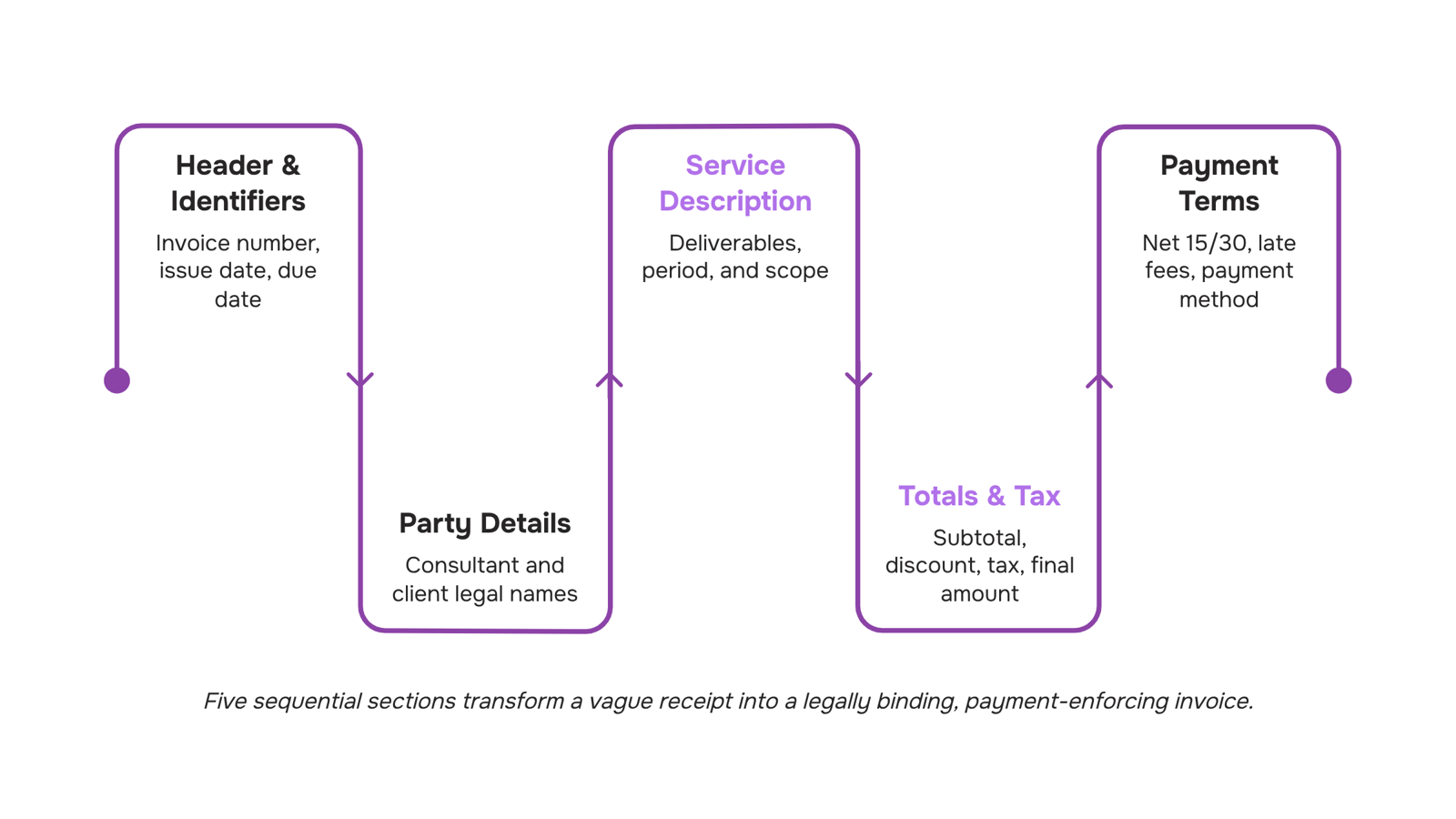
Every consulting invoice needs the same core fields, and the consequences of skipping or vagueing-out any one of them are concrete and predictable.
Invoice number: A unique, sequential identifier ties your invoice to your accounting records, your client's purchase order system, and any dispute that comes up later. Clients who run formal AP processes will reject or delay payment on invoices without one. Start at 001 or use a date-prefixed format like 2025-001 — either works, as long as it never repeats.
Issue date and due date: The issue date starts the payment clock. The due date tells the client exactly when you expect to be paid. Without a due date, "net 30" lives only in your head. Write the due date explicitly — "Payment due by July 15, 2025" — not as a formula the client has to calculate.
Consultant and client details: Your legal name or registered business name, address, and contact email. The client's legal entity name, billing address, and the name of whoever approved the work. Sending an invoice to the wrong legal entity is one of the most common reasons payment stalls on larger accounts.
Service period: For any engagement billed by the hour or on retainer, the dates covered matter as much as the dollar amount. "June consulting services" is not a service period. "June 2 – June 27, 2025" is.
Payment terms and late fees: State your net terms (net 15, net 30), accepted payment methods, and your late fee policy in the same document. In the US, a late fee of 1.5% per month is standard and generally enforceable; in the UK, the Late Payment of Commercial Debts Act sets a statutory rate of 8% above the Bank of England base rate. If you want to charge it, it needs to be on the invoice before the due date passes.
For a closer look at how these fields map to a standard layout, the standard format for a consultation bill covers the structural conventions most clients expect to see.
A sample invoice for consulting services that omits even one of these fields gives a client an easy reason to delay. An example invoice for consulting services that includes all of them removes that option entirely.
How to Structure the Service Description and Line Items
The service description is where most consulting invoices fall apart. Clients don't dispute the total — they dispute what they're paying for. A line item that reads "consulting services – October" gives a client every reason to stall, request clarification, or push back on the amount.
Write each line item as if you're defending it in a dispute. Include the specific deliverable, the time period or scope boundary, and the quantity. "SEO audit and technical recommendations – Phase 1 (Oct 1–15)" is defensible. "Consulting" is not.
Hourly billing requires the most detail. Each line item should show the date or date range, the task performed, the hours logged, and the hourly rate. If you worked across multiple workstreams in a week, split them into separate line items rather than collapsing them into one. Clients reading an invoice for consulting services want to see where the time went, not just the total.
Fixed-project billing works differently. You're billing against a defined deliverable, not time spent. Your line item should reference the project name, the milestone or phase, and the agreed fee. If the project has multiple phases, each phase gets its own line. This structure also protects you: if a client claims scope creep, your line items become the paper trail that shows what was agreed.
Retainer billing is the simplest to structure but the easiest to dispute if you're vague. List the retainer period, the scope it covers (hours included or services included), and the flat fee. If you track hours against the retainer, attach a summary — don't embed it in the invoice itself.
A sample invoice for consulting services that separates these billing models clearly reduces back-and-forth before payment is due. For a deeper look at what each line item should contain, the guide on essential elements every invoice needs covers the full field-by-field breakdown.
Tax, Discounts, and Totals: What to Show and How to Calculate
The math on a consulting invoice needs to be self-evident. If a client has to ask how you got to the total, you've already created a reason to delay payment.
Structure your totals block in this order: subtotal, discount (if any), taxable amount, tax, and final total. That sequence makes the calculation auditable at a glance.
Subtotal is the sum of all line items before any adjustments. Show it even when there are no discounts or taxes, because it anchors the rest of the math.
Discounts go on their own line, labeled clearly ("Project discount: 10%") and applied before tax. Applying a discount after tax is a common mistake that changes the client's tax liability and yours.
Tax depends on where you're registered. In the US, consulting services are generally not subject to sales tax, but check your state. In the UK, you charge 20% VAT once you cross the £90,000 registration threshold. In Australia, GST at 10% applies once you exceed AUD 75,000 in annual turnover. If you're below the threshold, state that explicitly on the invoice: "GST not applicable, registered below threshold." Ambiguity here invites disputes.
For a sample invoice for consulting services word template, this totals block is the section most consultants get wrong by collapsing it into a single line.
Tools like Inzo handle multi-line tax and discount calculations automatically, so the numbers are always consistent with the essential elements every invoice needs without manual recalculation.
Payment Terms and Instructions That Actually Get You Paid
Payment terms are where most consulting invoices quietly fail. The math is right, the line items are clear, and the client still pays late because the invoice left the "when" and "how" open to interpretation.
Net 15 vs. net 30 vs. due on receipt each carry different expectations. Net 15 works well for smaller fixed-project invoices where scope was agreed upfront. Net 30 is standard for larger engagements or enterprise clients with AP cycles. "Due on receipt" is appropriate for retainer renewals or clients with a history of delays, but it can strain new relationships if introduced without context.
Late fee language needs to be specific to hold up. A clause like "1.5% per month on outstanding balances after the due date" is clearer and more enforceable than "late fees may apply." In the US and UK, 1.5% monthly (18% annualized) is widely used and generally enforceable; confirm local rules before applying it to international clients.
Payment method instructions should remove every procedural excuse. List the exact bank details, ACH routing number, or payment link. If you accept Stripe or PayPal, include the direct payment URL, not just the platform name. Clients who have to ask how to pay will delay while they ask.
For IT companies managing multiple client invoices, keeping payment terms consistent across engagements reduces the back-and-forth that stalls collection. When you know how to make an invoice for consulting services that specifies terms precisely, you remove the ambiguity clients use to defer payment.
How to Create and Send a Consulting Invoice Without Starting from Scratch
Three options exist for building a consulting invoice: a Word template, a dedicated invoicing tool, or automated generation tied directly to your project work. Each has a real tradeoff.
Word templates are free and fast for a first invoice. Search "sample invoice for consulting services Word" and you'll find dozens of usable starting points. The problem is manual: every engagement means re-entering client details, recalculating totals, and hoping nothing gets overwritten. One transposed number on a line item description delays payment by days or weeks, because clients use vague descriptions as grounds to query before paying.
Standalone invoicing tools solve the re-entry problem. You store client records, pull them into a new invoice, and send from the same interface. For consultants billing a handful of clients on fixed-project terms, this works well. The gap appears when your billing model is hourly or milestone-based: the tool holds your invoice, but your time logs and project records live somewhere else. Assembly is still manual.
Project-linked billing removes that gap. Inzo generates an invoice for consulting services directly from a completed project or approved estimate, so line items, hours, and rates carry over without re-entry. Estimates convert to invoices in one step, which matters when a client has already approved scope in writing.
For IT consultants managing multiple engagements, the decision comes down to volume and billing model. One or two fixed-fee clients per month: a Word template or basic tool is fine. Hourly billing across three or more active projects: manual assembly will cost you time and introduce errors that slow payment.
Check the time tracking and billing tools built for consultants if you want a side-by-side view of what each approach handles.
Closing
A well-structured consulting invoice does three things at once: it documents what was delivered, it establishes your payment terms legally, and it removes reasons for the client to delay. The difference between a vague line item and a specific one often determines whether you're paid in 30 days or 60. If you recognized your current invoicing process in this article — rebuilding invoices manually, chasing clarifications, or waiting weeks for payment — the next step is to link your invoices directly to completed projects so they generate automatically. Inzo's project-based billing does exactly that, pulling deliverables and hours from your project records and building the invoice without manual rebuild. Start there if you're billing across multiple engagement types and want the payment clock to start on time.
FAQ
What information should be included in a consulting services invoice?
Invoice number, issue date, due date, consultant and client legal names, service period, payment terms, late fees, line item descriptions (specific deliverables and dates), subtotal, tax, and final total. Each field removes a reason the client can use to delay payment.
How can I create a professional invoice for consulting services?
Use a template or tool that separates line items by billing model (hourly, project, retainer), shows the math step-by-step (subtotal, discount, tax, total), and includes explicit due dates and payment terms. Structure each line item as if defending it in a dispute.
What are the best practices for invoicing clients as a consultant?
Write line items with specific deliverables and dates, not vague descriptions. State payment terms and late fees upfront. Send invoices on the day work completes, not weeks later. Include your invoice number and the client's legal entity name to avoid AP delays.
Can I use a template to generate an invoice for consulting services?
Yes. A template ensures consistent formatting and reduces errors. For best results, use one that separates hourly, project, and retainer billing models so you're not rebuilding the structure each time.
How do I invoice for consulting services billed by the hour vs. fixed project?
Hourly: show date, task, hours, and rate per line item. Fixed project: reference the project name, milestone, and agreed fee per phase. Retainer: list the period, scope covered, and flat fee. Each model has a different line item structure.
What payment terms should I put on a consulting invoice?
Net 15, 30, or 45 depending on your cash flow and industry norms. State it explicitly — 'Payment due by [date]' — not as a formula. Include your late fee policy (typically 1.5% per month in the US) so it's enforceable if payment stalls.


 Ryan Mitchell14 September 2026


