TL;DR: Most content audit guides hand you a crawl export and a checklist that stops at "update or delete." The PRUNE Framework gives IT company owners a scored decision matrix across traffic potential, topical authority, conversion value, and AI-answer eligibility, so every page gets a ranked action, not a judgment call. You'll finish with a prioritized list you can execute, not a spreadsheet you'll revisit in six months.
What a content audit for SEO actually does
Most teams treat a content audit as a cleanup task: export URLs, check traffic, delete the weak ones. That framing misses the point.
A content audit for SEO is a prioritized action system. You're not deciding what to delete. You're deciding what each page should do next, based on where it sits in your site's authority structure, how it serves search intent, and whether it's pulling traffic or diluting it.
The PRUNE Framework gives every page a category before anyone touches it: Preserve, Redirect, Update, No-index, or Eliminate. That five-way split replaces the binary "keep or cut" logic most guides use, which forces bad calls on pages that actually need consolidation or a canonical fix instead.
Page-level categorization also makes the SEO content audit process scalable. A 500-URL site and a 2,000-URL site face the same structural problem: too many pages competing for the same queries, too few pages earning meaningful links. Categorizing first, then acting, stops you from pruning pages that should have been merged.
If you want to see how a similar structured approach plays out in practice, the AUDIT Framework walkthrough covers the diagnostic logic in detail.
The next section covers exactly what data you need before any of this starts.
Before you touch a single URL, you need four data layers in front of you. Missing any one of them turns a content audit for SEO into guesswork.
Crawl data is your foundation. You need every indexable URL, its HTTP status, word count, canonical tag, and internal link count. Ranko's Site Inspector crawls and scores every page nightly, so your inventory is never stale. If you prefer a one-time pull, Screaming Frog works for sites under 500 URLs on the free tier.
Google Search Console gives you impressions, clicks, average position, and which queries each page ranks for. Export the last 12 months, not 3. Seasonal content looks dead at 90 days and healthy at 365.
Google Analytics (or GA4) adds engagement signals: sessions, bounce rate, time on page, and conversion events. A page with 400 monthly visits and zero conversions reads differently than one with 40 visits and three demo requests.
A page inventory spreadsheet ties everything together. Columns at minimum: URL, crawl status, GSC clicks, GA sessions, primary keyword, word count, last-modified date, and your PRUNE category (you'll assign that in the next step). This is your SEO content audit working file.
For teams running audits across more than a few hundred pages, the AUDIT Framework offers a complementary scoring approach that maps well onto this same data structure.
Pull these four sources before anything else. The categorization work only takes an hour once the data is clean.
How a content audit differs from a technical SEO audit
A content audit for SEO focuses on what your pages say and whether that content earns traffic, conversions, or topical authority. A technical SEO audit focuses on how your site is built: crawlability, indexation, Core Web Vitals, structured data. Both matter, but they answer different questions and pull different people into the work.
Dimension | Content audit | Technical SEO audit |
|---|
Scope | Page-level quality, relevance, and performance | Site architecture, speed, and crawl health |
Primary inputs | GSC queries, Analytics engagement, page copy | Crawl data, server logs, PageSpeed scores |
Key outputs | Update, consolidate, or cut decisions | Fix tickets for dev or site config |
Who owns it | Content lead or SEO strategist | Developer or technical SEO specialist |
Cadence | Quarterly or after major publishing pushes | After site changes or on a rolling basis |
Scoping this correctly matters before you touch a single URL. If your pages rank but don't convert, that's a content audit problem. If they don't get crawled at all, fix the technical layer first. For teams that want both layers covered, Ranko's Site Inspector crawls and scores every page nightly, so you're not choosing between them.
The PRUNE Framework: a decision matrix for every page
PRUNE stands for Promote, Redirect, Update, Neutralize, and Eliminate. It gives every URL a clear destination instead of leaving your team to debate "keep or delete" on gut feel.
Most content pruning SEO guides stop at two options. PRUNE gives you five, each tied to specific scoring criteria so the call is defensible, not arbitrary.
How scoring works
Rate each page across four dimensions, each on a 1–3 scale:
Traffic potential: organic sessions trend over 90 days, plus keyword ranking position
Topical authority: does this page support a cluster, or is it an orphan?
Conversion value: does it sit on a path to a demo, trial, or qualified lead?
AEO eligibility: is the page structured to appear in AI-generated answers? For a deeper look at what makes a page eligible to appear in AI-generated answers, that dimension alone can shift a page from Eliminate to Update.
A page scoring 10–12 gets Promoted. A page scoring 3–5 with no salvageable angle gets Eliminated. Everything in between lands in one of the three middle states.
What each state means in practice
Promote: strong on all four dimensions. Add internal links pointing to it, expand the content, push it into your featured-snippet and AEO content audit checklist.
Redirect: low traffic, but the topic is covered better elsewhere. 301 to the stronger page and recover whatever link equity exists.
Update: ranking on page 2–3, solid topical fit, but thin or outdated. This is where most of your SEO effort pays off. Rewrite, add depth, re-optimize for current search intent.
Neutralize: no SEO value, but the page serves a product or support function. Remove it from crawl scope with a noindex tag rather than deleting it.
Eliminate: low score across all four dimensions, no internal linking value, no conversion path. Delete and redirect to the nearest relevant URL.
For a complementary approach to page-level assessment, the AUDIT Framework maps well alongside PRUNE, particularly for teams that want a second scoring pass before committing to elimination.
Running this manually across hundreds of URLs is slow. Ranko's Site Inspector crawls and scores every page nightly, so your PRUNE inputs stay current without a monthly re-crawl sprint. The next section shows how to sort your scored pages into a sequenced action list using impact-versus-effort logic.
How to prioritize which pages to fix first
Once every page has a PRUNE score, the real work is sequencing — deciding what gets fixed this week versus next quarter.
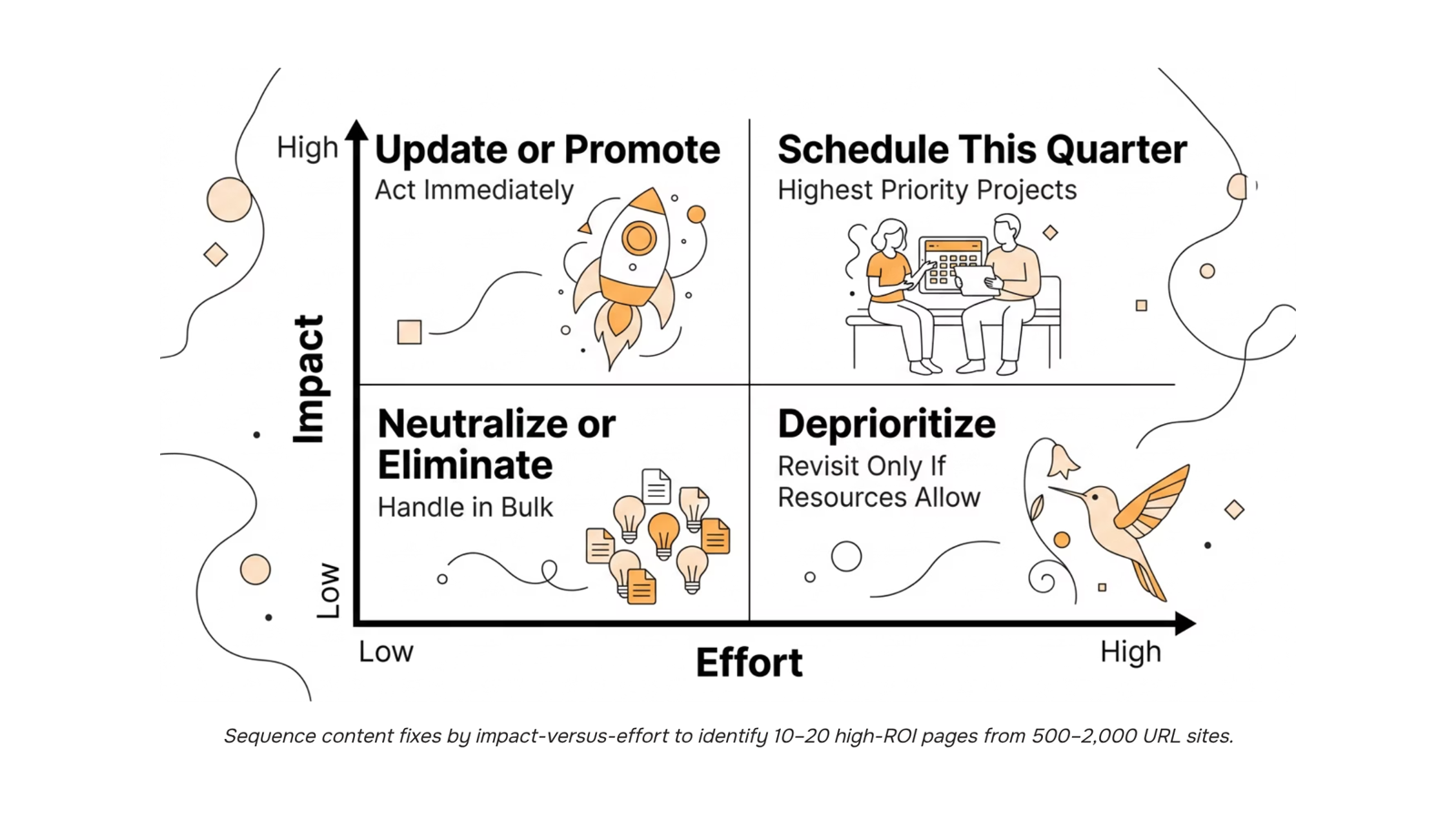
Sort your scored pages into a simple 2×2: impact on one axis (traffic potential plus conversion value), effort on the other (word count, link equity, redirect complexity). Pages that score high on impact and low on effort are your first batch. For most IT company sites in the 500–2,000 URL range, that first batch is smaller than you expect — often 10 to 20 pages that account for a disproportionate share of recoverable traffic.
Work through the quadrants in this order:
High impact, low effort — Update or Promote immediately. These are quick wins that compound fast.
High impact, high effort — Schedule within the current quarter. Don't skip them; they move the needle most.
Low impact, low effort — Neutralize or Eliminate in bulk. Thin pages drag crawl budget without contributing.
Low impact, high effort — Deprioritize. Revisit only if topical authority gaps make them strategically necessary.
This sequencing is the core of a defensible SEO content audit process. If you want the prioritization to stay current without re-running the matrix manually, Ranko's Site Inspector crawls and scores every page nightly, so your ranked to-do list updates automatically as pages gain or lose signals.
How to audit content for AI answer engines, not just Google
Google rankings and AEO eligibility are scored differently, and most content audits only measure one.
For a standard content audit for SEO, you're tracking rankings, clicks, and crawlability. For AI answer engine optimization, you're asking a different question: would an LLM cite this page as a source? The criteria shift toward factual density, structural clarity, and topical authority signals — things like defined terms, named frameworks, specific numbers, and clear authorship.
The PRUNE Framework's AEO eligibility dimension scores each page on four signals:
Factual anchors: does the page contain citable data points, named processes, or sourced claims?
Structural clarity: are answers surfaced in the first 100 words, with headers that match likely query phrasing?
Topical depth: does the page cover one topic completely rather than several topics shallowly?
Entity consistency: is the brand, author, or product named consistently across the page and its metadata?
A page can rank on page one and still score zero on AEO eligibility. What makes a page eligible to appear in AI-generated answers depends on citation-worthiness, not just keyword match.
For a complementary page-level view, the AUDIT Framework offers a parallel assessment approach worth running alongside PRUNE.
How to make your content audit repeatable
Run a content audit for SEO once and you've solved today's problem. Build a repeatable content audit process and you stop the decay from compounding.
For most mid-size B2B sites (500–2,000 URLs), a quarterly cadence works. Sites publishing more than 20 pieces per month should run a lightweight monthly pass, with a full SEO content audit each quarter. Smaller sites with stable output can get away with twice a year.
The manual version of this content audit checklist gets expensive fast. Ranko's Site Inspector, which crawls and scores every page nightly, automates the inventory and scoring steps you'd otherwise rebuild from scratch each cycle. Auto page data tags flag status changes, traffic drops, and AEO eligibility shifts the moment they happen, not three months later when the damage is done.
That changes the audit from a project into a standing signal. Your team reviews exceptions, not spreadsheets.
For a complementary page-level approach that pairs well with PRUNE, the AUDIT Framework covers granular on-page assessment in the same structured way.
Closing
The PRUNE Framework turns a content audit from a cleanup chore into a ranked action system. Every page gets a category—Promote, Redirect, Update, Neutralize, or Eliminate—based on traffic potential, topical authority, conversion value, and AI-answer eligibility. That means no more gut calls, no more six-month-old spreadsheets gathering dust.
Start this week by pulling your crawl data, GSC clicks, and GA sessions into one inventory. Score your top 50 pages across the four dimensions, then sort by impact-versus-effort. You'll have your first batch of updates ready to hand off to your content team before Friday. Ready to see how this works at scale? Check out how teams use Ranko to drive results to watch the PRUNE Framework in action, then explore Ranko's Site Inspector to automate the nightly scoring and inventory work.
FAQ
How do I conduct a content audit for my website?
Pull crawl data, Google Search Console clicks, and GA sessions into one inventory spreadsheet. Score each page across traffic potential, topical authority, conversion value, and AI-answer eligibility on a 1–3 scale. Assign each page a PRUNE category—Promote, Redirect, Update, Neutralize, or Eliminate—then prioritize by impact-versus-effort.
What tools can I use to simplify the content audit process?
Ranko's Site Inspector crawls and scores every page nightly, keeping your inventory current without monthly re-crawls. Screaming Frog works for smaller sites. Google Search Console and GA4 provide traffic and engagement signals. Tie them together in a spreadsheet or inventory tool.
How often should I perform a content audit?
Run a full audit quarterly or after major publishing pushes. With Ranko's nightly scoring, your data stays fresh continuously, so you're updating priorities weekly rather than rediscovering stale pages every six months.
What are the benefits of performing a regular content audit?
You eliminate pages diluting your site's authority, consolidate competing content into stronger clusters, prioritize updates that drive traffic and conversions, and ensure every page serves a clear SEO or business purpose. This stops wasted crawl budget and improves topical authority.
Can a content audit help improve my website's search engine rankings?
Yes. Consolidating weak pages, updating page-2 content with fresh depth, and promoting strong pages through internal linking all strengthen your site's topical authority and crawl efficiency, which directly improves rankings for your target queries.
What metrics determine whether a page should be updated, redirected, or deleted?
Score pages on traffic potential (sessions and ranking position), topical authority (cluster fit), conversion value (demo or lead path), and AI-answer eligibility. High scores across most dimensions warrant updates. Low scores with better coverage elsewhere get redirected. Pages scoring 3–5 with no salvageable angle get eliminated.
How do I audit content for AI answer engines, not just Google?
Add AI-answer eligibility as a fourth scoring dimension alongside traffic, authority, and conversion value. Check whether your page is structured to appear in AI-generated answers—clear definitions, cited data, and direct answers to common queries all signal eligibility. Pages scoring well here get promoted or updated; weak ones may shift from Eliminate to Update.


 Elena Petrova15 September 2026


