TL;DR: Most follow-up email guides hand you a template and call it a strategy. This one gives IT company owners a timing-first framework: exact wait windows by deal stage, a decision rule for how many follow-ups to send, and the content shift each message needs to avoid sounding like a resend. You'll leave with a repeatable system you can put to work today.
Why silence is not the same as a no
No reply usually means busy, not uninterested. Research from the Brevet Group found that 80% of sales require at least five follow-ups, yet most people send one email and stop. That gap is where deals quietly die.
Silence has a dozen explanations before "not interested" even makes the list: a packed inbox, a decision still waiting on budget approval, a forwarded email that got buried. Your prospect may have read your message, meant to reply, and simply moved on to the next fire.
This is why knowing how to send a follow up email after no response is a system worth building, not a one-off task. A structured follow up email sequence keeps you visible without being aggressive. It also tells you something useful: if someone doesn't respond after a deliberate series of touchpoints, that's signal, not silence.
The next section covers exactly how long to wait before each send based on context, not a single generic rule.
How long to wait before sending a follow-up email
Timing a follow-up isn't a single rule. It's a decision based on context: who you emailed, what you asked, and where they are in your pipeline.
Here's a practical framework by stage:
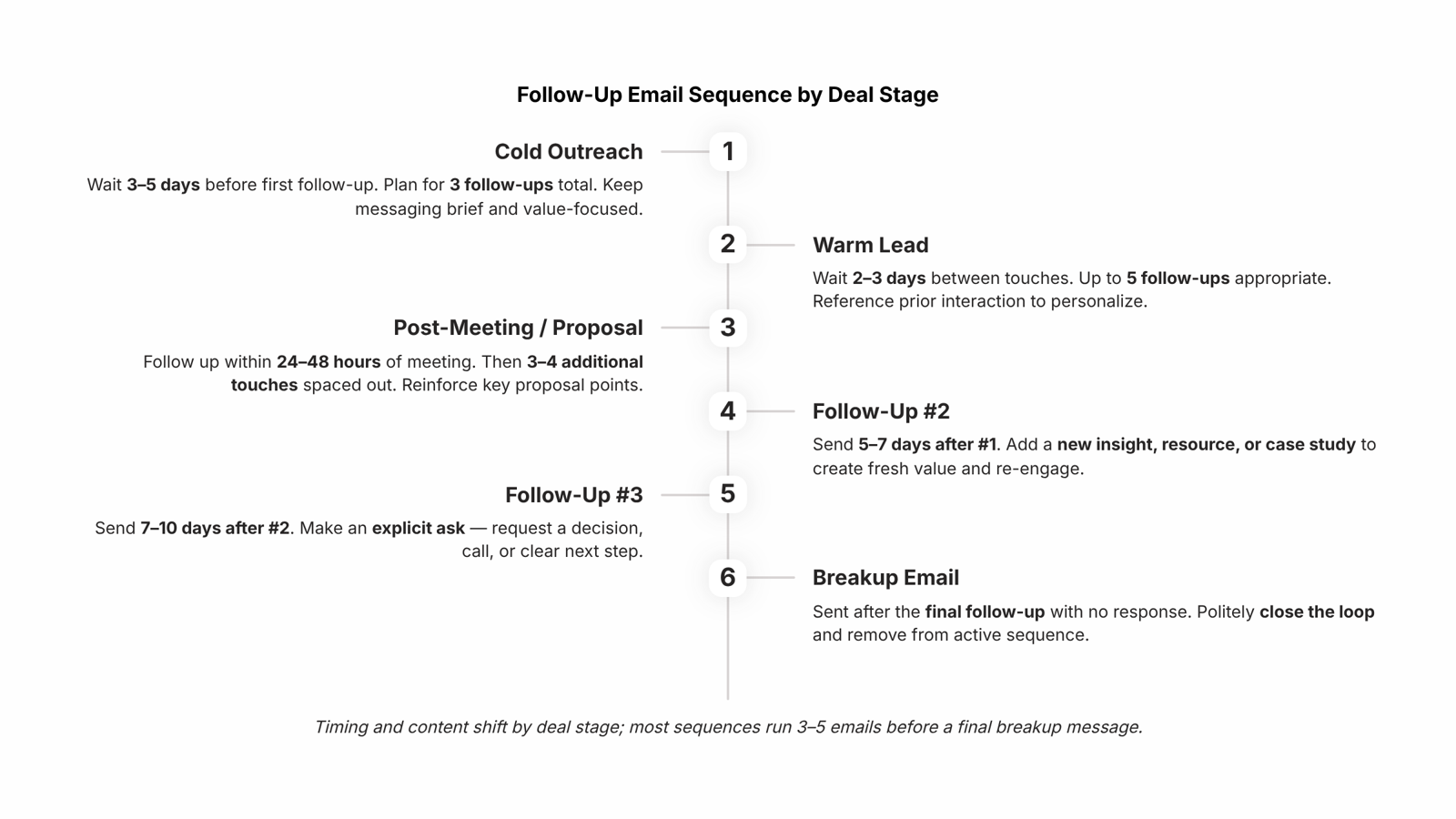
Cold outreach (first contact): Wait 3 to 5 business days before your first follow-up. The person doesn't know you yet, so hitting their inbox the next morning reads as pressure. Five days gives them time to process without letting the thread go cold.
Warm leads or existing relationships: Two to three business days is enough. They already know your company, so a quicker nudge fits the relationship. Waiting a full week here often means they've mentally filed your email under "deal with later."
Post-meeting or post-proposal: Follow up within 24 to 48 hours. You had their attention; the follow-up is expected. A same-day or next-morning email while the conversation is still fresh gets the highest response rates in this context.
Ongoing sequences (follow-up two and three): Space these out more. After your first follow-up gets no reply, wait 5 to 7 business days before sending a second. After that, another 7 to 10 days before a third. Compressing the gaps signals desperation; stretching them too far loses momentum.
On timing within the day, most B2B practitioners find Tuesday through Thursday mornings (8 to 10 a.m. in the recipient's timezone) outperform Monday and Friday sends, when inboxes are either catching up or clearing out.
One thing to set before you start any sequence: a stop rule. Decide in advance how many follow-ups you'll send, typically two to three after the original email, and what you'll do when the sequence ends. That might mean routing the contact to a longer-term nurture list or closing the thread with a final "no-pressure" note.
For a breakdown of what to include in each follow-up email after no response at each stage, the next section covers how the content angle should shift across follow-up one, two, and three.
What to write in each follow-up email
Each follow-up email needs a different job. The first one re-opens the door. The second adds something new. The third makes a clear, final ask. If all three say the same thing in different words, you're not following up — you're repeating yourself, and silence is the natural response to repetition.
Follow-up one: a short, low-friction nudge
Your first follow-up after no response should be brief — two or three sentences at most. Don't re-pitch. Don't apologize for following up. Simply resurface the original thread with a single, easy question or a one-line restatement of what you're asking for.
A practical example: if your original email proposed a 20-minute call, your first follow-up might read, "Wanted to make sure this didn't get buried. Still happy to work around your schedule — does next week work?" That's it. The goal is a reply, not a conversion.
Follow-up two: add a reason to respond now
By the second follow-up, you need to give the reader something they didn't have before. That could be a relevant case study, a piece of information that changes the context, a deadline, or a specific question tied to their situation.
This is where most follow-up email sequences go wrong. Generic content — "just checking in again" — signals that you have nothing new to say. If you're thinking about what to write in a follow up email that actually moves a conversation forward, the second email is where specificity matters most. Name something concrete: a result a similar company saw, a constraint you noticed on their website, a question only they can answer.
Follow-up three: make the ask explicit and easy to decline
The third email is your clearest. State what you're looking for, why it matters to them specifically, and give them a clean way out if the timing is wrong.
Something like: "If this isn't a priority right now, just say the word and I'll stop reaching out. If it is, I'd love 15 minutes this week." This framing respects their time, reduces friction, and often produces a reply — even if that reply is a no.
A "no" closes the loop. Silence after a well-written third email is data: the timing, fit, or offer isn't right. That's useful, and it's a better outcome than an inbox full of unanswered follow up emails after no response.
How many follow-up emails to send before you stop
The right number depends on context, but most sequences run three to five emails before you stop.
For cold outreach, three follow-ups after the original is the ceiling. By email four, you're past the point of diminishing returns and into territory that damages your sender reputation. Research from RAIN Group suggests most B2B responses come after the second or third touchpoint, not the first, so don't quit after one silence, but don't run six either.
For a warm lead (someone who clicked, replied once, or attended a demo), five emails is defensible. They've already shown intent. A longer follow up email sequence makes sense here because each email can shift angle: add a case study, address a likely objection, offer a different format for the next conversation.
For a post-proposal situation, three to four follow-ups is standard. After that, you're not nurturing, you're pressuring.
The stop rule is simple: if someone hasn't responded after your final follow-up, send one breakup email. Keep it short. Something like "I don't want to keep landing in your inbox if the timing is off. Happy to reconnect whenever it makes sense." That email often gets a reply when nothing else did, because it removes the pressure entirely. You can read more about how to follow up without sounding pushy if that's the tone you're aiming for.
After the breakup email, stop. Move the contact to a long-term nurture list or close the thread. Continuing past that point rarely converts anyone and consistently trains your audience to ignore you.
The best time of day and week to send follow-ups
Timing your follow-up matters more than most guides admit. Sending the right message at the wrong moment means it lands in a crowded inbox and gets buried.
For B2B outreach, Tuesday through Thursday between 9–11 a.m. or 1–3 p.m. in the recipient's time zone consistently produces the highest open rates, according to Mailchimp's email benchmarks. Monday mornings are cluttered with catch-up tasks. Friday afternoons are mentally checked out.
But the best time to send a follow-up email also depends on where you are in the sequence:
First follow-up (day 3–4): Send mid-morning Tuesday or Wednesday. The prospect is past the Monday rush and still in decision-making mode.
Second follow-up (day 7–10): Thursday morning works well here. Avoid Friday entirely.
Third follow-up (day 14+): Tuesday again, but try a different time slot than your previous sends. Variation prevents pattern blindness.
One practical rule: never send two follow-ups in the same week unless the prospect has already engaged (opened, clicked, replied). Engagement signals reset the clock.
For a deeper breakdown of what to include in each follow-up email at each stage, or guidance on how to follow up without sounding pushy, those posts cover the content side in detail.
Automate your follow-up sequence so nothing slips
Manual follow-up sequences break down the moment your pipeline gets busy. You forget who's on day three, who already replied, and who hit the stop rule. Automation removes that failure point entirely.
A well-built follow up email sequence runs on triggers, not memory. Set your first follow-up to send 48 hours after no open, your second at day five, and your third at day ten. Each message should shift angle slightly — from value reminder to social proof to a direct close. If you need guidance on what to include in each follow-up email, that breakdown covers message-by-message content.
Evox handles the sequencing and stop logic automatically: when a prospect replies or books, the sequence halts. Lio layers on top by scoring which leads warrant a follow up email after no response at all, so your sequence runs on qualified contacts from the start.
Common mistakes that kill your reply rate
Most follow-up sequences fail before they start. Here are the errors worth checking before you hit send:
Repeating the subject line: A copied subject line signals automation, not persistence. Change it every time.
Vague CTAs: "Let me know your thoughts" gives the reader nothing to act on. Ask for one specific thing: a 15-minute call, a yes/no, a date.
Following up too fast: Sending a second email within 24 hours reads as pressure, not value. Check the best time to send a sales follow-up email before scheduling.
No stop rule: Three to four touches is the ceiling for most cold sequences. Beyond that, you're burning the contact, not warming them.
Closing
The system works because it separates timing from content and gives you a clear stop rule. Wait the right number of days, shift your angle with each send, and know when to step back. Most deals die not because prospects aren't interested, but because follow-ups either pile up too fast or stop too soon. Evox handles the sequencing and timing for you — no manual tracking, no missed delays — while Lio flags leads who go cold so nothing slips through. Start a free trial or book a short demo to see how the two work together to keep your pipeline moving without the inbox management headache.
FAQ
What is the best time to send a follow-up email after no response?
Tuesday through Thursday mornings, 8 to 10 a.m. in the recipient's timezone. Cold outreach waits 3 to 5 business days; warm leads get 2 to 3 days; post-meeting follows up within 24 to 48 hours.
How many follow-up emails should I send after no response?
Three to five, depending on context. Cold outreach stops at three; warm leads can go to five. Always end with a breakup email that removes pressure and gives them a clean way out.
What should I write in a follow-up email after no response?
First: a two-sentence nudge. Second: add something new (case study, deadline, specific question). Third: make the ask explicit and easy to decline. Each email needs a different job, not a rewrite of the last one.
How long should I wait before sending a follow-up email after no response?
Cold outreach: 3 to 5 business days. Warm leads: 2 to 3 days. Post-meeting: 24 to 48 hours. Second follow-up: 5 to 7 days. Third: another 7 to 10 days. Compress the gaps and you signal desperation.
Is it okay to send a follow-up email if I never heard back?
Yes. Research shows 80% of sales require at least five follow-ups. Silence usually means busy, not uninterested. A structured sequence keeps you visible without being aggressive.
What subject line should I use for a follow-up email after no response?
Keep it short and reference the original thread. Use "Re:" to stay in the same conversation. Avoid urgency words; they trigger spam filters and read as pressure.


 Elena Petrova11 September 2026


