TL;DR: Most articles on marketing automation CRM define each tool separately and leave the integration to your imagination. This one shows IT company owners the exact handoff points where CRM data triggers automation sequences, and where automation feeds qualified leads back into the CRM, so both systems compound each other's value. You'll leave with a clear framework for wiring them together.
What marketing automation and CRM each actually do
A CRM (Customer Relationship Management platform) is a system of record for people. It stores contact details, deal stages, communication history, and account ownership. Your sales team lives in it. When a rep closes a deal or logs a call, that action updates the CRM. The data is mostly retrospective: what happened, with whom, and when.
Marketing automation is a system of action for audiences. It sends emails, scores leads, runs nurture sequences, and triggers workflows based on behavior, such as a prospect downloading a whitepaper or visiting your pricing page three times in a week. The data it owns is behavioral and forward-looking: who is showing interest, and what should happen next.
The distinction matters because each tool fails without the other. Marketing automation can identify a high-intent lead but has no visibility into whether that person is already mid-negotiation with a rep. A CRM can show a deal stalled at proposal stage but cannot automatically re-engage the contact with relevant content. Teams running both tools without a sync strategy end up with duplicate contacts, mismatched lead scores, and sales reps chasing prospects marketing already disqualified.
The data handoff between the two is the part most guides skip. Specifically, CRM fields like deal stage, close date, and rep assignment should feed back into your automation platform to suppress, re-route, or re-score leads in real time. That loop is what separates a connected sales marketing automation CRM setup from two tools that happen to share a contact list.
For the mechanics of building the automation workflows that run on top of your CRM data, or running campaigns directly from your CRM, the next sections cover both.
The clearest way to separate these tools is to look at four dimensions: who uses them, what data they own, when they act, and what outcome they drive.
Who uses each: Marketing automation is primarily a marketing team tool. It runs campaigns, scores leads, and manages sequences before a prospect ever talks to sales. The CRM is where sales and account management live. When both teams share one platform without clear ownership boundaries, you get duplicate contact records and conflicting activity logs faster than you'd expect.
What data each owns: Marketing automation owns behavioral data: email opens, page visits, form fills, content downloads. The CRM owns relationship data: deal stage, call notes, contract value, renewal dates. These are different data types serving different decisions. Trying to run sales forecasting from your automation platform, or segment nurture campaigns from raw CRM deal data, is where sales marketing automation crm workflows break down in practice.
When each system acts: Automation acts on triggers: a prospect downloads a whitepaper, a sequence starts. A CRM acts on human judgment: a rep reviews the record, decides to call. The timing mismatch is the core tension in marketing automation crm dynamics. Automation moves fast and at scale; CRM work is deliberate and contextual.
What outcome each drives: Automation drives pipeline volume: more qualified leads entering the funnel. CRM drives pipeline conversion: moving the right leads to closed. Neither metric is more important, but conflating them produces bad reporting. A team that measures marketing by CRM close rate, or sales by email open rate, is measuring the wrong system.
These four distinctions matter most when you're building the automation workflows that run on top of your CRM data or running campaigns directly from your CRM, because the failure mode in both cases is the same: treating one system as a substitute for the other.
How marketing automation enhances your CRM
Most CRM records tell you a contact exists. A well-integrated marketing automation layer tells you what that contact actually did, and when.
The specific signals that matter are engagement score changes, email sequence completions, form fills, and page visit patterns. When your automation platform passes these back to the CRM record in real time, a sales rep opening that contact no longer sees a name and a company. They see someone who opened three emails, downloaded your pricing page PDF, and completed a nurture sequence yesterday. That context changes the conversation before the first call.
The marketing automation CRM integration also works the other direction. When a rep marks a deal as "Proposal Sent" in the CRM, that status change can trigger a new automation sequence automatically, without anyone manually enrolling the contact. This is the data handoff loop most teams miss. They configure a one-time sync at setup and assume the job is done. It isn't. The loop needs to run continuously, and the CRM fields that receive automation data (lead score, last engaged date, sequence status) need to be mapped deliberately, not left to defaults.
Teams running email marketing automation with CRM access to live engagement data tend to follow up faster and on more relevant triggers. The failure mode without this sync is a sales team working from stale records while marketing re-engages contacts who already talked to a rep three days ago.
Tools like Revo let you wire trigger-based automation directly from CRM activity, so a field update fires a workflow without manual intervention. If you're building the automation workflows that run on top of your CRM data or running campaigns directly from your CRM, the trigger mapping is where the real efficiency lives.
How the two systems handle lead nurturing together
Most lead nurturing breakdowns treat the two systems as separate lanes. They're not. The real value comes from understanding which system owns each stage of the journey.
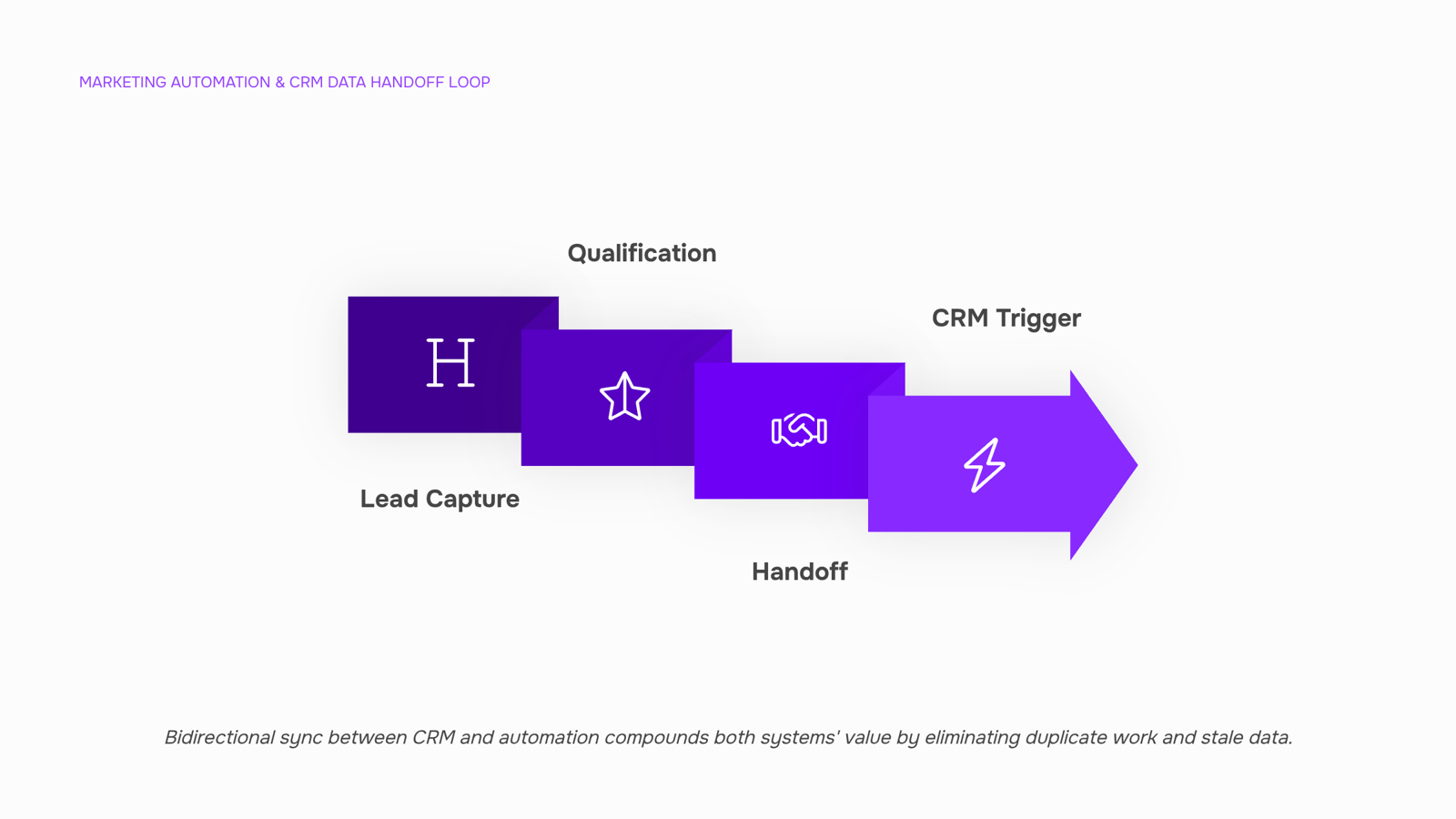
Capture happens in your marketing automation platform. A lead fills out a form, downloads a resource, or clicks a sequence link. The automation tool logs the action, tags the lead, and starts an email marketing automation CRM workflow, typically a drip sequence timed to the behavior that triggered entry.
Qualification is where the two systems start talking. As the lead moves through the sequence, the automation platform scores each interaction: email opens, link clicks, page visits, form completions. Those scores write back to the CRM record in real time. By the time a lead hits your qualification threshold, the CRM contact already carries a full engagement history, not just a name and company.
Handoff is where most teams lose time. If the CRM record is current, a sales rep opens it and sees exactly which emails the lead engaged with, which pages they visited, and where they dropped off. That context shapes the first call. Without it, the rep starts cold regardless of how warm the lead actually is. The manual CRM tasks automation removes from your sales team covers this gap in detail.
The handoff also triggers the next automation layer. Once a lead is marked sales-qualified in the CRM, Revo can fire a task assignment, alert the right rep, and pause any active nurture sequences so the lead doesn't receive a marketing email the morning after a sales call.
Setting up the integration between your CRM and automation platform is the right starting point if that sync isn't in place yet.
The data handoff loop most teams miss
The failure mode is almost always the same: the CRM and the marketing automation platform are connected, but only in one direction. Leads flow from automation into the CRM, and that's where the loop ends. Sales reps never push engagement data back. Marketing never learns which nurture sequences actually converted. Both teams keep working from incomplete pictures.
The result is predictable. Reps chase leads that went cold three weeks ago because no one updated the lead score after the prospect stopped opening emails. Marketing keeps sending campaigns to contacts who already bought, or worse, already churned. Duplicate contacts, stale records, and misrouted leads pile up quietly until someone notices the pipeline numbers don't add up.
The fix is a bidirectional sync, not a one-time setup but an ongoing exchange. When a rep logs a call outcome in the CRM, that event should trigger a marketing automation rule. When a lead's email engagement score drops, the CRM record should reflect it automatically.
A concrete example of how this works in practice: Lio captures and scores inbound leads, then routes qualified ones to the CRM with full engagement context attached. Evox monitors reply behavior and deal stage, then re-enters cold leads into a reactivation sequence without a rep having to remember to do it. The two agents pass data in both directions, so building the automation workflows that run on top of your CRM data becomes a compounding system rather than a one-time configuration.
That's the marketing automation CRM integration most teams skip.
Four criteria separate a platform worth buying from one you'll be migrating off in 18 months.
Native sync depth: Ask whether the integration writes back to both systems or just reads from one. A platform that pushes contact records into your CRM but never pulls back deal stage, close date, or rep notes leaves your marketing automation running on stale data. The sync should be bidirectional at the field level, not just the contact level.
Trigger logic tied to CRM events: Your automation should fire based on what happens inside the CRM, not just on email clicks. A prospect who goes quiet for 14 days after a demo should trigger a re-engagement sequence automatically. If you have to build that manually in a separate tool every time, the system is already fragile. When building the automation workflows that run on top of your CRM data, this is the first thing to test.
Lead scoring that updates in real time: Static lead scores assigned at form fill are nearly useless by day 10. Look for scoring models that recalculate as contacts open emails, visit pricing pages, or get tagged by a rep.
Two-way inbox visibility: Sales reps should see every marketing touchpoint in the contact timeline. Marketing should see every reply a rep sent. Without that, both sides operate on partial context and running campaigns directly from your CRM becomes guesswork.
Any sales marketing automation CRM platform that clears all four of these is worth a serious evaluation. One that misses two or more will create the same sync failures the previous section described.
Closing
The gap between marketing automation and CRM isn't a technical problem—it's a handoff problem. When CRM data (deal stage, rep assignment, close date) flows into your automation platform in real time, and behavioral data (email opens, page visits, lead scores) flows back into the CRM, both systems compound each other's value. Your sales team stops chasing cold leads marketing already disqualified, and your marketing team stops re-engaging prospects already in negotiation.
Lio and Evox handle this loop natively: Lio captures and scores inbound leads, routes them based on CRM criteria, and Evox runs nurture sequences that write engagement data straight back to your CRM record. The integration setup guide walks you through the field mappings and trigger logic in under an hour. Start a free trial and test the handoff with your own lead data this week.
FAQ
What is the difference between marketing automation and CRM?
A CRM stores contact details, deal stages, and communication history—it's your system of record. Marketing automation sends emails, scores leads, and triggers workflows based on behavior—it's your system of action. Each fails without the other.
How does marketing automation enhance CRM capabilities?
Automation passes behavioral signals (email opens, page visits, lead scores) back to the CRM record in real time, so reps see full engagement context before calling. It also triggers CRM-based workflows automatically—when a rep marks a deal "Proposal Sent," a nurture sequence fires without manual enrollment.
Can marketing automation CRM help with lead nurturing?
Yes. Automation captures and scores leads through sequences while writing engagement data to the CRM. Sales then inherits a warm, qualified record with full history instead of starting cold. The handoff is where most nurturing value lives.
What are the top marketing automation CRM platforms for sales teams?
Lio handles lead capture, scoring, and CRM routing. Evox runs nurture sequences and writes engagement data back to your CRM. Together they close the loop most standalone tools miss: behavioral data flowing both directions in real time.
Do you need both a CRM and a marketing automation tool, or can one replace the other?
You need both. A CRM alone cannot identify high-intent leads or run nurture sequences at scale. Automation alone cannot track deal stages or assign rep ownership. Each tool fails without the other's data flowing in real time.


 Elena Petrova15 September 2026


