TL;DR: Most articles on SEO content marketing services describe what vendors offer. This one gives IT company owners a five-layer framework to audit any proposal, spot the gaps vendors hide, and decide what to buy with confidence. You'll finish with a named structure you can apply to the next vendor conversation you have.
Why Vendor Proposals for SEO Content Services Are Hard to Compare
Two vendors quote you the same phrase, "SEO content marketing services," and deliver completely different scopes. One means a monthly blog post and a keyword spreadsheet. The other means a technical audit, a content brief, distribution, and rank tracking. Both call it the same thing.
This is the core buying problem. The label is standardized; the work behind it is not. Most buyers only discover the gap after signing, when the first invoice arrives and the deliverables list looks nothing like what was discussed. If you're building a content marketing plan before you hire a vendor, you need a way to cut through that ambiguity before the contract stage.
The comparison problem gets worse because vendors bundle and unbundle differently. Technical SEO, keyword research, content production, distribution, and measurement each represent distinct skill sets and cost centers. A budget proposal often drops two or three of these entirely without flagging it. Content marketing agency deliverables vary so widely that a side-by-side comparison of two proposals is nearly meaningless without a shared vocabulary.
That's what the 5-layer framework in the next section gives you: a consistent structure for reading any vendor proposal, identifying what's included, and spotting what's quietly missing. You can also use it alongside content optimization tools vendors use in Layer 3 to pressure-test specific deliverables.
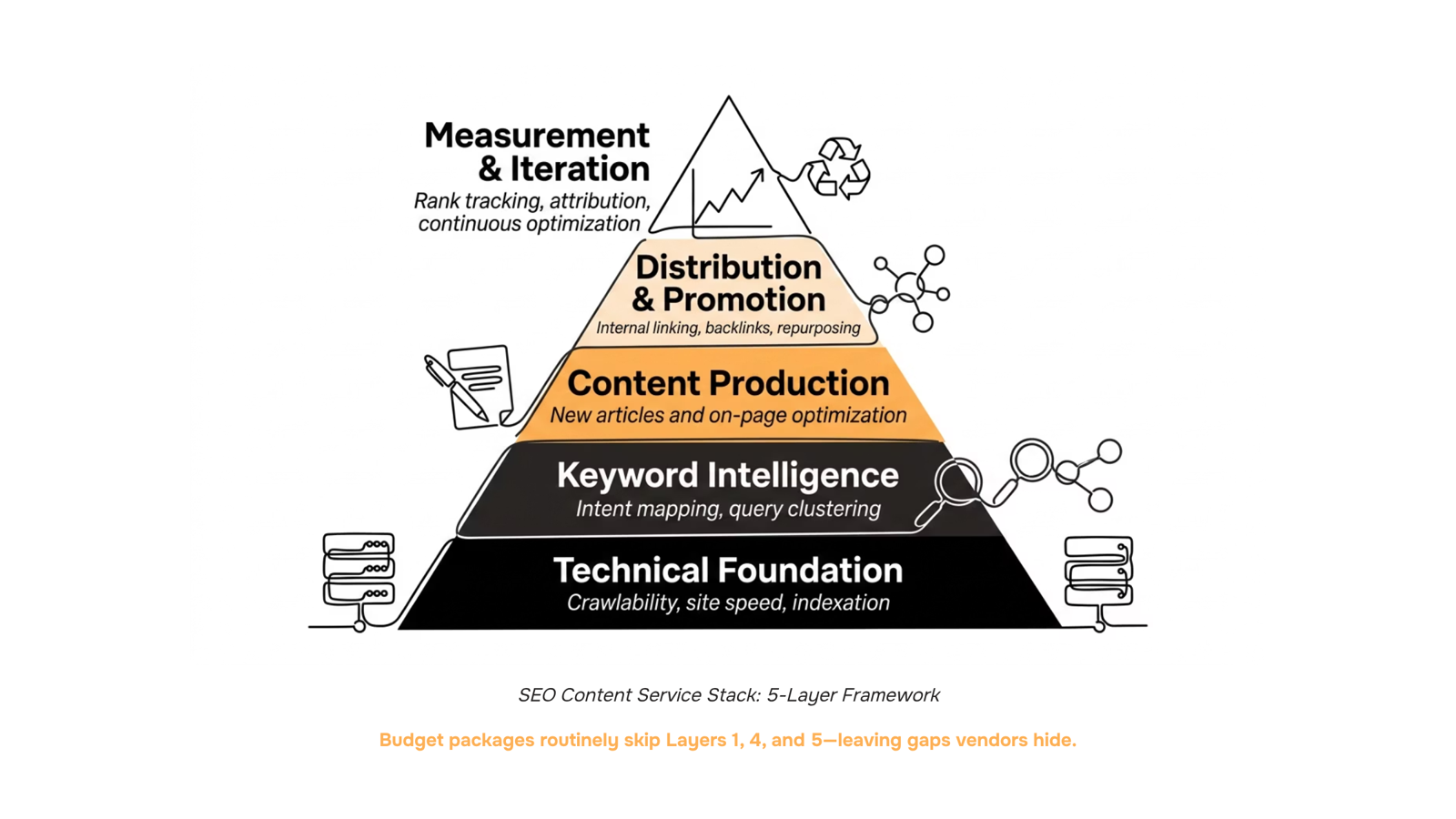
The SEO Content Service Stack: A 5-Layer Audit Framework
Think of this framework as a checklist you run against any vendor proposal before you sign. Each layer represents a distinct category of work. When a vendor skips one, you're not getting a discount — you're getting a gap.
Layer 1: Technical Foundation
This is the infrastructure work that makes everything else rankable: crawlability, site speed, structured data, canonical tags, and indexation health. Without it, even well-written content sits in a dead zone. Ask any vendor: "Does your scope include a technical audit at kickoff, and who owns fixes — your team or ours?" Budget packages almost always exclude this layer or treat it as a one-time PDF that nobody acts on.
Layer 2: Keyword Intelligence
Keyword research services at this layer mean more than pulling a list from Ahrefs or Semrush. Real keyword intelligence maps search intent, clusters related queries, identifies cannibalization risks, and connects terms to funnel stages. The question to ask: "How do you distinguish discovery keywords from conversion keywords, and how does that affect what you write first?" Most proposals hand you a spreadsheet and call it strategy. It isn't.
Layer 3: Content Production
This is the layer most buyers focus on — and the one with the widest quality variance. The shift toward AI-assisted production has changed throughput significantly; many agencies now draft at 3–5× the volume they did in 2022, but editing and subject-matter review haven't scaled at the same rate. Understand the difference between content production (net-new articles) and content optimization (improving existing pages for rankings). Vendors often price these separately, and content optimization tools vendors use — tools like Surfer or Clearscope — are often an add-on, not a default. Ask: "What percentage of your deliverables are new content versus optimized existing pages?"
Layer 4: Distribution and Promotion
Writing a piece and publishing it are not the same as distributing it. This layer covers internal linking strategy, outreach for backlinks, content repurposing across channels, and paid amplification where relevant. Most budget packages stop at publish. Ask: "What happens to a piece after it goes live?" If the answer is nothing, you're paying for production without promotion.
Layer 5: Measurement and Iteration
An SEO content strategy without a measurement layer is a publishing schedule, not a program. This layer includes rank tracking, organic traffic attribution, conversion reporting, and a defined cadence for updating underperforming content. Tracking rank movement should be a standing deliverable, not something you chase down each month. Ask: "How do you decide which content to update, and on what schedule?"
Which layers budget packages drop
Routinely cut: Layer 1 (technical), Layer 4 (distribution), and the iteration half of Layer 5. What you're usually buying in an entry-level package is Layers 2 and 3 — keyword research and content production — with measurement limited to a monthly traffic summary.
If you're building a content marketing plan before you hire a vendor, map your current gaps against these five layers first. That tells you which scope items to negotiate for, not just which package to pick.
Keyword Research and Content Strategy Are Not the Same Service
Most vendor proposals bundle keyword research and content strategy into a single line item. They're not the same work, and paying for one while expecting the other is where budgets quietly disappear.
Keyword research is a discovery deliverable. A vendor runs search volume analysis, maps intent clusters, identifies gaps, and hands you a prioritized list of terms. That's where keyword research services typically end. The output is data.
SEO content strategy is a planning deliverable. It takes that keyword data and answers: which topics do we build first, in what format, targeting which stage of the funnel, published on what cadence? Without this layer, you have a spreadsheet, not a plan.
The practical test: ask your vendor to show you the content calendar that came out of their keyword research. If they look confused, you bought discovery without planning.
This distinction matters more now that AI has changed content throughput. Producing 20 articles a month is operationally possible for most agencies. Producing 20 articles that map to a coherent topic cluster, support a conversion path, and avoid cannibalizing each other requires an actual SEO content strategy — and that's the work most budget packages skip.
Before you hire anyone, build your content marketing plan so you can tell the difference between a vendor offering both layers and one offering only the first.
Content Production vs Content Optimization: What Each Actually Covers
These two service components look similar on a vendor proposal but fund completely different work.
Content production starts from a keyword brief and ends with a published article. The inputs are a target query, a content angle, and a word count. The timeline from brief to live page typically runs two to four weeks. ROI is slow by design — new articles rarely rank before three to six months after publication.
Content optimization starts from a page that already exists and already has some ranking signal. The inputs are a current-rank report, a gap analysis against top-ranking competitors, and a rewrite brief. Turnaround is faster, often one to two weeks, and rank movement can appear within days of Google re-crawling the page.
The ROI profiles are genuinely different. Optimization compounds existing authority; production builds new surface area. A vendor scoping only one without flagging the other is leaving half the work unnamed.
Before hiring, build a content marketing plan that separates your production backlog from your optimization backlog. When evaluating SEO content marketing services, ask vendors to quote each as a separate line item. If they can't, the scope is blurred.
How AI-Assisted Content Production Changes What Vendors Can Deliver
AI has shifted what content agencies can realistically promise — and how fast they can deliver it.
A vendor using AI-assisted content production can draft a 1,500-word article in under an hour. That changes throughput math significantly: where a traditional agency might commit to 8 to 12 articles per month per writer, AI-augmented teams routinely deliver 20 to 30. That sounds like a win, but throughput without quality controls produces content that ranks briefly and then drops.
When evaluating content marketing agency deliverables, ask vendors three direct questions:
Which parts of production are AI-generated versus human-written?
What does the editing and fact-checking step look like, and who owns it?
How do you handle AI-generated content that fails to match search intent after publication?
Vendors who can't answer the second question clearly are shipping first drafts.
The more useful shift is when AI handles the workflow connective tissue — keyword clustering, brief generation, internal link mapping — freeing human writers to focus on argument and evidence. That's where AI tools for optimizing content creation actually earn their place.
Ranko is built around this model: keyword research, content planning, and article production run in a single workflow, so nothing gets lost between the research phase and the published draft. For IT owners buying SEO content marketing services, that end-to-end traceability is worth asking any vendor to match.
How to Measure ROI from SEO Content Marketing Services
Measuring SEO content ROI requires matching metrics to the service layer that produced them, not treating every article as a single line item.
For Layer 1 and 2 work (keyword research, strategy), track share of voice and keyword coverage gaps closed. These are planning outputs, not traffic drivers. Expect a 3-to-6-month lag before they show up in rankings. For Layer 3 (content production), monitor organic impressions, click-through rate, and time-on-page per article. For Layers 4 and 5 (distribution, conversion), watch assisted conversions and pipeline influenced, not just sessions.
Content marketing planning frameworks consistently show that most teams measure the wrong thing at the wrong stage, which is why SEO content marketing services look slow when they are actually on track.
On timeline: new articles typically take 3-6 months to generate meaningful organic traffic. Require your vendor to show a ranking-progress report at the 90-day mark, not just a delivery confirmation.
Three reporting deliverables worth requiring in any contract:
Monthly keyword rank movement by cluster, not just total keywords tracked
Attribution model documentation (first-touch vs. last-touch, clearly stated)
A content decay report flagging articles losing position after month six
Questions to Ask an SEO Content Agency Before You Sign
Before you sign anything, run the quoted scope through these questions:
Which of the five layers are excluded from this price? Most proposals bundle keyword research with content strategy — they're different activities. Push for a line-item breakdown.
How do you disclose AI-assisted production, and what's your human editorial process? Agencies that can't answer this clearly are outsourcing quality control to you.
What reporting cadence and rank-movement metrics are contractually committed? Tracking rank movement should be a deliverable, not a favor.
What content optimization tools does your team use in on-page work? Vague answers signal a thin Layer 3.
If you're still mapping your SEO content strategy before hiring, do that first.
Closing
The five-layer framework gives you a shared vocabulary for any vendor conversation. Most budget packages drop technical work, distribution, and iteration — which means you're paying for content production without the infrastructure or promotion to make it rank. Before your next agency call, map your gaps against these layers and ask which ones are in scope. That one question — "which layers are included?" — will cut through more vendor ambiguity than a feature list ever will.
FAQ
What do SEO content marketing services typically include?
Most packages cover keyword research and content production. Budget tiers typically skip technical audits, distribution strategy, and iteration cycles — the layers that actually drive rankings and ROI.
How can SEO content marketing services benefit my business?
When all five layers are present, services drive organic traffic, reduce paid acquisition costs, and build a rankable content asset. Without distribution and iteration, you get articles that sit unpromoted.
What are the best SEO content marketing services for small businesses?
Look for vendors that cover Layers 2, 3, and 5 (keyword intelligence, production, measurement). Avoid packages that hand you a spreadsheet and call it strategy, or publish content with no promotion plan.
Can SEO content marketing services help me reach a wider audience online?
Yes, if Layer 4 (distribution and promotion) is included. Internal linking, backlink outreach, and repurposing expand reach. Without it, your content stays invisible.
Which service layers are most commonly missing from low-cost SEO content packages?
Technical foundation (Layer 1), distribution (Layer 4), and iteration (Layer 5) are routinely cut. Entry packages typically include only keyword research and production.
How is keyword research different from content strategy as a paid service?
Keyword research is discovery — it outputs a prioritized list. Content strategy is planning — it answers which topics to build first, in what format, and on what cadence. Most vendors bundle them but deliver only the first.
What questions should I ask an SEO content agency before signing a contract?
Ask which five layers are in scope, whether technical audits are included, what happens to content after publish, and how they decide which pages to update. These cut through vendor ambiguity faster than feature lists.


 Ryan Mitchell14 September 2026


