TL;DR: Most web sales guides recycle the same CTA tips and call it strategy. This one connects website optimization to the two variables IT company owners actually control: lead response speed and pipeline management. You'll get a concrete framework for turning more site traffic into closed revenue, without rebuilding your entire stack.
What web sales actually means for IT companies
Modern digital dashboard with sales analytics and upward trending graphs symbolizing online revenue growth
Web sales, for an IT services company, is not a checkout button. It is the full sequence from a visitor landing on your site to a signed contract: the inquiry form, the response, the qualification call, the proposal, and the close.
That distinction matters because most advice on increasing web sales is written for e-commerce, where conversion means a purchase. For IT companies, conversion means a qualified lead turning into a conversation. The mechanics are different, and so is the failure point.
Most IT firms have no shortage of traffic. What they lack is a structured response process once that traffic raises its hand. Effective lead management for IT companies starts the moment a form is submitted, not when someone gets around to checking the inbox.
If you want to understand what happens after that first touchpoint, structuring your sales process after the lead comes in is where the conversion work actually lives.
Why most IT websites generate traffic but not revenue
Most IT websites have a traffic problem that looks like a content problem but is actually a response problem. Visitors arrive, read a service page, and fill out a contact form. Then nothing happens fast enough.
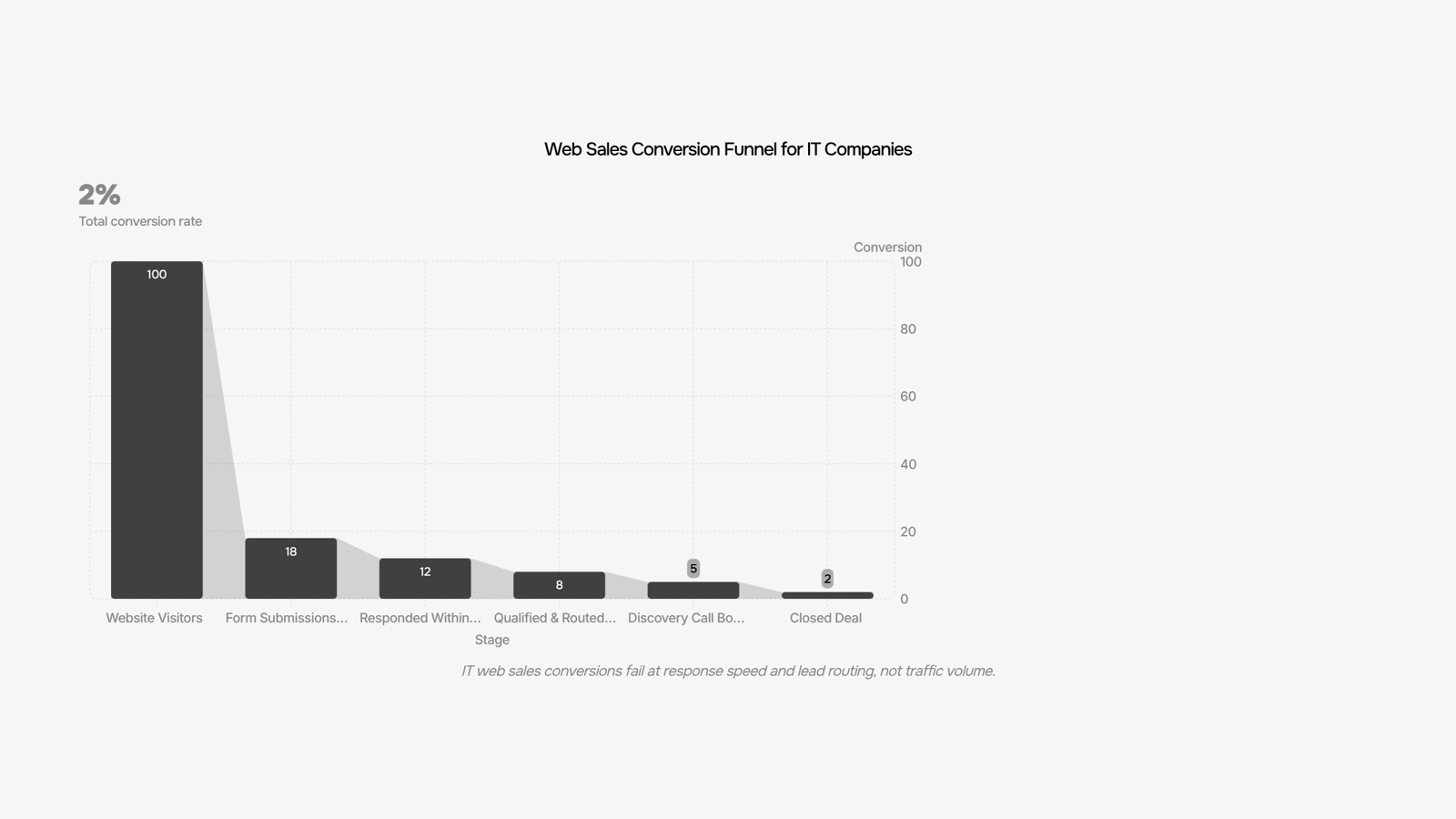
Research from Harvard Business Review found that B2B companies that follow up within an hour are nearly seven times more likely to qualify a lead than those that wait even 60 minutes longer. For most IT firms, the average website lead response time is measured in hours, not minutes.
That gap is where web sales conversions die. Traffic is not the bottleneck. The bottleneck is the absence of a structured process between form submission and first conversation.
If you want to increase qualified leads from your website, the page itself matters, but so does what happens after the click. The eight strategies below address both sides: what gets someone to convert, and what keeps that conversion from going cold.
Optimize your website to convert visitors into leads
Traffic alone does not produce revenue. A visitor lands on your service page, reads for 90 seconds, and leaves because nothing on the page gave them a reason to stay or a clear next step. That gap is where most web sales conversions are lost.
Start with page speed. Google's Core Web Vitals data shows that pages loading in under 2.5 seconds retain significantly more visitors than slower ones. For IT service companies, a slow site signals operational sloppiness before a prospect has read a single word.
Your service pages need to do three things: state who you serve, describe the specific outcome you deliver, and show one clear call to action. Not two. One. Most IT company sites bury their offer under generic language like "end-to-end solutions." Replace that with something a buyer can evaluate: "Managed IT support for 20- to 200-person professional services firms, with a 4-hour response SLA."
Trust signals matter more on IT service pages than on e-commerce sites because the purchase decision takes weeks, not minutes. Add client logos, named case study outcomes, and a visible privacy policy near any form. These reduce friction for buyers who are generating more qualified leads from your website through organic search and arriving with moderate intent.
Once the page converts a visitor into a form submission, the next variable is how fast your team responds.
Speed is the single highest-leverage variable in web sales for IT companies, and most teams underestimate how fast the window closes.
Research from Harvard Business Review found that B2B companies contacting leads within an hour were nearly seven times more likely to qualify them than those waiting even 60 minutes longer. Your competitor's sales rep is working the same lead list. Whoever responds first usually wins the conversation.
The problem is structural. A prospect fills out a contact form, and the notification lands in a shared inbox. Someone sees it, assumes someone else is handling it, and the lead sits for two hours. By then, your competitor has already booked a discovery call.
Automated lead assignment removes that gap. When a form submission triggers an immediate, personalized response and routes the lead to the right rep based on service type or territory, website lead response time drops from hours to minutes without adding headcount. This is where lead management for IT companies moves from a CRM hygiene issue to a direct revenue variable.
Lio, WorksBuddy's lead capture and routing agent, handles this automatically. A form submission triggers instant acknowledgment, scores the lead, and assigns it to the right person, so no lead waits in a queue while your competitor picks up the phone.
For a broader look at what happens after first contact, converting leads into sales covers the follow-up sequence that keeps momentum going.
Most IT companies treat social media as a brand channel. It can be a direct web sales channel if you approach it differently.
The distinction is intent. LinkedIn posts that describe a specific problem ("your MSP's onboarding takes 3 weeks; here's why") attract buyers who recognize that problem. Generic "we help businesses grow" content attracts no one useful.
A channel-specific approach works better than spreading thin:
LinkedIn: Share short diagnostic posts, not product announcements. Decision-makers at IT companies respond to operational specifics, not capability lists.
YouTube or Loom clips: A 90-second walkthrough of a real client problem drives more qualified clicks than a polished brand video.
Retargeting ads: Visitors who read a technical post but didn't convert are your warmest audience. A retargeting campaign costs far less than cold outreach to the same profile.
The goal is to increase web sales conversions from social traffic, not just lift follower counts. That means every post needs a next step: a link to a relevant resource, a case study, or a lead capture page that routes to the right person immediately.
Traffic without a structured intake process wastes the click. Structuring what happens after a lead arrives is where the revenue actually closes.
Qualify and route leads automatically so no deal slips through
Manual lead triage is where web sales momentum dies. A rep reviews a form submission, checks the CRM, decides if it's worth pursuing, then assigns it — often hours after the prospect filled out the form. Research from Harvard Business Review found that companies contacting leads within an hour were nearly seven times more likely to qualify them than those waiting even 60 minutes longer.
Automated qualification removes that delay entirely. You define the scoring criteria — company size, budget signals, job title, service type — and the system grades every inbound lead the moment it arrives. No human bottleneck between interest and response.
Routing works the same way. Instead of a manager deciding which rep gets which lead, rules push each qualified contact to the right person based on territory, specialization, or capacity. Knowing how to identify a qualified sales lead upfront makes those routing rules far more precise.
For IT companies managing lead management for IT companies across multiple service lines, this matters more than most. Lio captures web form submissions, scores them instantly using AI, and routes them to the right rep in real time — so your team responds while the prospect is still engaged, not after they've moved on.
Most web sales dashboards are full of traffic numbers that feel good and predict nothing. Unique visitors, page views, bounce rate — they describe activity, not revenue. The metrics worth watching are the ones with a direct line to conversion.
Start with lead response time. Research from Harvard Business Review found that companies contacting prospects within an hour are nearly seven times more likely to qualify the lead than those waiting even 60 minutes longer. For IT service companies, that gap is where deals go quiet.
The other web sales metrics that matter:
Lead-to-opportunity rate — what percentage of inbound leads become real sales conversations
Cost per qualified lead — not cost per click; the number after bad-fit leads are removed
Pipeline velocity — how fast leads move from first contact to proposal stage
Demo or discovery call booking rate — the clearest signal your landing page and follow-up sequence are working together
If you want to increase web sales conversions, these five numbers tell you where the process breaks before revenue does.
Traffic without conversion data is noise. If your current setup tracks sessions but not lead quality or response time, the fix starts with choosing the right tool to manage and track incoming leads before optimizing anything else.
Common mistakes that kill web sales conversion rates
Most IT company owners losing web sales conversions aren't making obvious mistakes. They're making quiet ones that compound.
Slow follow-up is the biggest. Research shows that responding to a web lead within five minutes makes conversion dramatically more likely compared to waiting an hour. Most B2B service companies wait far longer. By the time someone follows up, the prospect has already talked to a competitor.
Generic landing pages are a close second. A page that says "we help businesses grow with IT solutions" tells a mid-market IT buyer nothing. Specific pages tied to a specific problem, industry, or service convert at a fraction of the cost of paid traffic sent to a homepage.
No lead scoring means your team treats a pricing-page visitor the same as someone who downloaded a whitepaper six months ago. That's wasted capacity and slower pipeline velocity. If you're not yet managing and tracking incoming leads by intent signal, you're flying blind.
Ignoring mid-funnel drop-off is the fourth. Most teams optimize the top (traffic) and the bottom (close). The middle, where leads go cold, gets nothing. Nurturing leads who aren't ready to buy immediately is where most of the recoverable revenue sits.
No qualification on the form rounds it out. Collecting only a name and email means your sales team spends time on leads that were never a fit.
Closing
The gap between a visitor and a closed deal is almost never a traffic problem. It's a process problem. Your website may already attract the right buyers, but if your team responds in hours instead of minutes, or if leads get lost in manual routing, that traffic converts to nothing. Lio captures every lead the moment the form submits, qualifies it instantly, and assigns it to the right rep so your team responds in minutes, not hours. That single change—turning response time from a bottleneck into a competitive advantage—is where most IT companies unlock their next revenue tier. What's your current average response time to a web lead?
FAQ
What are the key metrics to track for web sales success?
Track website lead response time (aim for under 5 minutes), lead qualification rate, conversion rate from lead to discovery call, and average sales cycle length. Response speed is the highest-leverage metric—HBR research shows leads contacted within an hour are seven times more likely to qualify.
How can I improve my website's conversion rate for web sales?
Ensure pages load under 2.5 seconds, state clearly who you serve and what outcome you deliver, add one visible call-to-action, and include trust signals like client logos and case studies. Then optimize what happens after conversion by responding within minutes, not hours.
What role does social media play in driving web sales?
Social media drives qualified traffic when you share diagnostic posts that highlight specific problems your buyers face, not generic brand content. Link every post to a lead capture page so clicks convert into routed leads your team can respond to immediately.
How fast should I respond to a web lead?
Within 5 minutes if possible. Harvard Business Review research shows B2B companies contacting leads within an hour are nearly seven times more likely to qualify them than those waiting longer. Automated lead assignment makes this speed achievable without adding headcount.
What is the difference between web sales and e-commerce?
E-commerce conversion is a purchase. Web sales for IT companies is the full sequence from form submission to signed contract: inquiry, response, qualification, proposal, and close. The bottleneck is response speed and process structure, not traffic volume.


 Elena Petrova15 September 2026


