TL;DR: Most content on AI prospecting tools stops at the feature list. This article explains how these tools actually work — how they source contacts, score intent, and route leads — then maps each capability to the pipeline gaps sales teams run into most. You'll finish knowing which mechanics solve which problem, not just which names to Google.
Manual prospecting means hours of tab-switching: LinkedIn searches, company lookups, copy-pasting emails into a spreadsheet, then logging everything in your CRM by hand. AI prospecting tools replace that loop with an automated pipeline that finds, enriches, and prioritizes leads before a rep touches them.
The distinction from basic CRM automation matters. A CRM workflow can send a follow-up email when a deal stage changes. An AI prospecting tool does something earlier in the process: it identifies which companies fit your target profile, pulls contact data, fills in firmographic gaps, and ranks prospects by conversion likelihood using behavioral and historical signals. AI lead scoring is one layer of that; sales intelligence platforms are another.
According to Salesforce, AI for sales prospecting is technology that automates and enhances the way you engage with potential customers. The real operational shift is that sales prospecting automation moves qualification work upstream, so reps spend time on conversations rather than research.
The next section covers the four-step mechanism behind this: data sourcing, enrichment, scoring, and routing. Understanding that sequence is what separates a useful evaluation of prospecting tools for sales teams from a feature checklist.
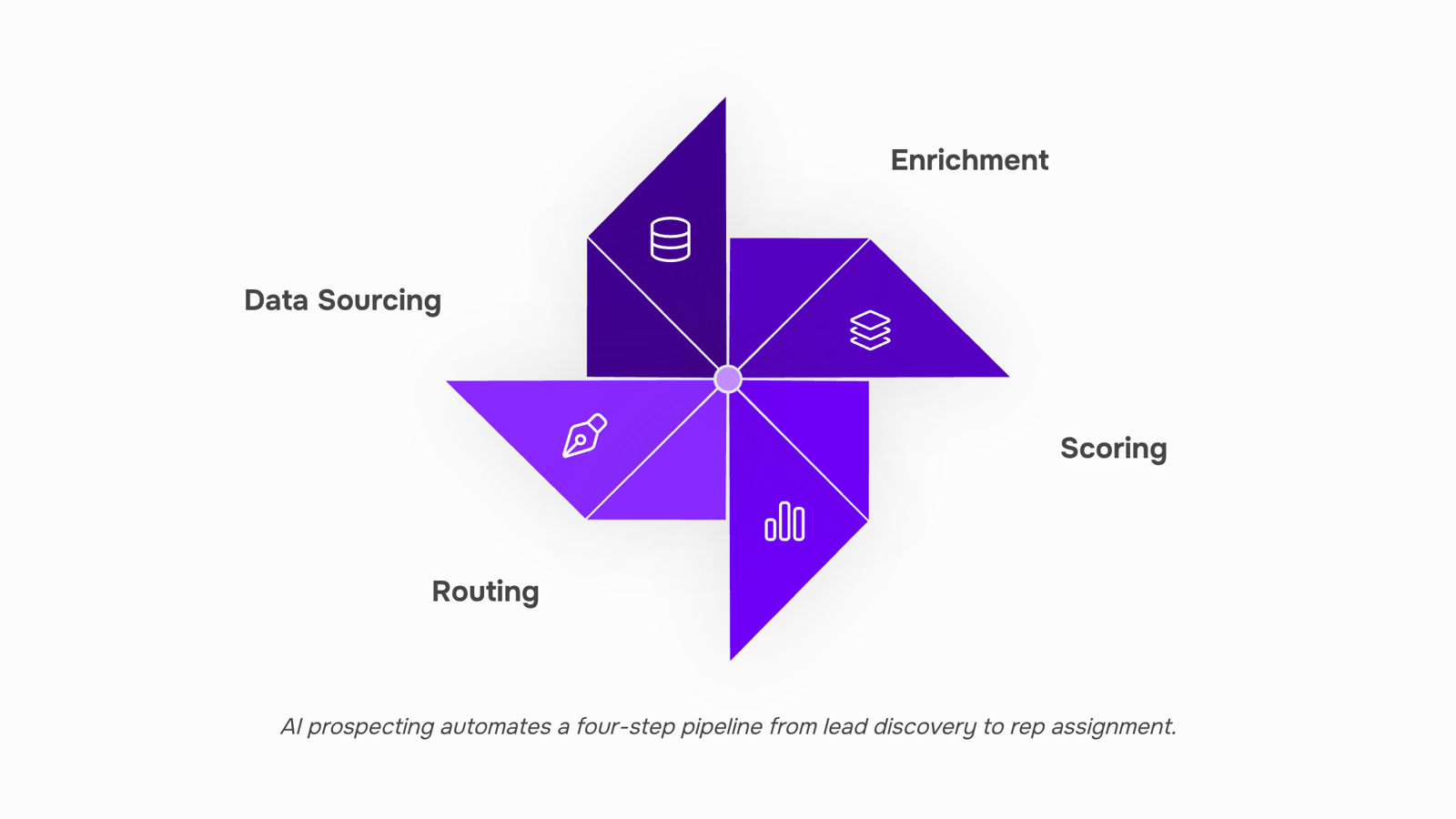
Most content on AI prospecting stops at "it finds leads faster." What actually happens is a four-step sequence, and understanding each step tells you exactly where a tool can fail you.
Data sourcing: The tool pulls prospect data from websites, social profiles, job boards, and your existing CRM simultaneously. According to IBM, AI tools scrape data from websites, social media, and CRM systems to provide comprehensive lead profiles, cutting the manual research loop that eats hours of a rep's week.
Enrichment: Raw contact data gets layered with firmographic signals: company size, tech stack, recent funding, hiring velocity. A lead that looked thin in your CRM becomes a qualified target once enrichment fills the gaps. This is where most sales intelligence platforms differentiate themselves.
Scoring: This is where AI lead generation earns its keep. Instead of a rep guessing which leads to call first, a model ranks the full list by fit and intent signals. Lead qualification automation at this stage means your team works the top 20% of the list, not the whole thing. You can explore how this works in practice through AI lead scoring.
Routing: Scored leads get assigned to the right rep or sequence automatically. Speed matters here — delayed routing kills conversion. The best lead management tools sync this handoff directly into your CRM without a manual step in between.
Each stage depends on the one before it. Weak enrichment produces bad scores. Bad scores produce wrong routing. That chain is what separates a useful tool from an expensive contact list.
Not every AI prospecting tool does the same job. The four-step mechanism covered above only works if the tool you pick handles each stage without gaps. Here are six capabilities worth stress-testing before you commit.
Data quality and verification frequency: A tool is only as useful as its underlying contact data. Ask vendors how often records are refreshed and whether phone numbers and emails are verified in real time or in batches. Stale data means bounced emails and wasted sequences before your team even starts.
AI lead scoring that reflects your actual ICP: Generic scoring models rank leads by job title and company size. Better tools let you weight signals that match your specific buyer: tech stack, hiring velocity, recent funding. If the scoring logic is a black box, you can't improve it.
CRM integration depth: Most tools mention CRM integration as a checkbox. What matters is sync parity: does a lead's status update in your CRM the moment it changes in the prospecting tool, or does your team reconcile records manually every week? Bi-directional sync with field-level mapping is the standard worth requiring. The lead management tools breakdown covers this in more detail.
Multistep engagement cadences: Single-touch outreach rarely converts. Look for tools that support sequenced AI sales outreach across email, LinkedIn, and phone, with branching logic based on prospect behavior rather than fixed wait times.
Buyer intent signals: Tools that surface intent data (content consumption, competitor research, job postings) let you prioritize outreach to accounts already in a buying motion, rather than spraying the full list.
Reporting tied to pipeline, not activity: Sequence open rates are vanity metrics. The tools worth keeping connect outreach activity to qualified meetings booked and revenue influenced. The best prospecting tools for sales teams guide maps several platforms against exactly these criteria.
Personalization at scale sounds like a contradiction until you see how the underlying workflow actually runs.
AI prospecting tools pull data from multiple sources simultaneously: LinkedIn profiles, company news feeds, job postings, technographic data, and CRM history. From that, they generate a first-draft message that references something specific to the prospect — a recent funding round, a hiring spike in their engineering team, a product launch — without manual research per lead.
The workflow typically runs in three steps:
Enrich the record: The tool appends firmographic and behavioral signals to a raw contact, filling gaps a rep would otherwise spend 20 to 30 minutes researching manually.
Score and segment: AI ranks prospects by fit and intent, so your highest-signal leads get the most tailored messaging rather than a generic blast.
Generate and send: Personalized copy is drafted, checked against spam filters, and queued at send times optimized for that recipient's time zone and engagement patterns.
That third step is where most LinkedIn outreach breaks down: the message reaches the right person at the wrong moment with generic copy. Tools like Evox are building exactly this layer, with personalization logic, spam checking, and send-time optimization working together rather than as separate manual tasks.
The result is sales prospecting automation that keeps message quality consistent whether you're sending 50 emails or 5,000.
"CRM integration" on a vendor's feature page usually means a one-way data push. What actually matters is whether the sync runs both ways.
Bi-directional sync means that when an AI prospecting tool enriches a lead profile, that data writes back to your CRM automatically. And when a rep updates a contact status in the CRM, the prospecting tool sees that change and stops targeting the same contact. Without this, you get duplicate outreach and stale records inside two systems that don't agree.
Field mapping is where most integrations quietly break down. The AI tool may capture "company size" as a range; your CRM stores it as a number. If nobody maps those fields during setup, enriched data lands in the wrong place or gets dropped entirely. Before you commit to a tool, ask the vendor for a field-mapping spec sheet, not a demo.
Real-time data flow matters most for lead qualification automation. A lead who fills out a form and gets scored, routed, and contacted within minutes converts at a meaningfully higher rate than one who waits hours while data syncs on a nightly batch. The best prospecting platforms push enriched records to your CRM the moment a trigger fires, not on a schedule.
The practical test is simple: map three fields, run a test contact, and check both systems within 60 seconds.
The table below gives you a scoring grid. Run any AI prospecting tool down the left column and you'll know quickly whether it belongs in your stack.
Criterion | What good looks like | Warning sign |
|---|
Lead qualification logic | Scores on behavioral signals, not just firmographics | Scores on job title and company size only |
CRM sync depth | Bi-directional, field-level mapping, real-time | One-way export or manual CSV upload |
Speed-to-lead support | Triggers follow-up within minutes of a signal | Batches alerts daily or requires manual review |
Intent data integration | Pulls third-party intent signals (G2, Bombora, etc.) | Relies solely on its own proprietary data |
Workflow fit | Configurable routing rules by territory, deal size, or rep | Fixed routing with no conditional logic |
Reporting | Shows pipeline influence per source, not just lead volume | Vanity metrics only (opens, clicks) |
The criteria that separate useful AI prospecting tools from expensive noise are almost always about workflow depth, not feature count. A tool that enriches a contact but can't route that contact to the right rep in under five minutes has a gap where revenue leaks.
AI lead generation works when the handoff between signal and action is automatic. If a rep still has to check a dashboard to know a prospect went cold or went hot, the tool isn't doing its job.
Start with your deal velocity. If leads go cold within an hour of showing intent, you need a tool that captures, scores, and routes in real time, not one that syncs to your CRM overnight. For that workflow, AI lead scoring is the capability to prioritize.
For smaller teams running outbound sequences, the question is CRM sync depth. Most tools mention integration as a checkbox. What actually matters is whether enriched contact data writes back to your CRM automatically or requires a manual export step. One missed sync means your reps are working stale data.
Match tool category to team size:
Solo or small team (1 to 5 reps): Prioritize sales prospecting automation with built-in sequencing over raw data breadth.
Mid-size team: Add lead management tools with routing rules and ownership tracking.
Data-heavy teams: Layer in sales intelligence platforms for firmographic filtering and intent signal coverage.
For speed-to-lead workflows specifically, Lio handles capture-to-route in one connected flow without a separate integration layer. It captures incoming leads, scores them against your ICP the moment they arrive, and routes each one to the right rep or sequence automatically. Your team stops checking dashboards and starts working leads that are already ranked and assigned.
Closing
AI prospecting tools work best when they handle all four stages cleanly: sourcing contacts, enriching their profiles, scoring by fit and intent, and routing to the right rep instantly. The difference between a tool that moves the needle and one that becomes expensive overhead comes down to whether each stage feeds into the next, and whether your team can see and trust the scoring logic behind the routing decisions.
Start by mapping your current prospecting bottleneck. Is it hours lost to research, leads sitting in a queue waiting for qualification, or reps working the wrong list? Once you know which stage is costing you most, you can evaluate tools against that specific gap. To see how instant lead scoring and routing works in practice, explore how Lio assigns and scores leads the moment they arrive.
FAQ
What are the best AI prospecting tools for sales teams?
The best tool depends on which stage of prospecting is your bottleneck: sourcing, enrichment, scoring, or routing. Evaluate candidates on data freshness, scoring transparency, CRM sync depth, and whether they connect outreach to pipeline outcomes rather than activity metrics.
How do AI prospecting tools improve lead generation and qualification?
They move qualification upstream by automating research, enrichment, and scoring before reps touch a lead. Instead of working a full list, your team focuses on the top-ranked prospects, cutting wasted outreach and speeding time to qualified meetings.
Can AI prospecting tools help personalize sales outreach and messaging?
Yes. They pull data from LinkedIn, company news, job postings, and CRM history to generate first-draft messages referencing specific signals — a funding round, hiring spike, or product launch — then optimize send times and run spam checks before delivery.
How do AI prospecting tools integrate with CRM systems?
Integration depth matters more than the checkbox. Require bi-directional sync with field-level mapping so lead status updates instantly in your CRM without manual reconciliation, and scored leads route directly into sequences.
What are the key features to look for in AI prospecting tools?
Prioritize data verification frequency, AI scoring that reflects your ICP, deep CRM integration, multistep engagement cadences with branching logic, buyer intent signals, and reporting tied to pipeline outcomes rather than open rates.
Do AI prospecting tools replace SDRs or just support them?
They support and amplify SDRs by removing manual research and routing work. Reps spend time on conversations instead of tab-switching, and your best people work higher-signal leads. Human judgment and relationship-building remain essential.


 Elena Petrova15 September 2026


