TL;DR: Most articles on change management in project management define the process and stop there. This one shows IT project leads exactly where change requests derail delivery, how to build a change plan that holds under stakeholder pressure, and which metrics tell you whether the change actually stuck. You'll leave with a framework you can apply to your next project.
What change management in project management actually means
Change management in project management is the structured process for submitting, evaluating, approving, and implementing changes to a project's scope, schedule, budget, or deliverables. It is not the same as organizational change management, which focuses on how people adapt to company-wide shifts. Here, the scope is narrower and more operational: what happens when a stakeholder wants to add a feature mid-sprint, a vendor misses a dependency, or a regulatory requirement changes after sign-off.
Every IT project accumulates change requests. Without a defined change control process, those requests get handled informally, which means inconsistently. Some get absorbed quietly into the workload. Others get rejected without documentation. Both patterns erode delivery predictability and, eventually, stakeholder trust.
The distinction matters because many IT leads treat change management as a log, not a process. A log records what changed. A process determines whether a change should happen, who approves it, how it affects the baseline, and how the team gets updated. Those are four different decisions, and collapsing them into a spreadsheet row is where most projects start losing control.
Project management processes that support structured change give your team a repeatable path from change request to approved adjustment, without stalling momentum or creating approval bottlenecks that slow delivery.
Why change management determines whether your project lands
Skipping a formal process for change management in project management doesn't save time. It transfers risk onto delivery.
Scope creep is the most visible cost. When change requests arrive without a structured intake, teams absorb extra work without adjusting timelines or budgets. PMI research consistently shows that projects without defined change processes run significantly over schedule and budget. The damage compounds because each untracked change creates a new baseline for the next one.
Team alignment breaks down faster than most leads expect. When priorities shift mid-sprint without clear communication, engineers and PMs operate on different assumptions. That's not a people problem — it's a process gap. Keeping your team coordinated through a change requires explicit re-alignment steps, not just a Slack message.
Stakeholder trust erodes when changes appear without explanation. Sponsors and clients notice when scope expands but delivery dates don't move. A documented process for assessing the risk of each change request gives you something concrete to show them.
The change control process handles approvals and documentation. Change management handles the people side: adoption, resistance, and whether the team actually executes the new direction. Both matter. Most IT projects only build one.
Change management vs. change control: what the difference costs you
The two terms get used interchangeably in most IT project retrospectives. That habit is expensive.
Change management addresses people and adoption: how your team understands, accepts, and embeds a shift in process, tooling, or structure. Change control handles approvals and scope: the formal gate that decides whether a requested change enters the project at all. One without the other breaks differently. Skip change control and scope creep inflates your timeline. Skip change management and the approved change never sticks.
Dimension | Change management | Change control |
|---|
Scope | People, behavior, adoption | Scope, budget, schedule |
Authority | Project sponsor, HR, comms lead | Change control board or PM |
Timing | Throughout the project lifecycle | At defined request points |
Goal | Sustained adoption | Approved, documented changes |
A solid change management plan for a project covers both tracks, but treats them as separate workstreams with separate owners. Conflating them is where most IT project leads lose control, because the person approving the scope change is rarely the person responsible for getting the team to actually use it.
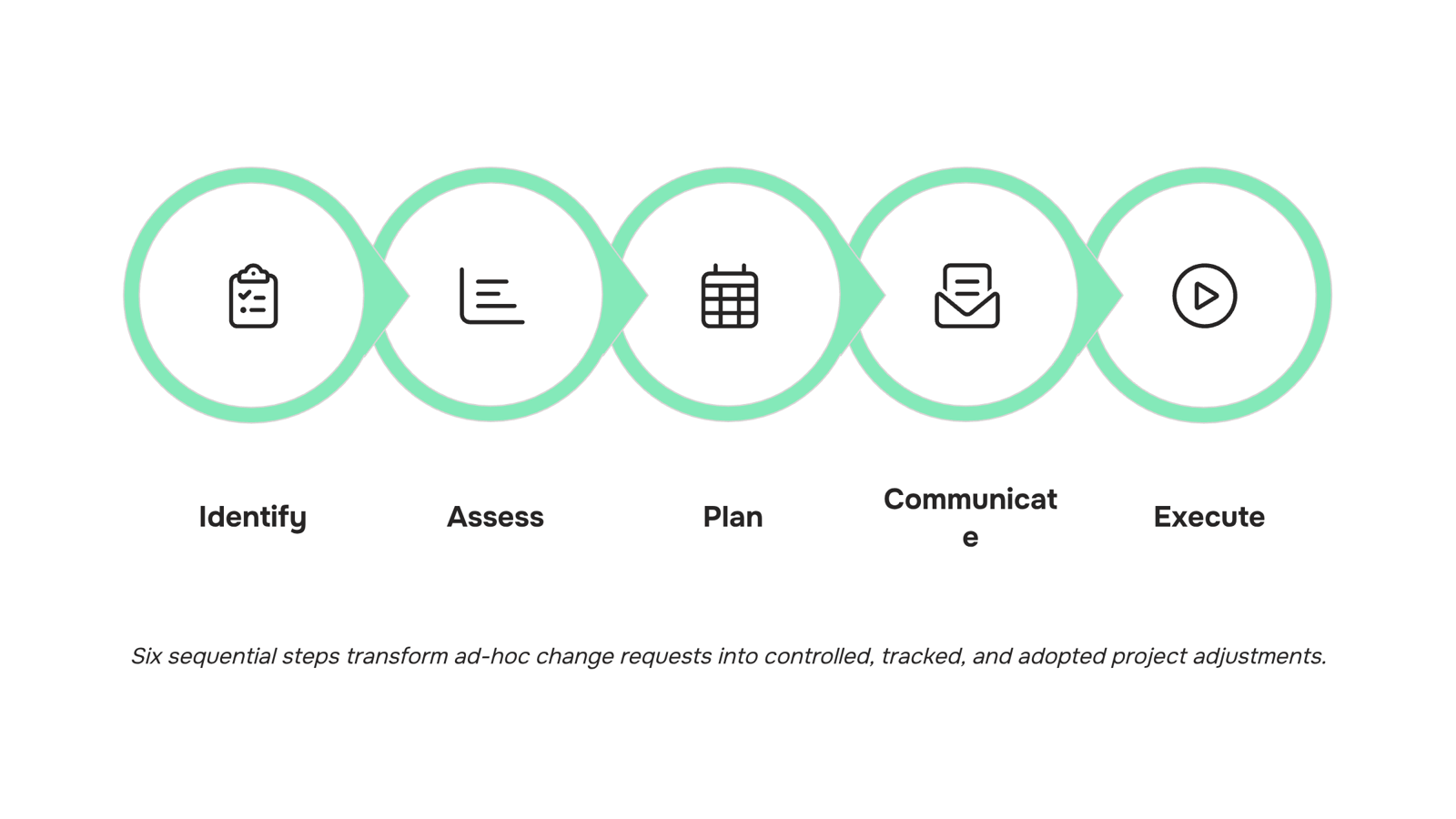
6 best practices for change management in your project
Identify the change and its source
Not every change request deserves the same response. Before anything else, log where the change came from: a client request, a technical constraint, a regulatory update, or internal scope drift. In an IT project, this might mean a client asking to add single sign-on (SSO) support three weeks before go-live. Document the request formally, not in a Slack thread.
Assess the impact before you commit
Once the change is logged, run a structured impact assessment. What does this touch: timeline, budget, dependencies, team capacity? Assessing the risk of each change request before approving it is what separates teams that absorb change cleanly from those that spiral into scope creep. For the SSO example, that assessment might reveal two extra sprints and a dependency on a third-party identity provider your team hasn't vetted.
Build or update your change management plan for the project
A change management plan for a project is not a one-time document. It should be a living record that captures the approved change, the revised scope, updated milestones, and who owns each piece. If you approved the SSO addition, the plan now reflects a new delivery date, a revised budget line, and a named engineer responsible for the integration. Without this update, the rest of the team is still working from the old version of reality.
Communicate the change to everyone it affects
Communication in change management is where most IT projects lose ground. The project manager knows about the change. The developer who owns the affected module sometimes does. The QA lead and the client stakeholder often do not. Set a rule: any approved change triggers a written update to all affected parties within 24 hours. That update should cover what changed, why, what the new timeline is, and who to contact with questions. A short async video or a structured Slack message with a clear subject line both work. What does not work is assuming people will catch it in the next standup.
Execute the change with clear ownership
Execution fails when accountability is vague. Assign a single owner for each change, not a team. That person is responsible for delivery, not just coordination. Use your change control process to confirm the change is tracked through to completion, with checkpoints built in. For the SSO integration, the owner runs a mid-point review at the end of the first sprint to confirm the identity provider is configured and the test environment is ready before the second sprint begins.
Confirm adoption and close the loop
This is the step most change management best practices skip. Once the change is delivered, verify that the people who need to use it actually can. In an IT context, that means checking that the client's admin team can configure SSO roles, that support documentation is updated, and that the original change request is formally closed in your project log. Keeping your team coordinated through a change does not end at deployment. It ends when adoption is confirmed and the change is no longer an open item.
Measuring whether change management in project management worked is straightforward if you track three things: whether the change was delivered within the revised timeline, whether affected team members could perform their tasks without re-training loops, and whether the change request was formally closed with no downstream incidents. If any of those three fail, the process has a gap worth diagnosing before the next change arrives.
The three places change management breaks down mid-project
Most change management breakdowns in project management don't happen because the plan was wrong. They happen in three specific places.
Late stakeholder involvement: Stakeholders brought in after a change is already scoped will push back on decisions they had no part in making. The fix: map your stakeholders before the change request is formally raised, not after. Your change control process should require sign-off from affected parties at the impact assessment stage, not the approval stage.
Communication gaps between teams: A change approved at the project level often reaches delivery teams as a verbal summary passed through two people. Critical context drops out. Build a single written source of truth for every approved change, and make it part of your standard project management processes that support structured change. Communication in change management fails when it relies on meetings instead of documented handoffs.
Undocumented verbal approvals: "The client said yes on the call" is not an approval. Verbal agreements create scope disputes weeks later when priorities shift. Every approval needs a written record tied to the original change request. If you're assessing the risk of each change request without a paper trail, you're carrying risk you can't see.
Self-diagnose: which of these three is your current project most exposed to?
How to measure whether your change management worked
Most teams declare a change "done" when the ticket closes. That's the wrong signal.
Measuring change management success means tracking four things after implementation:
Adoption rate: What percentage of the team is following the new process 30 days out? Below 80% usually means the change wasn't communicated clearly enough, or training was skipped.
Schedule variance: Did the change add unplanned days to the project? Compare your baseline against actuals. A well-managed change in project management should produce minimal schedule drift.
Stakeholder sign-off rate: What share of changes got documented approval before work started? If that number isn't close to 100%, your change control process has gaps.
Team escalation frequency: Count how many issues got escalated to leadership after the change landed. High escalation volume signals that the change created confusion the team couldn't resolve independently.
Run these four checks at the 30-day mark. If any signal is off, trace it back through your project management processes that support structured change before the next change request arrives. Waiting until the next problem surfaces costs more than a one-hour retrospective now.
Closing
Change management only works when every change is visible, tracked, and tied to a milestone—not buried in Slack threads or spreadsheet rows. The framework above gives you the structure to capture requests, assess impact before committing, and keep your team aligned as priorities shift. But structure alone isn't enough; you need a single place where change requests, task assignments, and timeline impacts live together, so nothing slips through.
Taro gives IT project leads exactly that: one workspace to log change requests, update assignments, and monitor downstream effects on your project timeline in real time. No more hunting across tools or guessing whether stakeholders know about a scope shift. Ready to stop losing control of changes mid-project? Start your free trial today and see how visibility changes delivery.
FAQ
What are the best practices for change management in project management?
Log every change formally with its source, assess impact before approving, update your change plan with new timelines and owners, communicate to all affected parties within 24 hours, and assign single-point accountability for execution. Track completion through your change control process.
How do I develop a change management plan for my project?
Build it as a living document that captures approved changes, revised scope, updated milestones, and named owners for each piece. Update it every time a change is approved, not once at the start, so your team always works from the current version of reality.
What are the most common challenges in change management during project implementation?
Informal intake (changes via Slack instead of formal requests), skipped impact assessments that lead to scope creep, poor communication leaving team members unaligned, and vague ownership where accountability dissolves across a team instead of landing on one person.
How can I measure the success of change management in my project?
Track whether approved changes stay within revised timelines and budgets, measure team alignment through post-change surveys or standups, and monitor whether stakeholder trust improves (fewer surprises, fewer late rejections). PMI data shows projects with formal change processes run significantly closer to schedule.
What is the difference between change management and change control in a project?
Change control handles approvals and scope (the formal gate deciding if a change enters the project). Change management handles people and adoption (ensuring the team understands and executes the approved change). Both are required; skip either one and delivery breaks differently.


 Elena Petrova11 September 2026


