TL;DR: Most subject line guides hand you a swipe file and leave the judgment call to chance. This one gives IT company owners a seven-step decision framework for evaluating any email subject line before it sends, grounded in B2B context, with specific criteria tied to open rates, deliverability, and buyer psychology. You'll finish with a repeatable process, not a list of words to copy.
What makes a good email subject line
3D illustration of an open envelope with glowing email notification and engagement metrics in professional blue and gold tones
A good email subject line does three things: it tells the reader the email is relevant to them, it's clear about what's inside, and it gives them a reason to open it now rather than later.
Relevance means the subject line matches what that specific reader cares about. A subject line written for a CFO reads differently from one written for a developer. Generic business email subject lines fail here first.
Clarity means no clever wordplay that obscures the point. If the reader has to guess what the email contains, most won't bother. Say what it is.
The third property, urgency or timeliness, is what separates a "maybe later" from an open. This doesn't require manufactured pressure. A reference to a specific trigger ("following your Q2 review" or "re: your open role in DevOps") creates real immediacy.
These three properties work together. A relevant, clear subject line with no reason to open now still gets deferred. One that feels urgent but vague gets ignored or marked spam.
Before you get into formulas, cold email subject lines that match proven templates are worth reviewing alongside these principles.
Why your subject line decides the whole campaign
Most of the copy in your email will never be read if the subject line fails. That's not a writing problem — it's a pipeline problem.
For B2B sales, the subject line controls whether a prospect even enters the funnel. A cold email subject line that gets ignored means your offer, your case study, your call-to-action — none of it exists. The rest of the email is irrelevant if the open never happens.
The stakes compound quickly. A 5-percentage-point improvement in open rate across a 1,000-contact sequence can mean dozens of additional conversations your team never had to source manually. For sales email subject lines specifically, that difference often separates a campaign that generates pipeline from one that generates nothing.
There's also a sequencing effect most teams miss: subject line quality filters your audience before your copy does. A vague subject line attracts low-intent opens and inflates your open rate while your reply rate stays flat. A precise one attracts fewer opens from the right people — and converts better downstream, which is what improving email conversion rate once your open rate climbs actually requires.
If you want cold email strategies that put your subject line to work, the subject line isn't the first thing you write. It's the last thing you get right.
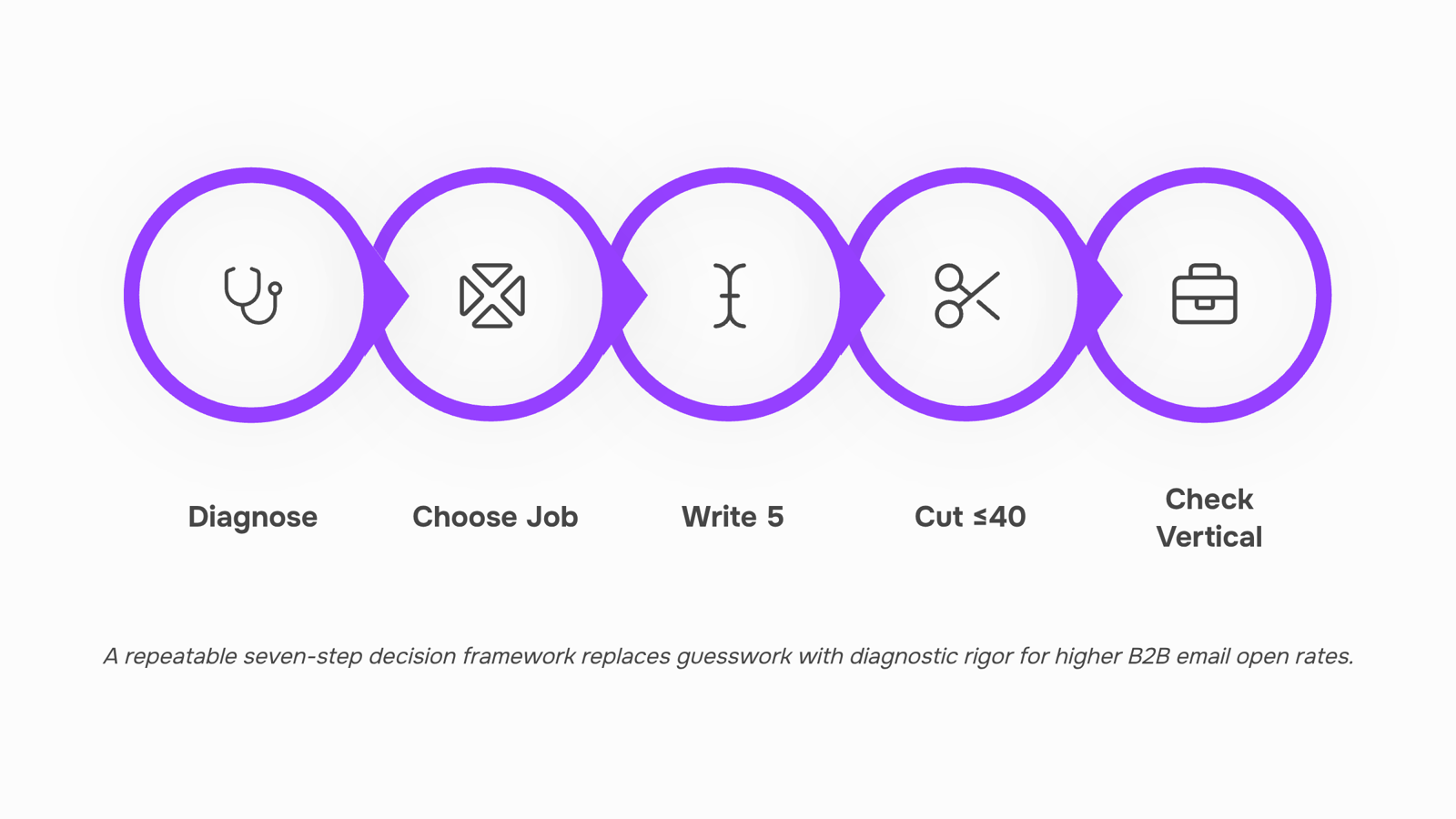
How to write an email subject line in 7 steps
Most subject line advice stops at "be specific" or "avoid spam words." That's not a process. Here's one that works from diagnosis to send.
Diagnose your audience's current pain
Before you write a single word, name the specific frustration your recipient is sitting with right now. Not their industry pain in general. The thing keeping them from hitting their number this quarter. A financial services ops lead running manual compliance checks has a different inbox than a SaaS sales director staring at a stalled pipeline. Your subject line has to match that specific context, or it reads like every other email they delete.
Example: "Compliance audit prep eating your Q3?" lands for the ops lead. "Boost productivity" lands for no one.
Choose one job for the subject line
A subject line can do one of three things: create curiosity, state a clear benefit, or reference a shared context (a trigger event, a mutual connection, a recent announcement). Pick one. Subject lines that try to do all three become vague. The best cold email subject lines are almost always doing exactly one job with precision.
Example: "Saw your Series B announcement" is trigger-event framing. Clean, one job.
Write five versions before you commit
Force yourself to write at least five variants before evaluating any of them. This breaks the habit of polishing the first thing that sounds decent. Vary the structure: a question, a direct statement, a number-led line, a name-drop, a pain-first opener. You need options to compare, not a single line you've already talked yourself into.
Example: "Cut audit prep time by 40%" vs. "How [Company] reduced compliance overhead" vs. "Quick question on your Q3 audit process."
Cut to the essential phrase
Take your best version and remove every word that doesn't carry weight. Filler phrases like "I wanted to reach out about" or "Following up regarding" belong in the trash. This step also sets you up for the character-count constraint covered in the next section, where keeping to 40 characters or fewer protects your open rate on mobile previews.
Example: "Question about your audit workflow" beats "I had a quick question about your current audit workflow process."
Check against b2b email subject line best practices for your vertical
Financial services, healthcare, and legal all have compliance sensitivities that make certain subject line patterns backfire. Urgency language ("Act now," "Limited time") reads as spam in regulated industries. Personalisation that references company financials can feel intrusive. Run your subject line against what's normal in your recipient's world, not just what converts in SaaS. For deeper context on vertical-specific approaches, cold email strategies that put your subject line to work covers this in detail.
Run it through an email subject line tester
Tools like CoSchedule's Headline Analyzer or Omnisend's subject line tester score your line against readability, word balance, and predicted engagement. They won't tell you what your specific audience will do, but they catch obvious problems: too many power words stacked together, all-caps, punctuation that triggers spam filters. Treat the score as a sanity check, not a guarantee. Then cross-reference against cold email subject lines that match proven templates to sense-check your instincts against what's actually working.
Set up an A/B test before you scale
If you're sending to more than 200 contacts, split your list and test two subject line variants. Measure open rate at the 4-hour mark, then send the winner to the remainder. Track which structural type won (curiosity vs. benefit vs. trigger), not just which words. That pattern is what you carry into the next campaign. Once your open rate climbs, shift focus to improving email conversion rate so the clicks your subject line earns actually convert.
How long should your subject line be
Desktop email clients typically show 60 characters of a subject line. Mobile cuts that to around 40. Since most emails are now opened on mobile devices, anything past character 40 is a gamble.
The practical rule: write your business email subject lines to land the core message within 40 characters, then use characters 41–60 to add context for desktop readers. Think of it as a headline with a subtitle baked in.
A subject line like "Q3 IT audit: 3 gaps we found" clocks in at 34 characters and works everywhere. "Q3 IT infrastructure security audit results and recommendations" hits 62 and gets truncated on most phones before the reader sees the point.
For cold email subject lines that match proven templates, the 40-character ceiling matters even more. Cold recipients make a keep-or-delete decision in under two seconds.
Subject line examples for B2B industries
The examples below are organized by industry. Each one follows the same logic: short enough for mobile preview, specific enough to earn a click, and framed around a problem the recipient actually has.
Manufacturing
"3 ways [Company] is cutting downtime in Q3"
"Your line efficiency vs. industry average"
"Quick question about your MRO spend"
The third example works as a cold email subject line because it signals a short ask, not a pitch deck.
Financial services
B2B email subject line best practices for financial services lean heavily on specificity and compliance-adjacent language. Vague teasers get ignored or flagged.
"Audit prep: what your peers changed in 2024"
"Q3 reporting gap we flagged for firms like yours"
"One change that reduced reconciliation time by 40%"
The second example names a concrete deliverable without overpromising. That framing consistently outperforms curiosity-gap openers in regulated industries.
IT services
Both stay under 50 characters, which protects preview text on mobile. For cold email strategies that put your subject line to work, pair each subject line with a first sentence that delivers on the implied promise immediately.
Common subject line mistakes that kill open rates
Five mistakes show up repeatedly in sales email subject lines, and each one is fixable in under a minute.
Spam trigger words like "FREE," "Act now," or "Guaranteed" push your message into junk folders before a human ever sees it. Strip them.
False urgency ("Last chance — expires tonight") trains your list to ignore you. If the deadline isn't real, don't invent one.
Vague teasers ("You won't believe this") tell the reader nothing. A subject line that withholds context gets deleted, not opened. Specificity is what earns the click.
Mismatched preview text is the quieter killer. If your email subject line promises a cost-reduction framework and the preheader says "Hi [First Name]," you've broken trust before the email opens. The two lines work as a unit.
Length creep is the fifth. Beyond 50 characters, mobile inboxes truncate mid-phrase. Check what makes a good business email subject line before you send.
Subject line vs. preview text: how they work together
The subject line gets the reader to pause. The preview text (the snippet that appears beside or below it in the inbox) either confirms that pause was worth it or loses the click entirely.
Most email clients show 35–90 characters of preview text before truncating. If you leave that space blank, the client pulls the first line of your email body, which is often an unsubscribe link or a greeting.
Treat the two as a single unit. The subject line states the hook; the preview text extends it. "Your Q3 audit checklist" paired with "Five items most IT teams miss before October" works. The same subject paired with "Hi there, hope this finds you well" wastes the space entirely.
Before sending any business email subject line, run it through an email subject line tester alongside the preview copy, not separately.
Closing
A good subject line does three things at once: it proves relevance to that specific reader, it's clear about what's inside, and it gives them a reason to open now. The seven-step process above moves you from gut feel to repeatable decision-making. But here's where most teams stall: running this process manually across every campaign, then manually tracking which variants actually won, then manually applying those patterns to the next send. That's where Evox steps in. It handles subject line A/B testing, send-time optimization, and campaign analytics in one place, so you spend less time evaluating and more time acting on what works. Ready to see how it works? Check out the Evox product page to watch it in action.
FAQ
What makes a good email subject line?
One that proves relevance to that specific reader, is clear about what's inside, and gives them a reason to open now. Generic subject lines fail at relevance first; vague ones fail at clarity; and ones with no urgency get deferred.
How do I write an effective email subject line for marketing campaigns?
Follow the seven-step process: diagnose your audience's specific pain, pick one job for the line (curiosity, benefit, or trigger), write five variants, cut filler, check against your vertical's norms, run it through a tester, and A/B test before you scale.
What are the best practices for crafting email subject lines that get opened?
Write to 40 characters for mobile, remove filler words, match the subject line to a specific reader context (not generic business speak), and test two variants on at least 200 contacts before sending to the full list. Track which structural type won, not just which words.
How long should an email subject line be to maximize open rates?
Land your core message within 40 characters since most emails open on mobile. Use characters 41–60 for desktop context. Anything past 40 characters risks being cut off and losing your point.
Can you give examples of successful email subject lines for different industries?
Financial services: "Compliance audit prep eating your Q3?" (pain-specific). SaaS: "Saw your Series B announcement" (trigger-event). Avoid urgency language like "Act now" in regulated verticals; it reads as spam. Match the tone and sensitivity of your industry first.


 Elena Petrova15 September 2026


