TL;DR: Most delegation advice stops at "assign and trust." This article shows IT company owners how to structure a handoff so the assignee has everything they need before they start — clear scope, the right context, and a defined check-in rhythm. You'll also get a framework for tracking progress without becoming the bottleneck yourself.
Why most task delegation breaks down before it starts
Modern 3D visualization of task delegation workflow with interconnected digital interface and team role icons
Most delegation problems don't start with the wrong person getting the task. They start the moment the handoff happens — incomplete, rushed, and missing the context the person actually needs to execute.
The typical pattern: a manager assigns a task verbally or drops a one-liner into a chat thread. No success criteria. No stated deadline rationale. No clarity on what "done" looks like. The team member starts working from assumptions, and the manager finds out those assumptions were wrong only when the deadline is close or already missed.
This is the real failure mode in task delegation: not the wrong person, but the incomplete transfer. Research consistently shows managers spend meaningful time each week correcting or redoing delegated work — not because their teams lack skill, but because the original handoff lacked structure.
Generic task delegation best practices rarely address this. They list tips like "be clear" or "set expectations" without showing what structured clarity actually looks like at the moment of assignment. Setting the right priority before you assign is one piece of it. But priority alone doesn't replace a full task brief.
The fix isn't more follow-up. It's building enough context into the original assignment that follow-up becomes optional. Tools that create a fully structured task from a one-liner exist precisely because most handoffs fail at the source, not mid-execution.
Match the task to the right person first
Most managers assign tasks based on availability. Who's free right now gets the work. That's reactive task assignment, and it's one of the main reasons delegated work comes back incomplete or wrong.
Before you assign anything, run a quick three-part check.
What does this task actually require? Separate the skill level from the familiarity level. A task might need someone with database experience, but it also needs someone who knows your client's specific environment. Those aren't always the same person.
Who has the right capacity? Available and capable aren't the same thing either. Someone with 40 hours of work already assigned isn't a good fit, even if they have the right skills. Check actual workload before you commit. Setting the right priority before you assign is easier when you can see what's already on each person's plate.
Is this a growth task or an execution task? Growth tasks stretch someone's skills and need more support time from you. Execution tasks should go to whoever can run them with minimal check-ins. Mixing these up creates bottlenecks.
A concrete example: if a mid-level developer is already carrying six active tickets and you're assigning a seventh that requires a technology they've used once, that's two risk factors on one task. Split the risk or reassign.
When you know how to delegate tasks to team members this deliberately, the handoff itself becomes cleaner. The next section covers exactly what that handoff must include.
Structure the handoff so the assignee can start without you
Most delegated tasks fail before the assignee writes a single line of code. The handoff itself is broken: vague instructions, no stated priority, no clear finish line. The assignee guesses, produces the wrong thing, and the manager spends an hour fixing it.
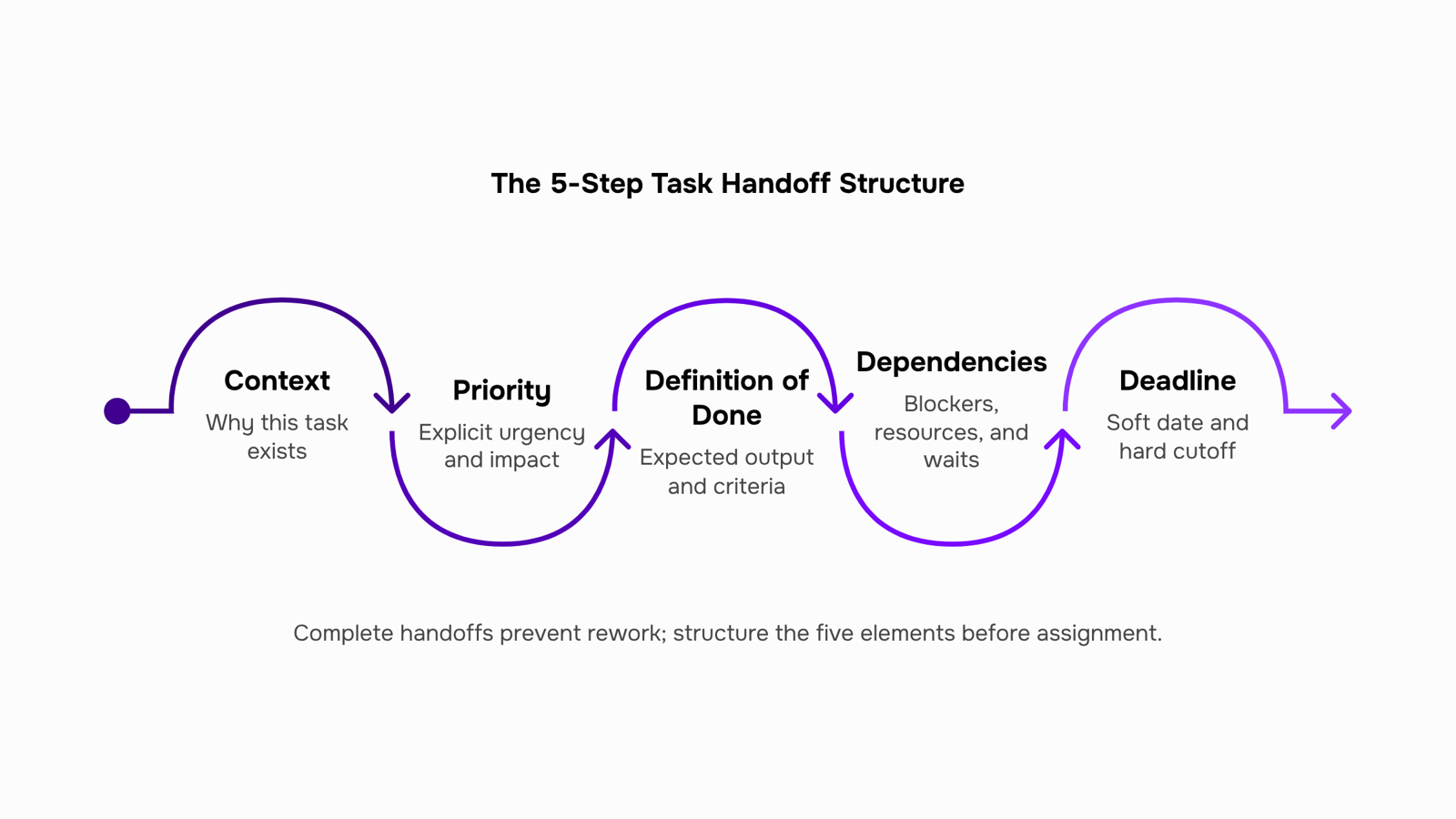
Every task you hand off needs five things before it leaves your hands.
Context — one or two sentences on why this task exists. Not a history lesson. Just enough that the assignee understands what decision or outcome depends on their work.
Priority — explicit, not implied. "This blocks the client demo on Thursday" is clearer than "high priority." If you're still figuring out how to rank work before you assign it, setting the right priority before you assign covers a practical framework.
Definition of done — describe the output, not the process. "A reviewed pull request merged to staging" beats "work on the login bug." Ambiguous finish lines are the single most common reason delegated work comes back incomplete.
Dependencies — name anything the assignee is waiting on or anything that's waiting on them. A task that looks self-contained often isn't, and discovering a blocker on day three wastes everyone's time.
Deadline — a real date, not "ASAP." If the task has a soft and a hard deadline, state both.
Writing all five from scratch for every task takes longer than most managers have. Taro's task detail generation fills in context, dependencies, and acceptance criteria automatically, and smart task creation can build a fully structured task from a one-liner. A task management system that enforces this structure means the checklist isn't optional — it's built into how work gets assigned.
When the assignee has all five, they can start without pinging you first.
Track progress without turning into a bottleneck
The goal is visibility without interruption. Most managers default to one of two broken patterns: daily check-ins that pull assignees out of focus, or no check-ins at all until a deadline is missed.
A better structure uses two mechanisms: a shared task board and a scheduled touchpoint. The task board handles passive visibility. When every delegated task has a status column (Not started, In progress, Blocked, Done), you can see where things stand without asking. Taro keeps this view live across your whole team, so you're not chasing updates through chat.
The scheduled touchpoint handles active visibility. A weekly 15-minute sync per direct report covers what's moving, what's stuck, and what needs a decision. That's it. If you're checking in more than once a week on a task that isn't blocked, that's avoid micromanaging territory.
The "blocked" status is the critical piece most teams skip. When an assignee can flag a task as blocked without it feeling like an admission of failure, problems surface early. Without that signal, managers find out at the deadline.
For task tracking to work without becoming overhead, the rule is simple: the assignee updates the status; the manager reads it. The manager only intervenes when something is blocked or overdue by more than 24 hours.
One practical setup: use a task management system that enforces this structure so status fields are required, not optional. Optional fields get skipped under pressure, which is exactly when you need them most.
Common delegation mistakes that stall IT teams
Four delegation mistakes show up on almost every struggling IT team, and each one has a predictable consequence.
Under-delegating is the most common. A team lead holds onto tasks they trust only themselves to complete, then wonders why their week is full and their team feels underused. The work gets done, but the team stops developing judgment.
Over-delegating without context is the opposite failure. You hand off a task with a deadline but no background: why it matters, what a good output looks like, or who else is involved. The assignee delivers something technically complete that misses the point entirely. This is where most workflow management breakdowns actually start — not in execution, but at the handoff.
Skipping success criteria is a quieter mistake. When the definition of "done" lives only in the manager's head, the assignee finishes what they think was asked. The manager reviews it, finds gaps, and either rewrites it or sends it back. Most teams find that this rework loop costs a manager several hours a week — time that compounds across every task delegation best practices guide but rarely gets measured.
Rescuing tasks too early is the one that does the most long-term damage. A manager steps in at the first sign of difficulty, solves the problem, and signals that struggle means failure. The assignee learns to escalate instead of think.
Each of these delegation mistakes shares a root cause: the handoff was treated as a moment, not a structure.
How to use technology to make delegation repeatable
Most delegation problems aren't people problems — they're system problems. When the handoff process lives in someone's head, it breaks the moment that person is busy, distracted, or out sick.
A structured approach to task tracking removes that dependency. Instead of relying on a manager to remember to attach context, set a due date, or clarify ownership, the tool enforces those steps at the point of assignment. Good delegation becomes the default because the system won't let you skip the checklist.
Here's what that looks like in practice. Before assigning a task, setting the right priority before you assign prevents the common failure where everything lands in someone's queue at equal urgency. Then, when you create the task, the tool prompts for owner, deadline, acceptance criteria, and dependencies — not as optional fields, but as required ones.
Taro handles this through AI-assisted task assignment. When you create a fully structured task from a one-liner, it expands the brief into a complete task with context, subtasks, and suggested priority. If the description is thin, you can generate full task context automatically so the assignee has everything they need before they start — no back-and-forth required.
The visibility piece matters too. A task management system that enforces this structure gives managers a live view of task status without requiring a status meeting. Delegating tasks stops being a leap of faith and becomes a traceable, repeatable handoff.
Build a delegation habit your team can rely on
Consistent delegation looks like this: your team knows what they own, why it matters, and where to go when they're stuck — without pinging you first.
When that structure is in place, the interruptions drop. Status-update meetings shrink. You stop context-switching between a developer's blocker and a client call.
For IT leads specifically, the payoff is focus. The work you can only do — architecture decisions, stakeholder alignment, hiring calls — finally gets protected time.
The habit forms when handoffs are repeatable, not heroic. Document the pattern once, run it through a tool that enforces it, and delegation stops being something you remember to do well and starts being something your team expects you to do consistently.
That consistency is also one of the fastest ways to build genuine motivation across your team.
Closing
The practices in this article only work if the system behind them is consistent. Every delegated task needs the same five elements — context, priority, definition of done, dependencies, and deadline — built in before it leaves your hands. Without that structure, even the best-matched assignee will come back with questions or incomplete work. Taro gives IT teams a single place where every delegated task arrives with those elements already set, priority already ranked, and ownership already clear. See how it works with no pressure — start with a quick walkthrough of how your team's current tasks would look if they were structured this way.
FAQ
Q. What are the best practices for delegating tasks to team members?
A. Match the task to the right person first by checking skill fit, actual capacity, and whether it's a growth or execution task. Then structure the handoff with five elements: context, priority, definition of done, dependencies, and deadline. Track progress passively via a shared task board and actively via a weekly 15-minute sync.Q. How can I ensure successful task delegation?
A. Build enough context into the original assignment that follow-up becomes optional. Include why the task exists, what done looks like, and what's blocking it. Use a task management system that enforces this structure so nothing gets skipped under pressure.Q. What are the common mistakes to avoid when delegating tasks?
A. Avoid under-delegating (holding onto work only you trust yourself with) and over-delegating without context (handing off a deadline but no background). Don't assign based on who's available right now; check actual workload first. Never leave the finish line ambiguous.Q. How can I use technology to facilitate delegating tasks?
A. Use a task management system that enforces structure — required context, priority, and acceptance criteria fields prevent incomplete handoffs. Tools like Taro auto-generate task details and dependencies from a one-liner, so you're not writing briefs from scratch for every assignment.Q. How do I know which tasks I should delegate and which I should keep?
A. Delegate execution tasks that your team can run with minimal check-ins. Keep work that requires your judgment, high-stakes decisions, or one-on-one coaching. If you're holding onto tasks because no one else can do them, that's a skill-building gap, not a reason to keep the work.Q. How do I delegate without micromanaging the outcome?
A. Use passive visibility (a shared task board with status columns) and one active touchpoint per week (a 15-minute sync). Only intervene if something is blocked or overdue by more than 24 hours. The assignee updates status; you read it. That's the boundary.


 Elena Petrova15 September 2026


