TL;DR: Most project management planning guides give IT company owners a checklist and call it strategy. This one pairs each best practice with a concrete decision rule, so you know what to do when scope shifts, timelines slip, or stakeholder priorities change mid-sprint. You'll leave with a framework you can apply to your next project this week.
What project management planning actually means
Project management planning is the work you do before any task gets assigned. It's the process of defining what you're building, how you'll build it, who owns what, and what "done" looks like — before a single sprint starts.
That distinction matters. Execution is running the work. Planning is deciding which work to run, in what order, and with what constraints. Skipping straight to execution is how IT teams end up three weeks in, realizing two workstreams depend on the same developer and neither lead knew it.
For IT company owners managing parallel workstreams, project management planning processes aren't a one-time kickoff exercise. They're a recurring checkpoint: scope gets validated, dependencies get surfaced, and priorities get re-ranked as new information arrives. Deciding which work to include in scope is itself a repeatable discipline, not a one-meeting decision.
What separates teams that ship on time from those that don't is usually traceable to how rigorously they planned — not how fast they started. If you're building a project planning process from scratch, that's the mindset shift to carry forward.
Why planning determines whether projects succeed or stall
Poor planning doesn't just slow projects down — it ends them. PMI research consistently shows that a significant share of IT projects fail not during execution, but because the groundwork was never solid enough to support the work.
Four outcomes shift when you invest in software project management planning upfront:
Scope stays bounded: Without a defined scope, every stakeholder request becomes a change order in disguise. Deciding which work belongs in scope before a sprint starts is what separates a focused team from one chasing moving targets.
Dependencies surface early: IT teams running parallel workstreams hit blockers when one team's output feeds another's input. Planning maps those handoffs before they become delays.
Resources get allocated, not assumed: A plan forces the question of who is actually available, not who you hope will be.
Risk gets a name: Unnamed risks don't get managed. A planning phase gives your team a moment to ask "what breaks first?" before something does.
The teams that skip straight to execution treat planning as overhead. It isn't — it's the decision layer that makes every downstream choice faster. Choosing the right project management process for your team starts here.
Key components every project management plan needs
Five elements show up in every plan that actually holds together under pressure.
Scope definition sets the boundary between what your team is building and what it isn't. Without it, deciding which work to include in scope becomes a weekly argument instead of a one-time decision.
Milestones break delivery into checkpoints your stakeholders can verify. They prevent the "we're 80% done for three months" problem that kills trust with clients.
Resource map shows who is assigned to what, at what capacity, and when. For IT teams running concurrent projects, this is the single document that prevents double-booking and burnout from going unnoticed until it's too late.
Risk register lists known threats before they become active problems, each with an owner and a response plan. PMI research consistently finds that scope creep ranks as the top cause of project delays, and a risk register is where you document the early signals of it.
Communication cadence defines who gets updates, how often, and through which channel. It prevents the status-meeting sprawl that eats engineering hours.
Together, these five elements form the core of any sound project management planning process. If you're choosing the right project management process for your team, start by confirming all five are present before you move to execution.
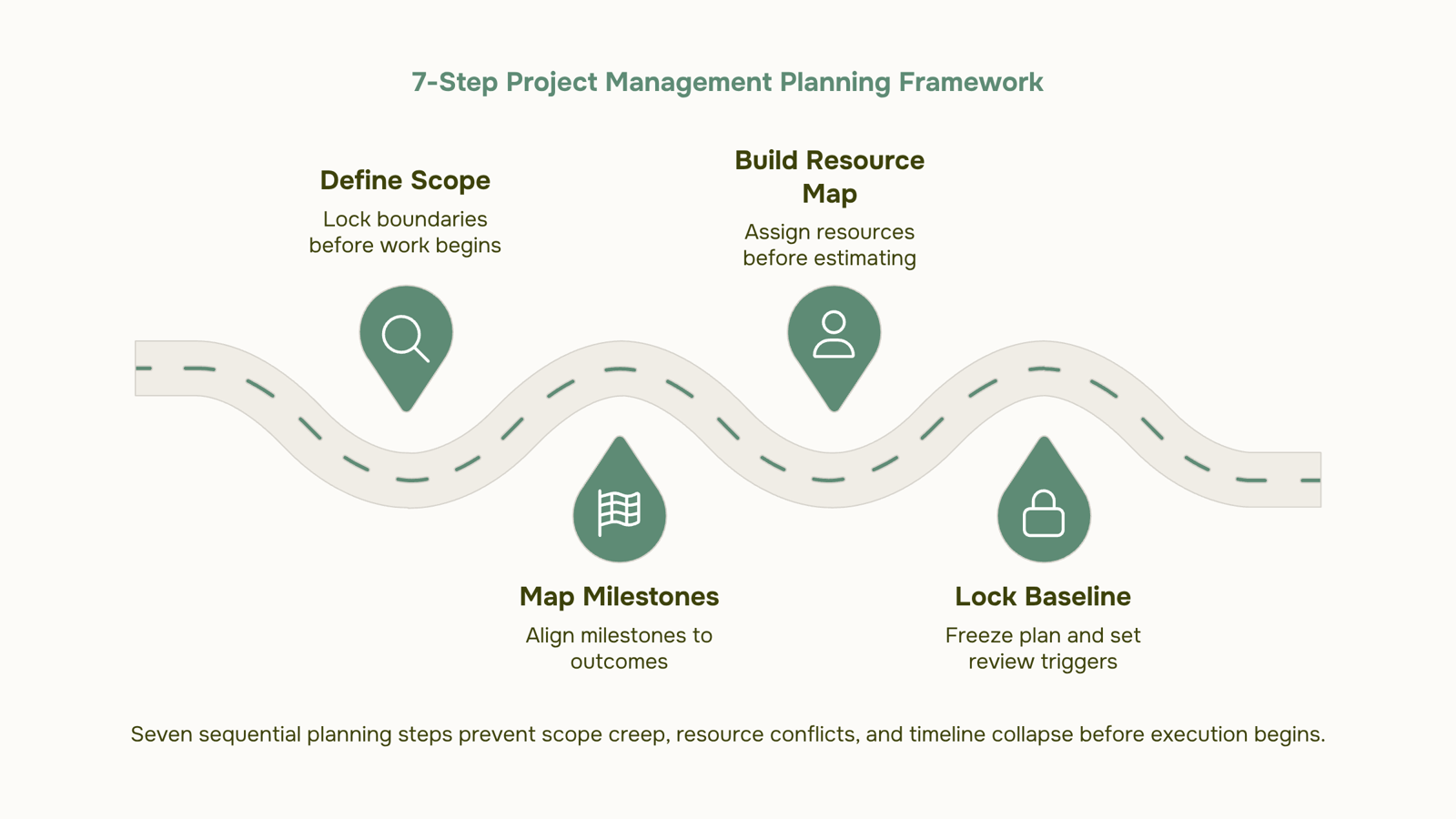
7 steps to build your project management plan from scratch
Start here, before you write a single task: define what done looks like.
1. Define scope before touching a timeline
Write a one-paragraph scope statement that answers three questions: what the project delivers, what it explicitly excludes, and who signs off on changes. Deciding which work to include in scope is the decision most IT teams skip, which is why scope creep consistently ranks as the leading cause of project delays in PMI research. For IT teams managing shared capacity, add a fourth line: which other active projects compete for the same engineers.
2. Map your milestones to business outcomes, not just dates
Each milestone should answer "so what?" A milestone labeled "backend complete" is weaker than "backend complete, enabling QA to start." Tie every major checkpoint to a downstream dependency or a stakeholder decision gate. This forces the team to think in sequences, not parallel wish lists.
3. Build the resource map before estimating effort
List every person by name, their current allocation across all active projects, and their hard constraints (vacations, part-time availability, shared service obligations). Only after that map exists should you estimate task effort. Estimating first and staffing second is the most common reason software project management planning produces timelines that collapse in week two.
4. Write the risk register as you plan, not after
For each milestone, ask: what single event would push this date by two weeks? Document it, assign a probability (high/medium/low), and name an owner. A risk register written during planning is a live decision tool. One written after the plan is approved is a compliance checkbox.
5. Set your communication cadence before kickoff
Decide the meeting rhythm, the async update format, and the escalation path before the project starts. Specifically: who gets a weekly status update, what triggers an unplanned escalation, and where decisions get recorded. Teams that define this in the planning phase spend less time in reactive standups later. For a fuller view of choosing the right project management process for your team, the communication structure is often the part that determines whether the process actually holds.
6. Run a capacity sanity check across concurrent projects
Before locking the plan, pull the resource map from step 3 and check it against every other active project in the portfolio. IT company owners managing three to five concurrent engagements regularly discover at this step that two projects share a critical dependency on the same senior engineer. Catching that conflict in planning costs an hour. Catching it in week four costs a sprint.
7. Lock the baseline and set a formal review trigger
A baseline plan is not a frozen plan. It is the agreed starting point against which you measure variance. Set a specific trigger for re-baselining: for example, any scope change that shifts the delivery date by more than five business days. Taro keeps the baseline, current plan, and change history in one place, so when a client asks why the timeline shifted, the answer is one click away, not a thirty-minute archaeology exercise.
For teams starting this process from the beginning, building a project planning process from scratch covers the structural decisions that sit underneath these seven steps.
How to check whether your plan is realistic before work starts
Before you lock a plan, run it through three checks. Most project management planning failures don't happen during execution — they're baked in at the planning stage, when assumptions go unquestioned.
Scope creep risk: List every deliverable and ask: does the client or a stakeholder expect something that isn't written down? If yes, it belongs in scope or explicitly out of scope. Deciding which work to include in scope before the kickoff meeting saves more time than any retrospective will.
Team capacity: Map each task to a named person, then check their actual availability — not theoretical hours. A developer committed to two other sprints has maybe 30–40% of their week, not 100%. If your plan assumes full availability across a shared team, it will slip.
Timeline buffers: PMI research consistently shows that scope creep is among the top causes of project delays. Build a buffer of 15–20% into any phase with external dependencies: client approvals, third-party APIs, infrastructure provisioning. These are the steps that stall without warning.
If any of the three checks fails, revise before baseline. A plan that looks complete but skips this review is just a schedule waiting to break. For teams choosing the right project management process, this feasibility check is the step most worth formalizing.
Common planning mistakes that derail IT projects
Five mistakes show up repeatedly in IT project post-mortems, and most of them happen before a single task gets assigned.
Planning to a deadline instead of to capacity: Teams back-calculate from a launch date without checking whether the people doing the work have bandwidth. The result is a plan that looks credible on paper and collapses in week two.
Treating scope as settled after kickoff: Scope creep is the top cause of project delays according to most project management surveys, yet IT leads rarely build a formal change-request step into their project management planning processes.
Skipping dependency mapping: If Task B can't start until Task A ships, that constraint belongs in the plan, not in someone's head.
Confusing a task list with a plan: A list of deliverables without owners, dates, and effort estimates isn't a plan.
Treating the plan as a one-time document: If you're not reviewing it at defined checkpoints, it goes stale fast.
Centralize your plan where your team actually works
When your project plan lives in three places, version control becomes a full-time job. A timeline in a spreadsheet, tasks in email threads, and sprint backlog in a separate tool means someone is always working from stale information.
Consolidating software project management planning into one workspace removes that problem. Taro keeps your project hierarchy, sprint backlog, task assignments, and workload view in a single environment. When scope shifts, every connected view updates automatically, so your team sees the same reality.
Taro's project completion forecasting also flags timeline risk before it becomes a missed deadline, not after. That's the difference between reacting to problems and preventing them.
If you're building a project planning process from scratch, start here: one tool, one source of truth.
Closing
The difference between IT teams that ship on time and those that slip is almost always traceable to planning rigor, not execution speed. The framework in this guide—from scope definition through capacity sanity checks—works because it forces the hard decisions upfront, when they're cheapest to change. Every step lives in one place in Taro: your Gantt timelines, sprint backlogs, resource maps, and risk registers all connected, so scope shifts and dependency conflicts surface before they become delays. Ready to run your next project without rebuilding the plan across three different tools? Check out Taro for IT teams.
FAQ
How do I create a project management plan from scratch?
Start by defining scope and what done looks like, then map milestones to business outcomes, build your resource map by name and allocation, write your risk register during planning (not after), set your communication cadence, run a capacity check across concurrent projects, and lock a baseline. Follow the seven-step framework in the article—order matters.
What are the key components of a project management planning process?
Scope definition, milestones tied to business outcomes, a resource map showing who is assigned at what capacity, a risk register with owners and response plans, and a communication cadence. All five must be present before execution starts.
How can I ensure my project management plan is realistic and achievable?
Build your resource map before estimating effort—not after. Check it against every other active project in your portfolio to catch shared dependencies early. A plan built on assumed availability collapses in week two; one built on actual capacity holds.
What is the difference between project planning and project management?
Planning is deciding which work to run, in what order, and with what constraints—before a single sprint starts. Management is executing that work. Skipping planning is how teams discover mid-project that two workstreams depend on the same developer.
How often should you update a project management plan once work starts?
Lock a baseline as your starting point, then set formal review triggers tied to scope changes or variance thresholds. A baseline plan is not frozen; it's the agreed reference point against which you measure and communicate change.


 Elena Petrova15 September 2026


