TL;DR: Most sales outreach guides stop at channel selection. This one shows IT company owners how to build outreach into a repeatable system, with specific sequences, response triggers, and follow-up logic that address the two failures that kill most pipelines: slow lead response and follow-up that never happens. You'll leave with a framework you can put into practice this week.
What is sales outreach?
Sales outreach is the structured process of initiating contact with potential buyers to start a sales conversation, qualify interest, and move them toward a purchase decision.
It's distinct from marketing. Marketing pulls people toward your brand. Outreach is your team going to them, directly, with a specific message tied to a specific problem they likely have.
For B2B and IT sales teams, that distinction matters because your buyers aren't browsing. A mid-market IT director evaluating a managed services vendor isn't reading blog posts at 2pm and filling out forms. They're reachable through targeted B2B sales outreach: a well-timed LinkedIn message, a cold email that names their stack, or a referral from someone they trust.
The mechanics of what is sales outreach haven't changed much. You identify a lead, choose a channel, send a message, and follow up. What has changed is the tolerance for generic contact. Buyers now expect outreach that reflects their role, their industry, and where they are in a buying cycle.
That's the gap most teams miss. They treat outreach as a volume game when it's actually a relevance game. Getting the lead is one problem; knowing how to identify a qualified sales lead before you reach out is what determines whether the conversation goes anywhere.
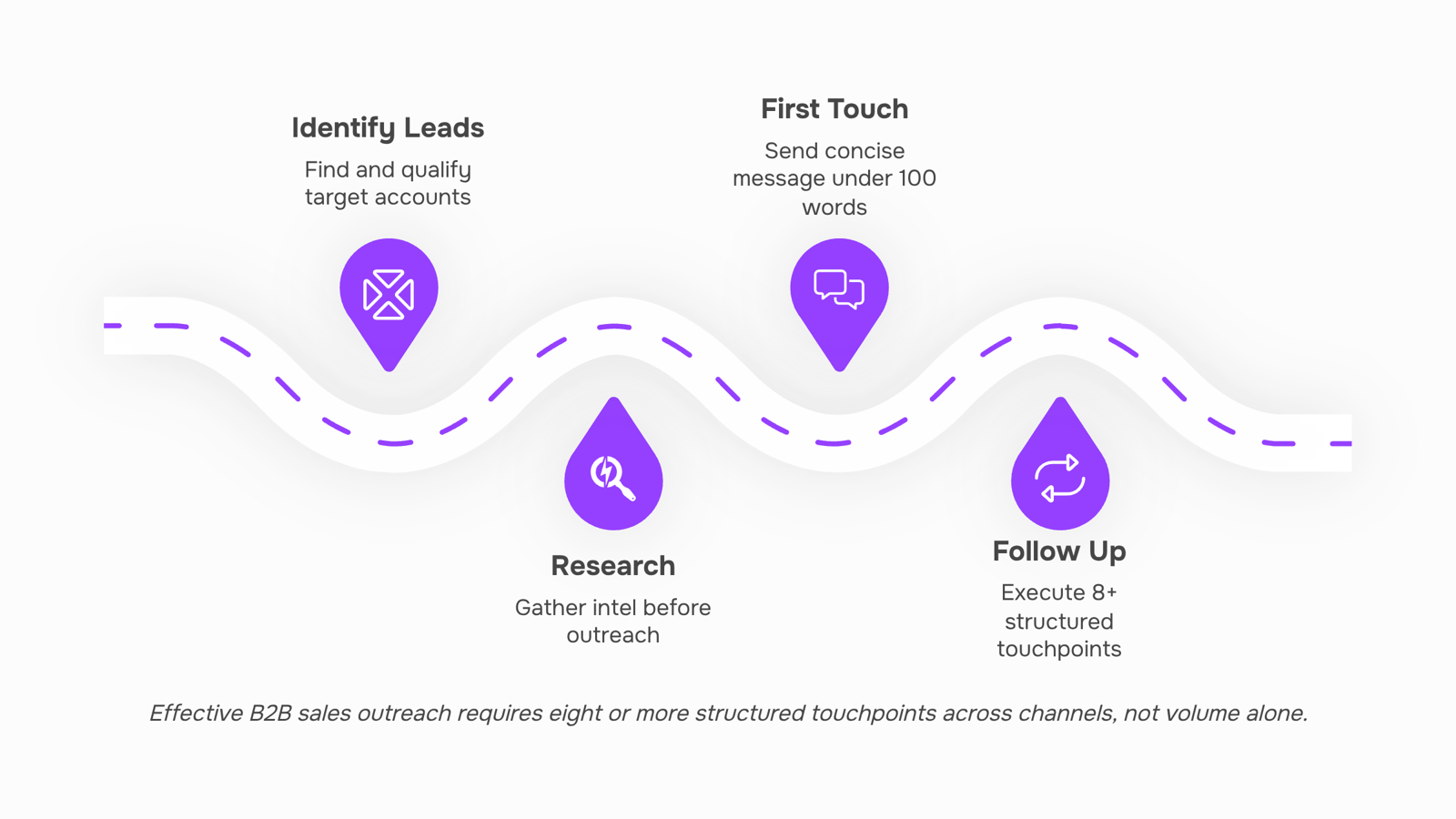
How sales outreach works: the basic sequence
Most B2B sales outreach fails not because the message is wrong, but because the sequence is. Here are the five steps that structure effective outreach from first signal to booked meeting.
Identify and qualify the lead: Pull from your CRM, LinkedIn, or inbound forms. Before you write a single word, confirm the lead fits your ICP on company size, tech stack, and budget authority. A weak list wastes every step that follows. Use a structured qualification framework to cut the noise early.
Research before you contact: Spend five minutes on their LinkedIn, recent press, and job postings. One specific detail in your opening line doubles reply rates more reliably than any subject-line formula.
Send the first touch. For B2B sales outreach, cold email remains the highest-volume channel. Keep it under 100 words: one problem, one relevant proof point, one ask. No attachments on the first contact.
Follow up on a schedule: RAIN Group research shows it takes an average of eight touches to book a B2B meeting. Most reps stop at two. Space follow-ups across email, LinkedIn, and phone over 10 to 14 days.
Qualify the response and route it: A reply is not a win yet. Score the response, confirm budget and timeline, then hand it to the right person or stage. This is where SDR outreach strategy and your prospecting tools need to connect cleanly.
Best strategies for sales outreach
Five strategies move the needle on what is sales outreach in practice. Here are the ones worth building into your process.
1. Match your channel to the lead's behavior
Cold email works best for decision-makers who research before buying. LinkedIn outreach performs better for leads who are already active on the platform. Don't default to one channel for every contact. Check where your lead has been active in the last 30 days and start there.
2. Personalize the first line, not the whole message
Buyers delete templated openers immediately. One specific reference — a recent company announcement, a post they published, a funding round — signals that you did the work. Keep the rest of the message short. Three sentences is enough for a first touch.
3. Follow up within the first hour after a lead engages
Research consistently shows that response rates drop sharply the longer you wait after a lead opens an email or clicks a link. Most B2B sales teams follow up hours or days later. That gap is where deals go quiet. Set a trigger so your rep gets notified the moment a lead engages.
4. Use social media sales outreach as a warm-up, not a close
Social media sales outreach works best before the ask, not instead of it. Comment on a prospect's post, share something relevant to their industry, or connect without a pitch. Then move to direct outreach. Leads who recognize your name before the first email are significantly more likely to reply.
5. Run a structured multi-touch sequence
RAIN Group benchmarks suggest it takes eight or more touchpoints to book a B2B meeting. Most reps stop at two. A structured sequence — email, LinkedIn, phone, repeat — keeps you visible without being aggressive. Map out the cadence before you start, not after the first non-reply.
For building the lead list that feeds these sales outreach strategies, prospecting tools purpose-built for B2B teams cut the research time significantly.
How to automate sales outreach without losing the personal touch
Automation handles the repetitive parts of outreach well: sending follow-up emails on a schedule, logging activity in your CRM, and triggering the next step when a prospect opens a message. What it cannot do is read context. That distinction is where most teams go wrong when they try to figure out how to automate sales outreach.
A practical split looks like this:
Automate:
Initial email send and follow-up sequence (steps 1 through 3)
CRM activity logging and contact record updates
Lead routing based on company size, industry, or source
Meeting link delivery once a prospect replies positively
Keep human:
The first LinkedIn message to a warm lead
Any reply that shows real buying intent or raises a specific objection
Outreach to accounts above a certain deal size threshold
Personalized references to a prospect's recent news or role change
The gap between a lead arriving and the first touch is where deals quietly die. Research consistently shows that response rates drop sharply after the first five minutes of inaction, yet most teams have no automated trigger covering that window.
This is where lead assignment matters. When a new lead hits your pipeline, the system should route it to the right rep immediately, not sit in a queue. Lio handles that assignment step automatically, so the rep gets the lead with context already attached and can send a human-written first message within minutes rather than hours.
For a fuller look at which tools support this kind of sequenced approach, the guide on outreach software for sales teams covers the category in detail.
The goal with any sales outreach strategy is to automate the mechanical and protect the human moments that actually move deals forward.
Social media fits into B2B sales outreach as a warm-up channel, not a primary close channel. LinkedIn specifically works best at two points in a sequence: before the first cold email (a profile view or connection request signals intent) and after an unanswered follow-up (a direct message resets the thread without filling an inbox).
For IT company owners doing social media sales outreach, the practical approach is narrow. Connect first, then message. Keep the first LinkedIn message under 75 words, reference something specific from their profile or recent post, and ask one question. Generic pitches get ignored at the same rate as cold email, but a relevant observation gets replies.
RAIN Group research consistently shows that B2B buyers need multiple touches across channels before agreeing to a meeting. LinkedIn covers the social proof gap that email alone cannot.
Where LinkedIn fits in a full sequence sits alongside your SDR outreach strategy and your B2B email nurturing track. The channel is not a standalone tactic. It works when it is wired into a sequence with clear triggers and a defined hand-off point.
Key metrics to measure sales outreach success
Tracking the right sales outreach metrics tells you where your sequence is working and where deals are quietly dying. Here are the six that actually drive decisions:
Reply rate by channel: If cold email sits below 5% and LinkedIn replies run at 15%, that's your signal to shift sequence weight toward LinkedIn for cold B2B contacts.
Time-to-first-touch: The window between a lead entering your CRM and your first outreach matters more than most teams realize. Delays beyond a few hours consistently drop conversion rates in B2B contexts.
Touchpoints to first meeting: RAIN Group benchmark research points to 8 or more touches before a B2B meeting is booked. If your reps stop at 3, the metric explains the gap.
Meeting-booked rate per sequence. Measures whether your messaging and cadence are working together, not just whether reps are sending volume.
Sequence drop-off point: If 60% of prospects disengage at step 4, rewrite step 3. This is where knowing how to automate sales outreach pays off: automated sequences surface drop-off data automatically.
Pipeline contribution per channel: Ties outreach activity to revenue, not just activity volume. Use this to justify where your team spends time.
Each metric maps to one decision. No metric should sit in a dashboard without an owner and a threshold that triggers action.
Closing
Sales outreach isn't about sending more messages—it's about sending the right message at the right time through the right channel, then following up consistently enough to actually book the meeting. The teams that win are the ones who treat outreach as a system: qualified leads, personalized first touches, immediate follow-up when a prospect engages, and a structured sequence that spans eight or more touchpoints instead of stopping at two.
Here's the practical question that separates teams that move deals from teams that lose them: How long does it take your team to respond after a lead comes in? If it's hours instead of minutes, you're already competing from behind. Lio closes that gap by capturing and assigning leads automatically the moment they arrive, so your rep can send a personalized first message in seconds, not hours. That speed difference compounds across your entire pipeline.
FAQ
What are the best strategies for sales outreach?
Match your channel to lead behavior, personalize the first line only, follow up within the first hour of engagement, use social media as a warm-up before direct outreach, and run a structured multi-touch sequence of eight or more touchpoints instead of stopping at two.
What are the key metrics to measure sales outreach success?
Track response rate (replies per outreach sent), reply-to-meeting conversion rate, time-to-first-response, and touchpoint count before booking. The gap between lead arrival and first touch is the most predictive metric most teams ignore.
Can sales outreach be done through social media?
Yes, but as a warm-up channel, not a primary close. LinkedIn works best before cold email—a connection request or profile view signals intent and increases reply rates when you follow with direct outreach.
What is the difference between inbound and outbound sales outreach?
Inbound is when buyers come to you (forms, website inquiries). Outbound is when your team reaches out directly to qualified leads through email, LinkedIn, or phone. Both require fast response and follow-up sequences to convert.
How many touchpoints does effective sales outreach require?
RAIN Group research shows it takes an average of eight touches to book a B2B meeting. Most reps stop at two, which is why deals go quiet. A structured sequence across email, LinkedIn, and phone over 10-14 days is standard.


 Ryan Mitchell15 September 2026


