TL;DR: Most tool roundups for sales lead generation list features and stop there. This one starts with where manual processes actually break, then maps specific tool capabilities to each failure point, so you can evaluate options against your real workflow, not a generic checklist.
What sales lead generation actually means in 2026
Sales lead generation is the process of identifying potential buyers and moving them into your pipeline — capturing contact details, qualifying intent, and handing off to sales at the right moment. In 2026, that process runs across four or five channels simultaneously: web forms, LinkedIn, paid search, referral programs, and product sign-ups, often all at once.
That's where the definition matters. Lead generation ends when a prospect enters your system. Lead management — scoring, routing, follow-up — starts there. Conflating the two is why most IT companies buy a tool that solves one problem while the other stays broken.
The sales lead generation process has three distinct stages: attract (get the prospect to raise their hand), capture (pull their data into one place), and qualify (decide if they're worth pursuing now). Most tools only handle one stage well.
Filling your pipeline with qualified leads requires knowing which stage is actually failing. If you're generating volume but conversion is low, the problem is qualification logic, not more traffic. If conversion is fine but pipeline is thin, the attract stage needs work. The rest of this article maps specific tools to each failure point so you can diagnose before you buy.
Where manual lead generation breaks down
Manual lead generation fails in predictable ways. Recognizing the pattern is the first step toward fixing it.
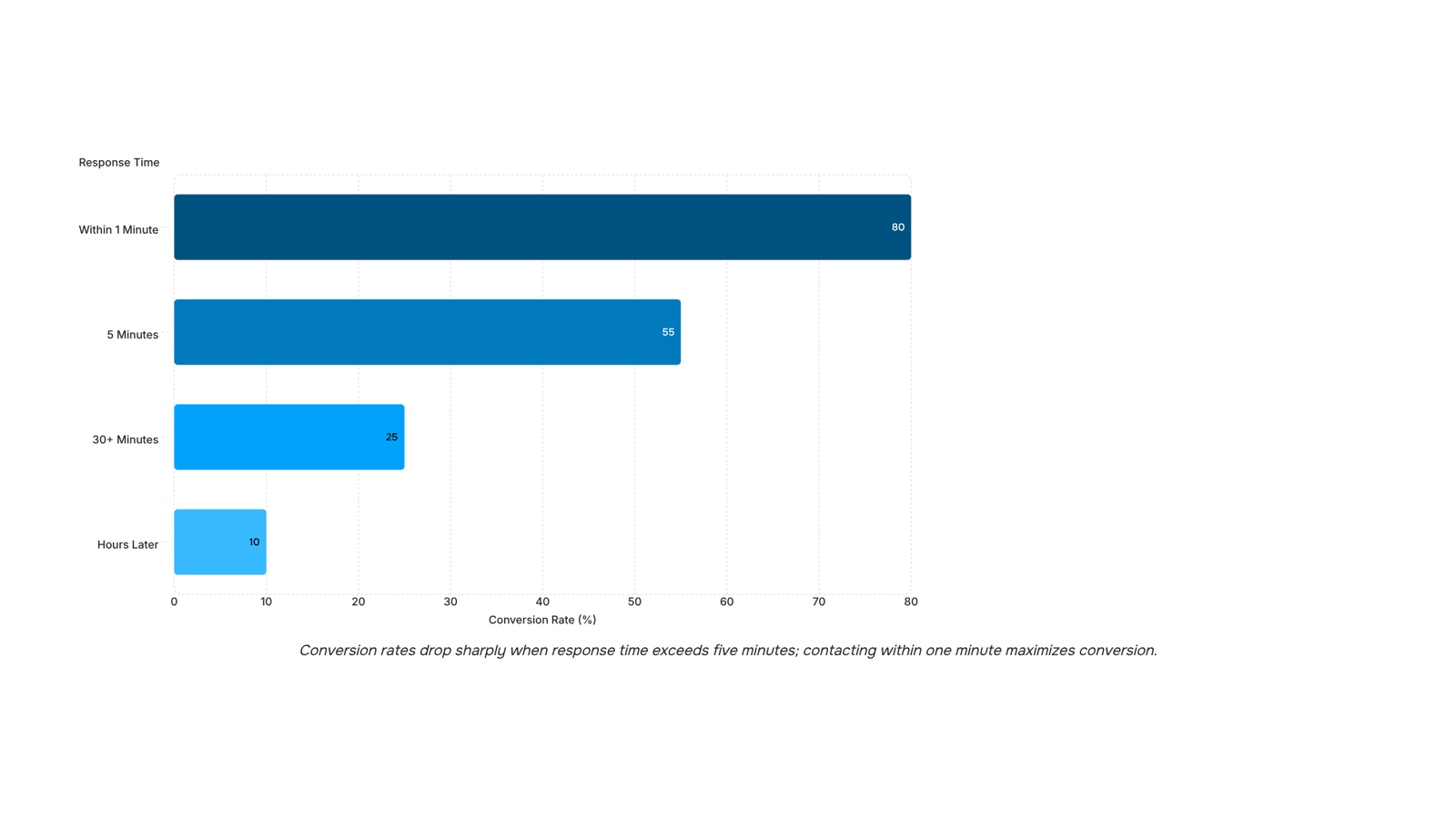
Slow response time is the most expensive failure. Research consistently shows that conversion rates drop sharply when response time exceeds five minutes — yet most teams relying on manual handoffs take hours. By then, the prospect has moved on.
Leads falling through source gaps is the second problem. Most IT companies run b2b sales lead generation across three or four channels simultaneously: web forms, LinkedIn outreach, paid ads, and referrals. Without a unified intake point, leads from one channel sit unnoticed while another gets all the attention. There is no system connecting them.
No qualification logic means your team treats every lead the same. A Fortune 500 CTO and a freelancer filling out your contact form both land in the same inbox. Without scoring criteria built into the sales lead generation process, reps waste time on low-fit contacts and miss high-intent ones.
No follow-up trigger is where deals quietly die. A lead responds, gets no reply within 24 hours, and goes cold. Manual processes depend on someone remembering. Nobody always remembers.
These four failure points compound each other. Understanding the metrics that connect lead source data to closed revenue makes the cost of each gap visible — and measurable.
The most effective strategies for sales lead generation
Three channels drive most pipeline: inbound, outbound, and referral. Knowing which to prioritize — and which to automate — saves your team from spreading effort across all three equally.
Inbound works by pulling leads toward you through SEO, content, and paid ads. A prospect fills out a form, downloads a resource, or books a demo. The problem is volume and fragmentation. Most teams run web forms, LinkedIn Lead Gen Forms, and paid campaigns simultaneously, which means leads arrive from three or four sources with no single capture point. That's where manual processes break down fastest, and where automation in your lead generation workflow starts paying for itself.
Outbound — cold email, LinkedIn outreach, and targeted calls — still works for b2b sales lead generation, especially when you're targeting a narrow ICP. It doesn't require automation at early stage. A rep with a list of 50 accounts and a clear message can do this manually. Once you're running sequences across hundreds of contacts, automation becomes necessary, not optional.
Referral is the most efficient channel by conversion rate. Most teams underinvest in it because there's no obvious trigger. Build a simple ask into your post-close workflow: one email, one timing rule, done.
Specialized contexts like hotel sales lead generation and healthcare sales lead generation follow the same three-channel logic, but the qualification criteria differ. The metrics connecting lead source to closed revenue help you see which channel is actually producing, not just generating volume.
Picking the wrong tool here doesn't just slow your team down — it breaks the pipeline at the point where speed matters most. Use these four criteria to cut through the noise.
Capture coverage: A tool that only pulls from your web form misses leads coming in through paid ads, LinkedIn, or partner referrals. Look for multi-source ingestion that consolidates every entry point into a single queue. Lio's Multi Source Lead Capture does exactly this, pulling web form submissions alongside other channels so no lead lands in a silo. If you're running more than one acquisition channel, this isn't optional.
Qualification logic: Raw lead volume is noise without a scoring layer. The tool should let you define qualification rules based on firmographic data, behavior signals, or both — and apply them automatically, not as a manual review step. For a deeper look at how AI scoring fits into an automated lead generation workflow, that's worth reading before you finalize your criteria.
Routing speed: Research consistently shows that conversion rates drop sharply when response time exceeds five minutes. Real-time routing — not batch assignment — is the standard any serious sales lead generation tool should clear. Lio's Real Time Lead Routing assigns leads to the right rep the moment they qualify, removing the manual handoff entirely.
Follow-up automation: Routing a lead to a rep is not the same as ensuring contact happens. The tool should trigger a follow-up sequence automatically if no outreach occurs within a defined window.
These four points give you a consistent lens for evaluating any of the sales lead generation solutions covered in the comparison table ahead. Lio uses all four as its baseline design, which makes it a useful benchmark when scoring alternatives.
The table below maps four tools against the decision framework from the previous section. Each tool is matched to the specific failure point it solves, not just the features it lists on a pricing page.
Tool | Capture sources | Qualification logic | Routing speed | Follow-up automation | Pricing tier |
|---|
Lio | Web forms, LinkedIn, paid ads, inbound calls | AI lead scoring with configurable rules | Real-time, under 60 seconds | Automated sequences via Evox integration | Mid-market; contact for quote |
HubSpot Marketing Hub | Web forms, live chat, email, ads | Score by behavior and firmographics | Minutes, depends on workflow triggers | Built-in sequences, limited on free tier | Free to ~$800/month (Professional) |
Salesforce Lead Management | Any source via API or native connectors | Einstein scoring, rule-based assignment | Near real-time with paid add-ons | Requires Salesforce Engage or third-party | Enterprise; $150+/user/month |
Pipedrive LeadBooster | Chatbot, web forms, prospector database | Manual or basic scoring only | Manual assignment default | Email automation add-on, not native | $32–$99/user/month |
A few things the table doesn't show but matter for b2b sales lead generation decisions:
Routing logic depth: Lio and Salesforce both route in real time, but Salesforce requires Einstein AI licensing on top of base CRM cost. Lio includes routing in the core product.
Source attribution: HubSpot tracks source well at the contact level but connecting that data to closed revenue requires the full CRM stack, not just Marketing Hub.
Multi-source capture: If your team runs web forms, LinkedIn Lead Gen Forms, and paid search simultaneously, check whether the tool ingests all three natively or relies on a Zapier bridge. A Zapier bridge adds latency and a point of failure.
For a deeper look at how these categories map to the broader automation landscape, what is the best lead generation automation software for B2B companies covers the evaluation criteria in more detail.
How to measure whether your lead generation is working
Four numbers tell you whether your sales lead generation process is working or wasting budget.
Lead response time is the most urgent. Research from InsideSales shows that contacting a lead within the first minute produces conversion rates dramatically higher than waiting five minutes or more. For most B2B teams, the realistic benchmark is under five minutes during business hours.
Lead-to-opportunity rate tells you whether the leads arriving are worth pursuing. A healthy B2B rate sits roughly between 10% and 20%. Below that, your qualification criteria need tightening before you invest more in volume.
Source attribution shows which channel actually drives revenue, not just form fills. Web forms, LinkedIn campaigns, and paid ads each behave differently at the bottom of the funnel. Without tracking origin-to-close, you're optimizing for clicks that never convert.
Conversion rate by channel is the output of that attribution work. It tells you where to put next quarter's budget.
The gap most teams hit is connecting these numbers. Lead Source Tracking in a tool like Lio ties the origin data directly to closed revenue, so you can see that a LinkedIn lead converts at twice the rate of a paid search lead, even if paid search drives more volume.
If you want to go deeper on generating quality pipeline before measuring it, this guide on generating more leads for your business covers the upstream work.
How to improve your lead generation conversion rate
Three changes move the needle faster than anything else in b2b sales lead generation.
Tighten qualification criteria first: If your team is chasing every inbound, they're wasting time on leads that were never going to close. Define a minimum score threshold, then let AI scoring filter before routing.
Cut response time to under five minutes: Research consistently shows conversion rates drop sharply once response time crosses that mark. Routing automation removes the manual handoff that causes the delay.
Add a structured follow-up sequence: Most leads go cold because no one owns the next step. A fixed sequence, three to five touches over ten days, closes that gap without relying on rep memory.
These three changes work on any sales lead generation solutions stack you're already running.
Closing
Speed and source fragmentation are where most sales lead generation systems fail — not because the tools are weak, but because they're solving for volume instead of velocity. The four criteria in this article (capture coverage, qualification logic, routing speed, and follow-up automation) aren't nice-to-haves; they're the difference between a pipeline that moves and one that stalls. If you're running lead generation across multiple channels and watching conversion drop, the problem isn't traffic — it's the gap between capture and contact. Ready to see how Real Time Lead Routing and Multi Source Lead Capture work together in practice? Book a 30-minute product walkthrough with Lio and watch how qualified leads move from entry to rep in under a minute.
FAQ
What are the most effective strategies for sales lead generation?
Inbound, outbound, and referral channels drive most pipeline. Inbound pulls through SEO and ads but fragments across sources — automation fixes this. Outbound scales once you're running sequences across hundreds of contacts. Referral converts highest but requires a post-close trigger to unlock.
How can I improve my sales lead generation conversion rates?
Conversion drops when response time exceeds five minutes. Implement real-time routing to eliminate manual handoffs, add qualification logic to focus on high-fit leads, and trigger follow-up sequences automatically if no outreach occurs within 24 hours.
How can I measure the success of my sales lead generation efforts?
Track metrics that connect lead source to closed revenue, not just volume. Measure response time, qualification rate by source, and conversion velocity. If pipeline is thin, the attract stage needs work. If conversion is low, qualification logic is the problem.
What is the difference between lead generation and lead management?
Lead generation captures contact details and qualifies intent — it ends when a prospect enters your system. Lead management starts there: scoring, routing, and follow-up. Most IT companies conflate the two, buying tools that solve one problem while the other stays broken.
How quickly should a sales team follow up with a new lead?
Research shows conversion rates drop sharply when response time exceeds five minutes. Real-time routing — not batch assignment — is the standard. If no outreach occurs within 24 hours, automated follow-up sequences should trigger to prevent deals from going cold.


 Elena Petrova15 September 2026


