TL;DR: Most content lists project manager responsibilities without connecting them to what actually happens on a team day-to-day. This article maps each core PM function to the specific decisions, handoffs, and outcomes it produces, so you can tell whether your current setup is driving results or just adding process. You'll finish with a clear picture of what a working PM structure looks like in practice.
What a project manager actually is
A project manager is the person accountable for delivering a defined outcome within agreed constraints: scope, timeline, and budget. That accountability is the key distinction from general team management. A team lead owns people development and day-to-day performance. A project manager owns the work itself, from kickoff through closeout, regardless of who does the execution.
According to PMI, project managers are goal-oriented professionals who use collaboration and creativity to lead work that makes a measurable impact. In practice, that means coordinating across functions, not just managing down a reporting line.
The role spans the full project lifecycle: initiation, planning, execution, and closure. At each stage, the PM's job is to keep those three constraints in balance while keeping people aligned on what matters next.
If you want a concrete starting point, a project management checklist that covers the eight elements most teams miss is a useful companion to this definition.
What a project manager does every day
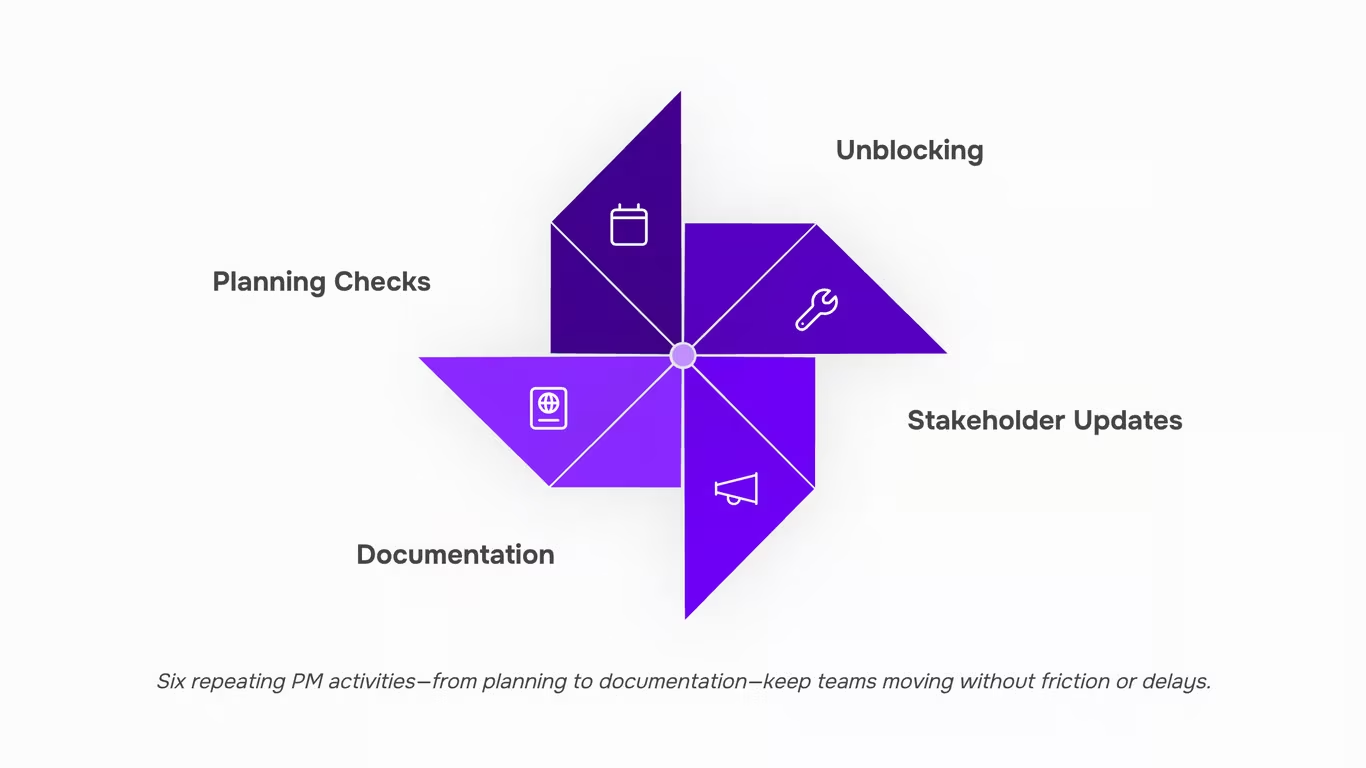
No two project managers have the same day. The mix of meetings, decisions, and interruptions shifts constantly based on where a project sits in its lifecycle. But the six core activities repeat across almost every workday, regardless of methodology or team size.
Planning check-ins come first. Most PMs start the morning by scanning what's due, what's at risk, and whether yesterday's blockers got resolved. This takes 15 to 30 minutes and sets the filter for every conversation that follows.
Unblocking tasks is where a significant chunk of time goes. A developer is waiting on a design decision. A vendor hasn't responded. Two team members have conflicting priorities. The PM's job is to remove those friction points before they compound. This is the human coordination work that rarely shows up in job descriptions but defines whether a project moves or stalls.
Stakeholder updates happen throughout the day, not just in scheduled meetings. A quick Slack message to a department head, a revised timeline sent to a client, a flag raised to a sponsor about a scope change. Each one is a judgment call: what needs to go up the chain now versus what can wait for the weekly report.
Risk scanning is ongoing, not periodic. A PM who only reviews risks in a formal meeting is already behind. The daily version looks like reading a status update and noticing that two tasks have the same dependency, or catching that a resource is double-booked three weeks out. A project management checklist that covers the eight elements most teams miss can help structure what to look for when your mental model gets overloaded.
Resource adjustments follow risk scanning naturally. When a risk materializes, someone's capacity or timeline needs to shift. The PM makes that call, communicates it, and updates the plan. On complex projects, this happens multiple times a day.
Documentation closes the loop. Decisions made in a hallway conversation need to be recorded somewhere the whole team can find them. Without this, the same question resurfaces in two weeks with three different answers.
When these six activities run well, the team moves without waiting for permission. When any one breaks down, how to prioritize tasks when everything feels urgent becomes the question everyone is asking at once.
Keeping all of it in one place matters more than most teams realize until they're mid-crisis. A single source of truth for every project your team runs removes the version-control problem before it starts.
How a project manager contributes to team success
The project manager role in a team is less about managing tasks and more about maintaining the conditions that let work move forward. When that function is missing, teams default to whoever shouts loudest, deadlines slip without warning, and no one owns the gaps between workstreams.
Each daily responsibility a PM carries connects directly to a team outcome. Planning check-ins surface blockers before they become delays. Stakeholder updates prevent the kind of late-stage surprises that force scope changes. Risk scanning gives the team a two-week window to adjust instead of a two-day scramble. These aren't administrative habits — they're the mechanism that keeps delivery rate stable across a project's full lifecycle.
Accountability is where the contribution becomes most visible. A PM doesn't just track who owns what; they create the shared context that makes ownership meaningful. When everyone on the team can see the same priorities, dependencies, and deadlines, how to prioritize tasks when everything feels urgent stops being a daily negotiation and becomes a structured decision. That shift alone reduces the coordination overhead that drains senior engineers and team leads.
According to PMI, the project manager holds the single most important position on a project and carries overall responsibility for its success. That framing matters because it separates the role from task coordination. Success means the team shipped something that met scope, budget, and timeline — not just that tasks got closed.
The daily responsibilities of a project manager compound over time. A team that runs consistent check-ins, clear documentation, and proactive risk reviews builds a delivery rhythm that's hard to disrupt. Using a project management checklist that covers the eight elements most teams miss is one practical way to make that rhythm repeatable from the first week of a project.
Skills that make a project manager effective
Three skill categories separate PMs who keep IT projects on track from those who spend their days chasing updates.
Communication is the most visible of the three project manager skills. In an IT delivery context, this means translating technical blockers into plain language for stakeholders, writing status updates that surface risk without burying it in jargon, and running standups that produce decisions rather than recaps. A PM who communicates well cuts the back-and-forth that quietly eats 5–10 hours a week per team member.
Structured thinking covers the planning and prioritization side of project management responsibilities. This includes breaking ambiguous goals into trackable work, sequencing dependencies correctly, and knowing which tasks to protect when scope creeps. A PM who thinks in systems will naturally build a project management checklist that covers the eight elements most teams miss rather than improvising each sprint. For IT teams specifically, structured thinking also means knowing how to prioritize tasks when everything feels urgent — because in most IT shops, everything always does.
Adaptability is where the first two skills get tested. Requirements shift mid-sprint, a key engineer goes out sick, a client changes the acceptance criteria two days before delivery. PMs who adapt quickly don't just react — they maintain a single source of truth for every project your team runs so the team can reorient fast without losing context.
None of these skills operate in isolation. A PM who communicates well but can't think structurally produces clear updates about a plan that's falling apart. All three have to work together.
Project manager vs. team leader: what is the difference
The short answer to "can a project manager also be a team leader?" is yes, but only when the organization is clear about which hat they're wearing at any given moment. In small IT firms especially, one person often carries both titles. The confusion comes when the boundaries blur.
Here is how the two roles differ across four dimensions:
Scope of authority. A project manager's authority is temporary and project-bound. They direct work until the project closes. A team leader's authority is structural and ongoing, tied to a standing group of people rather than a deliverable.
Accountability. The project manager answers for outcomes: budget, timeline, and scope. The team leader answers for people: performance, growth, and day-to-day morale. Miss a deadline and the PM owns it. Lose a developer to burnout and the team leader owns it.
Time horizon. Project managers think in milestones and sprints. Team leaders think in quarters and careers. One role is delivery-focused; the other is development-focused.
People focus. A project manager role in a team is coordination-heavy: aligning stakeholders, removing blockers, and keeping dependencies visible. A team leader is relationship-heavy: coaching, mentoring, and building trust over time.
Where teams get into trouble is treating these as interchangeable. A PM optimizing for delivery speed will sometimes make calls that cost the team leader months of trust-building. Separating the roles, even informally, reduces that tension.
If your team is small enough that one person covers both, how to prioritize tasks when everything feels urgent becomes a critical skill. Without a clear system, the delivery pressure of the PM role will consistently crowd out the people work.
Where project managers lose time and how to fix it
Three patterns eat most of a project manager's week, regardless of team size.
Manual status updates are the biggest offender. When your daily responsibilities of a project manager include chasing five people for progress reports before a Monday standup, that's coordination work disguised as management. Structured tooling that auto-pulls task status removes this entirely. Northeastern University's research on PM time management identifies this reporting loop as one of the top recurring time wasters for working project managers.
Scattered task context is slower but just as costly. When decisions, files, and comments live across email, Slack, and a spreadsheet, a PM spends real time reconstructing what happened before they can move anything forward. A project management checklist that covers the eight elements most teams miss shows exactly what falls through when context isn't centralized.
Late-breaking scope changes are the hardest to fix with process alone, but they're easier to absorb when ownership is already clear. If your team knows how to prioritize tasks when everything feels urgent, a scope shift becomes a reprioritization conversation rather than a crisis.
All three problems shrink when project manager skills include knowing which work belongs in a structured system. A single source of truth for every project your team runs is what makes that possible in practice.
Closing
A project manager's real job isn't managing tasks—it's maintaining the conditions that let work move forward without friction. The six daily activities that matter most (planning checks, unblocking work, stakeholder updates, risk scanning, resource adjustments, and documentation) only work if they're anchored in a system where the whole team sees the same priorities, dependencies, and deadlines at once.
When PMs spend their time gathering data from five different tools instead of making decisions, delivery slows. The difference between a PM who drives results and one who just adds process is whether they have a single source of truth where planning, task tracking, and milestone visibility live together. That's where Taro comes in—it's the project hub built so PMs can focus on what actually matters: keeping the team moving forward. Ready to see what happens when your PM isn't buried in status updates?
FAQ
Q. What are the daily responsibilities of a project manager?
A. Planning checks, unblocking tasks, stakeholder updates, risk scanning, resource adjustments, and documentation. These six activities repeat across almost every workday and directly determine whether a project moves or stalls.
Q. How does a project manager contribute to team success?
A. PMs create the shared context that makes ownership meaningful—clear priorities, visible dependencies, and stable deadlines. This reduces coordination overhead and builds a delivery rhythm that's hard to disrupt.
Q. What skills are required to be a successful project manager?
A. Communication (translating blockers for stakeholders), structured thinking (breaking goals into trackable work and sequencing dependencies), and relationship building (coordinating across functions, not just managing down).
Q. Can a project manager also be a team leader?
A. Yes, but the roles are distinct. A team lead owns people development and day-to-day performance; a PM owns the work itself and the three constraints: scope, timeline, and budget. One person can hold both, but they require different skill sets.
Q. What is the difference between a project manager and a product manager?
A. A PM owns delivery within defined scope, timeline, and budget constraints. A product manager owns what gets built and why—the strategy and roadmap. PMs execute; product managers define direction.
Q. How many projects should one project manager handle at a time?
A. It depends on project complexity and team size, but the limiting factor is the PM's capacity to run the six daily activities well. When a PM can't do planning checks, risk scanning, and unblocking work consistently, too many projects are in flight.


 Elena Petrova15 September 2026


