TL;DR: Most SEO contract guides hand you a template and assume you know what each clause actually does. This one walks IT agency owners through every essential clause, explains the legal function behind it, and flags the three most commonly omitted terms that quietly create disputes. You'll finish with enough context to review, adapt, or negotiate any SEO contract with confidence.
What is an SEO contract template
An SEO contract template is a pre-structured legal document that formalizes the working relationship between an SEO provider and a client. It defines exactly what services will be delivered, at what price, over what timeframe, and under what conditions either party can exit. One sentence you can hand a client: "This agreement protects both of us by putting every expectation in writing before work begins."
What the template covers: scope of SEO services, deliverables, payment schedule, reporting cadence, intellectual property ownership, and termination and exit clause terms. What it does not cover: the sale itself, proposed strategies, or projected outcomes — those belong in a proposal, which is a separate pre-sale document.
For IT agency owners, the distinction matters most around technical SEO work. Scope creep — a client requesting site migrations, Core Web Vitals fixes, or schema rewrites outside the original brief — is far easier to push back on when what makes a contract legally binding is already documented in a signed SEO service agreement.
SEO contract vs. SEO proposal: what is the difference
An SEO proposal is a sales document. It outlines what you plan to do, at what price, and why the client should hire you. It carries no legal weight until both parties sign something that binds them to those terms.
An SEO contract is that binding document. Once signed, it governs the entire engagement: scope, deliverables, payment schedule, and exit conditions. Understanding how a proposal differs from a signed agreement matters because confusing the two is where most IT agencies create accidental liability.
The sequence is straightforward:
Send the proposal to win the work
Issue the contract before any work begins
Get signatures before touching a single deliverable
Skipping step three is the most common mistake. A proposal with a verbal "yes" is not a contract. Without a signed agreement, you have no enforceable scope, which means no protection when a client requests three rounds of technical audits they never paid for.
The payment terms clause and the scope of work are what make a contract legally binding rather than just a formalized proposal. Those distinctions are covered in the next section.
Essential clauses every SEO contract template must include
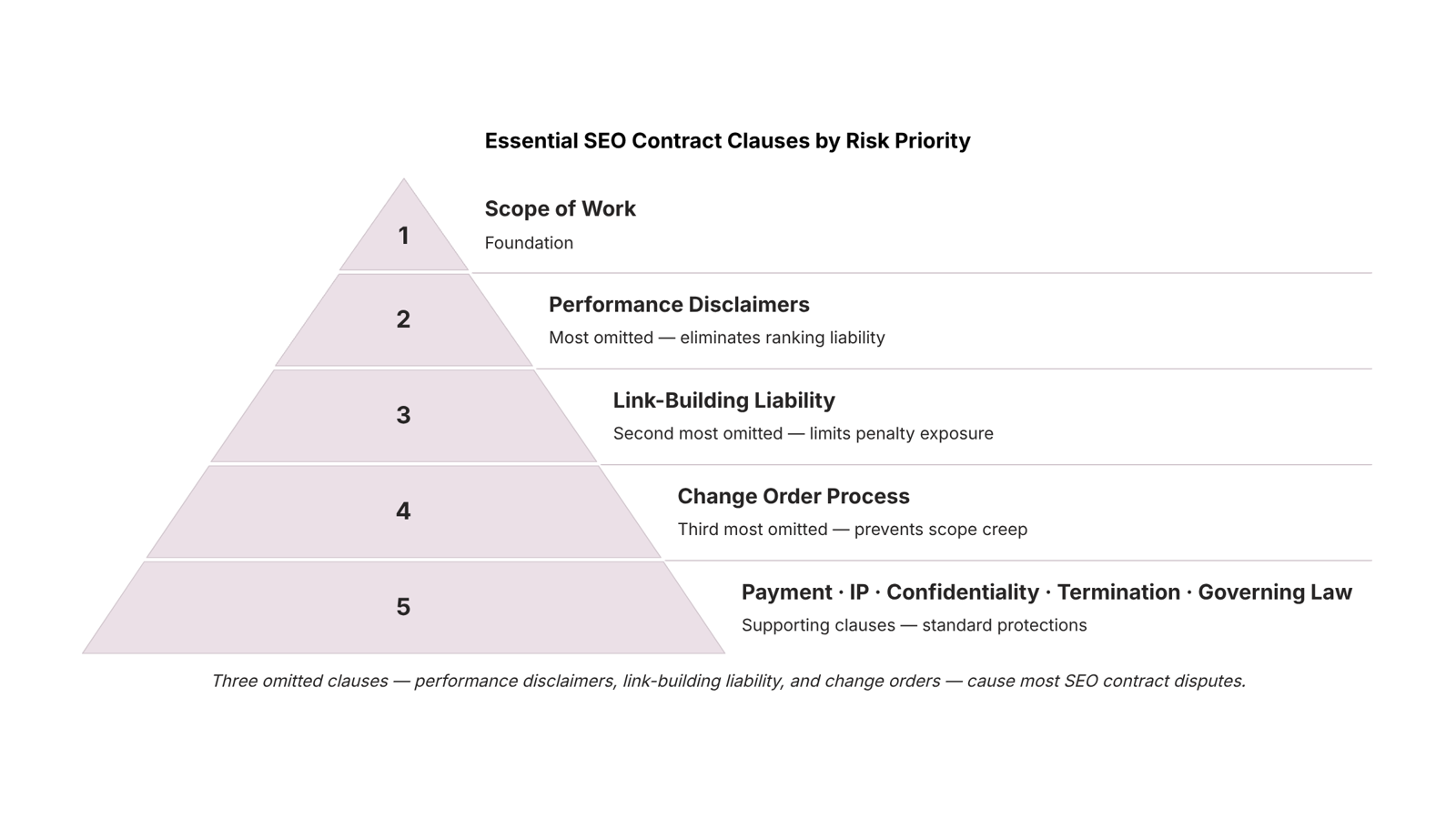
Nine clauses show up in every solid SEO contract template. Three of them get cut by IT agencies almost every time, and those three are where disputes start.
Scope of work is the foundation. Your seo contract scope of work section should name every deliverable explicitly: number of pages optimized per month, which technical audits are included, whether schema markup or Core Web Vitals remediation falls inside or outside the engagement. Vague language like "ongoing SEO services" is an open invitation to scope creep, which most digital marketing agencies cite as the primary driver of client disputes. Attach a deliverables table as an exhibit if the work is complex.
Payment terms should specify the retainer amount, billing cycle, and what triggers an invoice. For an seo retainer agreement, 30-day net terms with a 1.5% monthly late fee is a standard starting point. Include a clause that pauses deliverables if payment is more than 15 days overdue.
Performance disclaimers are the clause IT agencies omit most often, and the one that causes the most damage. Ranking guarantees are not enforceable under US contract law because Google's algorithm is outside your control. Your contract should state explicitly that you make no guarantee of specific rankings, traffic volume, or revenue outcomes. Without this, a client can argue breach of contract the moment their position drops.
Intellectual property assignment defines who owns the work product. Deliverables like content, technical audits, and link-building reports should transfer to the client on full payment. Work in progress stays yours until payment clears.
Confidentiality protects both sides. The client's analytics data, keyword strategy, and competitor research are sensitive. A mutual NDA clause inside the contract is cleaner than a separate document.
Termination and notice period sets the exit conditions. Thirty days written notice is typical for monthly retainers. Include a clause covering what happens to in-progress work and whether a kill fee applies.
Link-building liability is the second commonly omitted clause. If your agency builds links and a client's site later receives a manual penalty, you need language that limits your liability to the specific tactics outlined in the scope. Anything outside that scope is the client's responsibility. This matters more than most agencies realize, especially for technical SEO engagements where the work touches site architecture.
Change order process is the third missing clause. Any work outside the original scope requires a signed change order before it begins. This single clause prevents the majority of scope disputes on long-running engagements.
Governing law and dispute resolution closes the contract. Name the state, specify whether disputes go to arbitration or litigation, and identify which party bears legal fees if the dispute resolves in their favor.
For reference on how these clauses map to software-adjacent engagements, the structure used in a contract agreement for software development follows the same logic and is worth reviewing alongside your SEO service agreement clauses.
How to protect yourself with an SEO contract template
Three risks end most SEO engagements badly: scope creep on technical work, ranking disputes, and link building liability. Your seo contract template needs a clause mapped to each one.
Scope creep is the most common. A client asks for a site migration audit "while you're in there," and suddenly you've added 20 hours outside the retainer. A tightly written scope of work clause — listing exactly which deliverables, URLs, and technical tasks are included — gives you a paper trail when that conversation happens. Anything outside the defined scope triggers a change order, not a favor.
Ranking disputes come second. Clients often interpret a proposal as a performance guarantee. It isn't, and what makes a contract legally binding requires mutual agreement on defined terms, not implied outcomes. A no-guarantee clause, paired with a clear description of what SEO work actually controls, removes that ambiguity before it becomes a dispute.
Link building liability is the most overlooked. If a vendor delivers spammy backlinks under your white-label arrangement, your agency absorbs the penalty. An indemnification clause that flows liability back to the vendor is the fix. Pair it with solid service-level agreement terms covering deliverable quality, and you have a defensible position if a client's domain takes a hit.
Can you use one SEO contract template for all clients
One template can work as a starting point, but it needs conditional clauses built in for each engagement type.
The core terms that stay constant across every SEO contract template: payment schedule, IP ownership, confidentiality, and dispute resolution. These don't change whether you're running a one-off audit or a 12-month seo retainer agreement.
What changes is the seo contract scope of work block and the performance expectations tied to it:
Project engagements need a fixed deliverable list, a hard end date, and a change-order clause for anything outside that list
Retainer engagements need monthly deliverable caps, a rollover policy, and explicit language on what triggers a scope review
White-label arrangements need a confidentiality addendum covering client identity and a clause restricting the end client from contacting you directly
A single base document with these as modular sections is practical. What makes it legally binding isn't the format — it's whether each variation is signed and dated before work starts.
How to manage and store SEO contracts across clients
Managing a signed SEO contract template across a dozen active clients is where most IT agencies quietly lose control. Renewal dates slip, scope addenda get buried in email threads, and no one can locate the version the client actually signed.
A practical system has three components:
A central repository with version control (not a shared Drive folder with files named "final_v3_REAL")
Renewal alerts set 60 days before each contract end date
A linked addendum log so scope changes stay attached to the original agreement, not floating in a separate document
Sigi handles this directly, storing executed contracts, triggering renewal reminders, and attaching addenda to the parent record automatically.
For the underlying contract structure, what makes a contract legally binding and your payment terms clause are worth reviewing before you standardize your template.
Closing
An SEO contract template is only as effective as the system used to track it. When an IT agency manages 10 or more client agreements, version control, renewal dates, and termination notices become operational risks if they live in email or spreadsheets. Sigi's Contract Management keeps signed contracts organized, flags renewal deadlines automatically, and makes the full agreement text accessible without manual chasing. The clauses protect you legally; the system keeps you from accidentally letting a contract expire or missing a termination window. Start by auditing your current contracts against the nine essential clauses above. Which three are missing from your template right now?
FAQ
What are the key elements of an SEO contract template?
Scope of work, payment terms, performance disclaimers, intellectual property assignment, confidentiality, termination notice, link-building liability, change order process, and governing law. The three most commonly omitted—performance disclaimers, link-building liability, and change order process—are where disputes start.
Can I use an SEO contract template for all my clients?
Yes, but customize the scope of work and payment terms for each client. A template saves time on boilerplate; the legal protections only work when scope, deliverables, and exit conditions match the actual engagement.
What are the differences between an SEO proposal and a contract template?
A proposal is a sales document with no legal weight. A contract is a binding agreement that governs scope, payment, and exit conditions. Always send the proposal first to win work, then issue a signed contract before any work begins.
Does an SEO contract need to include a ranking disclaimer?
Yes. Ranking guarantees are not enforceable under US contract law because Google's algorithm is outside your control. Without an explicit no-guarantee clause, a client can argue breach of contract the moment their position drops.
What happens if a client breaches an SEO service agreement?
It depends on the breach type. Late payment triggers a pause on deliverables (per your payment terms clause). Scope violations require a change order. The governing law and dispute resolution clause determines whether you pursue arbitration or litigation.


 Elena Petrova15 September 2026


