TL;DR: Most sales plan guides hand you a template and call it strategy. This one walks IT company owners through each component with a clear reason it exists, a seven-step framework for building one that reflects how IT services actually sell, and a direct answer to how often to revisit it so the plan stays useful past the first quarter.
What a sales plan actually is
A sales plan is a written document that translates revenue targets into specific actions: who sells what, to whom, by when, and with what resources. It sits one level below strategy. Where a sales strategy answers "which markets do we pursue and why," a sales plan answers "what does the team do on Monday morning to hit the number."
Day-to-day, it gives reps clear quota ownership, managers a basis for pipeline reviews, and leadership a single source of truth when targets slip. Without it, territory disputes and missed handoffs fill the gap. Most teams that miss annual revenue targets trace the failure back to unclear quota or territory ownership, not bad products.
A sales plan also sets the review cadence. Quarterly is the minimum for most IT services teams; monthly works better when you're growing fast or entering a new segment.
For the metrics that belong inside your plan, the sales dashboard metrics every team should track is a useful companion read.
Sales plan vs. sales strategy: the real difference
A sales strategy answers "where are we going and why." A sales plan answers "who does what, by when, and with what resources." They're related but not the same document, and confusing them is how teams end up with a compelling vision and no execution.
The strategy sets direction: target market, competitive positioning, and the revenue model. The plan translates that direction into action: territories, quotas, headcount, activity targets, and timelines. If your strategy says "move upmarket into mid-size IT firms," your sales plan specifies which rep owns which accounts, what the 90-day pipeline target looks like, and how you'll track progress through a sales dashboard with the right metrics.
| Sales strategy | Sales plan |
|---|
Time horizon | 1 to 3 years | Quarterly or annual |
Primary question | Where are we going? | How do we get there? |
Key output | Positioning, ICP, revenue model | Quotas, territories, activity targets |
Owner | Leadership | Sales manager + reps |
When you sit down to work on how to develop a sales plan, start from an existing strategy. Without one, sales planning produces activity without direction.
Key components of a successful sales plan
A solid sales plan format sample covers six to eight components. Each one exists to answer a specific question your team will ask mid-quarter when things go sideways.
Revenue targets. The number your team is working toward, broken into monthly or quarterly milestones. Without a specific figure tied to a timeframe, quota conversations stay vague and accountability disappears.
Target market and ideal customer profile. Who you're selling to, defined by industry, company size, budget range, and buying trigger. For IT services teams, this often means segmenting by infrastructure maturity or compliance requirement, not just company size.
Sales tactics and channels. How your team will reach buyers: outbound calls, inbound content, partner referrals, or a mix. Specify the channel, the sequence, and who owns each. Vague tactics produce inconsistent pipelines. A clear sales pipeline structure makes this easier to operationalize.
Quota and territory ownership. Which rep owns which accounts or regions. Unclear ownership is one of the most common reasons IT services companies miss annual targets. Assign it explicitly, in writing.
Lead response and follow-up cadence. How fast reps respond to inbound leads and how many touches a cold prospect receives before disqualification. Teams with a formal process here respond measurably faster than those without one.
KPIs and review cadence. The metrics that tell you whether the plan is working: conversion rate, average deal size, pipeline coverage, and win rate. Track these in a sales dashboard so the data is visible without a weekly status meeting.
Budget and resources. Headcount, tools, and spend allocated to hit the target. A sales planning template that skips this section produces a plan that looks good on paper but stalls when a rep needs a tool approved.
Review each component quarterly, not annually. Markets shift, headcount changes, and a plan that isn't updated becomes a document nobody reads.
How to build a sales plan in 7 steps
Building a sales plan works best as a sequence. Each step feeds the next, so skipping one creates a gap that shows up later, usually in a missed quota or a territory dispute.
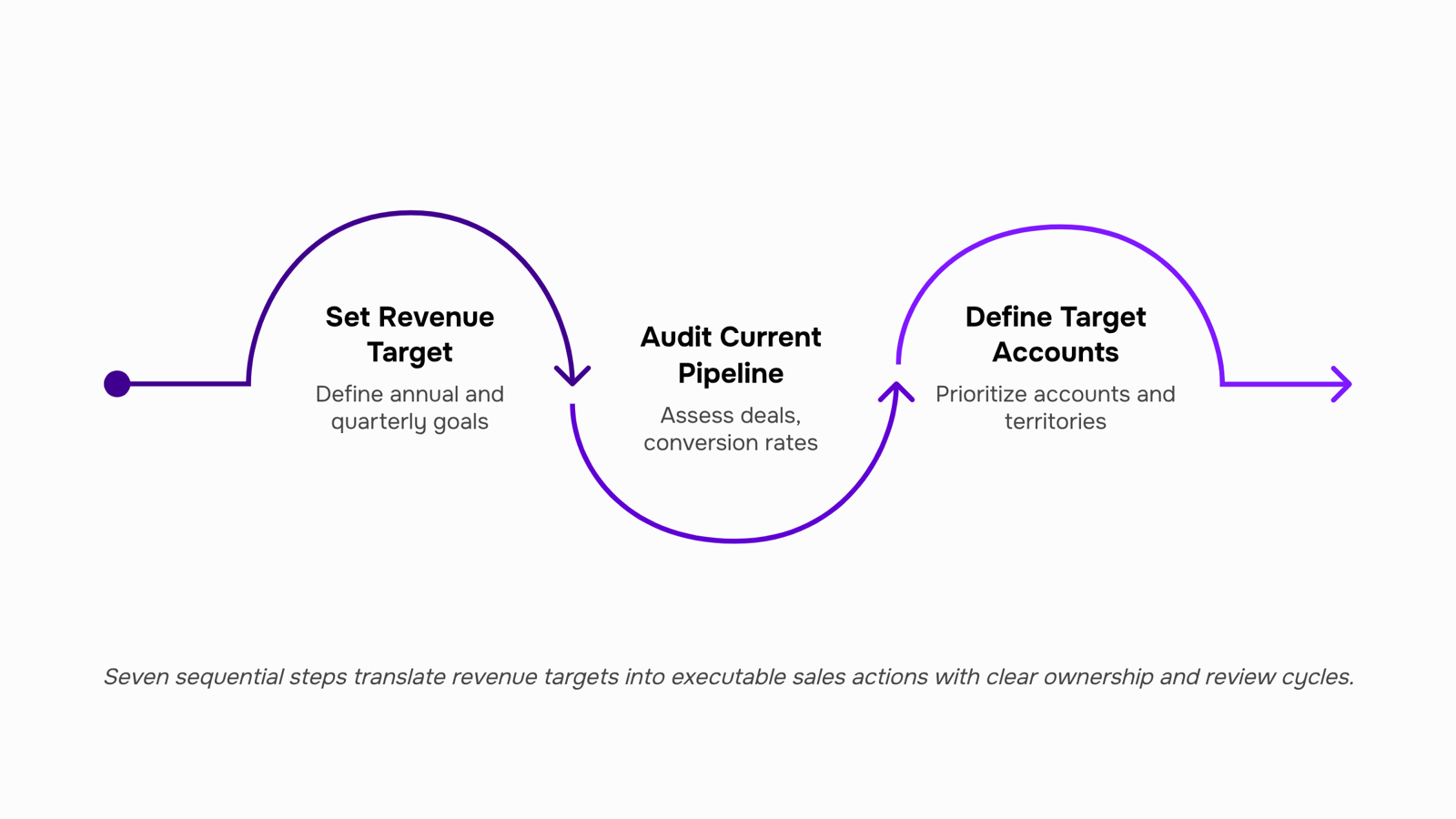
Set your revenue target. Start with a specific number tied to company goals, not a rough estimate. Break it down by month and by service line so you can spot shortfalls early rather than at year-end.
Audit your current pipeline. Before you plan forward, understand where you stand. Review open deals, average deal size, and close rates from the past two to four quarters. This is also where you build or refine your pipeline stages so the plan reflects how your team actually sells.
Define your target accounts and territories. Assign named accounts or geographic segments to specific reps before the plan is final. IT services teams that leave territory ownership vague tend to see duplicated effort on the same prospects and neglected segments elsewhere.
Set individual quotas. Divide the revenue target across reps based on territory size, experience, and historical performance. A quota that feels arbitrary gets ignored. One with a clear rationale gets owned.
Choose your sales activities and cadences. Decide how many calls, demos, and proposals each rep needs to run per week to hit quota at your current conversion rates. This is how to develop a sales plan that stays executable, not just aspirational. If your conversion data is thin, use industry benchmarks as a starting point and refine after 60 days.
Assign tools, templates, and resources. Specify which sales planning tools the team will use for CRM, outreach, and reporting. A plan that references "the CRM" without naming it, configuring it, or training on it is a plan that won't get used. A sales plan template for activities and a shared dashboard reduce the setup time for new reps significantly.
Set a review cadence. Most guides skip this step. A sales plan reviewed only at year-end is a historical document, not a management tool. Schedule a monthly 30-minute review against the 12 metrics your dashboard should track, and a deeper quarterly review where you adjust quotas, territories, or activity targets based on what the data shows. For IT services teams running longer sales cycles, quarterly is the minimum.
If you want to move faster on the activity side, automating your B2B sales process at steps five and six cuts the manual overhead without changing the plan structure itself.
The next section gives you a fillable template so you can start populating each of these steps immediately.
Below is a sample sales plan template you can copy and fill in today. Each header is a section; the prompt tells you exactly what to write there.
1. Revenue target Your number for the quarter or year, broken down by month.
2. Target accounts and segments Which verticals, company sizes, or geographies you are going after and why.
3. Offer and positioning What you are selling, the specific problem it solves, and how you describe it to a cold prospect.
4. Lead sources and volume Where leads come from (inbound, outbound, referrals) and how many you need to hit your target.
5. Sales activities and quotas Calls, demos, and proposals per rep per week, with named owners.
6. Tools and process Your CRM, sequencing tool, and the stage-by-stage steps a deal moves through.
7. Review schedule When you check results and who is in the room.
This sales plan format sample mirrors the structure used in marketing plans, so cross-functional alignment is easier to maintain once both documents exist.
How often to review and update your sales plan
Most sales teams set a plan in January and revisit it in December. That gap is where pipeline quietly disappears.
A practical review rhythm looks like this:
Weekly: Check pipeline velocity and open deal stages. Flag anything stalled beyond your average sales cycle.
Monthly: Compare actuals against quota. If you're tracking key metrics in a sales dashboard, this takes under 30 minutes.
Quarterly: Reassess territory assignments, pricing assumptions, and ICP fit. This is where your sales planning process gets recalibrated, not just reviewed.
Three signals should trigger an unscheduled update regardless of cadence:
A competitor changes pricing or enters a new segment you own
Win rate drops more than 10 points in a single month
A key rep leaves and their pipeline needs redistribution
Good sales planning tools can automate the data pull. The judgment call on what to change still sits with you.
Common mistakes that make sales plans useless
Four mistakes show up repeatedly when IT sales teams work through sales planning.
Confusing strategy with execution. A sales plan is not a vision statement. If your document says "grow enterprise accounts" without quota breakdowns, named owners, or a timeline, it will not drive action.
Setting targets without territory logic. When two reps share overlapping accounts, pipeline stalls and deals fall through gaps. Defining territory ownership before you assign quotas removes that friction entirely.
Skipping the metrics layer. A plan with no tracked KPIs is just a document. Pair your plan with a sales dashboard that surfaces the right signals and you will catch underperformance in weeks, not quarters.
Building it once and filing it away. Knowing how to develop a sales plan matters less than knowing when to revise it. Markets shift mid-year. If your plan does not, your pipeline pays the price.
Closing
A sales plan only works if it reflects how your team actually sells and gets reviewed regularly enough to stay relevant. The seven-step framework above gives you the structure; the harder part is making sure leads enter your pipeline the moment they arrive and get assigned to the right rep without manual sorting or handoff delays. That's where automated lead capture becomes critical to execution. Lio handles exactly this: it captures inbound leads, scores them against your ICP, and routes them to the correct territory owner in real time, so your plan's activity targets and quota assignments actually connect to pipeline flow. See how Lio maps to the steps you just built by starting a free trial or exploring the product page.
FAQ
What are the key components of a successful sales plan?
Revenue targets, target market definition, sales tactics and channels, quota and territory ownership, lead response cadence, KPIs, and budget allocation. Each answers a specific question your team will ask when targets slip mid-quarter.
How do I create a sales plan that drives revenue growth?
Follow the seven-step sequence: set revenue targets, audit your current pipeline, define target accounts and territories, set individual quotas, choose sales activities and cadences, assign tools and resources, and schedule a monthly review cadence. Skip none of the steps or gaps will show up later as missed quotas or territory disputes.
What is the difference between a sales strategy and a sales plan?
Strategy answers where you're going and why (market, positioning, revenue model). A plan answers who does what, by when, and with what resources (quotas, territories, activity targets). Strategy sets direction; the plan translates it into execution.
Can you provide an example of a sales plan template?
A solid template includes sections for revenue targets by month and service line, pipeline audit data, named account and territory assignments, individual quotas with rationale, weekly activity targets (calls, demos, proposals), assigned tools and CRM configuration, and a monthly and quarterly review schedule tied to specific KPIs.
How often should I review and update my sales plan?
Monthly for a 30-minute review against key metrics, and quarterly for deeper adjustments to quotas, territories, or activity targets. A plan reviewed only at year-end is a historical document, not a management tool.
How long should a sales plan be?
A working sales plan is typically 5 to 15 pages depending on team size and complexity. It should cover all six to eight key components without filler, be specific enough to guide daily action, and stay scannable so reps actually use it.
Does a small IT company need a formal sales plan?
Yes. Small teams miss revenue targets most often due to unclear quota or territory ownership, not bad products. A formal plan, even a lean one, prevents duplicated effort, ensures consistent follow-up, and gives you data to adjust quickly as you grow.


 Elena Petrova15 September 2026


