TL;DR: Most content on enterprise risk management solutions names COSO and ISO 31000, then stops. This piece breaks down what each component actually does inside a working system, where IT company owners feel the gap when one is missing, and what to check when evaluating whether a solution genuinely covers it.
What Enterprise Risk Management Solutions Actually Do
Most risk tools do one thing: log what already went wrong. Enterprise risk management solutions do something different. They give you a connected system for finding risks before they escalate, scoring them by impact and likelihood, watching them in real time, and routing the right information to the right person fast enough to act.
For IT companies specifically, that means one place where project delivery risks, vendor dependencies, compliance gaps, and cyber exposure all live together. Not four spreadsheets and a shared inbox. One system.
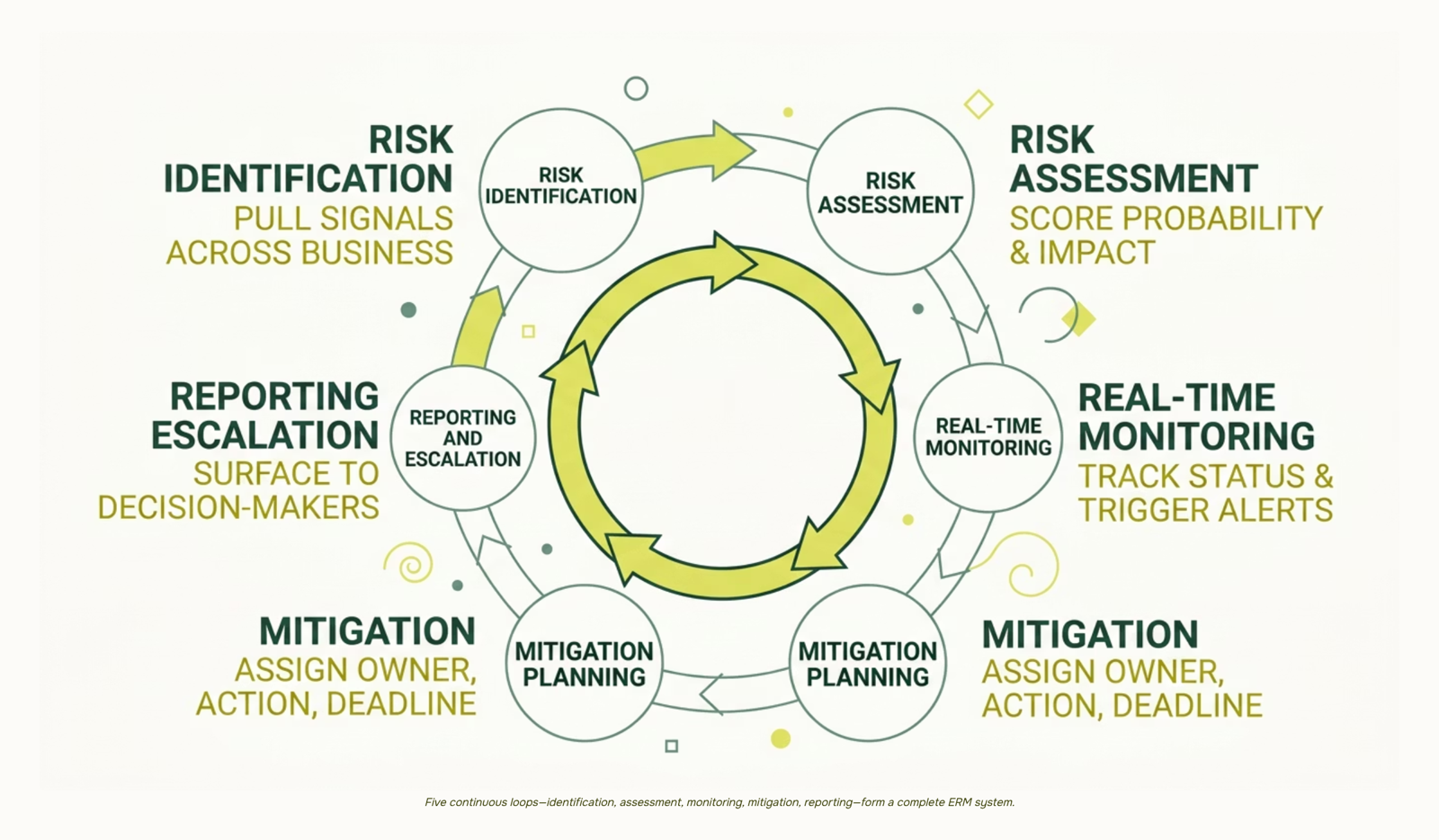
Operationally, a mature ERM solution runs four continuous loops:
Identification — pulling risk signals from across the business, not waiting for someone to file a report
Assessment — scoring each risk by probability and financial or operational impact so your team knows what to prioritize
Monitoring — tracking risk status as conditions change, with automated alerts when thresholds are crossed
Reporting and escalation — surfacing the right data to decision-makers before a risk becomes a crisis
The reason most IT companies struggle here is architecture, not intent. When risk data sits in disconnected tools, detection lags. By the time a project delivery risk surfaces in a weekly status meeting, the window to act has usually closed.
If you want context on how specific platforms handle these loops at scale, the top enterprise risk management tools for large businesses breaks that down.
The Five Core Components Every ERM Solution Must Have
Five components. If your enterprise risk management solution is missing any one of them, the system has a hole — and holes are where undetected risks live until they become incidents.
Risk identification and assessment is where everything starts. A functional ERM solution continuously surfaces risks from across your operations: project delays, vendor dependencies, compliance gaps, and yes, cyber exposure alongside operational risk types rather than in a separate silo. Without structured identification, your team only finds risks after someone trips over them. Assessment adds the scoring layer — likelihood, impact, velocity — so your team knows which risks to act on this week versus which to monitor.
Risk scoring and prioritization turns a long list into a ranked queue. Most IT companies carry dozens of active risks at any point. Without a scoring model, every risk feels equally urgent, which means nothing gets the attention it actually needs. A good scoring framework maps each risk to a business outcome: revenue impact, delivery delay, compliance exposure. That mapping is what separates a risk register from a risk management system.
Real-time risk monitoring is the component most teams skip when they're still running manual processes. A weekly risk review meeting is not monitoring — it's a retrospective. By the time the meeting happens, the signal has already aged. Automated monitoring watches for threshold breaches, schedule slippage, resource conflicts, and anomalies continuously, then triggers alerts before the situation escalates. The next section covers the mechanics of this in detail.
Risk mitigation planning closes the loop between knowing a risk exists and doing something about it. A mitigation plan assigns an owner, a response action, a deadline, and a fallback. Without that structure, risk identification produces reports that no one acts on. The risk mitigation plan is the operational artifact that turns assessment data into accountable work.
Reporting and escalation is what makes ERM visible to leadership. Risks that stay inside a project team's Slack channel don't get resourced. A reporting layer aggregates risk status across projects, flags items that have crossed escalation thresholds, and gives executives the visibility to make resourcing decisions before a risk becomes a cost. When this component is absent, leadership is always reacting — never ahead of the problem.
These five components aren't a framework checklist. They're the functional requirements your ERM solution needs to cover before you can say the system is actually managing risk rather than just recording it. If you're evaluating options, this breakdown of what ERM solutions include is a useful starting reference.
How Real-Time Monitoring Separates Reactive from Proactive Risk Management
A weekly risk review meeting tells you what already went wrong. Real-time risk monitoring tells you what's about to.
The distinction matters because most operational risk events don't arrive as sudden failures. They build. A task sits unassigned for two days. A dependency gets blocked quietly. A sprint fills past capacity while the deadline stays fixed. By the time these signals appear in a Friday status update, the window to act without cost has closed.
Effective real-time risk monitoring watches for those signals continuously, not periodically. The specific inputs a system should track include:
Deadline proximity against current task completion rate
Blocked or unassigned tasks older than a defined threshold
Workload imbalance across team members
Stalled workflows where no activity has occurred within an expected window
Dependency chains where upstream delays haven't yet propagated to downstream estimates
When any of those signals cross a threshold, the system should trigger an alert automatically, not wait for someone to pull a report. That's the core mechanism that separates enterprise risk management solutions that prevent problems from ones that document them.
Taro applies this directly inside your project workspace. It handles scanning for overdue tasks, stalled workflows, and blocked dependencies in real time, and surfaces eight alert types monitored live across deadline risk, workflow bottlenecks, and workload imbalance. You see the risk as it forms, not after it fires.
For a broader look at how monitoring fits into a full risk response, the section on building a risk mitigation plan covers what to do once an alert surfaces.
Where Cyber Threats Fit Inside an Enterprise Risk Management Solution
Cyber risk is not a separate category that lives outside your enterprise risk management solution. It is one operational risk type that runs through the same risk identification and assessment loop as a delayed vendor delivery or a compliance gap.
The mechanism is identical. You identify the threat, assess its likelihood and impact, assign ownership, and monitor for early signals. A ransomware exposure, an unpatched API endpoint, or a compromised contractor credential each gets a risk record, a severity score, and a named owner, the same way any project or operational risk does.
Where cyber threat risk management gets complicated is detection speed. A misconfigured access control can sit unnoticed for weeks inside a team that reviews risk in a monthly spreadsheet. That is why the monitoring layer matters. Taro scans for overdue tasks, stalled workflows, and blocked dependencies in real time, and its eight alert types monitored live across deadline risk, workflow bottlenecks, and workload imbalance apply equally to operational and cyber-adjacent signals, like a security review task that has gone 14 days past due.
The practical implication: your ERM solution does not need a separate cybersecurity module. It needs a monitoring loop fast enough to catch any risk type before it compounds. For IT companies building a risk mitigation plan, that single loop is the architecture worth building first.
The Business Case for Implementing an ERM Solution in an IT Company
The business case for enterprise risk management in an IT company comes down to three measurable outcomes: faster incident response, fewer project overruns, and documentation that survives an audit.
Without automated monitoring, most teams find out about operational risk events after the damage is done. A structured ERM solution changes that by running the same identification-assessment-monitoring loop across every risk type, including cyber threats, resource bottlenecks, and delivery failures, inside one system. Taro's risk engine, for example, is scanning for overdue tasks, stalled workflows, and blocked dependencies in real time, which cuts the gap between a risk appearing and a team lead knowing about it.
Project overruns are the most visible cost. Building a risk mitigation plan before a sprint starts, rather than reacting mid-delivery, keeps scope and budget predictable. Audit readiness is the less obvious win: when risk events are logged, timestamped, and tied to mitigation actions automatically, compliance reviews take hours instead of days.
For IT company owners evaluating where to start, the most effective risk management solutions for IT businesses share one trait: they treat enterprise risk management for IT companies as an operational discipline, not a compliance checkbox. That framing is what separates teams that prevent problems from teams that document them after the fact.
How to Choose the Right Enterprise Risk Management Solution for Your Business
Four criteria separate an enterprise risk management solution that earns its license fee from one that collects dust.
Coverage across all five risk types: Your solution needs to handle operational, financial, compliance, strategic, and cyber risk in one place — not four of the five with cyber bolted on as an afterthought. If the tool treats cyber as a separate module, you'll end up managing two dashboards and missing the cross-type correlations that matter most.
Integration with your existing project and workflow stack: A risk platform that can't read your live project data is just a logging tool. Before shortlisting any vendor, map your current stack and confirm the integration is bidirectional — not a one-way export. If you're building a risk mitigation plan inside the same system where work actually runs, response time drops significantly.
Alert granularity: Generic "high risk" flags don't tell your team what to do. Look for eight alert types monitored live across deadline risk, workflow bottlenecks, and workload imbalance — that level of specificity is what turns an alert into an action. Taro's risk alerts dashboard operates at this granularity, scanning for overdue tasks, stalled workflows, and blocked dependencies in real time so your team sees the problem before it becomes a missed deadline.
Reporting depth for audit readiness: Dashboards are for your team. Reports are for your clients, auditors, and board. Confirm the solution exports structured documentation that maps directly to whatever compliance framework your contracts require.
For a broader view of how these criteria apply in practice, the most effective risk management solutions for IT businesses breaks down how mid-market IT companies are applying each one.
Closing
Enterprise risk management solutions work because they connect five functional pieces: identification, assessment, scoring, monitoring, and escalation. Without all five, you're still managing risk reactively—waiting for problems to surface in meetings instead of catching them as they form. If your IT team already tracks work in a project management tool, you're closer to a working ERM setup than you think. Taro's built-in risk prediction and live alert dashboard handle the real-time monitoring and escalation components without requiring a separate platform, so your team sees deadline risk, blocked dependencies, and workload imbalance the moment they emerge. Start by auditing which of the five components you have today—and which one is costing you the most when it fails.
FAQ
What are the key components of enterprise risk management solutions?
Risk identification and assessment, risk scoring and prioritization, real-time monitoring, risk mitigation planning, and reporting and escalation. All five must work together; missing any one creates a gap where undetected risks live.
How can enterprise risk management solutions help mitigate cyber threats?
Cyber threats follow the same identification, assessment, and monitoring loop as operational risks. Real-time monitoring detects signals like unpatched endpoints or misconfigured access controls before they become breaches, then routes alerts to the right owner for action.
What are the benefits of implementing enterprise risk management solutions?
You catch risks before they escalate, prioritize by actual impact instead of noise, give leadership visibility to make resourcing decisions early, and reduce the cost of reactive firefighting by moving to proactive detection.
Which enterprise risk management solutions are suitable for financial institutions?
Financial institutions need solutions with strong compliance reporting, real-time monitoring, and audit trails. The top enterprise risk management tools for large businesses breaks down platform-specific compliance capabilities.
How do I choose the right enterprise risk management solution for my business?
Audit which of the five core components you have today, then evaluate solutions on real-time monitoring speed, scoring transparency, and how easily risks route to the people who own them. Avoid tools that only log—you need continuous detection and escalation.
What is the difference between enterprise risk management and project risk management?
Project risk management focuses on delivery threats within a single project. Enterprise risk management connects risks across projects, vendors, compliance, and cyber into one system so leadership sees enterprise-level exposure and can allocate resources strategically.


 Elena Petrova15 September 2026


