TL;DR: Most project management content hands you a checklist of health metrics and leaves you to figure out what they actually mean. This one maps each success signal to the specific failure mode it prevents, so you can diagnose problems before they compound. IT company owners get a practical lens for reading project health at any stage.
Why most projects fail before anyone notices
Upward trending arrow and progress indicators symbolizing project success metrics and growth indicators
Most projects don't fail at delivery. They fail in week two, when scope starts drifting and nobody has a name for what's happening yet.
According to PMI's research, a significant share of IT projects run over budget or miss deadlines, and the warning signs are almost always present before the midpoint. The problem isn't that teams can't see them. It's that they have no system for reading them consistently.
A missed status update gets absorbed. A delayed approval gets manually chased. An unclear owner gets quietly ignored. Each event looks like a one-off. Together, they're a pattern that predicts failure weeks before the retrospective confirms it.
This matters especially for IT company owners managing client-facing work, where final sign-off and contract closure often surfaces problems that were visible much earlier in the task log. By then, the cost is already paid.
The sections below give you a concrete set of observable signals, each tied to the specific failure mode it prevents. Read them as a diagnostic, not a checklist. The goal is to spot the pattern early enough to act on it.
Signs that assure a project is on track
The clearest assure sign a project is healthy isn't a green status dot on a dashboard. It's a pattern of observable, repeatable signals that show work is moving, decisions are landing, and risks are surfacing before they become problems.
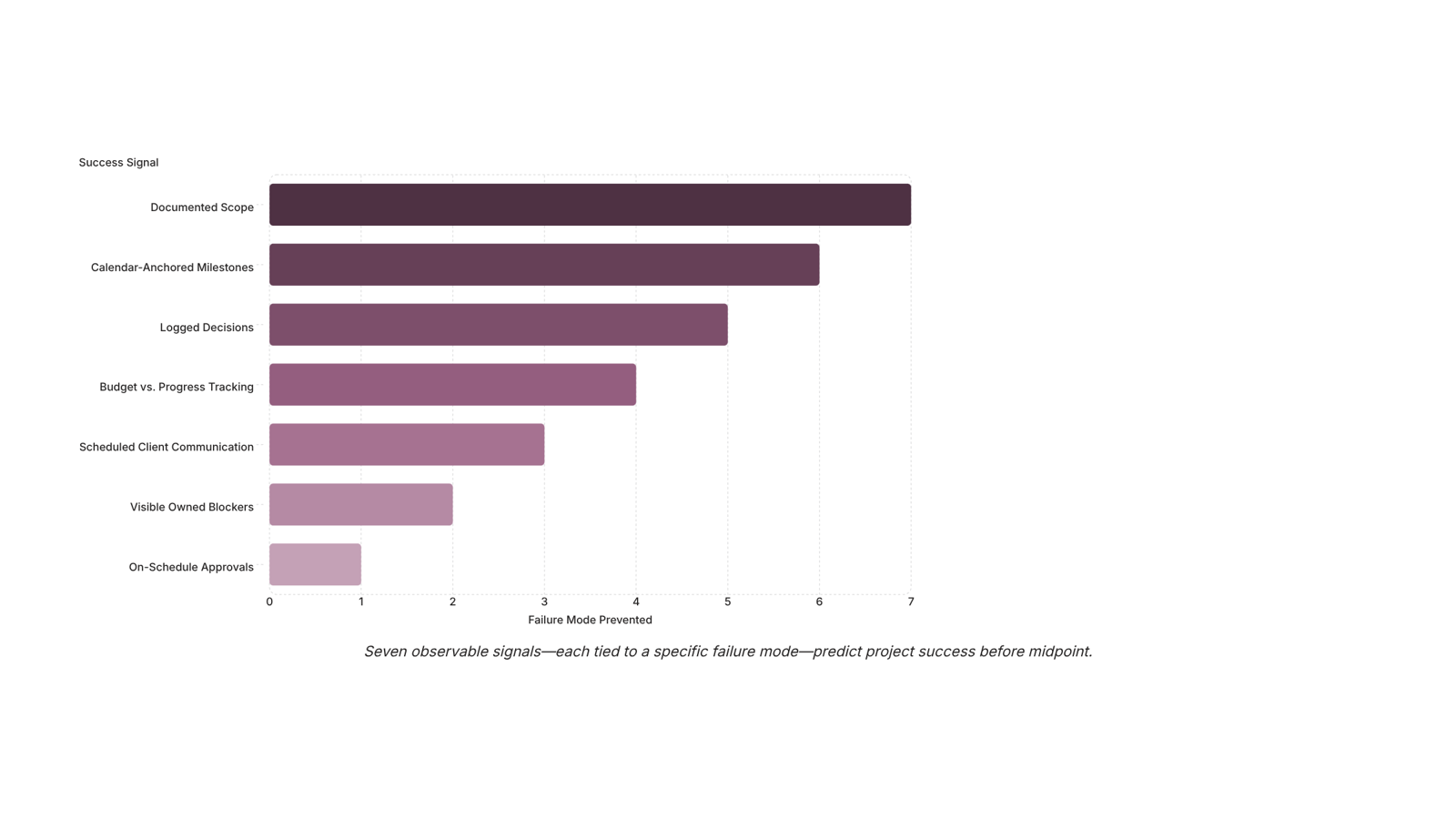
Here are the signals that matter, each paired with the failure mode it prevents.
Scope is documented and agreed upon in writing: When every stakeholder has signed off on the deliverables list before work starts, scope creep has nowhere to hide. The failure mode this prevents: mid-project "but I assumed we'd also get X" conversations that push timelines by weeks.
Milestones are tied to dates, not effort estimates: "We're 80% done" is not a milestone. A signed client approval by Friday is. Projects that track calendar-anchored checkpoints catch slippage early. Those that track effort percentages often discover they're two weeks late only when the deadline arrives.
Decisions are logged, not just made: When a team lead changes a technical approach in a standup, that change needs a record: who decided, when, and why. Teams without a decision log spend hours in retrospectives arguing about what was agreed. According to PMI research, poor requirements and change management are among the top drivers of project failure — and undocumented decisions are a direct contributor.
Budget consumption tracks against actual progress: Spending 60% of the budget at the 40% completion mark is a warning, not a coincidence. IT project owners who review cost-to-completion weekly, not monthly, catch this pattern in time to act.
Client communication has a cadence, not just a trigger: Reactive updates (only when something goes wrong) train clients to assume silence means trouble. A weekly status note, even a short one, is a signs-of-achievement-in-goals signal that keeps trust intact and reduces the volume of "just checking in" emails.
Blockers are visible and owned: A blocker that sits in a chat thread for three days is a blocker that will kill your timeline. Healthy projects surface blockers in a shared tracker with a named owner and a resolution date. The failure mode this prevents: cascading delays that only become visible at the final review.
Approvals and sign-offs happen on schedule: Late approvals are the most common silent killer of IT project timelines. Building a structured process around automating the approval and sign-off stage removes the manual follow-up loop that stalls delivery. For teams managing final sign-off and contract closure, this is where projects either close cleanly or drag on for weeks.
Seven signals. Each one observable today, without a new tool or a process overhaul.
Signs of productivity that confirm your team is moving
Busy teams and productive teams look identical from a distance. The difference shows up in the output, not the activity.
The clearest signs of productivity in a team aren't hours logged or messages sent. They're closed tasks with verified outputs, decisions that stick, and blockers that surface within hours rather than days. On a healthy project, a task marked complete means the deliverable exists and the next dependency can start. On an unhealthy one, "complete" means someone stopped working on it.
Here's what genuinely productive output looks like at the task level:
Acceptance criteria are met before status changes, not after a review cycle catches gaps
Blockers are raised in the same day they appear, not buried in a status call three days later
Handoffs happen without a follow-up request, because the next owner already has what they need
Scope changes are logged against the original baseline, so drift is visible before it compounds
The distinction matters because activity without output is the most common early-warning sign that a project is quietly slipping. A team generating long threads, frequent check-ins, and high meeting volume while task completion slows is showing you a coordination problem, not a productivity signal.
Signs of progress in tasks are more reliable than subjective team sentiment. If your task board shows consistent daily movement, dependencies clearing in sequence, and no task sitting in "in progress" for more than two working days without a status note, the project is moving. If tasks cluster in one stage for days, that's where the bottleneck is.
For teams managing this across multiple client projects, pairing task data with time data sharpens the picture further. Time mapping shows where hours are actually going, not where the schedule assumed they would.
Signs of effective time management at the task level
Task-level time data is one of the clearest signs of effective time management on any project. When individual tasks are consistently completed within their estimated windows, that pattern compounds into on-time delivery. When they're not, the gap between estimate and actual is your earliest warning signal.
Three specific signals tell you a project is tracking well at this level:
Estimated vs. actual time per task stays within roughly 20% variance across the team
Tasks move to "done" before their due date, not on it or after it
No single team member is absorbing a disproportionate share of overdue work
The inverse signals matter just as much. If a task estimated at two hours routinely takes five, the schedule is built on fiction. Most project managers don't catch this until a milestone slips, which is too late to course-correct without cost or client friction.
Effective time management techniques help at the individual level, but the project-level view requires aggregating that data across every task, every sprint, every team member. That aggregation is where most IT owners lose visibility. They're reading status update emails instead of watching the actual numbers move.
Visible signs of progress in tasks — completion rate trends, time-to-done averages, and overdue task counts — give you a diagnostic picture before a deadline becomes a crisis. The goal is to see the drift while you still have room to fix it.
How to track these signals without adding overhead
Most tracking systems add work. A daily standup, a status email, a spreadsheet update — each one pulls attention away from the project itself. PMI research shows that project managers spend roughly a third of their time on status reporting rather than actual project work. That number climbs when signals are scattered across tools.
The fix is not more meetings. It is surfacing signs of progress in tasks and signs of achievement in goals from work that is already happening.
Taro does this at the task level. Its issue and bug tracking system captures blockers, completion rates, and ownership gaps as they occur, not after a weekly sync. When a task stalls past its expected window, Taro flags it before the delay compounds. When a milestone closes cleanly, that signal is visible to the whole team without anyone writing a report.
For IT company owners managing client-facing projects, this matters more than it does for internal work. Clients notice slippage before you do. A two-day delay in one sprint can shift the delivery date by a week once dependencies stack up.
The practical setup is straightforward:
Map your project's five or six critical signals to Taro's tracking fields at kickoff, not mid-project.
Set threshold alerts for task age, open blockers, and milestone completion rate.
Review the dashboard once per day, not once per hour.
That last step handles the final sign-off and contract closure stage too, since you can see exactly which deliverables are cleared before moving to automating the approval and sign-off stage.
Closing
The signals are there. Documented scope, calendar-anchored milestones, logged decisions, visible blockers, and on-time approvals. The real problem isn't spotting them—it's monitoring them consistently without turning project management into a full-time job. Once you know what to watch for, the next step is automating the watch itself. Taro surfaces these signals automatically as work moves through your system, so you're reading project health from the task data itself, not from status emails. Start by asking: which of these seven signals are you checking manually today, and which ones are you missing because nobody has time to track them?
FAQ
What are the signs that assure a project's success?
Documented scope, calendar-anchored milestones, logged decisions, budget tracking against actual progress, consistent client communication, visible blockers with owners, and on-schedule approvals. Each prevents a specific failure mode before it compounds.
How can I assure a sign of productivity in my team?
Watch for closed tasks with verified outputs, blockers surfaced within hours, handoffs without follow-up requests, and consistent daily task movement. Activity without output is a coordination problem, not productivity.
How do I assure a sign of progress in my tasks?
Track completion rate trends, watch for tasks moving daily, and flag any task sitting in 'in progress' longer than two working days without a status note. Clustering in one stage reveals your bottleneck.
What are the key signs that assure effective time management?
Estimated vs. actual time stays within roughly 20% variance, tasks complete before due dates, and no single team member absorbs disproportionate overdue work. A 20% gap signals schedule fiction.
How can I assure a sign of achievement in my goals?
Tie milestones to calendar dates and client sign-offs, not effort percentages. Track whether each checkpoint lands on schedule and whether approvals happen without manual chasing. On-time approvals are the strongest signal of goal achievement.


 Elena Petrova15 September 2026


