TL;DR: Most articles on product strategy frameworks hand you a definition and a diagram. This one shows IT company owners how to pick the right framework for their current stage, apply it to real products, and connect it to daily execution so it drives decisions rather than decorating a slide deck. You'll leave with a clear selection process and a working model you can use this week.
What a product strategy framework actually is
A product strategy framework is the documented logic that connects your business goals to the specific product decisions you make every day. It answers three questions: where are we going, why does that direction matter, and how will we know we are making progress.
That is different from a product vision, which describes a future state without prescribing how to get there. It is also different from a roadmap, which sequences the work once the direction is set. You turn your strategy into a product development roadmap after the framework is in place, not before. The backlog sits further downstream still: it holds the individual tasks that execute on roadmap items.
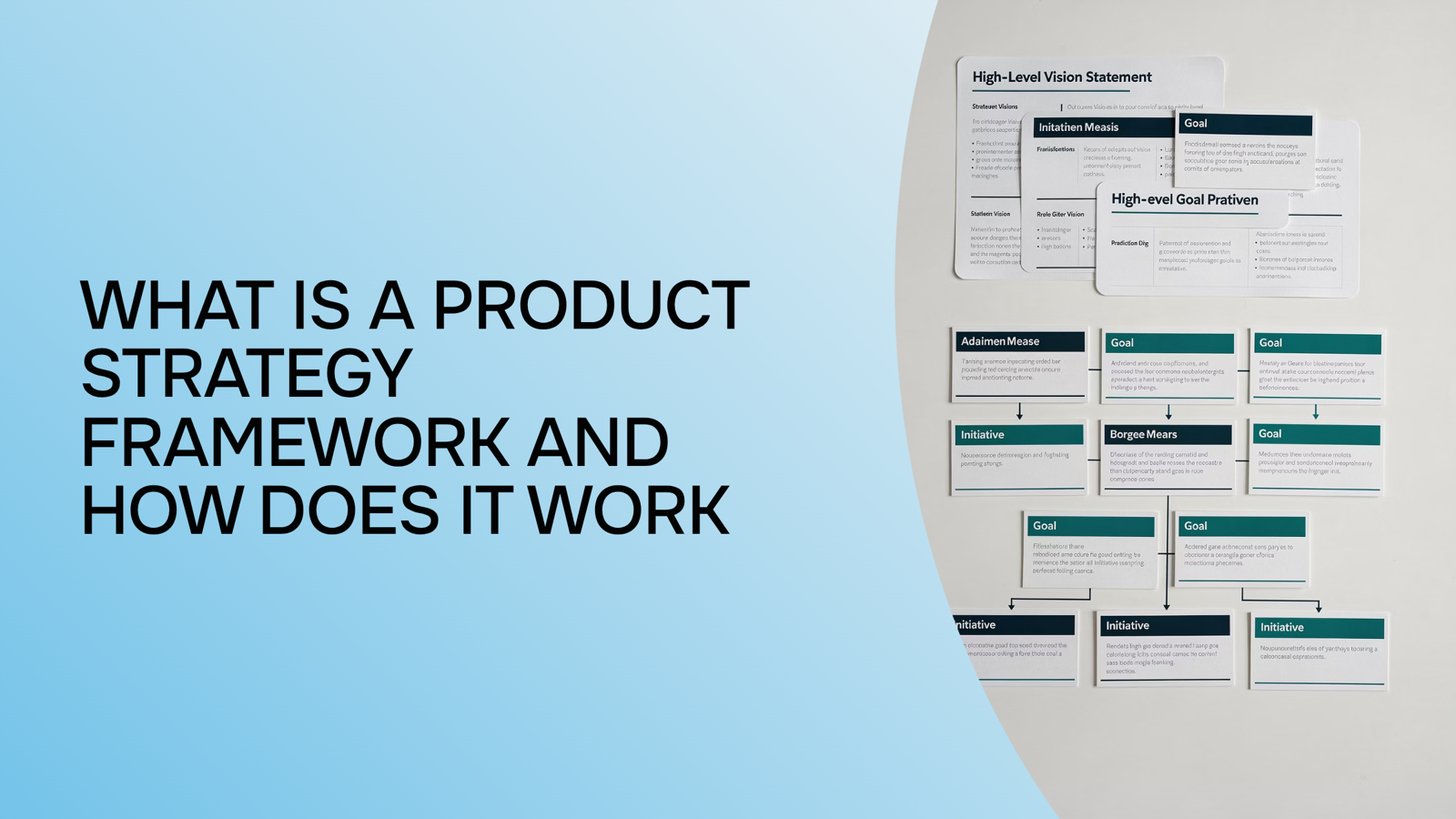
Think of it as a hierarchy. Product vision and goals sit at the top. The framework translates those goals into criteria. Those criteria let you prioritize which initiatives make it into your roadmap, and you document each initiative with a product requirements template before you move strategy into your sprint and product backlog.
Without that hierarchy, teams make locally reasonable decisions that collectively pull in different directions. The framework is what keeps them aligned.
Why your team needs a framework before building anything
Building without a framework is how teams end up three sprints deep into a feature no one asked for.
A product strategy framework forces three decisions before a single line of code gets written: what you're building, who it's for, and why it beats the alternatives on your backlog. Those decisions directly compress prioritization time. Without them, every sprint planning meeting restarts the same argument about what matters most.
The alignment problem is real. Research consistently shows that product roadmaps drift from business goals when there's no shared strategic layer connecting the two. For IT company owners, that drift shows up as sales promising capabilities engineering hasn't scoped, or engineering shipping features sales can't explain to prospects.
A product prioritization framework fixes this by giving sales, product, and engineering a single source of truth. When a customer request comes in, the framework answers whether it fits the strategy, not whether it sounds interesting.
Knowing how to build a product strategy also changes how you staff sprints. Teams with a clear framework spend less time in rework because the "should we build this?" question gets answered once, upstream, not repeatedly mid-build.
The framework doesn't replace your roadmap. It's the logic your roadmap runs on.
Key components every product strategy framework includes
Every product strategy framework, regardless of which one your team adopts, is built from four components. Miss one and the framework stops working.
Product vision is the starting point. It answers where the product is going in the next two to three years, written in terms your sales team and engineering lead can both repeat without a slide deck. Vague vision statements produce misaligned roadmaps.
Target customer is the second component, and it needs more precision than a persona card. You want a specific job title, company size, and the exact problem they're paying to solve. Without that specificity, your product vision and goals drift in opposite directions every sprint.
Goals translate the vision into measurable outcomes for a defined period, typically a quarter or a fiscal year. These are the numbers your team is accountable to, not aspirations.
Prioritized initiatives are the bets you're making to hit those goals. This is where most IT teams stall: every idea looks equally urgent until you prioritize which initiatives make it into your roadmap against a fixed set of criteria.
Once you have all four, you can turn your strategy into a product development roadmap and document each initiative with a product requirements template before anything moves to a sprint.
How to choose the right framework for your business
The right product strategy framework depends on three variables: how well you know your customers, how mature your product is, and how fast your team needs to move.
Framework | Best team size | Product maturity | Customer clarity | Iteration speed |
|---|
Jobs-to-be-Done | 5–30 | Early or rebuilding | Low | Slow to medium |
OKR-driven strategy | 20+ | Growth or scaling | Medium to high | Fast |
Kano model | Any | Mid to mature | High | Medium |
Jobs-to-be-Done fits IT companies that are still figuring out what problem they actually solve. It forces customer interviews before any prioritization happens, which slows early sprints but reduces rework later.
OKR-driven product strategy works once you have a customer base and need alignment across engineering, sales, and delivery. If your team is debating which features to ship next quarter, OKRs give everyone a shared scorecard. You can prioritize which initiatives make it into your roadmap using the same OKR hierarchy.
Kano model is the right call when you already have paying customers and need to separate table-stakes features from genuine differentiators. It answers "what do customers expect versus what will actually delight them," which matters more for product-led growth than for early-stage discovery.
One practical note: most IT companies at the 10–50 person stage benefit from starting with Jobs-to-be-Done to sharpen customer clarity, then layering OKRs once the direction is set. Once your initiatives are defined, document each one with a product requirements template before moving to execution.
Build your product strategy framework in 6 steps
Six steps is enough to go from blank page to a strategy your team can actually ship against. Work through them in order the first time; once you know the pattern, you can revisit any single step when conditions change.
1. Write a one-sentence product vision: Constrain it: one sentence, one audience, one outcome. "Help IT company owners close client projects faster by automating the handoff between delivery and billing" is a product vision. "Build great software" is not. If your team can't recite it unprompted, it's too long or too vague.
2. Identify the one or two problems worth solving: Talk to five to ten customers before you write anything down. You're listening for the gap between what they're doing today and what they wish they could do. A useful signal: if three separate customers describe the same workaround, that workaround is your problem statement. Document each one using a product requirements template so nothing gets lost between discovery and planning.
3. Set two or three measurable goals: Tie each goal to a business outcome, not a feature. "Reduce time-to-invoice by 30% within two quarters" is a goal. "Add an invoicing module" is a feature request. Goals anchor every prioritization decision that follows and give you a clear test for whether the strategy is working.
4. Choose your initiatives and prioritize ruthlessly: List every initiative that could move your goals. Then cut. A practical filter: does this initiative address a problem your customers named, and can your team ship it in the next two quarters? Use a structured method to prioritize which initiatives make it into your roadmap rather than defaulting to whoever lobbied loudest in the last planning meeting.
5. Turn the strategy into a roadmap: A product strategy framework without a roadmap stays theoretical. Map your prioritized initiatives to quarters, assign owners, and flag dependencies. If you're building this for the first time, turn your strategy into a product development roadmap before your next sprint planning session. The roadmap is the artifact your team executes against; the strategy is the reasoning behind it.
6. Validate with real customer data, then adjust: Ship something small, measure it against your goals, and update the strategy accordingly. This is where most teams stall: they treat the strategy as fixed once written. A working product strategy components review should happen at least once per quarter. If a goal moves, the roadmap moves with it.
To connect strategy to daily execution, move your initiatives into your sprint and product backlog so the team always knows which sprint work ties back to which strategic goal.
Apply the framework to an existing product, not just new ones
Most teams assume a product strategy framework is a launch tool. It isn't. Applying it to an existing product requires two steps that differ from a greenfield build.
Audit before you plan: Map what your current product actually does against your stated vision. Where features exist without a clear goal, cut or freeze them. Where customer problems are unaddressed, those gaps become your next roadmap inputs.
Reset your position, not your product: You're not starting over. You're asking: does the market we built for still match the market we're in? If your ICP has shifted, your product roadmap framework needs to reflect that before you prioritize which initiatives make it into your roadmap.
A practical example: an IT company running a five-year-old service platform might find 30% of its features serve fewer than 5% of active users. That audit alone resets the strategy.
Common mistakes that make a product strategy fail
Four execution errors show up repeatedly once the framework is built.
Strategy drift happens when quarterly priorities quietly diverge from the original strategic bets. No single decision causes it — just enough small pivots that your product roadmap framework no longer maps to your goals.
Ignoring lead signals is the faster killer. If your product prioritization framework ranks features by gut feel rather than validated demand, you're shipping what feels right, not what the market confirmed.
Skipping validation before a build is common in IT companies under delivery pressure. A two-week discovery sprint catches more than six months of rework after launch.
The fourth mistake is treating the framework as static. A product strategy framework needs a scheduled review — most teams find quarterly works — because markets shift and a document that isn't updated becomes noise. AI-assisted decision tooling can flag when signals suggest a review is overdue.
Closing
A product strategy framework isn't a planning document that sits in a folder—it's the operating system that keeps your team's daily decisions aligned with where you're actually trying to go. When vision, target customer, goals, and prioritized initiatives are wired together, you stop debating what to build and start executing what matters. The real test isn't whether your framework looks good on a slide; it's whether sales, product, and engineering can all answer "does this fit our strategy?" the same way.
Start by identifying which framework matches your current stage: Jobs-to-be-Done if customer clarity is your gap, OKRs if you need cross-team alignment, or the Kano model if you're separating table-stakes from differentiators. But here's what most teams miss—a framework only stays grounded in reality if you're continuously feeding it the signals that matter. That's where Lio comes in: it captures the lead qualification and customer intent signals that fuel Step 4 of the framework, so your strategy is built on market demand, not internal assumptions. Ready to see how this works in practice? Explore the product development roadmap guide next.
FAQ
What are the key components of a product strategy framework?
Product vision, target customer, goals, and prioritized initiatives. Miss one and the framework stops working—each component feeds the next, from vision through execution.
How can a product strategy framework help me develop a successful product?
It forces three decisions before coding starts: what you're building, who it's for, and why it beats alternatives. This compresses prioritization time and prevents teams from shipping features no one asked for.
Can a product strategy framework be applied to existing products or only new ones?
It works for both. Mature products benefit most from the Kano model to separate table-stakes features from differentiators; early-stage products often start with Jobs-to-be-Done to sharpen customer clarity.
How do I choose the right product strategy framework for my business?
Pick based on three variables: how well you know your customers, how mature your product is, and how fast your team needs to move. Jobs-to-be-Done suits early discovery; OKRs suit scaling teams; Kano suits mature products.
How often should I update my product strategy framework?
Revisit quarterly when conditions change—new customer feedback, market shifts, or missed goals. The framework itself stays stable; individual components adapt based on signals.


 Elena Petrova15 September 2026


