TL;DR: Most sales prospecting guides give you a channel list and leave the system-building to you. This one gives IT company owners a seven-step workflow that connects finding, qualifying, and following up with B2B leads, with specific triggers and criteria at each stage. You'll leave with a process you can run this week, not a tactics menu.
What sales prospecting actually means
Sales prospecting is the act of identifying and contacting specific individuals who fit your target profile and have a realistic chance of buying. It is not the same as lead generation. Lead generation pulls potential buyers toward you through content, ads, or referrals. Prospecting is what your team does next: research a company, confirm it matches your criteria, find the right contact, and initiate an outreach sequence.
In a B2B IT context, that distinction matters. B2B lead generation fills the top of your funnel with names. B2B sales prospecting turns those names into qualified conversations worth a salesperson's time.
The output of prospecting is not a meeting. It is a qualified opportunity: a contact who has a problem you solve, the authority to act on it, and a reason to talk now. Everything before that point is research and outreach. Everything after it is selling.
If your team skips the qualification step, you fill the calendar with the wrong conversations. The next section covers exactly where that breakdown happens on lean IT sales teams.
Why prospecting breaks down for IT sales teams
Most IT sales teams don't lose deals at the close. They lose them earlier, during prospecting, because a few structural problems compound quietly until the pipeline dries up.
Slow follow-up is the most common one. A prospect downloads a whitepaper or replies to a cold email, and a rep gets to them two or three days later. By then, the window has closed. Research from RAIN Group suggests it takes an average of eight touches to book a B2B meeting, which means every delayed first response makes the remaining touches harder to land.
No qualification criteria is the second. Without a defined ICP, reps chase anyone who looks vaguely interested. That wastes hours on accounts that will never buy.
Manual data entry is the third. When reps spend 30 to 45 minutes per prospect logging notes, researching firmographics, and updating CRM fields by hand, they prospect less. It's arithmetic, not a motivation problem.
The fourth is fragmented sales prospecting methods across the team. One rep uses LinkedIn, another works referrals, nobody shares what's working. No consistent best practices in sales prospecting means no compounding improvement.
For a fuller look at where tooling fits, the best prospecting tools for sales teams covers the stack worth evaluating.
How to find new B2B sales prospects online
Four channels do most of the work for IT company owners running lean sales teams.
LinkedIn Sales Navigator lets you filter by company size, tech stack, and recent hiring signals — so you're reaching CTOs and IT directors who are actively building, not just browsing. Pair it with a sales prospecting tool that automates connection tracking and you cut manual logging time significantly.
Intent data platforms (Bombora, G2 Buyer Intent) surface companies actively researching solutions like yours. For IT services, a prospect researching "managed security" or "cloud migration" this week is worth ten cold names from a static list.
Referral networks convert faster than any outbound channel. A warm introduction from a current client in the same vertical typically skips two to three qualification steps because trust transfers. Build a short referral ask into every successful project close.
ICP-matched directories — G2, Clutch, and Capterra for IT vendors — let you find companies already evaluating your category. Cross-reference those profiles against your qualified sales lead criteria before you reach out.
The channel matters less than the match. Each of these works because it narrows the universe to buyers with a real problem right now, which is the core discipline behind effective B2B sales prospecting. Pick one channel, work it for 30 days, then layer in a second.
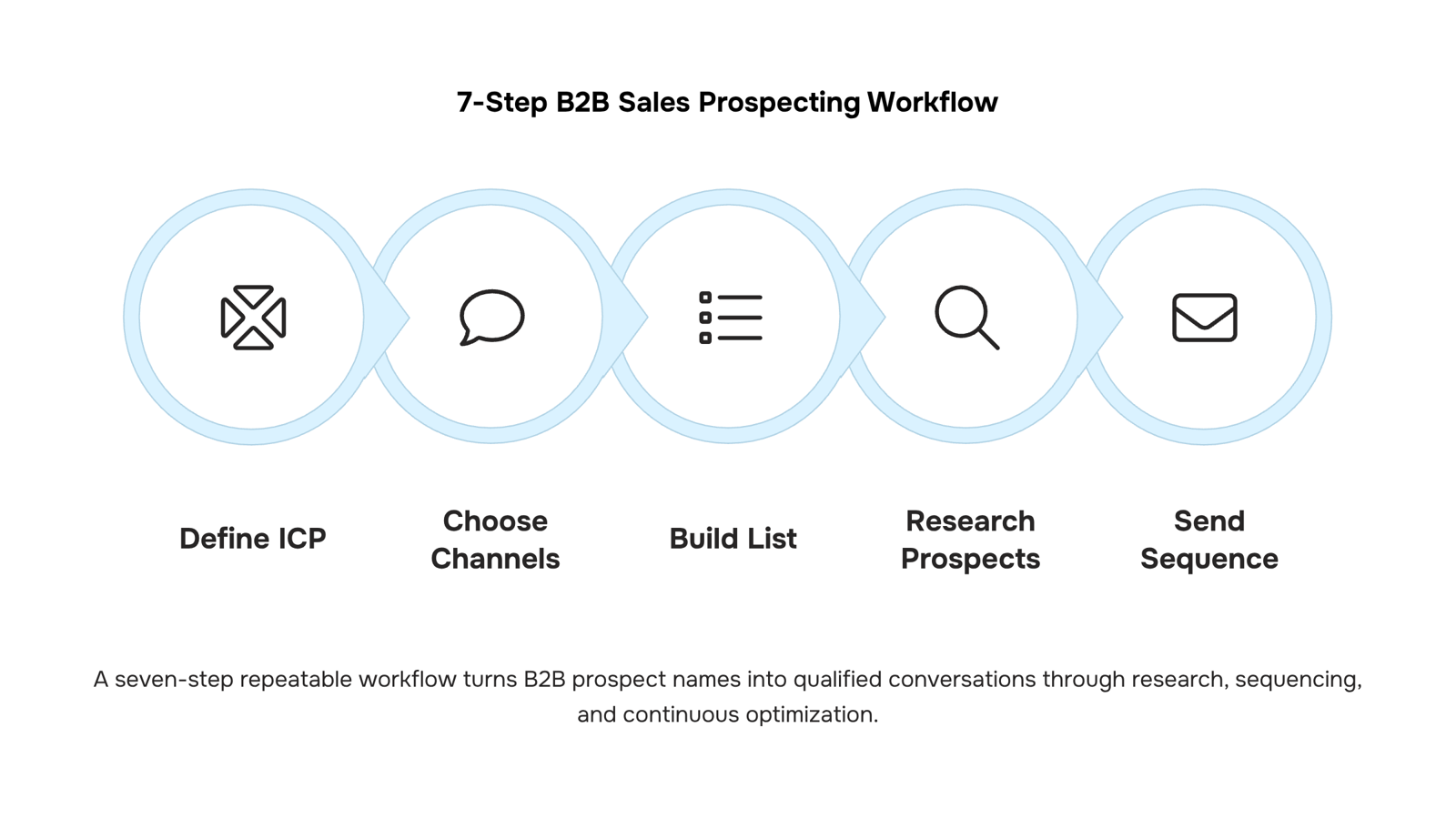
The 7 steps to a repeatable sales prospecting process
A repeatable b2b sales prospecting process removes the guesswork from your pipeline. Instead of chasing whoever replied last, you work a defined sequence that produces consistent results for a lean IT team.
Define your ICP before you touch a list: Write down the firmographic and technographic profile of your best-fit customer: company size, tech stack, budget signals, and the role that signs the contract. Everything downstream depends on this. An IT services firm targeting mid-market companies, for example, should filter by companies running legacy ERP systems, not just "technology companies."
Choose two or three channels and commit: LinkedIn Sales Navigator, intent data platforms, and ICP-matched directories like G2 or Clutch are the highest-signal sources for IT buyers. Spreading across six channels produces shallow coverage on all of them. Pick the ones your buyers actually use and build a rhythm there.
Build a prospect list with a daily cap: Set a fixed number of new prospects to add each day, 10 to 20 is realistic for a solo founder or small team. Use sales prospecting software to automate the enrichment step so you spend time on outreach, not data entry.
Research each prospect before the first touch: Check their LinkedIn activity, recent company news, and any intent signals your tools surface. A one-line reference to a prospect's recent product launch or hiring push converts a cold message into a relevant one. This step takes two minutes per prospect and meaningfully improves reply rates.
Send a sequenced, multi-touch outreach: Research from RAIN Group shows it takes an average of eight touches to book a B2B sales meeting. Build a sequence of at least six to eight touches across email and LinkedIn, spaced three to five days apart. Vary the medium and the angle with each touch rather than repeating the same ask.
Use AI for sales prospecting to handle the repetitive middle: AI tools can score inbound leads, flag prospects showing buying signals, and draft personalized first-line copy at scale. For a lean IT team, this is the layer that makes a 10-person operation feel like a 30-person one. Treat AI as a workflow layer that handles volume so your reps handle judgment calls.
Track, measure, and adjust weekly: Log reply rate, meeting-booked rate, and pipeline value by channel. If one channel produces meetings at half the cost of another, shift time toward it. Review the numbers every Friday and make one adjustment, not ten. Consistent small corrections compound faster than periodic overhauls.
Once this sequence is running, the next question is which prospects in your list are actually worth pursuing. A structured qualification checklist, covering fit, intent, authority, and timing, helps you identify a qualified sales lead before you invest more outreach time on the wrong ones.
How to qualify a sales prospect before you pitch
Pitching before you qualify is the fastest way to waste a sales cycle. Use four criteria to decide whether a prospect deserves your time.
Fit: Does the company match your ICP on firmographics: industry, headcount, tech stack? For an IT services firm, that might mean 50–500 employees running hybrid infrastructure with no in-house security team.
Intent: Has the prospect shown buying signals? Job postings for roles you'd replace, recent funding, or content downloads from your site all indicate active need. Without intent signals, you're interrupting rather than responding.
Authority: Are you talking to someone who can approve the budget? In B2B sales prospecting, reaching the right title early saves weeks of re-routing. If your contact needs three sign-offs above them, map those stakeholders before you pitch.
Timing: Does their renewal cycle, fiscal year, or current pain align with your sales window? A well-qualified prospect at the wrong moment is a future pipeline entry, not a current one.
Run every prospect through all four before you book a discovery call. If two or more criteria fail, either nurture or disqualify. Applying these best practices in sales prospecting keeps your pipeline honest rather than inflated.
For a deeper look at how these criteria map to your ICP, build a qualification framework around your ICP.
Can AI help with sales prospecting?
AI handles three specific tasks in a sales prospecting workflow, and understanding which three matters more than knowing AI exists.
Scoring ranks inbound leads against your ICP criteria automatically, so your team stops debating whether a lead is worth calling. Enrichment pulls firmographic data (company size, tech stack, recent funding) from sources like Clearbit or Apollo without a rep spending 20 minutes on LinkedIn. Assignment routes qualified leads to the right rep based on territory, deal size, or vertical, the moment they hit a score threshold.
Good sales prospecting software handles all three without manual handoffs. That's where AI earns its place in ai for sales prospecting: removing the repetitive layer so reps focus on conversations.
Human judgment still owns two things: reading buying signals that don't fit a clean pattern, and deciding when a technically qualified lead isn't actually a fit. No scoring model catches a prospect who's evaluating you to benchmark a renewal with a competitor.
For the qualification criteria that feed those scoring models, build a qualification framework around your ICP before configuring any tool.
Common prospecting mistakes that stall your pipeline
Skipping an ICP definition is the most common entry point for stalled pipelines. Without one, your team contacts everyone and qualifies no one, which burns hours on leads that were never going to close.
One-touch outreach is the next culprit. Research from RAIN Group suggests it takes 8 or more touches to book a B2B meeting, yet most IT sales reps stop after two or three.
Skipping qualification early wastes your closers' time on prospects who lack budget or authority. Build a two-question filter into every first call: confirmed budget range, confirmed decision-maker on the line.
No assigned owner per lead means follow-up falls through the gaps entirely. Pair this with solid CRM best practices for sales teams and ownership becomes automatic, not a conversation you have every Monday.
These are the best practices in sales prospecting that most sales prospecting methods documentation skips entirely.
Closing
Sales prospecting works when you treat it as a system, not a series of one-off outreach attempts. Define your ICP, pick your channels, research before you touch a prospect, and measure what converts. The framework above gives you the sequence. The real leverage comes in steps 5 and 6, where qualification and assignment happen, but most IT sales teams stall there because manual tracking and lead routing eat up the time that should go to actual selling. Lio handles both automatically, scoring inbound leads and routing qualified prospects to the right rep without a spreadsheet. If your team is still logging prospect data by hand or debating who should follow up next, a short demo or free trial will show you what it looks like when that layer runs in the background. What's one prospecting channel your team is already working that you could measure this week?
FAQ
What is sales prospecting in B2B?
Sales prospecting is identifying and contacting specific individuals who fit your target profile and have a realistic chance of buying. It's the research and outreach work that turns lead generation names into qualified opportunities worth a salesperson's time.
What are the most effective sales prospecting techniques?
LinkedIn Sales Navigator, intent data platforms, referral networks, and ICP-matched directories like G2 or Clutch produce the highest-signal prospects for IT buyers. Pair channel selection with research before the first touch and multi-touch sequences spaced three to five days apart.
How can I find new sales prospects online?
Use LinkedIn Sales Navigator to filter by company size and hiring signals, intent data platforms to surface active researchers, referral networks for warm introductions, and ICP-matched directories to find companies already evaluating your category. Pick one channel, work it for 30 days, then layer in a second.
What is the best way to prospect for B2B sales leads?
Define your ICP first, choose two to three channels, build a prospect list with a daily cap, research each prospect before outreach, send a sequenced six to eight-touch sequence, use AI to handle scoring and routing, and track reply rate and meeting-booked rate by channel weekly.
How many touches does it take to convert a B2B prospect?
Research from RAIN Group shows it takes an average of eight touches to book a B2B meeting. Build sequences of at least six to eight touches across email and LinkedIn, spaced three to five days apart, varying the medium and angle with each touch.


 Elena Petrova15 September 2026


