TL;DR: Most sales prospecting tool articles rank by feature count or G2 score. This one gives IT company owners a decision framework tied to pipeline stage: where leads are actually slipping, what capability closes that gap, and how to avoid buying a third tool that does what your CRM already does. You'll leave with criteria you can apply to your current stack today.
A sales prospecting tool identifies, qualifies, and prioritizes potential buyers before they ever enter your CRM. That distinction matters. Your CRM manages relationships that already exist. Marketing automation nurtures contacts already in your funnel. A prospecting tool works upstream of both, finding signals that indicate buying intent and surfacing the right contacts at the right moment.
The problem it solves is not a data problem. It is a response-speed and qualification problem. Research consistently shows that leads contacted within five minutes of first touch convert at dramatically higher rates than those reached 30 minutes later. Most B2B sales teams without automation cannot hit that window consistently.
The right sales prospecting tool for lead generation depends on where your pipeline actually breaks, not which tool has the longest feature list. If your reps spend hours manually researching contacts, you need better data enrichment. If qualified leads sit uncontacted for days, you need faster routing. If cold, unqualified leads keep polluting your CRM, you need sharper scoring at the entry point.
Those are three different problems. A tool that solves one rarely solves all three without connecting to lead management tools that handle routing and scoring or sales intelligence platforms that enrich prospect data.
Diagnose the break first. Then pick the tool.
Without a dedicated tool handling the front of your pipeline, three problems compound quietly: reps spend hours on manual research, unqualified leads fill the CRM, and response time stretches past the window where deals are actually won.
Response speed is the clearest stake. Leads contacted within five minutes of first touch convert at dramatically higher rates than those reached after 30 minutes — yet most B2B teams without automation average response times measured in hours, not minutes. A dedicated sales prospecting tool closes that gap by triggering outreach automatically the moment a prospect meets your qualification criteria.
The second outcome is CRM hygiene. When reps manually source and enter leads, bad data enters the system — wrong titles, stale emails, duplicate records. The best sales prospecting tools filter and enrich leads before they ever hit your CRM, so your pipeline reflects real opportunities rather than noise your team has to sort through later.
The third is rep focus. B2B sales prospecting tools handle the research, scoring, and initial sequencing that currently pull reps away from conversations. When those tasks run automatically, reps spend their time on prospects who have already shown intent, not on cold lists that rarely convert.
Together, these outcomes shift prospecting from a time tax into a structured intake process. The tool does not replace judgment — it removes the manual work that prevents reps from applying it where it counts.
Not every feature listed on a demo slide earns its place in a real B2B workflow. The ones that matter share a common trait: they remove a step a rep would otherwise do manually.
Lead sourcing accuracy is the first filter. A sales prospecting tool that pulls stale or mismatched contacts wastes rep time before a single email goes out. Look for tools that verify emails in real time and update job titles on a rolling basis, not just at import. Sales intelligence platforms that enrich prospect data do this continuously, which matters when your target accounts have high turnover.
Qualification logic separates tools from databases. A good tool applies your ICP criteria automatically, scoring or filtering leads before they reach a rep. Without this, your CRM fills with noise and reps spend time deciding who to call instead of calling.
CRM integration is non-negotiable for B2B sales prospecting tools. Bi-directional sync means a lead enriched in your prospecting tool shows up in your CRM with full context, and activity logged in the CRM flows back. One-way exports create duplicate work. Check whether the integration is native or relies on a third-party connector, because connectors break. CRM software your prospecting tool needs to connect with should support field-level mapping, not just contact sync.
Response automation closes the gap between a lead showing intent and a rep making contact. Tools that trigger a follow-up sequence the moment a prospect fills a form or visits a pricing page consistently outperform manual outreach. You can compare the best prospecting tools for sales teams on exactly this dimension before your next demo cycle.
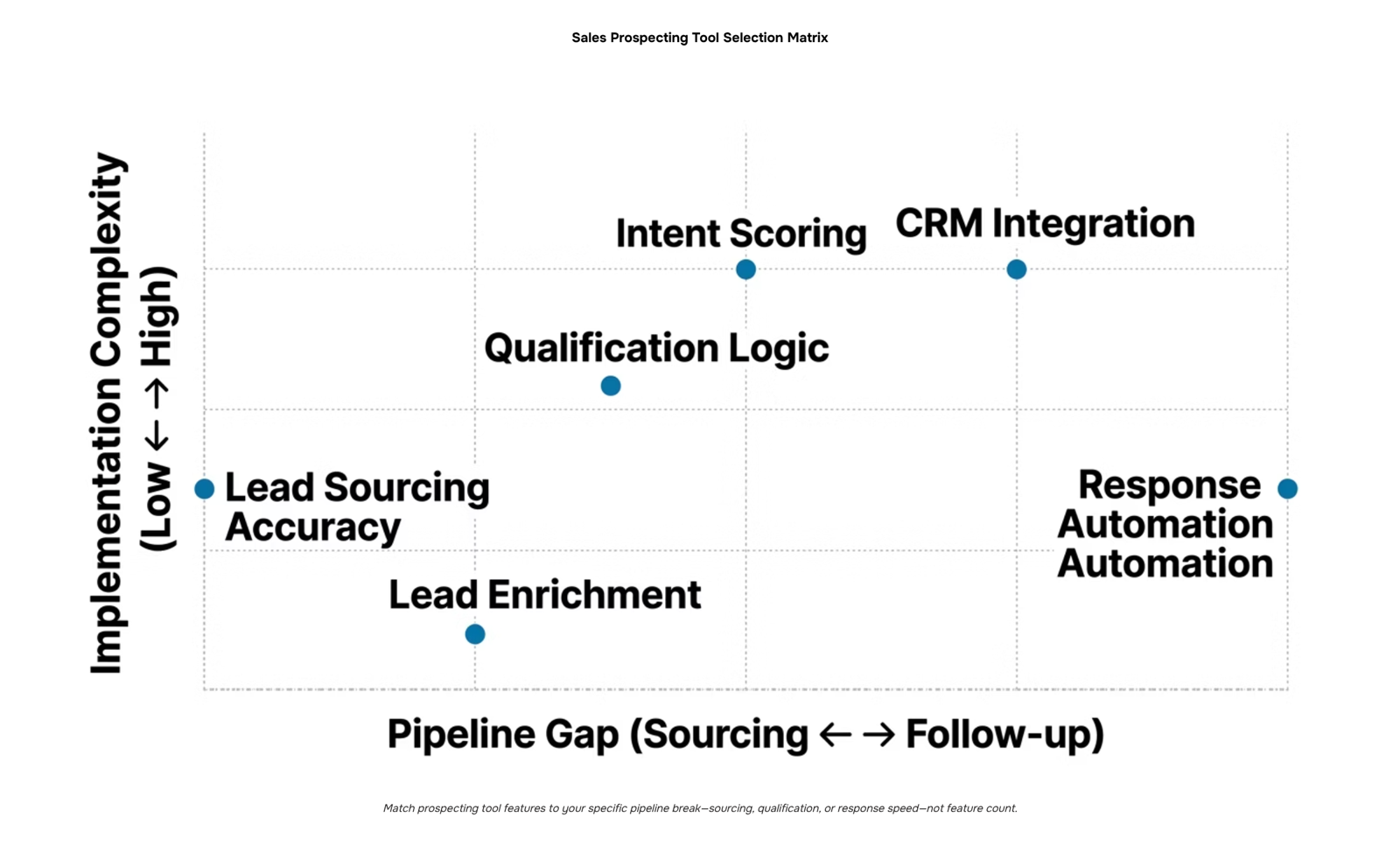
Most teams pick a sales prospecting tool by reading a review article, shortlisting three options, and choosing the one with the best demo. That process skips the diagnostic work, which is why the tool often sits underused six months later. Here is a five-step method that starts with your pipeline, not a vendor's feature page.
1. Diagnose the actual gap
Pull your last 90 days of pipeline data. Where do leads stall — sourcing, qualification, or follow-up? If your reps spend more than 20% of their week manually researching contacts, the gap is sourcing. If leads go cold after the first touch, the gap is response speed. Name the specific failure before you look at any tool.
2. Define the use case precisely
"We need better prospecting" is not a use case. "We need to identify and contact 50 qualified SMB decision-makers per rep per week, with first outreach within 15 minutes of a trigger event" is. Write that sentence for your team. It becomes the filter every tool gets measured against. This step matters especially for niche workflows — mortgage sales prospecting tools, for example, need contact data tied to property and loan triggers, not just firmographics.
3. Check integration fit before anything else
A sales prospecting tool that doesn't connect cleanly to your CRM creates a second data problem. Before you book a demo, confirm the tool writes enriched contact records back to your CRM automatically, not via CSV export. Review the CRM software your prospecting tool needs to connect with to know what a clean integration actually requires.
4. Score against your must-have features
Take the checklist from the previous section — lead sourcing accuracy, qualification logic, CRM sync, response automation — and weight each criterion by your use case. A team whose gap is sourcing weights data accuracy highest. A team whose gap is follow-up weights automation highest. Lead management tools that handle routing and scoring often overlap with prospecting tools here, so clarify which problem each product owns before scoring.
5. Run a time-boxed trial against one real workflow
Two weeks, one rep, one defined workflow. Measure the specific metric from step one — contacts sourced per hour, time-to-first-outreach, qualified leads passed to pipeline. If the tool doesn't move that number, no amount of additional features will fix it. You can compare the best prospecting tools for sales teams once you have a real benchmark to compare against, not just a feature checklist.
The method works for any sales prospecting tools for lead generation, whether you are evaluating five tools or two.
A sales prospecting tool and a CRM are not the same thing, and conflating them creates gaps in your pipeline.
A CRM manages relationships with people already in your system. It stores contact history, tracks deal stages, and logs activity. What it rarely does well is find and qualify net-new leads before they're worth entering. That's the prospecting tool's job: sourcing contacts, enriching data, scoring intent signals, and triggering outreach at the right moment.
The overlap sits in the middle, where a qualified prospect becomes a CRM record. Most b2b sales prospecting tools push enriched, scored leads directly into your CRM via native integration or API sync. The handoff should be automatic. If your team is manually copying contact fields between tools, the integration isn't working.
Layer | Prospecting tool | CRM |
|---|
Find new contacts | Yes | No |
Enrich and score leads | Yes | Limited |
Track deal stages | No | Yes |
Log communication history | Partial | Yes |
Trigger outreach sequences | Yes | Rarely |
When evaluating vendors, ask specifically: does the sync write to custom fields, or only standard ones? One-way pushes miss status updates. Bidirectional sync, where CRM stage changes update the prospecting queue, is the cleaner setup. Lead management tools that handle routing and scoring often bridge this gap natively.
Manage prospecting and pipeline in one place with Lio
Most prospecting tools hand leads off at the point of capture and leave pipeline management to your CRM. The gap between those two systems is where deals stall.
Lio's Custom Sales Pipeline Builder closes that gap by connecting incoming leads directly to pipeline stages. When a lead comes in, it's captured, scored, and assigned to a stage automatically. No manual handoffs, no spreadsheet updates, no rep deciding where a lead belongs.
Custom Field Sets let you define exactly what qualifies a lead at each stage, whether that's company size, budget range, or product fit. That means your pipeline reflects real qualification criteria, not just activity volume.
For teams evaluating what is the best sales pipeline management software, the practical question is whether the tool tracks leads from first touch to closed deal without a separate system handling each phase. Lio is built to do that in one place, which matters most when you're running the best sales prospecting tools for lead generation alongside an active pipeline.
Frequently asked questions
What is the best sales prospecting tool for small B2B teams? A dedicated b2b sales prospecting tool beats a generic CRM add-on when your team is under 20 reps. Prioritize response speed and lead routing over feature count. See how lead management tools that handle routing and scoring compare.
Does a sales prospecting tool integrate with my CRM? Most do, but depth varies. Look for two-way sync, not just data export. CRM software your prospecting tool needs to connect with covers what that connection should actually do.
Closing
The most effective sales prospecting tool is not the one with the longest feature list — it's the one that closes your specific pipeline gap. Whether that gap is sourcing speed, qualification accuracy, or response time, the right tool removes manual work and gets qualified leads to your reps fast enough to actually convert them. The cost of not acting is clear: leads sitting uncontacted for hours, reps buried in research instead of conversations, and CRM noise that wastes everyone's time. Start by diagnosing where your pipeline actually breaks, then measure every tool against that one problem. Ready to see how Lio handles the prospecting-to-pipeline handoff without adding another system to your stack? Start your free trial today and watch qualified leads flow into your CRM automatically.
FAQ
What is the most effective sales prospecting tool for B2B sales?
The most effective tool depends on your pipeline's specific break: sourcing accuracy, qualification speed, or response time. Diagnose which one first, then choose a tool with native CRM integration, real-time lead enrichment, and automation that triggers outreach within minutes of intent signals.
How do I choose the right sales prospecting tool for my business?
Start by identifying your actual gap in the last 90 days of pipeline data, then define your use case precisely (e.g., '50 qualified leads per rep per week, contacted within 15 minutes'). Check CRM integration fit before demoing, and score tools against must-have features weighted to your specific problem.
Can a sales prospecting tool really help me find new leads?
Yes, but only if it combines lead sourcing with qualification logic and response automation. The real win is not finding leads — it's finding qualified leads fast enough to contact them within the five-minute window where conversion rates spike dramatically.
What are the key features of a good sales prospecting tool?
Lead sourcing accuracy (real-time email verification, rolling job title updates), qualification logic (automatic ICP scoring), native CRM integration (bi-directional sync), and response automation (triggered sequences on intent signals). Each feature should remove a step a rep would otherwise do manually.
Is there a sales prospecting tool that integrates with my CRM?
Most modern prospecting tools offer CRM integration, but confirm it's native (not a third-party connector that breaks) and supports bi-directional sync. Field-level mapping is essential — contact sync alone creates duplicate work.


 Elena Petrova11 September 2026


