TL;DR: Most standup guides explain the three questions and stop there. This one gives IT team leads the full picture: why standups lose their purpose over time, what the common failure modes look like in practice, and how to run them effectively whether your team is in the room or distributed across time zones.
What is a daily standup meeting
A daily standup is a short, time-boxed team meeting — typically 15 minutes — where each member reports what they completed, what they're working on next, and what's blocking them. Inside a scrum sprint, it functions as the team's daily calibration point: a structured moment to confirm the sprint is still on track before the day's work begins.
The format is simple, but the purpose runs deeper than a status check. A scrum daily standup creates shared awareness across the team without requiring a separate coordination meeting. When everyone hears the same update at the same time, misaligned assumptions surface immediately rather than at the end-of-sprint review.
One distinction most teams miss: the standup is for synchronization, not blocker resolution. If a blocker needs a real conversation, that happens after the standup with only the people who need to be in the room. Conflating the two turns a 15-minute meeting into a 45-minute one.
If you're newer to sprint ceremonies, the sprint planning meeting in scrum is where the daily standup's context gets set. And if you're weighing whether async updates could replace standups entirely, what 1,000 projects revealed about async vs. status meetings is worth reading before you decide.
What is the purpose of a daily standup in agile teams
The agile daily standup serves three distinct functions inside a sprint, and conflating them is where most teams go wrong.
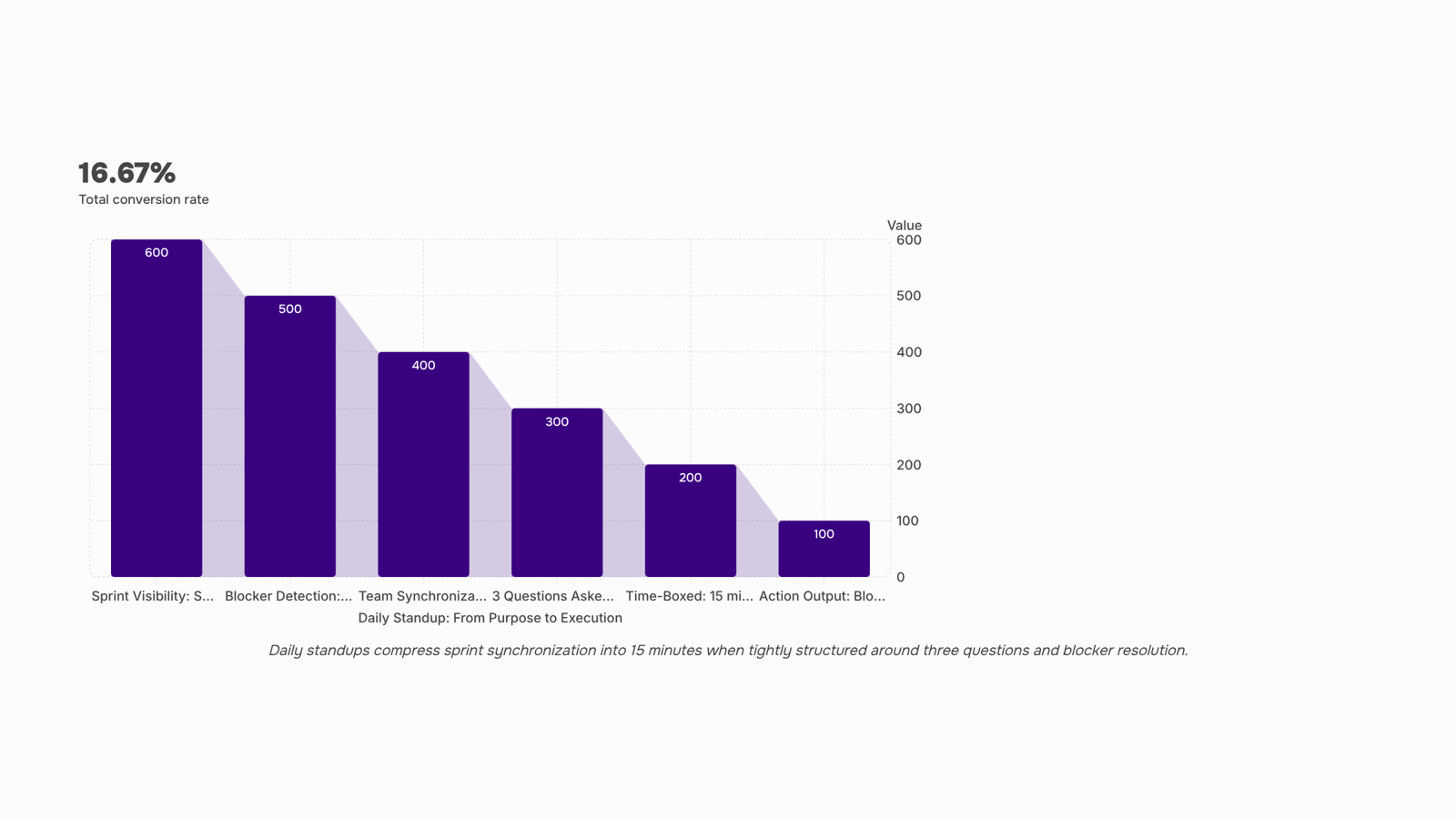
Sprint visibility is the first. Every team member states what they completed since yesterday and what they're tackling today. That 24-hour snapshot lets the team see whether the sprint is on track without waiting for a mid-sprint review. If three people are all pulling from the same backlog column, the team catches the overlap before it costs half a day.
Blocker detection is the second, and it's the one most guides underweight. The standup is not where blockers get resolved — it's where they get named. A developer who's been stuck for two hours waiting on an API credential raises it in 15 seconds. The team lead routes it to the right person after the meeting. That separation between surfacing and solving is what keeps the standup to 15 minutes. Teams that try to fix blockers during the standup routinely run 40-plus minutes, which is the failure mode that turns people against the format entirely.
Team synchronization is the third. Not morale, not culture — coordination. When dependencies shift overnight, the purpose of daily standup becomes recalibration: who needs to adjust their plan based on what someone else just learned. Research on async vs status meetings consistently shows that short synchronous check-ins reduce mid-sprint surprises more than longer weekly syncs.
All three functions only work together when the meeting stays tightly time-boxed.
How a daily standup works: the 3 questions and the 15-minute rule
The format is simple by design. Three questions, a 15-minute time-box, and one person keeping it on track.
Every team member answers the same daily standup questions in sequence:
What did I complete since the last standup?
What will I complete before the next one?
What is blocking me?
That's the full daily standup agenda. Question one creates accountability. Question two creates commitment. Question three surfaces blockers before they compound into missed sprint goals.
The 15-minute rule is not a suggestion. When a team of seven each takes two minutes, you've used the time-box. Anything beyond that is a problem-solving session, not a standup. Those conversations belong after the meeting, between the people who actually need to resolve the blocker. Everyone else leaves.
Facilitation matters more than most teams realize. The facilitator's job is not to answer questions or run the meeting like a status report. It's to keep each speaker on the three questions, flag anything that needs a follow-up conversation, and end on time. On co-located teams, a Scrum Master usually fills this role. On distributed teams, rotating facilitation keeps the habit from becoming one person's burden.
What happens after is where most daily standup meeting templates fall short. The output of a standup is a short list: blockers that need owners, dependencies that need a conversation, and any sprint-board updates that didn't happen before the meeting. Assign those immediately, or they disappear.
For teams still figuring out whether synchronous standups are worth the calendar slot, this breakdown of async vs. status meetings across 1,000 projects is worth reading before you change the format.
Why daily standups break down and how to fix them
Four failure modes kill most standups. Here is what each looks like and how to fix it.
Status-reporting creep. The scrum daily standup turns into a progress report to the manager instead of a synchronization between peers. Each person summarizes what they did rather than flagging what the team needs to know. Fix: redirect any sentence addressed to the manager back to the team ("tell us, not me").
Blocker avoidance. Engineers mention blockers vaguely or skip them entirely to avoid looking stuck. The agile daily standup only works if the team treats blockers as shared problems, not individual failures. Fix: after each person speaks, ask one direct question — "what do you need from someone in this room today?"
Wrong attendees. Stakeholders, product managers, and executives join "just to listen," which changes how engineers speak. The daily standup meeting is for the people doing the sprint work. Fix: observers get a read-only sprint board update; they do not join the call. If you are curious what that board-first approach looks like in practice, the tradeoffs are worth reading before your next sprint.
Over-running the time-box. Once a standup regularly hits 20 minutes, attendance drops and the format loses credibility. Fix: a visible timer and a hard cut at 15 minutes, with a dedicated blocker-resolution slot scheduled separately for anything that needs deeper discussion. See how sprint planning in scrum handles the same time discipline across longer ceremonies.
How to run a daily standup virtually
Virtual standups fail for one reason more than any other: the team treats them as a shrunken version of a conference room meeting. They're not.
For co-located time zones, a 15-minute video call with a shared sprint board on screen works well. Each person answers the three standup questions while the board updates in real time. The visual anchor keeps the daily standup agenda honest and cuts the "what did you do yesterday" memory tax.
For time-zone-split teams, synchronous calls often don't make sense. An async standup using a tool like Slack, Loom, or a dedicated bot (Geekbot and Standuply are common choices) lets each person post their three answers within a defined window, say 9 AM local time. A team lead reviews blockers before the earliest overlap window and escalates anything that needs a live call.
When your sprint board shows real-time task status, the agile daily standup call becomes optional for low-complexity sprints. If everyone can see what moved, what's blocked, and what's at risk, the synchronization purpose is already served. You only need the call when human judgment is required, not when the board answers the question.
For a deeper look at when async genuinely outperforms live standups, the research across 1,000 projects is worth reading before you set your team's default format.
Benefits of running a daily standup consistently
A well-run scrum daily standup does five specific things for your team.
Faster blocker resolution. Blockers surfaced in a standup get resolved the same day instead of sitting in someone's inbox. The Scrum Alliance notes that teams who surface impediments daily resolve them significantly faster than those relying on async escalation alone.
Less status-meeting overhead. When everyone already knows where the sprint stands, the 30-minute "quick sync" stops getting scheduled. That's the core finding across hundreds of projects comparing async and synchronous formats.
Sprint predictability. Daily visibility into task movement lets the team catch scope drift before it becomes a missed deadline. Sprint planning sets the target; the daily standup keeps the team honest about whether they're hitting it.
Tighter alignment. Each person hears what adjacent teammates are working on, which cuts duplicate effort and uncoordinated handoffs.
Reduced context-switching. A defined daily standup meeting time gives the team one structured coordination moment, which means fewer ad-hoc interruptions throughout the day. How scrum improves team productivity covers this dynamic in more depth.
The purpose of daily standup isn't ceremony. It's compounding small corrections into a predictable sprint.
Closing
A daily standup only works when the team walks in already knowing what everyone else completed yesterday. When your sprint board is visible before the meeting starts, those 15 minutes stay focused on blockers and dependencies, not updates. That shared context is what separates a standup that moves the needle from one that feels like overhead. The question isn't whether your team needs standups — it's whether you have the visibility layer that makes them count. Taro brings that layer into WorksBuddy: task ownership, sprint progress, and blocker flags all visible to the team before you dial in. Start by auditing your last three standups. How many minutes were spent on blockers versus recapping what people already knew?
Frequently asked questions about daily standups
How long should a daily standup be?
Fifteen minutes is the Scrum Guide's ceiling, not a target. Most teams land between 8 and 12 minutes when each person answers the three core questions without narrating their entire day. If your standup regularly runs over, the meeting has drifted into problem-solving territory — move that conversation to a separate session after the standup ends.
What are the three questions in an agile daily standup?
The standard agile daily standup format asks: what did you complete yesterday, what are you working on today, and what is blocking you. These questions exist to surface blockers fast, not to report status upward. If your answers sound like a manager update, the meeting's purpose has shifted.
How is a standup different from a status meeting?
A status meeting reports progress to a stakeholder. A standup synchronizes peers so the team can move together. The audience, direction of information, and outcome are all different. For a deeper look at where async communication outperforms live status updates, the distinction matters more than most teams realize.
How do virtual standups work?
Remote standups need a fixed video link, camera-on as the default, and a shared board visible to everyone. Async text standups in Slack or Teams can substitute when time zones span more than four hours, but they lose the real-time blocker signal that makes the format valuable.
Do you need a daily standup meeting template?
A simple daily standup meeting template covers the three questions, a parking lot for blockers, and a two-minute timer per person. Teams new to Scrum benefit from a written template for the first four to six sprints, then drop it once the cadence is natural.


 Elena Petrova15 September 2026


