TL;DR: Most content on service agreement management stops at definitions and generic benefit lists. This one connects each component of a management system to the operational breakdowns IT company owners face after a contract is signed: missed renewals, scope disputes, and manual handoffs that slow delivery. You'll leave with a clear picture of what a working system looks like and where yours is likely failing.
What is service agreement management?
Service agreement management is the process of creating, storing, tracking, and renewing the contracts that define what your IT company delivers, to whom, and under what conditions.
Most IT firms start with a shared Google Drive folder or a spreadsheet. That works until you have 15 active clients, three renewal dates in the same month, and no clear owner for a contract that quietly auto-renewed at last year's rates. According to WorldCC research, poor contract management costs businesses an average of 9.2% of annual revenue — for a $2M IT services firm, that's roughly $184,000 walking out the door annually through missed renewals, scope creep, and untracked obligations.
A dedicated service agreement management system replaces that patchwork with a single workflow: one place where every contract lives, every service level agreement is visible, and every renewal triggers an alert before it becomes a problem.
The difference between generic contract management and service contract tracking for IT companies is specificity. Your agreements include SLA response windows, uptime commitments, and escalation paths. A spreadsheet can store those terms. It cannot flag a breach, trigger a renewal review, or route a contract for signature automatically.
Service level agreement management breaks down when the signed document disappears into a folder and no one monitors what was promised. A system closes that gap by connecting the signed agreement to the operational workflow that delivers on it. That connection is what the next section covers.
How a service agreement management system works
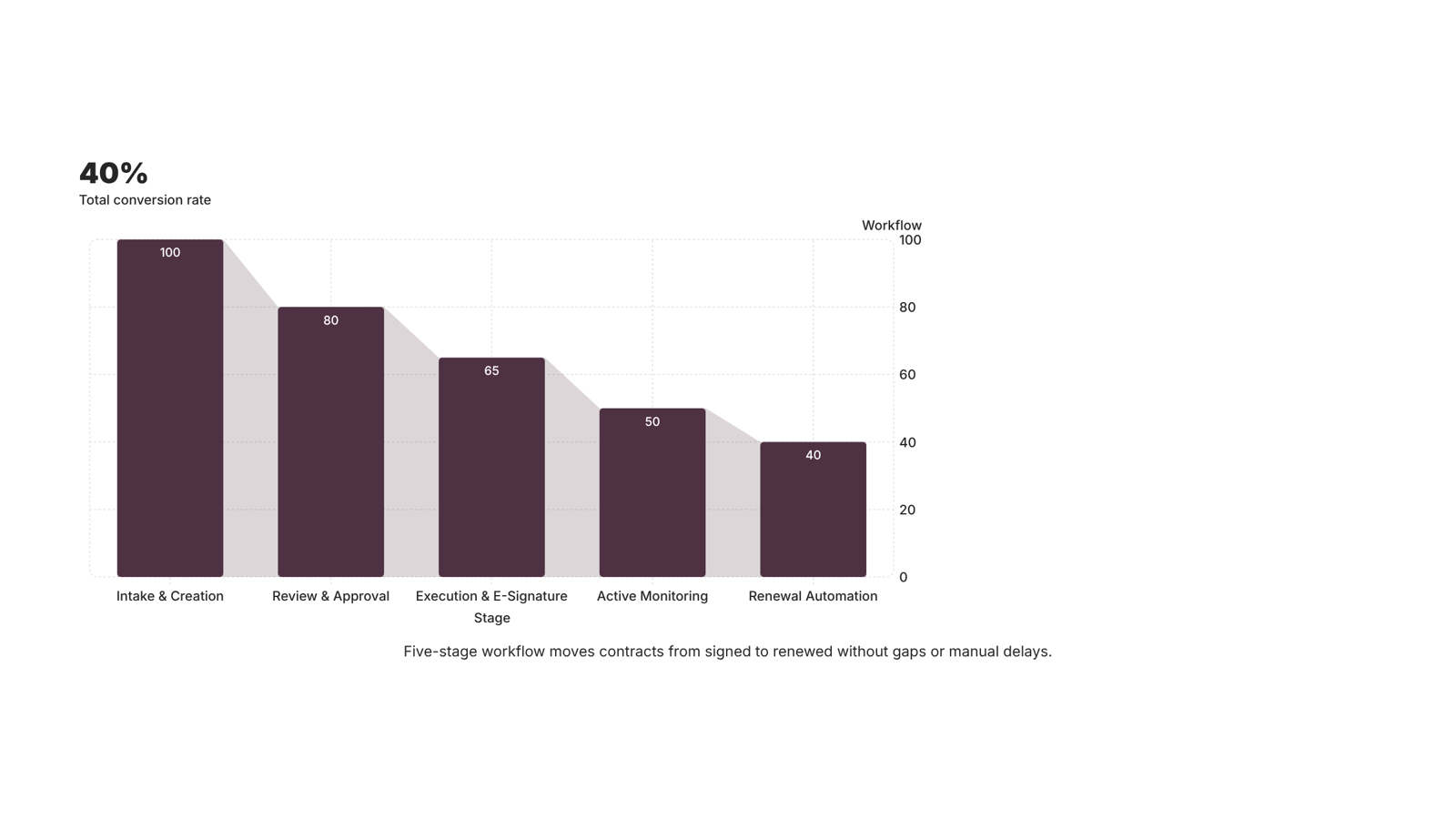
A service agreement management system moves every contract through five repeatable stages, so nothing falls through the gap between "signed" and "expired."
Intake and creation: A new agreement enters the system through a structured template or an uploaded draft. Key fields, client name, service scope, SLA terms, billing cadence, are captured at the start, not reconstructed later from email threads.
Review and approval routing: The system routes the draft to the right stakeholders in sequence. No version confusion, no "did you see my email?" delays. Everyone signs off in one place.
Execution and e-signature: Once approved, the agreement goes out for signature through an integrated AI contract signing tool. Turnaround drops from days to hours because the bottleneck is a click, not a PDF attachment.
Active monitoring and obligation tracking: This is where most spreadsheet-based approaches break down. The system tracks live SLA commitments, flags missed deliverables, and surfaces upcoming review dates. Understanding the purpose of an SLA agreement matters here, because the system enforces it automatically rather than relying on someone to remember.
Renewal or expiry handling: Contract renewal automation kicks in 60 to 90 days before an end date, triggering a review workflow rather than a silent rollover. WorldCC research shows poor contract management costs businesses an average of 9.2% of annual revenue — most of that loss happens at this stage, when agreements auto-renew without anyone checking the terms.
Each stage hands off cleanly to the next. That handoff chain is what separates a system from a folder.
Key components of a service agreement management system
Centralized contract repository
A centralized contract repository is a single, searchable location where every vendor service agreement, client contract, and renewal record lives. Without it, agreements scatter across email threads, shared drives, and individual inboxes — and when a renewal deadline hits, nobody can find the original terms. A good repository indexes contracts by vendor, service type, expiration date, and status, so any team member can pull up the right document in under a minute.
Automated alerts and renewal tracking
Automated alerts notify the right people before a contract expires, escalates, or triggers a penalty clause. This is where most manual systems fail: a significant share of contracts auto-renew without review, locking companies into terms they'd have renegotiated with even a 30-day warning. A service agreement management system replaces calendar reminders with rule-based triggers tied to contract data — 90 days out, 30 days out, day of.
SLA monitoring and compliance tracking
Service level agreement management means tracking whether the obligations written into a contract are actually being met. This component connects the signed document to live performance data: uptime percentages, response times, delivery milestones. When a vendor misses an SLA threshold, the system flags it rather than waiting for a client complaint.
Workflow and approval routing
Every contract needs a defined path from draft to signature. Approval routing assigns reviewers, sets deadlines, and creates an audit trail showing who approved what and when. For IT company owners managing multiple vendors, this removes the bottleneck of chasing sign-off over email. Pairing this with an AI contract signing tool cuts the time between final draft and executed agreement.
Reporting and audit trails
Reporting turns contract data into operational visibility. You can see which agreements are expiring this quarter, which vendors have open SLA violations, and where renewal spend is concentrated. Audit trails satisfy compliance requirements and give you defensible records if a dispute arises.
Benefits of using a service agreement management system
Poor service agreement management costs more than most IT owners expect. WorldCC estimates that businesses lose an average of 9.2% of annual revenue to poorly managed contracts — for a $2M IT services firm, that's $184K walking out the door each year.
Here's where a dedicated system pays for itself:
Fewer missed renewals: Automated alerts flag upcoming expirations 30, 60, or 90 days out. You stop losing clients because a contract quietly lapsed.
Cleaner service contract tracking: Every agreement, amendment, and SLA sits in one searchable record. When a client disputes a deliverable, you pull the signed version in seconds, not hours.
Reduced unintended spend: Vendor contracts auto-renew by default more often than most owners realize. A system that surfaces renewal dates before they hit prevents budget surprises.
Faster dispute resolution: Version history and audit trails give you a timestamped record of what was agreed, when, and by whom. That cuts the back-and-forth when something goes sideways.
Compliance without manual overhead: Regulatory and client-mandated clauses get flagged automatically at the right review stage, so nothing slips through because someone forgot to check.
If you want the broader case for digitizing contracts, the breakdown of SaaS contract management benefits covers the financial and operational side in more detail.
Can service agreement management be automated?
Yes, most of the work in service agreement management can be automated. The tasks that eat time and cause the most errors — tracking renewal dates, sending reminders, routing documents for signatures — follow predictable patterns, which makes them good candidates for a system to handle.
Here is how a typical automated workflow runs:
Agreement intake: A new contract is uploaded or created from a template. The system extracts key dates, parties, and terms automatically.
Obligation tracking: Milestones, SLA checkpoints, and review windows are mapped to a calendar. No manual entry per agreement.
Renewal alerts: Automated reminders go out 60, 30, and 7 days before expiration. This directly addresses the pattern where contracts auto-renew without review, creating unintended spend.
Signature routing: The agreement moves to the right signatory without someone chasing it. This is where Sigi fits: it handles e-signature routing and removes the bottleneck between a finalized draft and a countersigned document.
Post-signature tracking: Once signed, the agreement stays visible. Obligations, payment triggers, and renewal terms remain active in the system rather than buried in email.
The honest limit: automation handles the process, not the judgment. Deciding whether to renew, renegotiate, or exit an agreement still requires a person. A good contract management software for small businesses handles the workflow so your team's attention goes to those decisions, not to finding the file.
How to track and renew service agreements with multiple vendors
Managing 10 to 50 active vendor agreements simultaneously is where most IT owners hit a wall. The volume isn't the problem — the lack of a repeatable process is.
Start by building a single source of truth. Every vendor service agreement goes into one system with four data points attached: start date, end date, auto-renewal clause (yes/no), and the owner responsible for the renewal decision. Without that last field, renewals get missed because everyone assumes someone else is watching.
Next, set tiered review triggers. Flag agreements 90 days out for renegotiation candidates and 30 days out for anything on auto-renew. WorldCC research shows that a significant share of contracts auto-renew without review, creating unintended spend that compounds across a multi-vendor portfolio.
For service contract tracking, the review itself needs a defined checklist: has scope drifted from the original terms, has the vendor's pricing tier changed, and does the purpose of an SLA agreement still match current delivery expectations?
Contract renewal automation handles the calendar logic — reminders, routing, and signature collection — so the process runs without manual follow-up. Sigi, WorksBuddy's e-signature agent, fits here: it routes renewal documents to the right signatory and closes the loop without a back-and-forth email chain.
The result is a service agreement management cycle that runs on schedule, not on memory.
Common challenges in service agreement management
Missed renewals are the most visible failure. Without automated tracking, a support contract quietly rolls over at last year's rate while your costs have climbed — or lapses entirely, leaving a client unprotected. WorldCC research estimates that poor contract management costs businesses around 9.2% of annual revenue, a figure that compounds fast across 30 active agreements.
Scope disputes follow. When the signed document lives in someone's inbox rather than a shared system, "what we agreed to" becomes a memory contest.
Manual handoffs between sales, legal, and operations introduce version confusion — two people editing different drafts, neither aware of the other.
Effective service level agreement management requires more than a shared folder. Each of these four failure points has a process fix, and most of them are addressable with the right contract management features before the next renewal cycle hits.
Closing
Service agreement management isn't about storing contracts—it's about preventing the $184K annual revenue loss that happens when renewals slip, SLAs go unmonitored, and scope disputes turn into client friction. A system that automates intake, routes approvals, tracks obligations, and triggers renewals 60–90 days out closes every gap a spreadsheet leaves open. The choice is clear: continue absorbing missed renewals and manual handoffs, or move to a platform built for it. Sigi handles contract creation, sending, tracking, and renewal alerts in one workflow—no more scattered emails or silent auto-renewals. Ready to see how it works?
FAQ
What is the purpose of a service agreement management system?
To move contracts through five repeatable stages—intake, approval, execution, monitoring, and renewal—so nothing falls through the gap between signing and expiry. It replaces scattered folders with a single workflow that tracks SLA commitments, flags breaches, and triggers renewals automatically.
How can I effectively manage service agreements with multiple vendors?
Centralize every contract in one searchable repository indexed by vendor, service type, and expiration date. Pair that with automated alerts and approval routing so no renewal sneaks past and no sign-off gets lost in email threads.
What are the benefits of using service agreement management software?
Fewer missed renewals, cleaner tracking, reduced unintended spend, faster dispute resolution, and compliance without manual overhead. WorldCC research shows poor contract management costs businesses 9.2% of annual revenue—a dedicated system recovers most of that.
Can service agreement management be automated?
Yes. Automation handles alerts 30–90 days before expiry, routes approvals to the right stakeholders, integrates e-signature for faster execution, tracks live SLA performance, and triggers renewal workflows before contracts lapse silently.
How do I track and renew service agreements before they expire?
Set rule-based renewal triggers tied to contract data—90 days out, 30 days out, day of. A dedicated system surfaces upcoming expirations in a centralized dashboard and routes renewal reviews to the right owner automatically, eliminating calendar reminders and manual follow-up.


 Ryan Mitchell14 September 2026


