TL;DR: Most CLM explainers stop at a feature list. This one maps each stage of the contract lifecycle to the specific business risk IT company owners carry when that stage is manual — then shows exactly how software closes each gap, including CRM integration that most comparisons skip entirely.
What is contract lifecycle management software?
Contract lifecycle management software is a category of business software that manages every stage of a contract's existence — from the initial request through drafting, negotiation, approval, execution, and post-signature obligations like renewals and compliance tracking.
The "lifecycle" part is what separates CLM software from a basic e-signature tool or a shared folder of PDFs. A standalone signature tool handles one moment: the sign. CLM software handles the entire sequence before and after that moment. It tracks who requested the contract, which version is current, who has approval authority, whether obligations are being met, and when renewal windows open.
For IT company owners, the scope matters because contracts don't fail at signature — they fail earlier, in drafting errors and missed review steps, or later, in auto-renewals nobody caught and SLA obligations nobody tracked. According to the WorldCC 2023 Contract Management Report, poorly managed contracts cost organizations an average of 9% of contract value, a figure that compounds fast across a client portfolio.
The software typically connects to the systems where contract work actually happens. When CLM integrates with a CRM, a signed deal can automatically trigger onboarding tasks, invoices, or renewal reminders without manual handoffs.
If you're evaluating options for a smaller operation, the best contract management lifecycle software for small businesses covers what to prioritize at that scale.
The next section walks through each lifecycle stage in sequence.
How contract lifecycle management software works
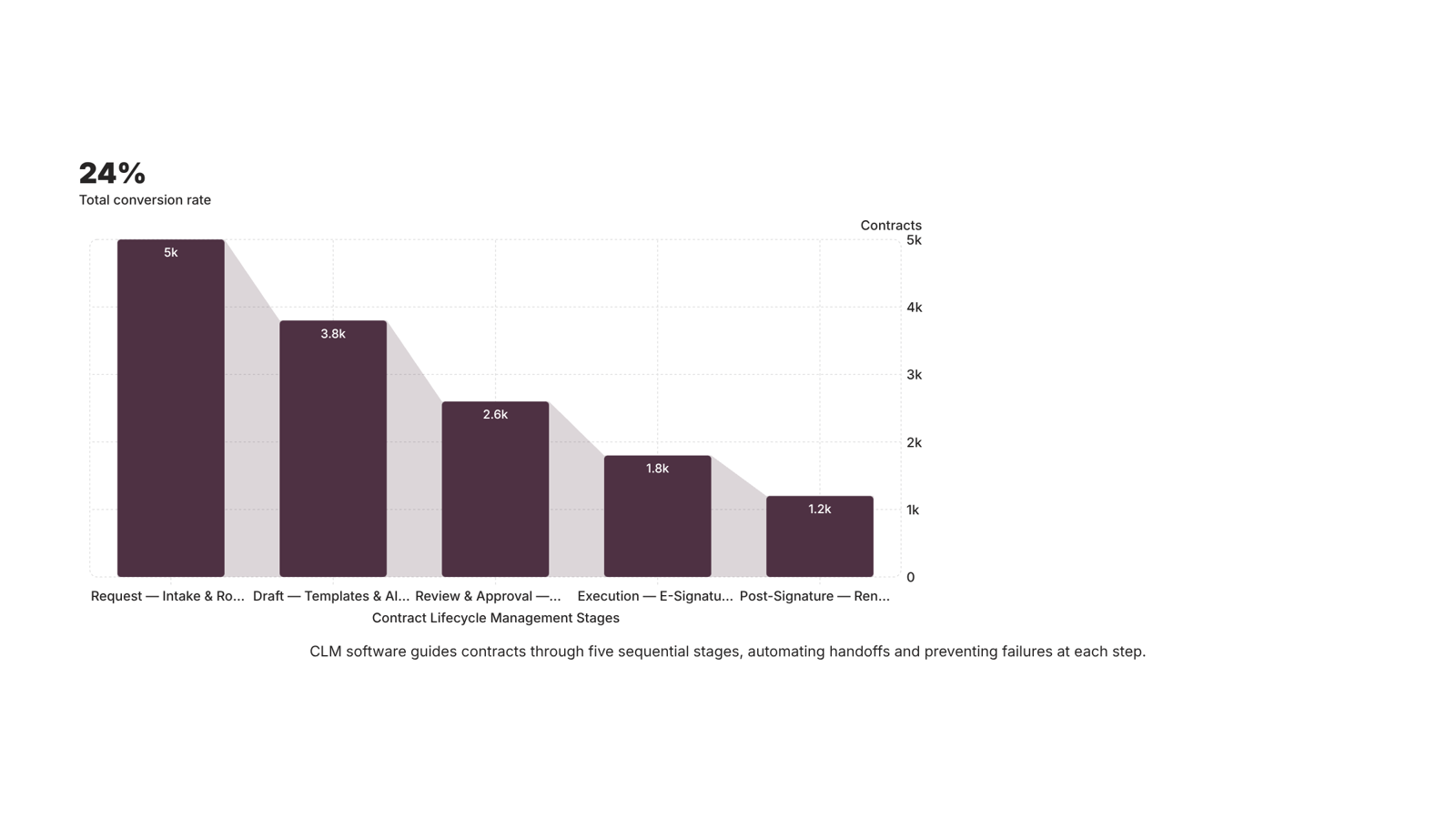
Most contract processes fail not because the contract itself is bad, but because no one owns the handoffs between stages. Contract lifecycle management software works by creating a structured process across five distinct phases, with automation and visibility built into each one.
Request: Someone inside the organization identifies a need for a contract — a new vendor, a client deal, a partnership. Instead of emailing templates back and forth, CLM software captures the request through a standardized intake form, routes it to the right owner, and logs it immediately.
Draft: The software pulls pre-approved templates and clause libraries, reducing the time spent writing from scratch. AI-assisted drafting flags non-standard language before it ever reaches legal review — a meaningful catch, given that manually managed contracts contain errors or non-standard clauses at a significantly higher rate than those processed through structured workflows.
Review and approval: Stakeholders are notified in sequence or parallel, depending on your approval logic. Every comment, redline, and version is tracked in one place. No more "final_v3_ACTUAL_final.docx" in someone's inbox.
Execution: This is where e-signature replaces printing, scanning, and courier delays. Enterprise contract lifecycle management software connects signing directly to the deal record — so when a contract executes, the CRM updates automatically. Sigi does exactly this by linking signed documents to WorksBuddy CRM deals, tasks, and invoices in real time.
Post-signature management: The contract doesn't end at signing. CLM software tracks obligations, renewal dates, and compliance checkpoints, and surfaces alerts before deadlines pass.
Each stage compounds: fix the handoff at request, and you prevent the bottleneck at execution.
Key features to look for in a CLM solution
When evaluating contract lifecycle management software, most feature checklists read like a spec sheet with no context for what each capability actually prevents. Here's what matters and why.
Centralized contract repository
A single searchable store for every contract, version, and attachment. Without it, your team hunts across email threads and shared drives when a renewal deadline hits or a dispute lands.
AI-powered clause review
The software scans incoming and outgoing contracts for risky language, missing protections, or non-standard terms before anyone signs. WorldCC research puts the cost of a poorly managed contract at roughly 9% of its total value — clause-level AI review is the earliest point in the process where you can stop that loss.
Configurable approval workflows
Route contracts to the right reviewers in the right order, with automatic escalation if someone stalls. For IT firms managing vendor agreements, SOWs, and client MSAs simultaneously, a rigid linear workflow breaks fast. You need branching logic tied to contract type or value threshold.
E-signature with a tamper-proof audit trail
Not just a signature field — a completion certificate that logs who signed, when, from which device, and in what sequence. This is what holds up in a dispute. If you want to see how AI contract agents handle clause review and signature tracking end-to-end, that's worth reading before you finalize your shortlist.
CRM and project tool integration
Contracts that live outside your deal or project context get missed. The best contract lifecycle management software connects signing events directly to CRM records, tasks, or invoices — so a signed MSA automatically moves the deal stage and triggers onboarding.
Renewal and obligation tracking
Automated alerts for expiry dates, notice windows, and milestone obligations. This is the feature most teams wish they'd prioritized — usually after a contract auto-renewed on unfavorable terms.
If you're earlier in the evaluation process, best contract lifecycle management software for small businesses covers how these features scale down for leaner teams.
How contract lifecycle management software reduces risk
Contract risk doesn't usually arrive as one catastrophic failure. It accumulates: a renewal window missed by three days, an edited clause no one approved, a signature collected over email with no audit trail. Contract lifecycle management software addresses each of these as a system problem, not a human error problem.
Four risk categories account for most contract losses in IT service businesses.
Missed renewals: Automated alerts tied to contract end dates remove the dependency on someone remembering. Most CLM platforms let you set multi-stage reminders at 90, 60, and 30 days out.
Unauthorized edits: Version control with a locked audit trail means every change is timestamped and attributed. If a clause shifts between draft and final, you know who changed it and when.
Signature gaps: Collecting signatures over email creates no enforceable record. A proper signing workflow generates a tamper-proof completion certificate the moment all parties sign, which matters when a client disputes terms later.
Compliance failures: CLM software compliance features, including clause libraries and obligation tracking, flag non-standard language before a contract goes out, not after it causes a problem.
WorldCC's 2023 Contract Management Report found that poorly managed contracts lose an average of 9% of their total value, mostly through missed obligations and renegotiation costs.
For IT firms managing service agreements at volume, how AI contract agents handle clause review and signature tracking covers the specific mechanisms that catch these failures before they compound.
How CLM software improves compliance
Compliance failures in IT service contracts usually trace back to three gaps: no clear audit trail, version confusion, and obligations that slip through without anyone tracking them.
Audit trails solve the "who changed what and when" problem. Every edit, approval, and signature gets timestamped and attributed. When a client disputes a term or a regulator asks for documentation, you pull the log rather than reconstruct events from email threads.
Version control keeps everyone working from the same document. Without it, a redlined draft from legal and a clean copy from sales can both circulate simultaneously. Enterprise contract lifecycle management software locks versions so only the current draft is active, and prior versions are archived, not deleted.
Automated obligation tracking is where most manual processes collapse. An IT services contract might carry 15 to 20 obligations: SLA response windows, renewal notice periods, compliance certifications due quarterly. CLM software compliance tools flag each obligation before the deadline, not after.
Together, these three mechanisms do the work that calendar reminders and shared drives cannot. If you want to see how AI contract agents handle clause review and signature tracking inside a connected workflow, that covers the practical layer in detail.
Can CLM software integrate with your existing CRM?
Yes, most contract lifecycle management software can connect to your CRM — and for IT firms running deals through a pipeline, that connection changes how contracts actually move.
Without it, your sales rep closes a deal in the CRM, then manually downloads a contract template, fills in the client details, emails it for signature, and updates the deal record once it comes back. Each handoff is a place where something gets missed: wrong pricing, outdated terms, a signature that never arrives.
A CRM-to-CLM integration removes those handoffs. When a deal reaches a defined stage, the contract is generated automatically from the CRM data already in the record — company name, service scope, agreed price. The document goes out for signature without anyone copy-pasting from a spreadsheet.
Sigi handles this directly inside WorksBuddy. When Lio, WorksBuddy's lead and deal management agent, moves a deal to "closed," Sigi can generate the contract, route it for signatures, and attach the completed certificate back to the deal record. No switching tools. No manual data entry. If you want to understand how AI contract agents handle clause review and signature tracking, that workflow is worth seeing in detail.
For IT firms managing recurring service agreements, this kind of contract management CRM integration also means your compliance records and signed documents live where your team already works.
When does an IT company need CLM software?
Three signals tell you manual contract handling has become a liability.
Volume: Once you're managing more than 15 to 20 active contracts at once, version control breaks down. Renewals get missed. Signed copies live in someone's inbox instead of a shared record.
Compliance: If your clients require SOC 2, GDPR, or sector-specific data processing agreements, you need an audit trail that a shared folder can't produce. Enterprise contract lifecycle management software generates tamper-proof completion certificates automatically.
Approval chains: When a contract touches legal, finance, and a client stakeholder before it can be signed, manual routing creates delays and version conflicts. CLM software enforces the sequence.
If two of these three apply to your business, contract lifecycle management software built for IT firms will pay for itself in recovered time and reduced exposure before the quarter ends.
Closing
The real operational payoff of contract lifecycle management software hits at a specific moment: when a deal closes in your CRM but the contract still lives in email threads, waiting for signatures, revisions, or approvals that nobody's tracking. That gap — between closed deal and executed contract — is where IT companies bleed time, miss renewals, and lose contract value. Sigi closes that gap by connecting signed documents directly to your WorksBuddy CRM deals, tasks, and invoices in real time, so the moment a contract executes, your entire operation moves forward without manual handoffs. If you're managing multiple client agreements, vendor SOWs, and renewal windows across a growing team, that integration is the difference between a system that works and one that just logs documents. Ready to see how it works?
FAQ
How can contract lifecycle management software reduce risk?
CLM software eliminates the four risk categories that cost IT firms most: missed renewals through automated alerts, unauthorized edits via version control audit trails, signature gaps using tamper-proof completion certificates, and compliance failures by flagging non-standard language before execution. Poorly managed contracts lose 9% of their total value on average — CLM addresses each loss point systematically.
What features should I look for in a contract lifecycle management software solution?
Prioritize centralized searchable storage, AI-powered clause review, configurable approval workflows, e-signature with audit trails, CRM integration that triggers downstream tasks automatically, and renewal/obligation tracking with multi-stage alerts. CRM integration matters most — it's what prevents contracts from living outside your deal context.
Can contract lifecycle management software integrate with my existing CRM?
Yes — the best CLM solutions connect directly to your CRM so signed contracts automatically update deal stages, trigger onboarding tasks, and generate invoices without manual handoffs. Sigi integrates with WorksBuddy CRM in real time, closing the gap between deal closure and contract execution.
How does contract lifecycle management software improve compliance?
CLM software flags risky or non-standard language before contracts go out through AI-powered clause review, maintains tamper-proof audit trails of every edit and signature, and tracks obligation deadlines and renewal windows automatically. This shifts compliance from reactive (catching problems after signing) to preventive (stopping them before execution).
What is the difference between CLM software and a standard document management system?
Document management stores files; CLM manages the entire contract lifecycle — drafting, approval workflows, e-signature, obligation tracking, and renewals — with automation and visibility at each stage. CLM also integrates with CRM and project tools so contracts trigger downstream business actions automatically, not just sit in a repository.


 Elena Petrova11 September 2026


