TL;DR: Most sale contract guides list clauses without explaining what makes them enforceable or what happens when one is missing. This one gives IT company owners a functional breakdown of every required term, flags where contracts differ by asset type, and covers breach scenarios with enough specificity to act on. You'll finish with a working reference, not a checklist.
What is a sale contract?
A sale contract is a legally binding written agreement between a buyer and a seller that documents the terms of a transaction, including what is being sold, the price, and the conditions each party must meet before ownership transfers.
That definition sounds straightforward, but the "written" part carries real weight. A verbal agreement to sell your car, your business, or a piece of equipment is difficult to enforce because it leaves price, delivery, and warranties open to interpretation. An invoice records a transaction after the fact. A sale contract sets the terms before money or assets change hands, which is why courts treat it differently from both.
The distinction matters most when something goes wrong. If a buyer backs out or a seller delivers the wrong asset, a signed sale contract gives you a documented basis for remedies. Without one, you are arguing from memory.
A well-structured sale contract template covers the parties, the asset, the price, payment terms, warranties, and what happens on breach. The exact clauses shift depending on what you are selling, which the next section breaks down by asset type.
For a deeper look at what makes any agreement enforceable, see how to make a contract legal and binding.
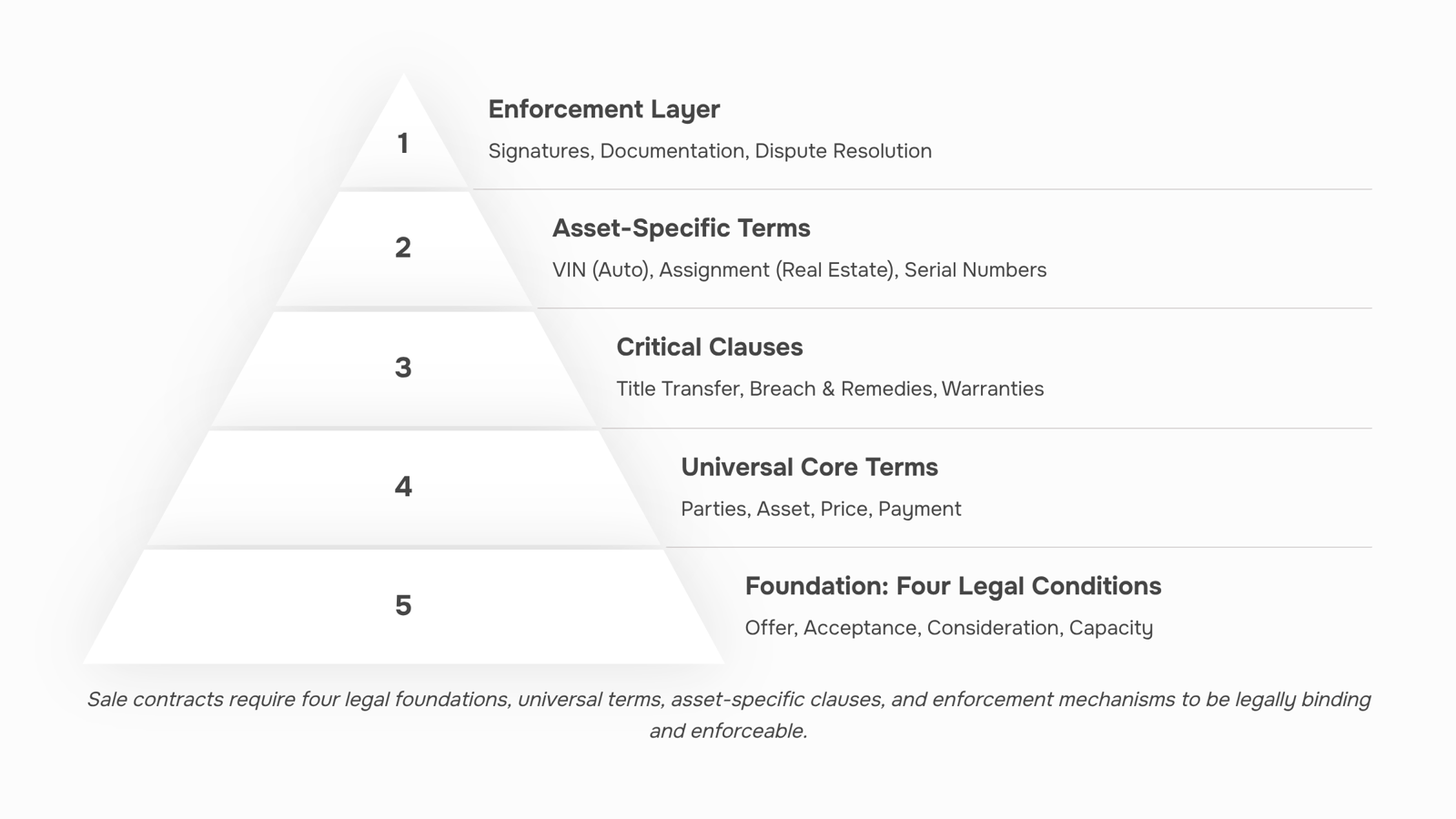
What should be included in a sale contract
Every sale contract, regardless of asset type, shares a core set of terms. Miss one and you create the kind of ambiguity that turns a straightforward deal into a dispute.
The universal elements every sale contract needs:
Parties: Full legal names and addresses for both buyer and seller. For a business sale contract, include entity type (LLC, corporation) and state of formation.
Asset description: Specific enough to be unambiguous. A car sale contract needs year, make, model, VIN, and odometer reading. A business sale contract needs the entity name, assets included, and any liabilities being transferred.
Purchase price: The agreed amount, currency, and whether it includes taxes or fees.
Payment terms: Lump sum, installments, or escrow. Specify due dates, accepted payment methods, and what constitutes a default.
Condition of the asset: "As-is" or with specific warranties. Stating "as-is" in writing limits seller liability after closing; omitting it leaves room for post-sale claims.
Transfer of title and possession: When ownership legally changes hands and when the buyer takes physical possession. These are often different dates.
Representations and warranties: Each party's factual claims about the asset. For a business sale, the seller typically warrants that financials are accurate and there are no undisclosed liabilities.
Breach and remedies: What counts as a breach, what remedies are available (damages, specific performance, contract termination), and any notice requirements before a party can act.
Governing law: Which state's law applies and where disputes are resolved.
Signatures: Dated signatures from both parties. For real estate transactions, notarization is typically required for the deed, though the sale contract itself may not need it depending on the state.
Two terms that most generic sale contract templates skip: a dispute resolution clause (naming mediation or arbitration before litigation) and an integration clause (confirming the written contract supersedes all prior verbal agreements). Both matter more than they look.
Before you finalize any draft, review how to make a contract legal and binding to confirm you haven't left out an enforceability requirement. If you're working from a business sale contract sample, cross-check it against this list rather than assuming the template is complete.
Once the terms are set, the faster you can get signatures, the lower the risk of a deal falling apart. Send, track, and close sale contracts with e-signature without chasing anyone down manually.
Key terms that vary by asset type
The clauses that belong in a sale contract shift significantly depending on what you're selling. Using the wrong template for the wrong asset type is one of the fastest ways to create a dispute.
Car sale contracts (and auto sale contract templates generally) need to capture the VIN, odometer reading, year, make, model, and a clear "as-is" or warranty disclosure. Without the odometer clause, you're exposed to odometer fraud claims under federal law. If the buyer is financing, the contract should also name the lienholder and specify what happens if financing falls through before the transfer date.
Real estate wholesale contracts work differently. A real estate wholesale contract assigns the buyer's equitable interest to a third party before closing, so the assignment clause is the critical term, not ownership transfer itself. You also need the earnest money amount, inspection period window, and a clear closing timeline. Many wholesale deals fall apart because the contract doesn't specify whether the assignment fee is disclosed to the seller or buried in the closing statement.
Business sale contracts carry the most complexity. Beyond price and payment terms, you need representations and warranties about financials, a non-compete clause with a defined geographic scope and duration, a list of included assets (equipment, IP, customer lists), and any seller financing terms. Missing a non-compete scope is one of the most common reasons business sale disputes end up in arbitration.
The pattern across all three: generic clause lists don't tell you which terms are load-bearing for your specific deal. A car sale contract template built for a private vehicle sale will leave dangerous gaps in a wholesale real estate assignment. Match the template to the asset, then verify the enforceable elements before anyone signs.
How to make a sale contract legally binding
Four conditions determine whether a sale contract holds up in court.
Offer means one party proposes specific terms: price, asset, and timeline. Vague language like "we'll work something out" isn't an offer. Acceptance means the other party agrees to those exact terms without modification. A counteroffer restarts the clock and voids the original offer entirely. Consideration means both sides exchange something of value, typically money for goods or property. A contract where only one party gives something is generally unenforceable. Capacity means every signatory is legally competent: at least 18 years old and not under duress or impairment at signing.
Miss any one of these and the contract is voidable, regardless of how detailed the rest of the document is.
The most common errors that void a sale contract aren't dramatic. They're small: a missing signature page, a price left as "TBD," or a buyer who was a minor at signing. For a mobile home sale contract, capacity and consideration issues surface more often than in standard real estate deals because transactions sometimes involve informal arrangements between family members.
Notarization is a separate question. Most sale contracts don't legally require it, but real estate transactions in most US states do require notarized deeds to record the transfer. The contract itself can still be binding without a notary stamp.
For a deeper breakdown of what makes any agreement enforceable, the guide on how to make a contract legal and binding covers edge cases worth reviewing before you finalize terms.
What happens if a sale contract is breached
When a sale contract is breached, the non-breaching party has three primary remedies: compensatory damages, specific performance, and contract rescission.
Compensatory damages cover actual financial loss — lost profit, costs to source a replacement, or expenses incurred because the deal fell through. Specific performance is rarer; courts order it mainly when the asset is unique, such as a parcel of real estate or a one-of-a-kind business. Rescission cancels the contract entirely and returns both parties to their original position.
To act on any of these, you need documentation. Keep the signed sale contract, all written communications, payment records, and a clear timeline of what was promised versus what happened. A business sale contract sample that includes a default clause and a cure period (typically 10 to 30 days) makes this evidence chain much cleaner.
Most US states set the statute of limitations for breach of a written contract at four to six years, though it varies by jurisdiction. Missing that window forfeits your right to sue.
The fastest way to reduce breach risk is tightening the contract before it's signed. Understanding how to make a contract legal and binding cuts the ambiguity that turns minor disputes into litigation. Once terms are agreed, send, track, and close sale contracts with e-signature so there's a timestamped record from the start.
Can you write your own sale contract or do you need a lawyer
For most straightforward transactions — a used vehicle, standard equipment, or a wholesale contract between known parties — a well-drafted sale contract template gets the job done. The key word is "well-drafted." A template works when the deal is under $10,000, the asset type is common, both parties are in the same jurisdiction, and no financing or IP is involved.
Bring in a lawyer when any of those conditions break down: cross-border deals, real estate transfers, business acquisitions, or any transaction where custom indemnity or liability caps matter. The cost of a reviewed contract (typically $300–800 for a commercial attorney review) is almost always less than the cost of a disputed clause.
A practical middle path: start with a bill of sale that holds up legally, then flag any clause you can't confidently explain to a lawyer before signing.
Most AI contract tools in 2026 still stop at clause flagging. The better ones close the loop: they track who opened the document, when they hesitated, and whether they signed or ghosted.
For IT teams running a sale contract through multiple stakeholders, that behavioral layer matters. A deal stalls not because the terms are wrong but because someone on the buyer's side sat on page four for three days. Knowing that lets your team follow up with context, not guesswork.
Sigi's AI signer behavior analysis does exactly that. Pair it with Lio's CRM, and every contract event, open, review, delay, signature, feeds back into the deal record automatically. No manual status updates.
If you're still deciding whether to build a sale contract template or bring in counsel for complex deals, the same workflow applies either way. The contract moves; you just watch the signals.
Closing
A sale contract only works if it actually gets signed, tracked, and enforced before ambiguity kills the deal. You now know what belongs in the document and why each term matters—from parties and asset description through breach remedies and governing law. The gap most IT company owners hit next is the operational one: sending the contract, monitoring who hasn't signed, flagging missing clauses before closing, and keeping everything auditable without manual follow-up. That's where the friction lives. Sigi handles the entire workflow—draft, send, track signatures, and flag gaps—so your deals close on time instead of stalling in email chains. Ready to stop chasing signatures manually?
FAQ
How do I create a legally binding sale contract?
Include four elements: a clear offer (specific price, asset, timeline), acceptance without modification, consideration (both sides exchange value), and capacity (all signers are 18+ and unimpaired). Then add parties, asset description, payment terms, warranties, breach remedies, and governing law—and get both signatures dated.
What are the key terms to include in a sale contract?
Parties, asset description, purchase price, payment terms, condition/warranties, transfer of title and possession, representations, breach and remedies, and governing law. Add a dispute resolution clause and integration clause to close gaps most templates skip.
Can I write my own sale contract or do I need a lawyer?
You can write your own using a template matched to your asset type (car, real estate, business), but verify it covers all enforceable elements before signing. For complex deals like business sales, legal review catches non-compete gaps and liability issues that generic templates miss.
What happens if a sale contract is breached?
The breached party can pursue remedies named in the contract: damages, specific performance, or termination. Without a documented breach clause specifying notice requirements and remedies, you're arguing from memory in court instead of enforcing a written term.


 Elena Petrova15 September 2026


